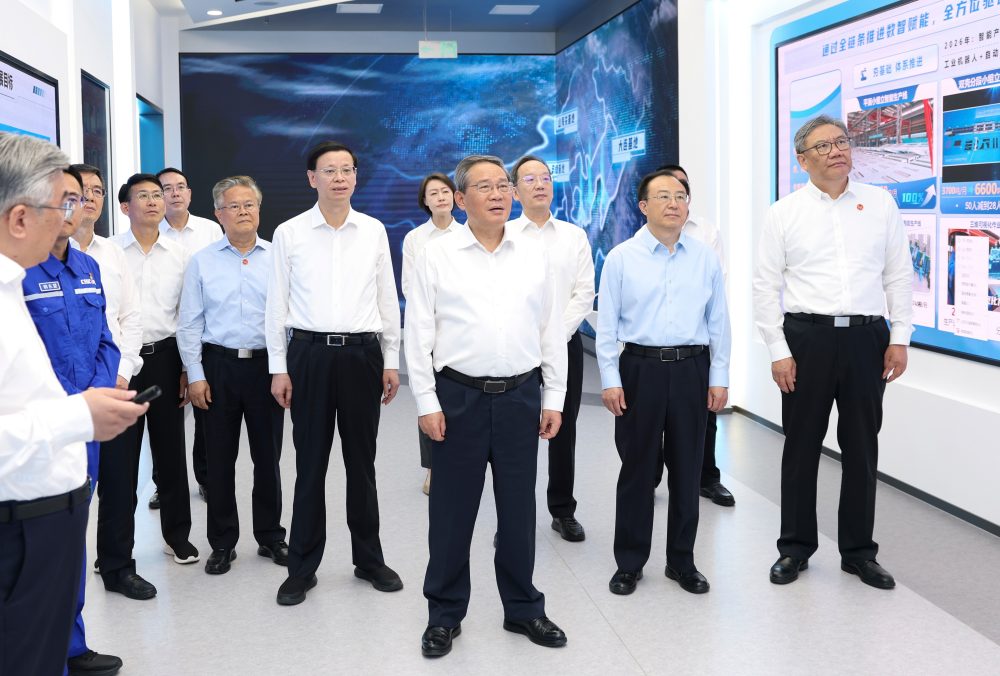

HONG KONG (AP) — China’s Premier Li Qiang took the stage Wednesday to argue that his country’s rapid technological growth represents a positive development for the global community, not something to fear.
Speaking at the opening session of the World Economic Forum’s Annual Meeting of the New Champions — commonly called “Summer Davos” — Li delivered his remarks in the northeastern Chinese coastal city of Dalian. The forum draws global business and political leaders each year.
Li acknowledged that concerns have been mounting worldwide about China’s tech boom, with some critics using the phrase “China Shock 2.0” to describe what they see as a destabilizing force for advanced economies. Li rejected that framing entirely, offering a different label instead.
“From the global development perspective, ‘China Opportunity 2.0’ means there’ll be broader access to advanced technologies and more widely shared benefits,” Li said.
He continued: “China’s emerging technologies and products are bringing to the world not shocks, but opportunities. Not threats, but empowerment.”
China has dramatically expanded its exports of electric vehicles, solar panels, computer chips, batteries, artificial intelligence systems, and robotics in recent years. While those products have offered lower-cost options in global markets, they have also triggered complaints from governments worried about oversupply and unfair competition. Several countries have responded with protectionist trade measures.
Li also pushed back on the widely held view that Beijing’s heavy government subsidies are the engine behind China’s high-tech surge. U.S. and European policymakers have repeatedly raised alarms about Chinese state support giving its industries an unfair edge. A June report from the 38-country Organization for Economic Cooperation and Development, known as the OECD, warned that large state subsidies — including those provided by China — can distort global markets and tilt the competitive playing field.
Li dismissed those concerns directly. “There are some people who say that Chinese products are competitive mainly because the Chinese government’s subsidies,” he said. “That’s not true. The Chinese government is not that wealthy.”
Instead, he pointed to China’s enormous domestic market of 1.4 billion people, which allows new technologies to be deployed rapidly and at massive scale, along with significant private-sector investment, as the real forces behind the country’s technological momentum.
Li highlighted two Chinese companies as examples of that homegrown innovation success: tech giant Huawei and robotics firm Unitree. Both companies have grown quickly in size and market share, though both have also faced restrictions in Western markets. Earlier this month, the Pentagon expanded its list of Chinese companies with alleged military ties to include Unitree, barring it from receiving U.S. defense contracts. Huawei is also on that list.