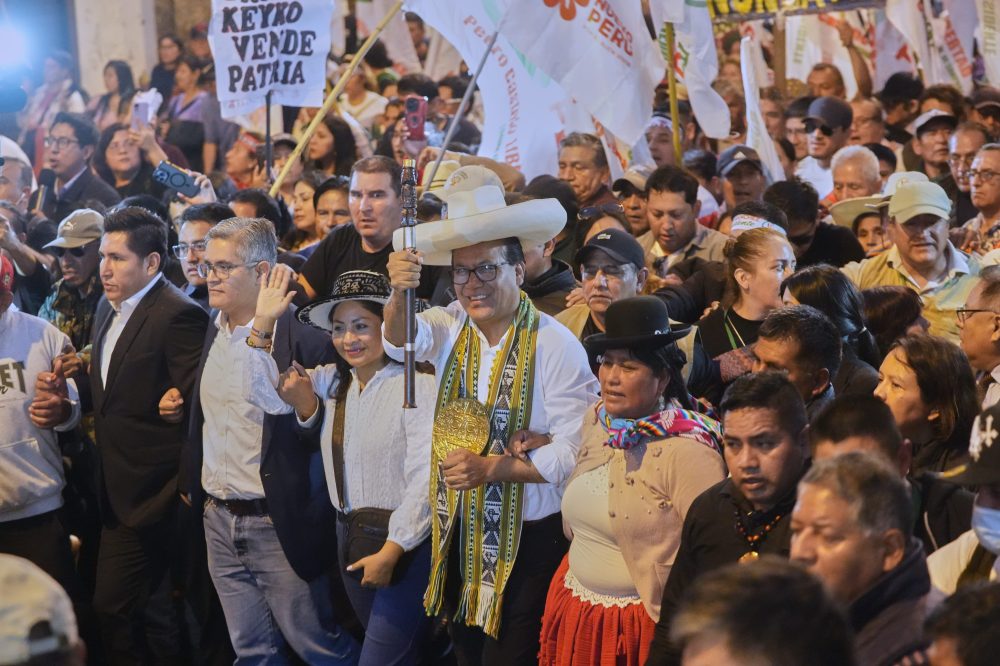

LIMA, Peru — Presidential hopeful Roberto Sánchez announced Tuesday that he refuses to acknowledge the outcome of Peru’s June 7 presidential runoff election — but only if election authorities move forward with counting ballots submitted by Peruvians living outside the country, which he claims were handled improperly.
With 99.72% of ballots tallied, Sánchez finds himself trailing conservative rival Keiko Fujimori by approximately 40,000 votes. Election analysts expect him to fall short once officials finish processing the remaining tally sheets. More than 18 million Peruvians cast ballots in the runoff.
However, according to data released by Peru’s election authorities, Sánchez would actually come out ahead if the votes submitted by Peruvians living abroad were thrown out entirely. That detail is central to why his campaign is pushing to have those ballots invalidated.
Sánchez’s team has formally filed a petition to discard the overseas votes, claiming that Peruvian consulates failed to use a government-mandated app to scan tally sheets — a step required under Peruvian election law.
Peru’s Foreign Affairs Ministry pushed back in an official statement, explaining that in late May it had received approval from electoral officials to skip the scanning step at consulates and instead send tally sheets directly to the capital, Lima, for processing after voting concluded.
The ministry said the adjustment was necessary because the scanning application had experienced technical difficulties during the first round of voting. Sánchez’s campaign, however, argues that this procedural workaround created an opening for potential fraud — an allegation that both Peru’s national elections agency, ONPE, and the Foreign Affairs Ministry have flatly denied.
“Under these conditions of transgression of the rules, we will not recognize the government of Miss (Keiko) Fujimori,” Sánchez declared on Tuesday.
According to ONPE, more than 307,000 Peruvians residing abroad participated in the June 7 runoff, with 65% of those voters casting their ballots in favor of Fujimori.
Fujimori, who ran on a platform focused heavily on combating crime, captured an overwhelming share of votes from Peruvians living in the United States, Argentina, and Japan — the country where her paternal grandparents were born. She has not publicly responded to Sánchez’s demand to throw out the overseas ballots.
Sánchez, who is aligned with imprisoned former President Pedro Castillo, has pledged sweeping changes to Peru’s mining industry that would give local community groups a financial stake in copper and gold operations. His campaign dominated in the mountainous southern regions of Peru, areas that have long faced economic hardship, but struggled in Lima, where roughly one-third of the country’s electorate is concentrated.
Peru has cycled through eight presidents over the past decade. Only two of them reached office through a general election — the rest stepped in after predecessors either resigned or were ousted by Peru’s Congress amid corruption scandals.
Despite this persistent political turbulence, Peru has managed to maintain steady economic policies, allowing it to rank among the fastest-growing economies on the South American continent.