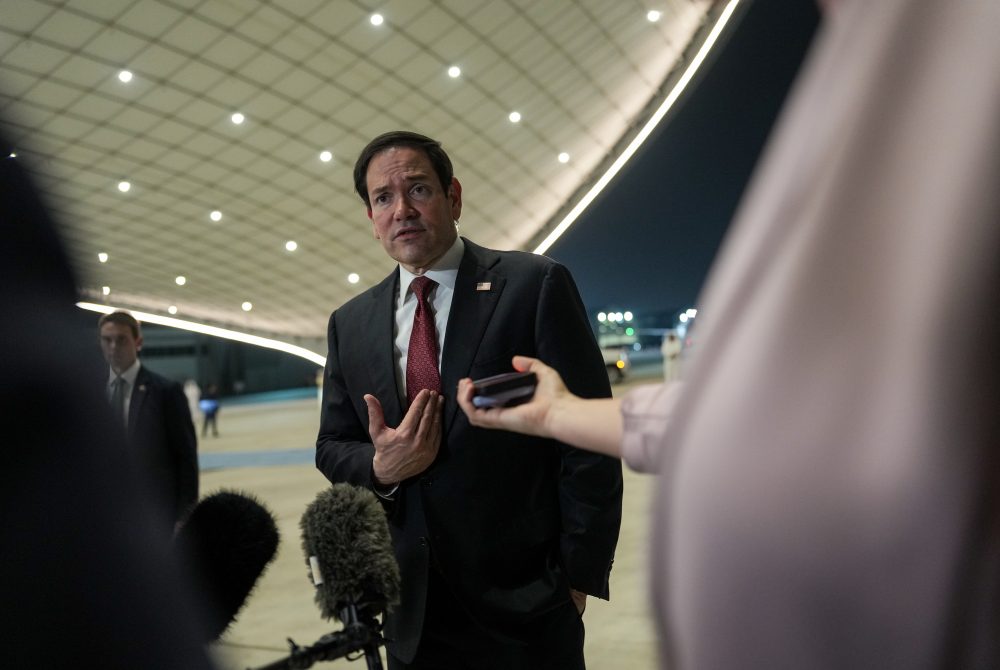

ABU DHABI, United Arab Emirates — U.S. Secretary of State Marco Rubio has touched down in the United Arab Emirates, kicking off the first stop of a three-nation Gulf tour designed to calm the nerves of regional allies who are uneasy about a tentative agreement reached with Iran.
Rubio landed in Abu Dhabi late Tuesday, following two days of intense diplomatic exchanges between the United States and Iran in Switzerland. Those talks, spearheaded by Vice President JD Vance, produced what Vance describes as a major agreement — one that would bring all hostilities in the region to an end, reopen the Strait of Hormuz to shipping, and offer Iran sanctions relief, with nuclear negotiations set to wrap up within 60 days.
The tour will take Rubio to the UAE, Kuwait, and Bahrain — three countries that were struck by Iranian missiles and drones in response to U.S.-Israeli airstrikes. Leaders in those nations have, in some instances, taken a harder stance toward Iran than the Trump administration has recently.
Speaking briefly to reporters after landing, Rubio said he planned to lay out the benefits of the agreement to these skeptical Gulf partners — but only if the deal is actually put into practice. He noted that a proposed $300 billion investment fund for Iran would never materialize unless, as he put it, “its leadership makes a decision that they want to be a country instead of a revolutionary movement that exports terror.”
Gulf allies have also raised concerns that the agreement fails to address Iran’s missile capabilities, its backing of regional proxy forces, and that it delays the nuclear question to a later date.
Rubio pushed back on those concerns, pointing out that the memorandum of understanding signed last week calls for the “complete end of hostilities and conflicts in the region.” He argued that language effectively requires Iran to stop financing proxy groups such as Hamas in Gaza, Hezbollah in Lebanon, and the Houthis in Yemen.
“You can’t have the end of hostilities and conflicts in a region as long as Iranian proxies are launching missiles and drones from Iraq, and are participating in terrorism, like Hamas did, and like Hezbollah did,” Rubio said. “So, I do think it’s covered by the MOU, and it is an issue that will be gotten to at the appropriate time in these negotiations.”
The UAE has been especially vocal in pushing for firm action to guarantee the Strait of Hormuz stays open. There have been conflicting signals about what last week’s memorandum of understanding actually means for the strait — a critical waterway that global shipping depends on being able to transit freely.
While the U.S. has held a firm position on free passage, Iran has been moving forward with a plan that could impose service fees on ships passing through the strait — something many view as essentially a toll system. Rubio made clear the U.S. will not accept that under any circumstances.
“It’s an international waterway,” he said. “No country is allowed to charge tolls or fees on an international waterway. That’s existing international law. That’s the way it is.”
Rubio added that he doesn’t expect to have much convincing to do on that particular point among Gulf leaders. “I think all the countries in this region would agree with us,” he said.