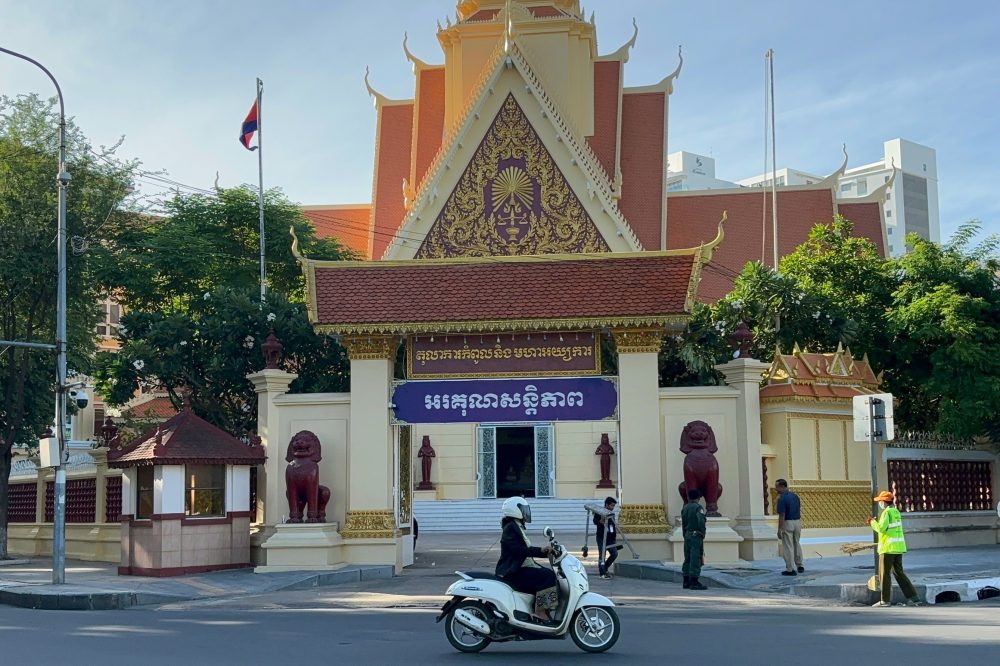

PHNOM PENH, Cambodia — Cambodia’s highest court was expected to deliver a decision Thursday on whether to overturn the treason convictions of two journalists who were jailed for posting photographs connected to border clashes with Thailand last year.
The ruling arrives at a time when serious questions are being raised about whether the court operates independently of the country’s ruling party.
Phorn Sopheap, a journalist with Battambang Post TV Online, and Pheap Pheara, of TSP 68 TV Online, were taken into custody last July after returning from reporting assignments along the border. Authorities alleged the two men had posted images they captured inside a restricted military zone to Facebook.
Both journalists have denied any wrongdoing, maintaining they had authorization to be in the area where the photographs were taken. They are asking the Supreme Court to throw out their convictions and the 14-year prison sentences that came with them.
Among the photos that drew significant attention was an image showing land mines, which was picked up and widely circulated by Thai media. That photograph strengthened Thailand’s argument that Cambodia had placed new mines along the shared border — mines that had injured Thai soldiers on patrol.
Cambodia’s government officially rejected those claims, stating the country complies with international agreements that prohibit the use of land mines. Cambodian officials suggested the mines found may have been remnants from decades of internal conflict that came to an end in the late 1990s.
The border fighting, which flared up in July and again in December, forced hundreds of thousands of people on both sides of the border from their homes and resulted in the deaths of roughly 100 soldiers and civilians. A ceasefire reached in December has held, though the situation between the two countries remains tense.
The two journalists were originally found guilty of treason in December by Siem Reap Provincial Court, which determined they were guilty of “supplying a foreign state with information prejudicial to national defense.” Each received a 14-year sentence.
After a lower appeals court upheld those convictions in March, more than a dozen journalism organizations — both national and international — signed a joint letter urging the Cambodian government to drop the case against the two men.
Thursday’s hearing at the Supreme Court comes less than a week after that same court upheld an incitement conviction against Rong Chhun, a well-known opposition politician. That ruling once again put a spotlight on what critics describe as a pattern of using the legal system to suppress dissent.
Rong Chhun, who is 56 years old, was found guilty last year of inciting social unrest following meetings he held with villagers who had been displaced by government construction projects. Many observers viewed the prosecution as part of a broader effort by the government of Prime Minister Hun Manet to silence political opponents and critics.
Human Rights Watch said the ruling against Rong Chhun exposed the “lack of independence from the ruling party” within Cambodia’s court system. The government pushed back on that characterization, insisting the Supreme Court operates without political interference.
Cambodia spent nearly four decades under the autocratic leadership of former Prime Minister Hun Sen, a period marked by widespread criticism over human rights abuses, including the suppression of free speech and the right to organize. His son, Hun Manet, who received part of his education in the United States, took over in August 2023, but there have been few indications that political conditions have meaningfully improved.
The Committee to Protect Journalists, based in New York, accused Cambodia’s government earlier this year of “using vague national security laws to criminalize legitimate reporting” in the cases involving Pheap Pheara and Phorn Sopheap.
In the 2025 World Press Freedom Index published by Reporters Without Borders, a Paris-based organization, Cambodia ranked 161st out of 180 countries and territories — placing it in the category of nations where the press freedom situation is considered “very serious.”