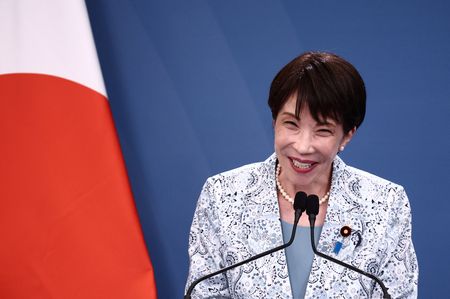

Japan’s government is preparing to formally ask its central bank to keep interest rates low in support of private-sector demand, according to a draft of the country’s long-term economic blueprint obtained by Reuters.
The document urges the Bank of Japan, known as the BOJ, to align its monetary policy decisions with Prime Minister Sanae Takaichi’s push to stimulate economic growth. It cites legal provisions that require the central bank to coordinate closely with the government.
“The government won’t hesitate taking nimble and sufficient steps” to prevent Japan from slipping back into deflation, the draft stated, as part of broader pledges to strengthen the country’s long-term economic potential.
The draft further states: “As the government seeks to achieve strong growth under its economic and fiscal policy, appropriate monetary policy that supports private demand through stable price rises is extremely important.”
The blueprint, which shapes Japan’s long-term economic direction, is expected to be finalized in July. It will be the first such document produced under Takaichi, who has historically expressed skepticism toward the BOJ’s attempts to move away from deflation-era stimulus measures.
While Japanese law protects the independence of the central bank, it also requires the BOJ to maintain close coordination with the government on policy matters. Using that requirement as a basis, the draft calls on the BOJ to “work closely with the government to sustainably and stably achieve its 2% inflation target” while watching for signs of a “positive cycle” of rising wages and prices.
The BOJ is scheduled to hold its next policy meeting on July 30-31. Markets widely expect rates to remain unchanged at that gathering, though investors will closely examine updated quarterly forecasts for clues about when the next rate increase might come.
Since assuming office last October, Takaichi has prioritized government spending as a tool for economic recovery — a position that has pushed bond yields higher amid growing concerns about Japan’s fiscal health.
Her new growth strategy targets more than 370 trillion yen, or approximately $2.3 trillion, in investment through the fiscal year 2040, spread across 17 strategic sectors including artificial intelligence and semiconductors.
That level of spending would be easier to sustain under low interest rates. However, rising inflationary pressures have led the BOJ to begin pulling back from its ultra-loose policy stance and raising borrowing costs.
Earlier this month, the BOJ lifted its policy rate to 1%, the highest level in 31 years, and has indicated it is prepared to tighten further as elevated fuel costs tied to the Iran war have kept inflation near its target for nearly four years.
Political pressure, however, may complicate any additional rate hikes. A government representative who attended the BOJ’s June meeting indicated the central bank should take “proactive and appropriate action” if economic conditions deteriorate — a signal, according to a summary of opinions from the meeting, that the administration is not pleased with the direction of rate increases.