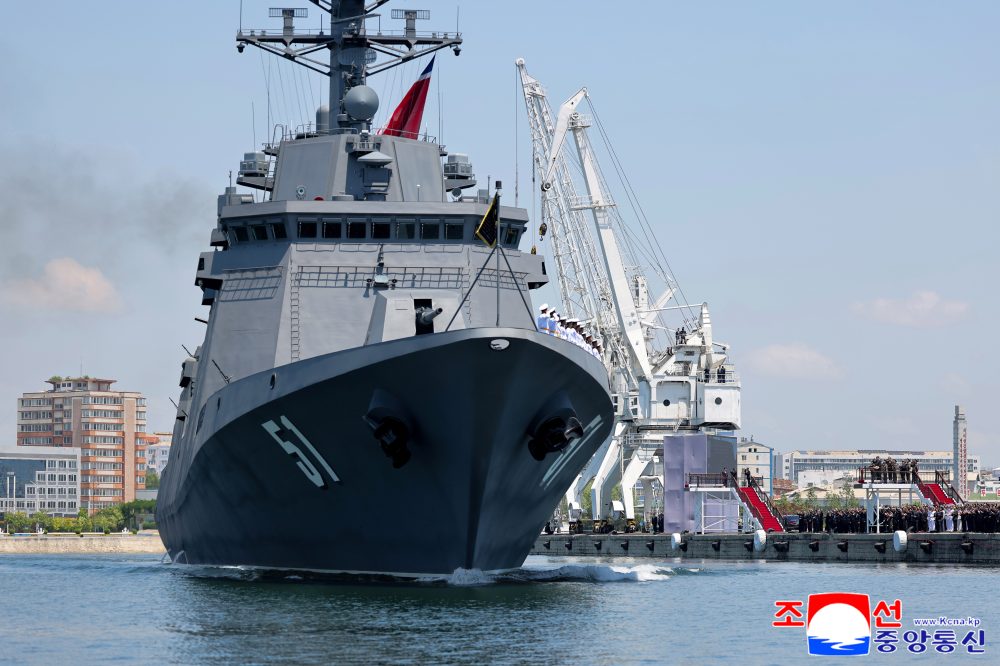

North Korea has officially added a 5,000-ton warship to its naval fleet, with leader Kim Jong Un using the occasion to boast about the country’s expanding nuclear and maritime military power, according to state media reports released Wednesday.
The country’s official Korean Central News Agency reported that Kim attended a commissioning ceremony on Tuesday at the western port of Nampo, where the destroyer — named the Choe Hyon — was formally inducted into service. Kim told those gathered that vessels like the Choe Hyon are evidence that his plan to arm the navy with nuclear weapons is moving forward on schedule.
According to KCNA, the Choe Hyon will be responsible for protecting North Korea’s western coastline. State media has previously reported that the ship carries a variety of weapons systems, including anti-aircraft and anti-ship armaments, along with ballistic and cruise missiles capable of delivering nuclear warheads.
Kim first revealed the ship in April 2025, presenting it as a significant advancement in his military’s ability to strike targets at range and take preemptive action. North Korea has conducted several tests with the vessel in the months leading up to its commissioning, including test launches of what it described as nuclear-capable cruise missiles fired from the ship.
Speaking at Tuesday’s ceremony, Kim declared that his navy’s role has fundamentally changed. “It has clearly become a thing of the past when our navy existed as a force for defending the sea off our land,” he said. “It is rising into a full-fledged service equipped with strategic means as the program of equipping the Navy with nuclear weapons is following its planned course unerringly.”
Officials and analysts in South Korea believe the Choe Hyon was likely constructed with help from Russia, reflecting the growing military relationship between Pyongyang and Moscow. However, some experts have questioned whether the destroyer is genuinely ready for active combat operations.
Kim’s attention has increasingly turned to naval power in recent years, following years of prioritizing ballistic missile development. He also highlighted naval goals — including the development of intercontinental ballistic missiles capable of being launched from underwater — at a Workers’ Party congress held in February. North Korea is also in the process of building a nuclear-powered submarine.
Following a missile test conducted aboard the Choe Hyon back in March, Kim claimed that arming his navy with nuclear weapons would “constitute a radical change in defending our maritime sovereignty, something that we have not achieved for half a century.” State media offered no further explanation of the remark, though some analysts believe North Korea may be laying the groundwork to formally declare a maritime boundary that could overlap with waters currently under South Korean control.
Kim has repeatedly stated that he does not recognize the Northern Limit Line — the sea boundary established by the U.S.-led U.N. Command following the 1950-53 Korean War — as inter-Korean tensions continue to escalate. That contested boundary has been the scene of multiple deadly confrontations over the years.
A second destroyer of the same class as the Choe Hyon, named the Kang Kon, was unveiled in May 2025 but suffered damage during a failed launch at the northern port of Chongjin, drawing a sharp and angry reaction from Kim. North Korea later announced the ship had been relaunched in June following repairs, though outside experts remain skeptical about its operational status. During Tuesday’s ceremony, Kim indicated the Kang Kon would also be entering service in the near future. Separately, North Korea has announced plans to construct an even larger 10,000-ton destroyer.
Since the breakdown of nuclear negotiations with U.S. President Donald Trump in 2019, Kim has moved aggressively to grow his nuclear stockpile and strengthen ties with both Moscow and Beijing. While taking a hardline approach toward South Korea, he has indicated a willingness to return to talks with Washington — provided the United States abandons its insistence on denuclearization as a starting condition for any new negotiations.