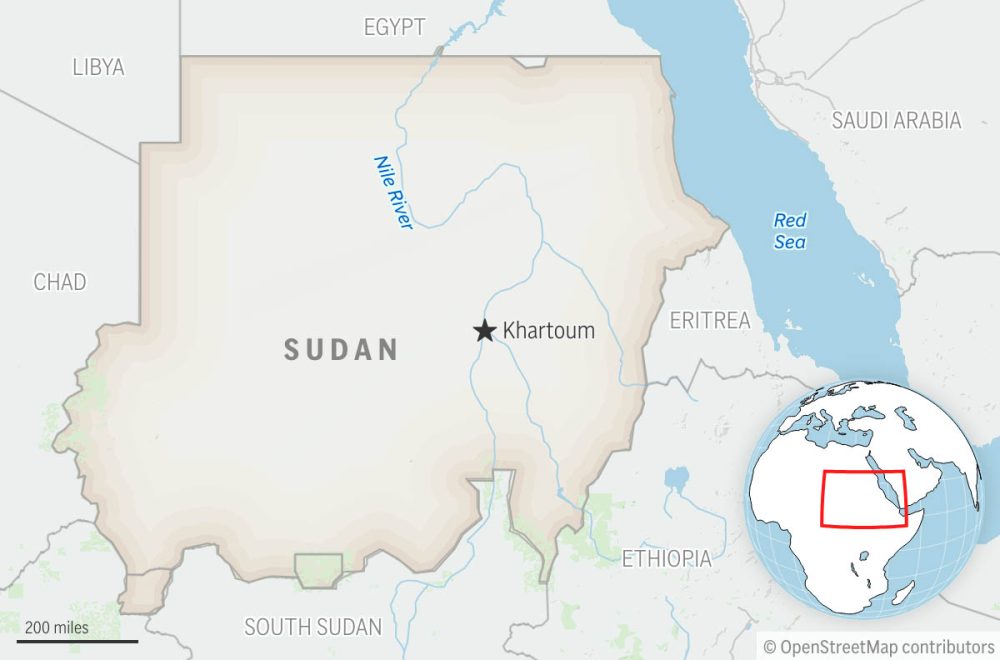

CAIRO — Concern is mounting across the international community over a potential large-scale attack on civilians in central Sudan, where a paramilitary force is gathering around a strategically vital city of approximately 500,000 people as the country’s ongoing war enters its fourth year.
A spokesman for United Nations Secretary-General António Guterres issued a stark warning, saying: “We must not allow the horrors of El Fasher to be repeated in El Obeid.”
That warning references a devastating assault last year in which the Rapid Support Forces, or RSF, seized el-Fasher, resulting in more than 6,000 deaths over just three days — an attack that U.N. experts said carried the “hallmarks of genocide.”
The U.N. Security Council has expressed alarm over reports of “substantial” RSF reinforcements building up around el-Obeid in North Kordofan. The United States, Britain, and several other European nations have also issued warnings about “escalating atrocity risks” in the region. The RSF did not respond to requests for comment.
El-Obeid sits along Sudan’s main east-west road connecting to the Nile Valley and the capital, Khartoum, making it a critical asset for Sudan’s military as it continues battling the RSF. The army broke a siege on the city that had lasted more than a year, doing so early last year. The city is also home to a large air base and an infantry division.
Nathaniel Raymond, executive director of the Humanitarian Research Lab at the Yale School of Public Health, explained the broader significance of the situation. “El Obeid is important beyond even the strategic implications because it shows what happens when you have two forces that are highly depleted attempting to gain advantage on the other in high proximity,” he said.
Raymond noted that the RSF is seeking to control the road to Khartoum — which Sudan’s military recaptured last year — along with the neighboring city of Omdurman. Regaining that territory would create “havoc for civilians” and severely complicate the work of humanitarian organizations trying to return to the capital area, he said.
Experts say a potential assault on el-Obeid would differ from the attack on el-Fasher, which followed an 18-month siege and involved widespread ethnically motivated killings. “This is not a genocidal move, it’s a tactical one,” Raymond said, though he cautioned that those perceived as aligned with the military could face reprisal killings if the RSF were to take the city.
Ali Mahmoud Ali, a Sudan researcher with the Armed Conflict Location and Event Data project, known as ACLED, said the RSF has the ability to cut off el-Obeid from multiple directions, but maintaining a prolonged siege would drain the paramilitary group of significant manpower, vehicles, and equipment. If the RSF does manage to capture and hold the city, he warned the situation there “could deteriorate rapidly.”
In recent months, el-Obeid has been subjected to repeated RSF drone strikes that have destroyed civilian infrastructure, including power facilities and residential neighborhoods. The U.N. reports that bridges and key supply routes into the city have also been targeted.
Taghreed al-Rashid, a 35-year-old resident reached by phone, said she takes some comfort in the presence of army forces but is increasingly frightened by drone attacks hitting homes and markets. A recent strike on a power facility triggered a water shortage so severe that she now pays $5 per barrel of water. “We’re committed to staying in the city despite our ongoing hardships because forced displacement is a bigger struggle,” she said.
The toll from these drone attacks has been severe across the broader Kordofan region. According to ACLED, at least 2,670 people — both civilians and combatants — were killed in 2025, representing a 600% increase in drone-related deaths and an 81% rise in drone attacks compared to the previous year.
Another el-Obeid resident, Magdy Abdou, said daily life — including visits to mosques and markets — remains manageable for now, but he is deeply worried about further strikes on critical infrastructure.
Capturing the city would give the RSF a base from which to launch drone attacks at a much closer range. Ravina Shamdasani, a spokesperson for the U.N. human rights office, described the humanitarian conditions as dire. “Many civilians are trapped. Those who are able to flee are doing so. The imminent offensive must be halted, and civilians enabled to safely leave the city,” she said, adding that recent infrastructure attacks have left residents with scarce food, fuel, water, health services, and transportation.
Raymond said the RSF’s “force strength is significantly reduced due to defenses and intertribal fighting” and that it lacks the personnel needed to withstand an expected military counterattack. Nevertheless, Ali noted that the RSF has deployed air defense systems in Abu Zabad, West Kordofan, which could serve as a logistical hub for operations targeting el-Obeid and the nearby city of Dilling, potentially intensifying the conflict.
Since the army broke the siege on el-Obeid last year, the RSF has launched multiple offensives trying to reestablish control from various directions. Sudan’s army, which also operates drones, said recent strikes destroyed an RSF battalion and more than 50 armored vehicles in West Kordofan, blocking advances toward North Kordofan and el-Obeid. An army official, speaking on condition of anonymity because he was not authorized to speak to the media, said the military has a plan in place to protect the city’s airspace from RSF drone attacks.
Federico Donelli, an associate professor of international relations at the University of Trieste, said the army has made defending el-Obeid and the east-west corridor to the Nile Valley a priority since last year. “Overall, the SAF appears capable of mounting an organized initial defense, but the key open question is whether it can sustain it against a faster, better-equipped RSF push,” Donelli said.