
PARIS (AP) — In an effort to dodge the brutal heat wave sweeping across much of Western Europe, Dior pushed its men’s Paris Fashion Week presentation to 9 a.m. Wednesday. Despite the early hour, the scorching temperatures still made their presence felt.
Attendees made their way to the Musée Nissim de Camondo as the city baked in extreme heat. Staff greeted guests at the entrance with cold towels, strawberries, and parasols in an attempt to offer some relief.
Inside the historic mansion, where Northern Irish designer Jonathan Anderson was presenting his newest Dior men’s collection, temperatures climbed rapidly. Some guests appeared to be struggling with the heat, and water was in short supply.
Despite the uncomfortable conditions, the front row was packed with well-known faces. Among those attending were LaKeith Stanfield, Little Simz, James Marsden, Drew Starkey, Mike Faist, 070 Shake, Alexander Ludwig, and Sam Nivola.
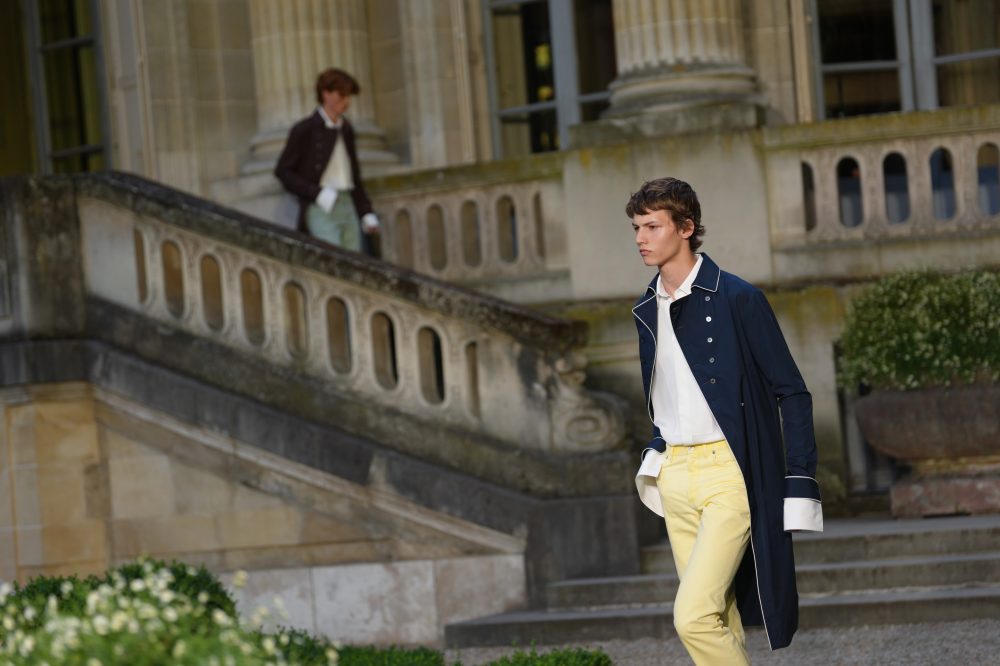
Anderson’s collection centered on the idea of formality coming undone — tuxedos worn loosely, denim torn and raw, sequins catching the light, and disco-ball boots striding through a venue steeped in old-world elegance.
Dior described the atmosphere behind the collection as “a soiree turning into a house party.” Anderson himself put it this way: “something quite formal becoming undone.”
The central concept was clear: the Dior man wasn’t just arriving at the party — he had been there all night and stayed until dawn.
Anderson opened with tailored looks, though he made them lighter and less rigid. Pinstripes and houndstooth patterns were printed onto silk chiffon rather than woven into heavier fabric, resulting in pieces that felt formal yet see-through.
The collection pushed Dior’s signature style into edgier territory. Sequined trousers were styled to resemble jeans, ripped denim was finished with delicate silver chains, tuxedos came in relaxed cuts, and pink denim shorts appeared beneath formal coats.
Accessories included crystal sunglasses, disco-ball boots, and patchworked Japanese denim shirts.
The standout pieces succeeded by keeping Dior’s identity recognizable while disrupting it. A scarf motif was drawn from a 1979 Dior haute couture piece, and silver embroidery was borrowed from an 18th-century gentleman’s coat.
Boots were intentionally styled to look worn and disheveled, decorated with tiny ladybird details.
The collection wasn’t a break from Dior’s history — it was a way of putting that history in motion.
The choice of venue added deeper meaning to the show. The Musée Nissim de Camondo, currently closed for restoration, was built around Moïse de Camondo’s collection of 18th-century decorative arts — the same era that captivated Christian Dior himself.
Anderson presented a collection about loosened formality inside a building also caught between its past and its future. Dior’s own show notes framed that “in-between” state as intentional, pointing to beauty found in imperfection.
The mansion also carries a painful history. Camondo’s son perished in World War I, and later generations of the family were deported and killed during the Holocaust. Today the building serves as both a museum and a memorial to that loss.
Set against that somber backdrop, the collection’s playful energy gave the clothing a certain tension. Anderson took elements already embedded in Dior’s identity — the tuxedo, the Bar silhouette, couture embroidery, 18th-century ornamentation — and recast them in a younger, more chaotic register.
The result stood as one of Anderson’s most focused and fully realized outings at Dior to date.