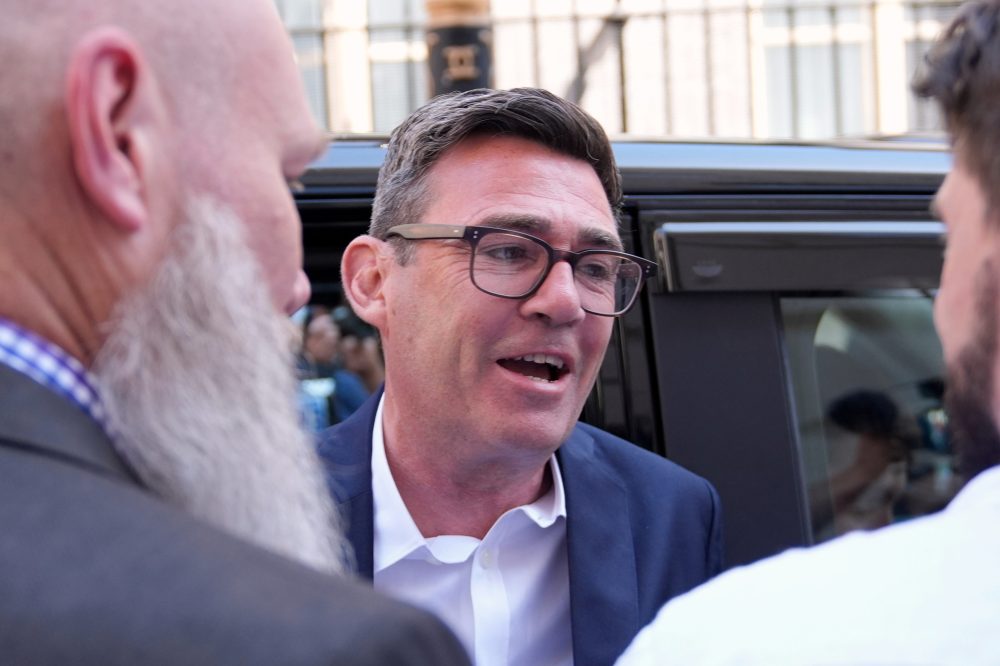

LONDON (AP) — Andy Burnham moved a step closer to becoming Britain’s next prime minister on Wednesday after Cabinet minister Darren Jones, who had been floated as a potential rival, announced he would not seek the Labour Party leadership.
At the same time, outgoing Prime Minister Keir Starmer is pressing ahead with efforts to leave a lasting mark on his tenure before departing office. Starmer faced the weekly Prime Minister’s Questions session in Parliament on Wednesday before traveling to Berlin to meet with European allies for discussions on Ukraine and the Middle East.
Starmer revealed his intention to step down on Monday and is expected to be out of office within weeks, once the Labour Party selects a new leader.
Jones, a close ally of Starmer, had been urged by some party members to enter the race so that Burnham’s ideas and policies would face scrutiny from Labour lawmakers and members. Others within the party, however, argued that a leadership contest would only shine a spotlight on internal divisions and prolong political uncertainty.
Speaking to Sky News, Jones said running for the leadership is “not something that I’m going to do.”
Even so, Jones offered a warning to Burnham, cautioning him against shifting too far to the left on economic matters — a concern shared by some in the business and financial sectors. Burnham is widely expected to name a new Treasury chief to succeed Starmer’s appointee Rachel Reeves. Jones said the person chosen must be someone “that can reassure the markets, reassure the trade unions and reassure the parliamentary Labour Party, and by extension the public.”
Burnham is expected to deliver a speech next week laying out elements of his economic vision.
Starmer is departing after two years in office that were clouded by missteps and poor judgment calls that weakened his standing with both his party and the British public.
Burnham, a former Cabinet minister who has served as mayor of Greater Manchester since 2017, won a special parliamentary election last week specifically to position himself to challenge Starmer for the Labour leadership and the prime ministership.
As of now, he has no declared opponents. Former Health Secretary Wes Streeting, once seen as Burnham’s main competition, has announced he will support Burnham instead.
Labour leadership nominations are set to open on July 9 and close one week later. Should Burnham be the sole candidate, he could be installed as prime minister as soon as July 17. If a contest does emerge, the new leader is expected to be in place when Parliament returns from its summer recess on September 1.
On Tuesday, Starmer told his Cabinet he intends to oversee an “orderly transition” to whoever succeeds him.
Despite his lame-duck status, Starmer is maintaining a packed schedule in an effort to cement his legacy. However, he is restricted from making major new policy announcements or committing to new spending during the remainder of his time in office.
His trip to Berlin for a gathering of the “E5” — Germany, France, Italy, Poland, and the United Kingdom — for talks on European defense, the Ukraine war, and Middle East conflict highlights the international role he has played. Starmer has generally been seen as more confident on the world stage — particularly in rallying allies to support Ukraine and managing fallout from the Iran conflict — than he has been on domestic issues.
The British government is expected to release a long-awaited defense investment plan before a NATO summit in Turkey on July 7 and 8, which Starmer is likely to attend. That same plan triggered the resignation of Defense Secretary John Healey on June 11.