Drivers heading northbound on Delaware Route 1 near Frederica Road should be aware of an active lane restriction this morning.
The right lane on northbound DE 1 at Frederica Road is currently closed as a result of construction work in the area. The closure is expected to remain in place until 11 a.m.
Motorists are advised to allow extra travel time or consider alternate routes to avoid potential slowdowns in the construction zone.
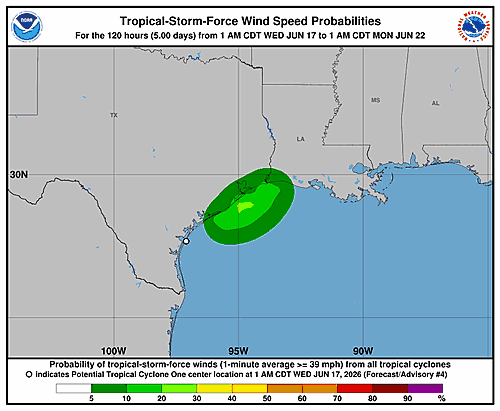
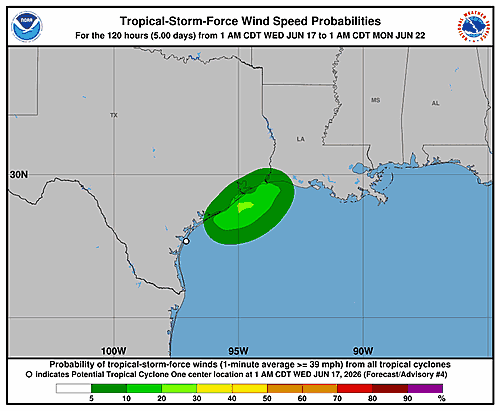
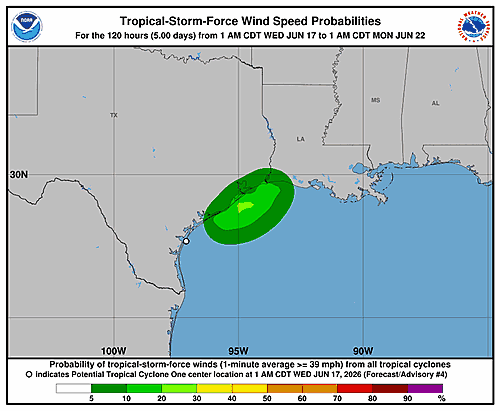
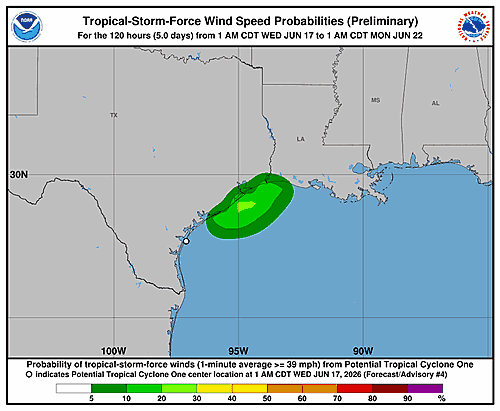
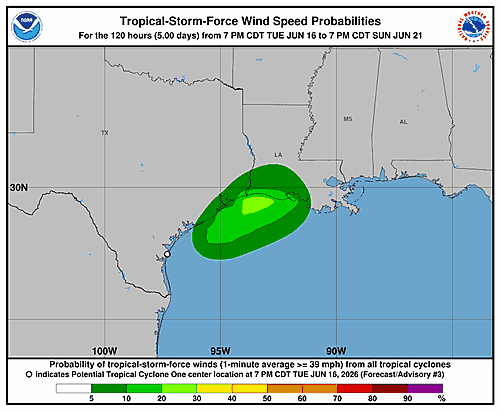
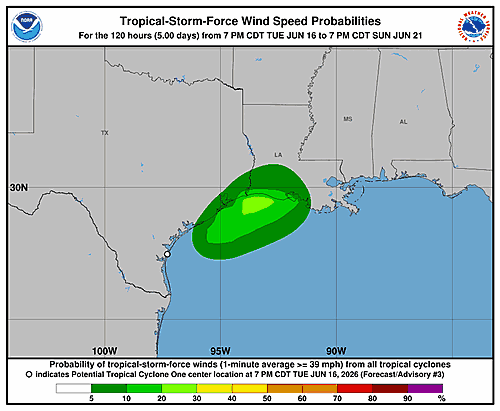
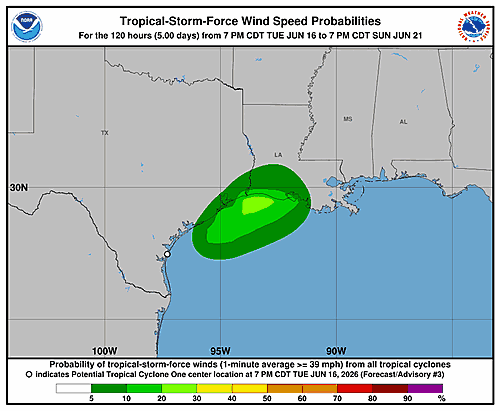
The National Hurricane Center has issued wind speed probability graphics for a system designated as Potential Tropical Cyclone One.
The graphics show the likelihood of 34-knot wind speeds affecting various areas over a 120-hour period. According to the National Hurricane Center, the wind speed probability information was last updated on Wednesday, June 17, 2026, at 9:21 a.m. GMT.
Residents are encouraged to continue monitoring the National Hurricane Center for the latest updates as this system develops.
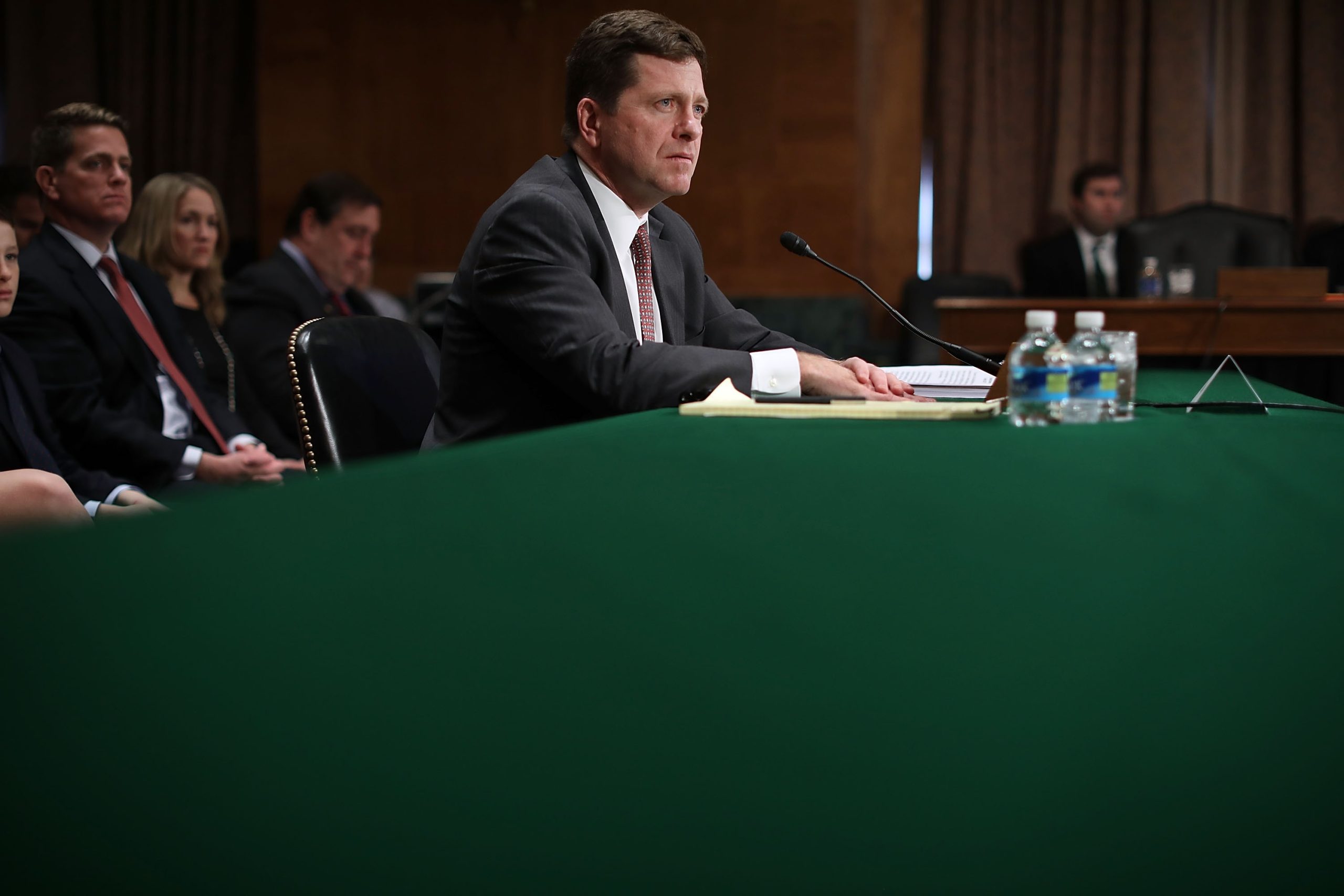
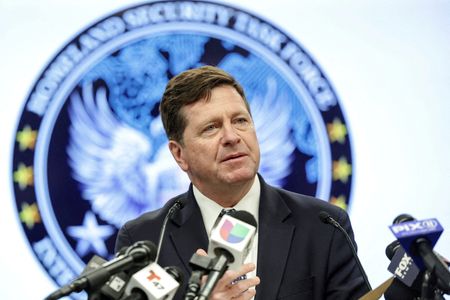
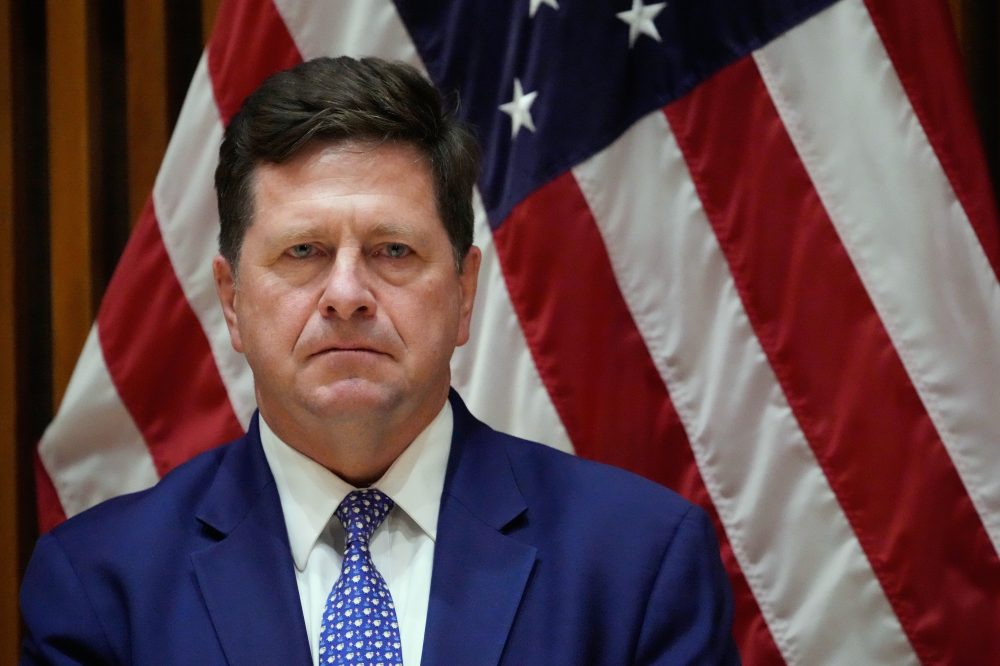
The Senate was prepared to kick off confirmation proceedings for Jay Clayton, President Trump’s nominee to lead the nation’s intelligence community as Director of National Intelligence. However, President Trump is now calling for that process to be put on hold.
Clayton had been set to appear before the Senate Intelligence Committee on Wednesday for his confirmation hearing. The nomination comes after Clayton previously served as chairman of the Securities and Exchange Commission, a role he was confirmed for following a Senate Banking Committee hearing back in March 2017.
No explanation for the president’s request to postpone the confirmation process was immediately available.
A developing tropical system is moving up the middle Texas coastline and poses a serious flooding threat to portions of the southeastern United States, according to forecasters.
As of 7:00 AM Central Daylight Time on Wednesday, June 17, the center of Potential Tropical Cyclone One was located near coordinates 28.3 degrees north, 96.2 degrees west. The system was tracking to the northeast at approximately 7 miles per hour.
The storm’s minimum central pressure was recorded at 1002 millibars, with maximum sustained winds of about 30 miles per hour.
Forecasters are warning that the system is expected to produce life-threatening flooding across portions of the southeastern United States as it continues to move inland.
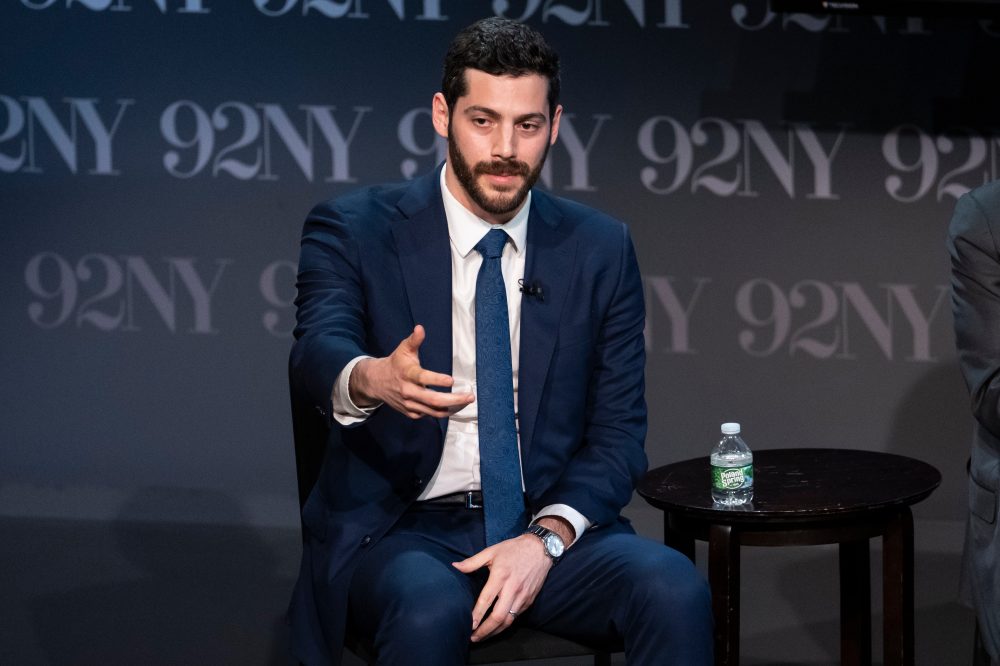
A New York state assemblyman’s campaign for a seat in Congress has triggered a massive spending war between rival corners of the technology industry, turning a Manhattan Democratic primary into one of the most expensive and closely watched races in the country.
Assemblyman Alex Bores, a former computer engineer, is competing in the June 23 Democratic primary for a U.S. House seat covering upper and midtown Manhattan — one of the wealthiest and most heavily Democratic districts in the nation. The seat is being vacated by retiring Democratic Rep. Jerry Nadler.
The trouble for Bores began after he championed legislation in Albany to regulate artificial intelligence. A political group called Leading the Future, backed by investors in OpenAI, responded by pouring more than $7 million into advertising aimed at derailing his congressional run. The group’s donor list includes prominent Silicon Valley figures, major venture capitalists, and former members of President Donald Trump’s Republican administration.
Bores publicly criticized the spending, warning that it could discourage other state and federal lawmakers from attempting to place guardrails on the rapidly expanding AI industry. His story quickly gained national attention as a symbol of a grassroots politician being outgunned by tech money.
But the story didn’t end there. A separate faction of the tech world stepped in to support Bores. Political groups partly funded by Anthropic — the company behind the AI chatbot Claude — have spent more than $10 million on his behalf. Crypto billionaire Chris Larsen, an investor in Anthropic, has pledged an additional $3.5 million to support Bores.
The race has evolved into a proxy fight over two very different philosophies about how government should handle AI and the broader technology sector. Complicating the picture is Bores’ history working for the data analytics company Palantir, which he left during Trump’s first term, citing concerns about the firm’s involvement in immigration enforcement.
“The lines are being drawn, and this primary is very much an expression of that,” said Morten Bay, a research fellow at the Center for the Digital Future at the University of Southern California. “The core divide is regulation — whether you’re for or against it.”
The split reflects a broader divide within Silicon Valley itself. Some tech leaders have aligned with Trump and his administration’s push to roll back government regulations, while a significant portion of the industry remains more traditionally Democratic and supportive of some level of government oversight.
Leading the Future — whose donors include OpenAI President Greg Brockman, venture capitalist Marc Andreesen, and Palantir co-founder Joe Lonsdale, all major Trump supporters — has spent $7.6 million through a subsidiary to oppose Bores. The group says it supports AI regulation in principle but believes Congress, not individual states, should lead that effort. The organization also argues that Bores is the one candidate who has been financially captured by outside interests.
“As we have said from day one, Anthropic, its investors and the dark-money groups it funds would spend millions to send Alex Bores to Congress, and that is exactly what has happened,” said Josh Vlasto, a co-lead of Leading the Future.
Bores points to his legislative record as evidence of how he would approach AI policy in Washington. The measure he led, called the RAISE Act, is regarded as one of the most comprehensive attempts by any state to regulate artificial intelligence. It requires large AI companies to submit reports on protections against “catastrophic” risks — scenarios such as AI triggering nuclear meltdowns or creating dangerous new viruses — that could harm more than 50 people.
Leading the Future initially opposed the RAISE Act before ultimately accepting a revised version that was signed into law. Despite that outcome, the group has made clear it still views Bores’ positions as extreme.
The RAISE Act is the type of state-level regulation that would be wiped out under a proposed federal AI framework backed by Trump, which would prevent states from passing their own AI rules in favor of a single national standard. However, Congress has made little progress toward creating such a standard, leaving the AI industry largely without federal oversight.
Bores’ rivals in the primary have echoed Leading the Future’s argument that he is simply a pawn in a corporate battle between tech giants. Among those in the race is Jack Schlossberg, the Kennedy family heir and social media personality.
“You’re in the middle of a civil war between OpenAI and Anthropic. It has nothing to do with standing up to Trump’s mega donors,” Schlossberg said.
Bores and his supporters reject that framing, saying opponents are trying to muddy the waters for voters.
“This race started with AI megadonors pledging $10 million to stop me because they were afraid after I passed the strongest AI safety law in the country,” Bores said in a statement. “Since then, everyone who supports AI regulation and safety — from teachers to tech workers, from AI safety advocates to progressive activists — has united to take the other side. This isn’t one company versus another, this is one ideology versus another: regulate the powerful and protect people, or don’t.”
Brad Carson, a former Democratic congressman from Oklahoma, runs a political action committee called Public First, which has spent more than $6 million supporting Bores through a subsidiary. Carson said the group was created specifically to counter Leading the Future and grew out of a nonprofit he helped fund to advocate for AI regulation. He pushed back on the idea that his organization is simply doing Anthropic’s bidding, saying it raised $30 million from nongovernmental organizations before Anthropic contributed $20 million.
“It’s not like two billionaires fighting it out,” Carson said. “It’s two philosophical movements fighting it out. All of them have wealthy supporters.”
Chris Larsen, the cryptocurrency billionaire backing Bores, said in a statement that his involvement “resulted directly from OpenAI’s threats to make examples of candidates who seek common-sense regulation.”
Bay, the University of Southern California research fellow, noted that the Manhattan district is an unusual target for groups aligned with Trump’s political movement, given how liberal the electorate is. Bores’ top competitor in the race, Assemblyman Micah Lasher, also supported the RAISE Act. Carson said his group is pulling for Bores but would be satisfied with a Lasher victory as well.
“He’s very good on AI issues too,” Carson said. “We win either way.”
If rising gas prices have you searching for a smarter way to get around, a used plug-in hybrid electric vehicle might be worth a serious look. These vehicles work like a standard hybrid but come equipped with a rechargeable battery that allows you to travel short distances using electricity alone. Plug it in regularly at home, and you could dramatically cut down on how often you visit the gas station.
The catch for many buyers is the price tag — new plug-in hybrids tend to cost significantly more than conventional hybrids. That’s where the used market comes in. The automotive experts at Edmunds have put together a list of five used plug-in hybrid models spanning different vehicle types that they consider among the best available. All of the vehicles are less than eight years old, and many have logged fewer than 50,000 miles. Prices will vary based on condition, but Edmunds has provided estimates based on what buyers can expect to find at national retailers like CarMax and Carvana.
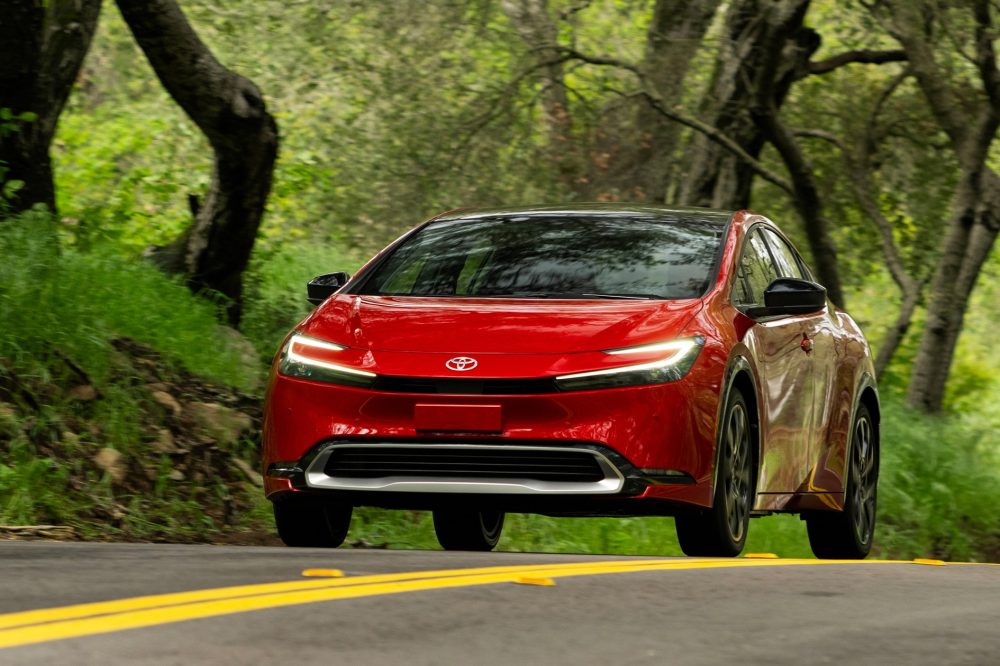
Toyota Prius Prime (2023-2024) — Estimated price: $30,000
Toyota gave the Prius a complete makeover for the 2023 model year, bringing a sharper look, better performance, and updated technology. The Prius Prime is the plug-in hybrid version of the iconic hatchback, delivering up to an EPA-estimated 45 miles of all-electric driving before the gas engine kicks in — at which point it achieves up to 52 mpg. With 220 horsepower and a hatchback body that offers more cargo room than a traditional sedan, a used 2023 or 2024 Prius Prime makes for a capable and efficient daily driver. It comes in SE, XSE, and XSE Premium trim levels.
If you need more passenger and cargo room than a compact car can offer, a plug-in hybrid SUV might be a better fit. The Hyundai Tucson Plug-in Hybrid delivers up to an EPA-estimated 33 miles of electric range and achieves 35 mpg in combined city and highway driving. Standard all-wheel drive and a turbocharged engine producing 261 horsepower make for confident acceleration. With up to 66.3 cubic feet of cargo space and a strong suite of technology, safety, and convenience features, the Tucson is a well-rounded choice.
Kia Sorento Plug-in Hybrid (2022-2025) — Estimated price: $30,000
For families that occasionally need a third-row seat, the Kia Sorento Plug-in Hybrid is worth considering. While it’s smaller than a full-size three-row SUV, its compact third row can accommodate children and shorter adults for shorter trips. Fold that row down, and you get up to 45 cubic feet of cargo space. The turbocharged 261-horsepower powertrain offers up to an EPA-estimated 32 miles of electric range and up to 34 mpg in hybrid mode. Buyers with a flexible budget may want to look at a 2025 model for its refreshed styling, interior, and technology upgrades.
BMW X5 Plug-in Hybrid (2021-2023) — Estimated price: $35,000
Most used BMW X5s on the market come with a standard gas engine, but a plug-in hybrid version is also available — and thanks to steep depreciation, it’s more attainable than you might expect. The 2021-2023 X5 plug-in hybrid offers an EPA-estimated 31 miles of electric range and 20 mpg when running in hybrid mode. BMW updated the powertrain for the 2024 and 2025 model years, bumping range to 39 miles and efficiency to 22 mpg. All versions seat up to five people in a roomy, upscale midsize package.
It may seem unexpected, but Porsche offers a plug-in hybrid in the form of the Panamera 4 E-Hybrid — the brand’s flagship luxury sedan with an electrified powertrain. These vehicles are harder to find on the used market, but it’s possible to snag one for under $50,000. Porsche estimates the 4 E-Hybrid can sprint from 0 to 60 mph in just 4.4 seconds. The electric-only range of roughly 14 to 16 miles isn’t exceptional, but the car returns up to 23 mpg and delivers a more exhilarating ride than most plug-in hybrids on this list.
According to Edmunds, plug-in hybrids come in a wide variety of shapes and sizes, but they all share one key advantage: they let drivers ease into electric vehicle ownership without giving up the reassurance of a gasoline engine. Charge one overnight when electricity rates are typically lower, and you’re likely to see real savings on fuel over time.
This story was provided to The Associated Press by the automotive website Edmunds. Christian Wardlaw is a contributor at Edmunds.
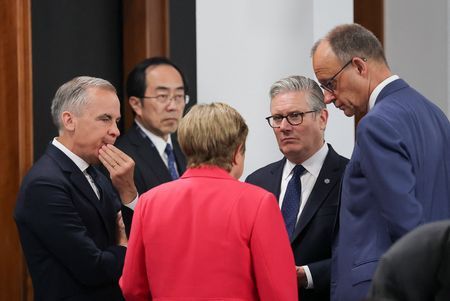
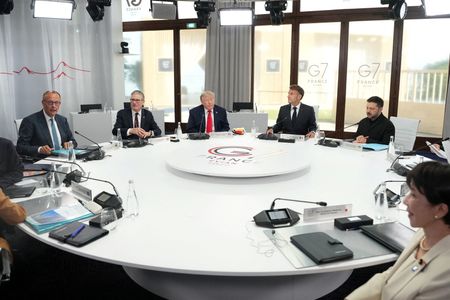
EVIAN-LES-BAINS, France — Canadian Prime Minister Mark Carney is heading home from the G7 summit this Wednesday without a formal bilateral sit-down with U.S. President Donald Trump, even as the future of a major free trade agreement between the two countries hangs in the balance.
While it has long been customary for Canadian leaders to hold one-on-one meetings with U.S. presidents at gatherings of the world’s top industrialized democracies, Carney pushed back on any interpretation that the absence of such a meeting was a diplomatic slight.
“I wouldn’t take a big message from that,” Carney said. “I had seven or eight discussions with President Trump over the course of last 36 hours. I’ll have more today, a wide range of subjects from the economy, relations, his birthday, artificial intelligence, Ukraine, obviously Iran.”
The timing is significant. The North American free trade pact — which has linked the economies of Canada, the United States, and Mexico since the early 1990s — is due for renewal on July 1. Trump indicated last week that he may choose not to renew the agreement, raising alarms for Canada, which sends roughly 75% of its exports to the American market.
On the trade negotiation front, Canada’s minister responsible for U.S. trade, Dominic LeBlanc, along with Canada’s chief negotiator Janice Charette, held talks at the summit with U.S. Trade Ambassador Jamieson Greer. LeBlanc reported that the discussions moved forward productively. He has previously expressed concern that the Trump administration may push for annual reviews of the trade deal, deliberately keeping its long-term status uncertain.
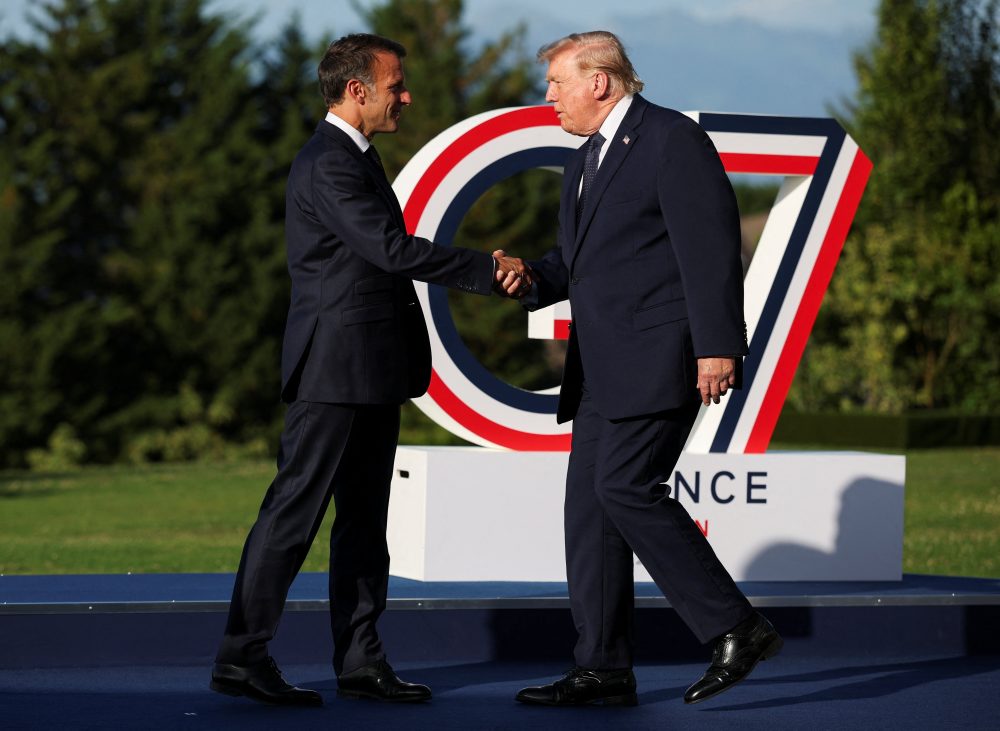
Among the G7 leaders, French President Emmanuel Macron — who is hosting the summit — was the only one to secure a formal bilateral session with Trump. Trump also held separate one-on-one meetings with leaders from Qatar, the United Arab Emirates, Egypt, and India, none of which are G7 members. Carney acknowledged that the host nation traditionally meets individually with the U.S. president.
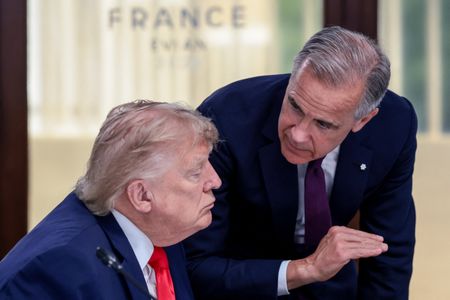
Despite the absence of a formal meeting, Carney found moments to connect with Trump on trade issues, sometimes using humor. At one point, a microphone picked up the two leaders joking about stealing Macron’s watch. The conversation then shifted to a more serious topic — Chinese electric vehicles entering the Canadian market.
A recording captured Carney explaining to Trump that Canada had capped Chinese electric vehicle imports at fewer than 49,000 cars, representing less than 3% of Canada’s market, following a deal struck with Beijing.
“It’s a cap, we capped, a hard line,” Carney told Trump. “I thought you’d actually like that.”
“That’s good, I like it,” Trump replied.
Earlier this year, Canada broke from the U.S. approach by agreeing to reduce its 100% tariff on Chinese electric vehicles in exchange for lower Chinese tariffs on Canadian agricultural products. Carney said he raised the subject with Trump on two separate occasions during the summit.
“I’m not surprised that the president of the United States doesn’t follow every detail of every agreement that Canada has, and he likes the structure. Actually, we had a follow-up conversation about it as well,” Carney said.
Peter Boehm, a Canadian senator who has overseen multiple G7 summits on Canada’s behalf, said Carney likely had ample opportunity for meaningful exchanges with Trump throughout the event.
“I wouldn’t see it as a snub,” Boehm said. “It’s amazing how much time leaders can actually have to have conversations.”
NYON, Switzerland — Heart of Midlothian suffered a gut-wrenching title loss on the final day of the Scottish Premiership season, and now the Edinburgh club faces a long road through Champions League qualifying, beginning with a trip to Austria next month.
The draw held Wednesday placed Hearts against Austrian side Sturm Graz in the second qualifying round. The Scottish club must successfully navigate three qualifying rounds before it can earn a spot in the 36-team league phase, which kicks off in September.
Scottish champion Celtic — the club that snatched the title from Hearts with a victory in the season’s final match — enters the competition at a later stage, beginning in the qualifying playoffs round in late August.
In another second qualifying round matchup involving runner-up clubs from mid-ranked leagues, Fenerbahce was drawn to face Gornik Zabrze.
First-leg matches are scheduled for July 21 and 22 — just two days after the World Cup final — with the return legs taking place one week after that.
Hearts’ troubles have only deepened since the title slipped away. Star forward Lawrence Shankland, currently representing Scotland at the World Cup, has departed to join Rangers. On top of that, Hearts is also set to lose coach Derek McInnes to the storied Glasgow club — and that departure is expected just five weeks before Hearts begins its Champions League qualifying campaign.
Should Hearts advance past Sturm Graz, potential third qualifying round opponents could include Bodo/Glimt, Lyon, or Union Saint-Gilloise.
Wednesday’s draw also featured a separate second qualifying round bracket for first-time national champions, and the two clubs involved came away with very different assignments.
Swiss champion Thun drew a difficult opponent in Champions League regular Dinamo Zagreb, with Thun hosting the first leg.
Sweden’s Mjällby will also play the opening leg at home, facing the winner of a first qualifying round tie between Lincoln Red Imps of Gibraltar and Inter Club d’Escaldes of Andorra. That first-round matchup is set for early July.
Both Thun and Mjällby entered the draw as unseeded clubs, guaranteeing each a seeded opponent. The seeded options available were Dinamo Zagreb, former European champion Red Star Belgrade, and Lincoln — which holds a higher UEFA ranking thanks to its participation in last season’s third-tier Conference League.
Red Star Belgrade, winners of the 1991 European Cup, was drawn to play their away leg first against either Tre Fiori of San Marino or Northern Ireland’s Larne.
BOSTON (AP) — For generations, Boston families have gathered on the gently sloping green lawns surrounding the Bunker Hill Monument to play and enjoy picnics — all while remnants of one of the American Revolution’s most pivotal battles lay quietly buried just beneath the surface.
Now, guided by a map that is centuries old, a team of archaeologists has been carefully excavating the park that marks the spot where American patriots hurriedly built an earthen fortification in an effort to slow the advance of British forces during what history remembers as the Battle of Bunker Hill.
Using ground-penetrating radar, researchers pinpointed possible locations of the fort within Boston’s Charlestown neighborhood. Shortly after breaking ground on the first trench, the team — led by Joe Bagley, the city of Boston’s official archaeologist — discovered clear evidence of a ditch that had been dug in the hours leading up to the battle on June 17, 1775, one of the earliest engagements of the American Revolution.
“The part that’s really crazy to me is that we get to stand in the same ditch,” Bagley said, speaking from one of two active dig sites where workers remove soil roughly four inches at a time, place it into buckets, and sift it through screens. Every item uncovered is bagged and catalogued.
The excavation has already produced musket balls and pieces of a musket from the battle itself. Researchers also recovered objects believed to have been left by British soldiers who held the area following the battle, among them tea cups, tobacco pipes, sleeve buttons, and a wig curler. Although nearly 150 combatants lost their lives at the site, no human remains have been found — though a forensic archaeologist is present to examine any bones that may surface.
“Everything about the ditch is from 1775. You’ve got musket balls, gun flints. It’s what you would expect to see,” Bagley said. “It’s pretty powerful because these things are being dropped in the middle of the battle.”
While many people associate the beginning of the American Revolution with the battles of Lexington and Concord on April 19, 1775, a number of historians consider Bunker Hill and June 17 to represent the war’s first truly significant military engagement.
The colonial rebels had originally planned to fortify Bunker Hill — a 110-foot-high slope in Charlestown situated across the Charles River from British-held Boston — in anticipation of a possible British assault. For reasons that remain unclear to historians, they instead took up a position on a smaller and more exposed ridge called Breed’s Hill, where the bulk of the fighting occurred.
Though the battle concluded with the rebels withdrawing, the British suffered more than 1,000 casualties in the process. Bunker Hill is frequently viewed as a moral victory for the American side, as the British failed to achieve a decisive win and the engagement helped unite the colonies in their resistance. A 221-foot white stone obelisk now stands atop Breed’s Hill as a memorial to the battle.
At the dig site, battlefield archaeologist Joel Bohy, who focuses on identifying weaponry from the American Revolution, expressed amazement at what the earth has given up. One volunteer cradled two jagged stones in her hand — a gray English gun flint and a beige French gun flint. When a musket’s trigger was pulled, the flint would strike steel, creating sparks that set off the gunpowder charge.
Eight marble-sized musket balls from both sides of the conflict were also recovered. The shape and markings on some of the balls indicated they had been fired but had not struck anyone — rounds that hit a person would have been visibly deformed.
“You can see the ramrod mark from when the soldier rammed it down. You can see the little ring on the top where it was pushed down,” Bohy said, noting that “marks on the edge of the ball” confirm it had been fired.
On the night before the battle, more than 1,000 provincial soldiers and local residents used pickaxes and shovels to dig through the darkness and construct a ditch three feet deep and more than six feet wide. The excavated soil was piled in front of the ditch to form a six-foot-high wall, or parapet, that stretched 150 feet along each of the fort’s four sides.
A map created by Henry Pelham just two months after the battle depicted a square redoubt on Breed’s Hill. Until this current dig, however, no one had physically confirmed that the shape shown on the map was accurate. Earlier excavations conducted in the 1990s had turned up battle-related items and some indications of the ditches, but nothing conclusive.
“If you come to the site, we have the monument, we have a lot of maps on display, and the landscape is beautiful. But you can’t really see the fort, the fortifications that were built,” Bagley said. “Very little of what’s here visibly is from 1775. So, this trench is the reason why all of this is here.”
In addition to locating the fort itself, the dig is giving visitors the opportunity to hold “a piece of the battle in their hand,” Bohy said. “In a way, it makes the history more dimensional when you look at these objects from the battle itself.”
A group of tourists from Colorado paused to observe the ongoing work. One of them, Greg Nockleby, who had spent a week in Boston exploring American history, described the scene as a “wonderful surprise.”
“A live dig happening right now to uncover our nation’s history is amazing,” he said. “To see that there has been people here who have died for our freedom and our nation is very immersive.”
Weather forecasters have issued wind speed probability graphics for a system designated as Potential Tropical Cyclone One, with the latest update posted on Wednesday, June 17, 2026.
The graphics, released by the National Hurricane Center, illustrate the probability of 34-knot wind speeds occurring within a 120-hour forecast window. These types of probability maps help residents and emergency managers understand the likelihood of tropical-force winds reaching various areas as the storm system develops.
Forecasters are continuing to monitor the system closely. Anyone in potentially affected regions is encouraged to keep a close watch on official weather updates as conditions evolve.
When someone is sent to a federal prison, they retain at least one significant right — the ability to formally complain about how they are being treated. Whether the issue involves physical abuse, denial of medical attention, or basic everyday needs, the grievance system is supposed to be the primary way incarcerated people can speak out.
But a new investigation suggests that system is largely failing them.
An analysis of federal data conducted by The Marshall Project and NPR found that in the vast majority of cases, grievances filed by people in federal prisons go absolutely nowhere. Complaints are routinely rejected, leaving those behind bars without recourse for issues that can range from minor inconveniences to serious health and safety concerns.
The investigation highlights how the grievance process — which is supposed to serve as a check on prison conditions and staff conduct — often acts instead as a barrier, stonewalling inmates for years and denying them the care or relief they are seeking.
For many incarcerated individuals, the grievance system is not just a formality. It is frequently a required first step before a person can pursue any legal action. When that system fails to function properly, it can effectively shut the door on any further attempts to seek justice.
The U.S. Supreme Court has declined to hear an appeal from a pro-life high school student group, turning away the case without any comment from the justices.
The student club had sought to challenge a school policy that prevented them from posting flyers critical of Planned Parenthood on hallway walls. It’s worth noting that the group was permitted to hand the flyers directly to fellow students — the restriction applied only to putting them up on school walls.
Courts at the lower level had sided with the school, determining that allowing the club to display flyers on hallway walls would amount to what is legally defined as “government speech” — meaning the school itself would effectively be seen as endorsing the message.
With the Supreme Court’s decision not to intervene, those lower court rulings remain in place.
Bethany Christian Services is making a major policy reversal, announcing it will no longer place children with same-sex couples — a significant shift from the direction the agency took five years ago.
When Bethany first announced it would allow children to be placed with gay couples, the decision drew intense criticism from many within the Christian community. Now, the agency is walking that back entirely.
In an official press release, the organization stated: “The Board of Directors has voted to take steps to clarify and reinforce the Christian faith commitments and beliefs that have shaped our work for more than 80 years.”
The move signals a return to the agency’s traditional, faith-based adoption policies that defined its work for decades before the earlier policy change.
Drivers traveling along North Star Road should be prepared for intermittent lane closures between Planet Road and Beech Road due to active construction work in the area.
The lane restrictions are expected to remain in place until 5:00 PM. Motorists are encouraged to allow extra travel time or consider using an alternate route to avoid potential delays.
No additional details about the nature of the construction project were provided. Drivers should remain alert to flaggers and traffic control personnel who may be present in the work zone.
The San Francisco Giants recently held a Gay Pride celebration at their stadium, outfitting all players with special uniforms featuring rainbow colors for the occasion.
However, three members of the team chose to make their own statement by writing Bible verses on their hats. The passages selected came from the Book of Genesis and referenced what the players described as the true meaning of the rainbow.
In response, Major League Baseball stepped in with a warning directed at the players, making clear that the Pride uniforms are not to be modified or altered in any way.
Illinois may have some of the most permissive abortion laws in the United States, but secretly administering abortion pills to a woman without her knowledge or consent remains a serious crime in the state.
Emerson Evans, 32, learned that lesson the hard way after being convicted of doing exactly that to his girlfriend. He will now spend seven years in prison for the offense.
The case is part of a broader pattern that has emerged since abortion medications became more widely accessible under the Biden administration. Authorities say a rising number of men have faced criminal charges for obtaining those drugs and using them to force women into unwanted abortions.
NEW YORK (AP) — For New York Knicks fans, Thursday’s celebration has been a long time coming.
The NBA champions will finally receive a ticker-tape parade through New York City — something that never happened when the team won titles in 1970 and 1973. This will mark the first time the Knicks have been honored with the city’s iconic lower Broadway procession.
Why did those earlier championships go without the famous “Canyon of Heroes” treatment? There’s no single clear answer, but history offers some clues. During the 1970s, then-Mayor John Lindsay had scaled back the grand confetti-filled events. Instead, he celebrated the Knicks at the mayoral mansion and at City Hall — respectable venues, but not the legendary Broadway route.
Current Mayor Zohran Mamdani appears eager to make up for lost time. He has boldly predicted that Thursday’s event could go down as “the largest parade in New York City history.”
“There will be performances, there will be New Yorkers, there will be the team and there will be history,” the mayor, a Democrat, said Monday while touring a city facility that was producing temporary “Champions Way” signs for the parade route. The celebration is scheduled to kick off at 10 a.m. Thursday near Battery Park and wrap up at City Hall.
The roots of New York’s ticker-tape tradition stretch back to the late 1800s. According to the Downtown Alliance, a lower Manhattan advocacy group, brokerage workers watching parades from their office windows began tossing out the narrow paper strips used by telegraph-era stock ticker machines — apparently as a form of decoration. The Downtown Alliance partnered with the private Museum of the City of New York to research and document the parade history.
Both organizations trace the tradition’s origin to an 1886 event marking the dedication of the Statue of Liberty. It became a city-organized affair in 1919 to welcome home soldiers returning from World War I. Athletes were first honored with a ticker-tape celebration in 1924, when the U.S. Olympic team received the treatment.
Over the decades, the parades multiplied, recognizing achievements in aviation, military service, sports, music, space exploration, and more, according to the museum and the Downtown Alliance.
The celebrations covered a wide range of occasions — historical anniversaries, firefighters, the Red Cross, ship rescues, an attempted ship rescue, and even a ship replica (the Mayflower II received the honor in 1957). A number of U.S. presidents were feted, as were dozens of foreign dignitaries — some with troubling legacies. French Marshal Henri Petain, for instance, was showered with ticker tape in 1931, only to later be convicted of treason for leading the Vichy government that collaborated with Nazi Germany during World War II.
By the time Lindsay took office in 1966, enthusiasm for the parades had begun to wane. Lower Manhattan businesses grew frustrated with the repeated disruptions, and some New Yorkers viewed the spectacles as hollow and overly routine. Lindsay and his public events commissioner — former Knicks captain John “Bud” Palmer — moved away from ticker-tape blowouts for visiting dignitaries, preferring smaller, more personal and cost-effective gatherings, according to reporting by The Associated Press and other outlets from that era.
The economic climate of 1970 made things even harder. The country was in a recession, the city’s events budget had been slashed, and Palmer — who worked for a symbolic salary of just $1 — was already irritated after a $372 expense bill (worth roughly $3,300 today) for materials used in a 1969 ticker-tape parade for the New York Mets’ World Series win was rejected, according to documents uncovered by the city Department of Records & Information Services.
The New York Jets’ Super Bowl victory that same year also went without a ticker-tape parade, even though one had recently been held to honor the Apollo 8 astronauts for their historic orbit around the moon.
Later in 1970, the Knicks defeated the Los Angeles Lakers to claim the NBA title. Lindsay, a liberal Republican, sent a congratulatory telegram and hosted a reception for the team at the official mayoral residence, according to news accounts from the time.
When the Knicks beat the Lakers again for the 1973 championship, Lindsay organized a celebration in front of City Hall and encouraged “every New Yorker who can to come.”
City officials were apparently caught off guard when more than 2,000 mostly young fans took him up on the offer. Police had difficulty keeping the area around the speakers’ platform clear, according to a New York Times report from that day.
The ceremony proceeded as planned, and Lindsay presented the team with a uniquely civic honor: medals commemorating the 75th anniversary of the consolidation of New York’s five boroughs into a single city.
Championship parades became more common in the following decades. The most recent ticker-tape event in New York City celebrated the WNBA’s New York Liberty in 2024.
SRN News brings its regular ‘Global Landscape’ feature to listeners this Wednesday, offering a compact two-minute rundown of the most noteworthy religion-focused stories making headlines around the world.
The segment is designed to keep audiences informed about significant events, cultural developments, and major shifts at the crossroads of faith and international affairs. Each edition delivers timely coverage in a format that is easy to follow and digest.
For the full audio segment and more details, listeners can visit SRN News online.
Nearly half of all American school-age children will soon live in states that provide public funding for private education. Texas has become the newest state to join the movement, setting aside one billion dollars to fund private and religious school scholarships as well as homeschooling costs starting this fall. Beginning next year, the federal government plans to offer incentives to encourage private school scholarship programs in states that have not previously had them. The shift is being driven in part by parents who want to remove their children from public schools due to concerns over issues including transgenderism and reading materials they consider inappropriate. Religious schools have emerged as a major beneficiary, with many families turning to them in search of a stronger educational environment.
A small community in Texas finds itself in an unusual standoff with a major religious institution. The town of Fairview is asking the Mormon Church to voluntarily scale back the steeple on its planned Fairview Temple — from 120 feet down to 100 feet. Town officials have described the request as a goodwill gesture toward the church’s surrounding neighbors. Fairview already went to court in an attempt to require the shorter steeple and lost that legal battle. The town council is now seeking a direct conversation with Mormon leadership to find a resolution. When the town previously attempted to use zoning rules to limit the structure, the Church successfully defended itself by invoking the Religious Land Use and Institutionalized Persons Act. The Fairview Temple is projected to be finished in the summer of 2028.
Among the lesser-discussed consequences of Russia’s ongoing war against Ukraine is the widespread destruction of the country’s historic religious buildings. The latest wave of Russian bombardment targeting Ukraine’s major cities has set fire to a portion of a significant Eastern Orthodox landmark. Church and cultural heritage officials report that the Dormition Cathedral, located within a historic monastery complex in Kyiv, sustained damage this week. The monastery was constructed over a period spanning the 11th through 19th centuries and holds UNESCO World Heritage status. Since Russia launched its invasion in 2022, approximately 740 churches and other religious structures across Ukraine have been either destroyed or seriously damaged. While the majority have been Orthodox sites, Protestant, Catholic, and Jewish buildings have also been hit.
Vice President J.D. Vance, for whom religious faith has played a defining role in his adult life, has authored a new book tracing his personal spiritual path. The book, titled “Communion: Finding My Way Back to Faith,” is being viewed by some observers as a potential foundation for a future presidential run. Vance worked on the project during an eventful decade that included a Hollywood film based on his upbringing, a term as a U.S. senator from Ohio, and his current role as vice president alongside Donald Trump. “Communion” functions in part as a statement of beliefs about the place of religion in public life. The book is arriving in stores fewer than five months before the midterm elections.
NAIROBI, Kenya — Taiwan is accusing Kenya of committing human rights abuses against Taiwanese nationals who traveled to Mombasa for a global oceans conference, and is pointing the finger at China for pressuring the East African nation into taking action.
According to Taiwan’s foreign ministry, the scholars had their passports and mobile phones taken away and were held in detention for more than 20 hours before ultimately being expelled from the country.
Taiwan’s Ministry of Foreign Affairs in Taipei released a statement saying it “strongly protests and condemns China’s pressure on the Kenyan government to refuse Taiwanese scholars’ attendance at the international ocean academic exchange conference, as well as the barbaric acts of confiscating passports, mobile phones, and restricting personal and communication freedoms — actions that violate human rights and international norms.”
Kenya, however, stood by its decision to remove the Taiwanese nationals. The country’s Foreign Ministry Principal Secretary Korir Sing’oei stated that Kenya’s foreign policy “recognizes only one China.”
Sing’oei went on to say, “Any person purporting to hold a Taiwanese passport would ordinarily not be allowed through our borders for lacking proper documentation and would not in any event be part of a formal state meeting convened by Kenya government.”
Kenya is currently hosting the annual oceans conference, an event centered on tackling pressing ocean-related challenges such as climate change, biodiversity loss, and pollution.
The conference has drawn hundreds of delegates from across Africa, the United States, the European Union, and climate-vulnerable nations in the Caribbean and Pacific islands. Event organizers have worked to highlight Africa’s role — as the first-ever host of the gathering — as a leading voice in global ocean governance.
The tension between Taiwan and China stretches back to 1949, when the two sides split following a civil war. For decades, China has maintained that Taiwan is part of its territory and has insisted the island must eventually come under its authority, by force if necessary.
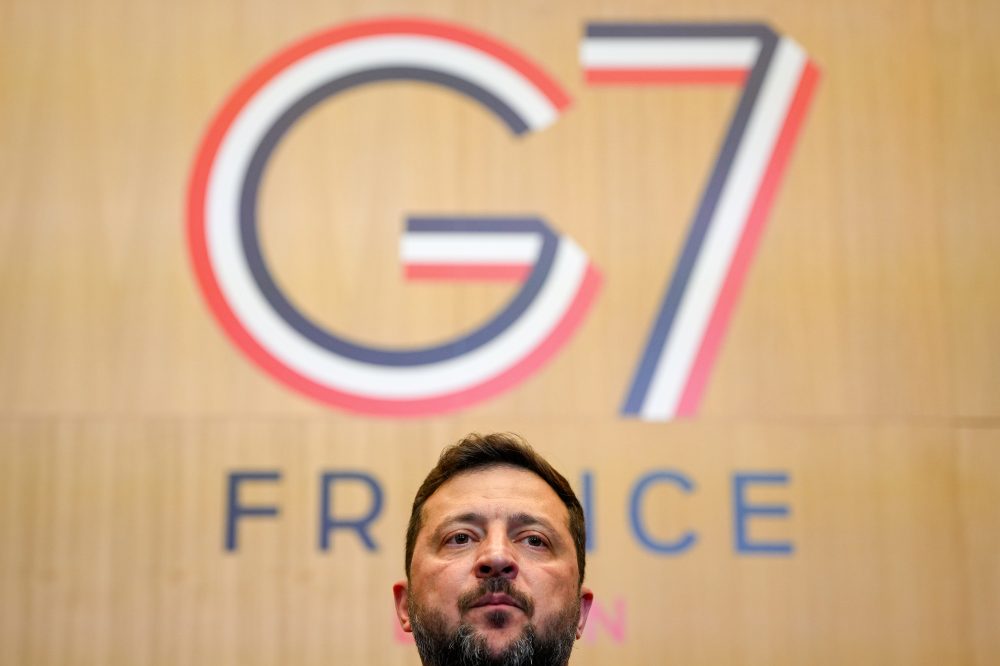
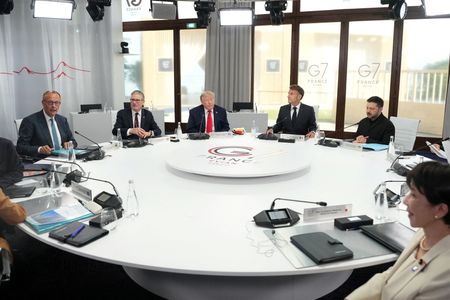
KYIV, Ukraine — Ukrainian President Volodymyr Zelenskyy announced Wednesday that leaders from the world’s top industrial nations, gathered at the Group of Seven summit in France, have made important new commitments to support Ukraine in its war against Russia.
The assembled leaders agreed to boost Ukraine’s air defense systems, safeguard the country’s energy infrastructure, and ramp up economic pressure on Moscow through additional sanctions — all as Ukraine’s battle against Russia’s full-scale invasion pushes into a fifth year with no clear end on the horizon.
Zelenskyy, who attended the summit in person, posted on X that the gathering produced meaningful outcomes. “The G7 Summit in France delivered important results for Ukraine. Most importantly, we agreed on additional strengthening of Ukraine’s air defense,” he wrote.
He added that allied nations would continue backing Ukraine’s military and energy stability, saying, “Our partners will ensure support for our defense and energy resilience,” and confirming that new sanctions against Russia would follow.
Since Russia launched its full-scale invasion in February 2022, Zelenskyy has worked tirelessly to build international backing for Ukraine while working to diplomatically isolate Russian President Vladimir Putin on the world stage.
Following the G7 gathering, Zelenskyy was set to travel to Brussels on Thursday for a European Union summit. Ukraine formally began EU membership talks on Monday, kicking off what is expected to be a lengthy process even as the country remains at war.
The ongoing conflict in Iran has pulled Washington’s attention away from its largely unsuccessful year-long push to bring the Ukraine war to an end. Zelenskyy used the G7 gathering — where key European leaders were also present — to engage directly with U.S. President Donald Trump.
Putin, meanwhile, has attempted to sideline both Europe and Kyiv, seeking to negotiate Ukraine’s fate in direct talks with Washington alone.
In a joint statement released overnight, the leaders of Japan, the United Kingdom, France, Germany, Italy, Canada, and the United States expressed their backing for Ukraine. “We commend Ukraine for its resilience and progress on the battlefield in recent months and emphasize there is now a new momentum” in Kyiv’s resistance, the statement read.
Western officials and analysts have noted a marked improvement in Ukraine’s battlefield performance in recent months, despite facing a much larger Russian military force.
Advanced Ukrainian drones have been effective at pinning down Russian troops along the front lines, disrupting supply routes in Russian-occupied Ukrainian territory, and striking oil production facilities deep within Russia — a key source of revenue for Moscow. These developments have brought the war into sharper focus for ordinary Russians and increased pressure on Putin.
However, Ukraine is facing a critical shortage of American-made Patriot air defense missiles, partly due to U.S. stockpiles being drawn down by the conflict in the Middle East. That shortage leaves Ukraine exposed to the ballistic missiles Russia deploys in its strategic bombing campaign against Ukrainian cities and infrastructure.
The G7 joint statement pledged additional air defense capabilities for Ukraine, though it did not specify which types of weapons systems would be provided.
Leaders also indicated they would look into allowing Ukraine to obtain licenses to produce Western weapons domestically. Kyiv has specifically requested permission to manufacture Patriot missiles on its own soil.
Among the attacks reported Wednesday, a Russian drone hit a children’s equestrian sports school in Ukraine’s northeastern Sumy region overnight, striking a stable and killing horses. Oleh Hryhorov of the Sumy regional military administration said school staff were unharmed, based on preliminary information.
Russia’s Defense Ministry, meanwhile, reported that its air defenses intercepted 157 Ukrainian drones between late Tuesday and early Wednesday.
MOSCOW (AP) — Russian President Vladimir Putin has opened a two-day summit in Kazan with leaders from the Association of Southeast Asian Nations, aiming to deepen business and diplomatic ties between Russia and the regional bloc.
The Russia-ASEAN summit is focused on expanding what Russia calls a “strategic partnership” with ASEAN’s member nations, which include Brunei, Cambodia, Indonesia, Laos, Malaysia, Myanmar, the Philippines, Singapore, Thailand, East Timor, and Vietnam.
ASEAN has long maintained relations with Moscow as a “dialogue partner,” with top-level meetings held annually. This year’s gathering in Kazan carries added significance as it commemorates the 35th anniversary of the Russia-ASEAN relationship.
In remarks to participants at a business forum running alongside the summit, Putin expressed confidence that the event would “create new opportunities for expanding mutually beneficial trade, investment, and industrial cooperation, while also strengthening direct dialogue between our business communities.”
Kremlin foreign affairs adviser Yuri Ushakov outlined the summit’s agenda, saying it would include discussions on global and regional issues as well as a review of progress in Russia-ASEAN relations. He noted that participants are expected to reaffirm their commitment to “forming a just and democratic multipolar world order based on the principles of international law and the United Nations Charter.”
Ushakov also confirmed that Putin planned to hold one-on-one meetings with individual ASEAN leaders throughout the summit.
The member nations of ASEAN vary widely in their global alignments. The Philippines, which currently holds the bloc’s rotating annual presidency, is considered closely aligned with the United States. Other members maintain significant trade and security ties with both China and Russia.
Several ASEAN countries — including the Philippines, Indonesia, Thailand, and Vietnam — have either already purchased Russian crude oil or expressed interest in doing so, following a sharp rise in global fuel prices in the aftermath of the war in Ukraine.
A weeks-long leadership battle inside the Philippine Senate came to an end Wednesday when a Duterte-aligned senator was ousted from the chamber’s top position — just as the body prepares to put the former president’s daughter on trial.
Sherwin Gatchalian, an ally of President Ferdinand Marcos Jr., secured the Senate presidency after winning the backing of 13 out of 24 senators. His opponent, Alan Peter Cayetano — a key supporter of former President Rodrigo Duterte — acknowledged the loss after one of his own allied senators switched sides, handing the rival faction a clear majority.
“It’s a relief,” said Jean Franco, a political professor at the state-run University of the Philippines. However, she cautioned that the country’s democracy, “with its weak and fragile institutions,” still faces significant challenges ahead.
The Senate power struggle has widely been viewed as an extension of the bitter political feud between Marcos and Vice President Sara Duterte. The two were once political partners before a very public and acrimonious falling out — a conflict that highlights the deep divisions and turbulent nature of Philippine politics.
Vice President Duterte has held Marcos responsible for her father’s arrest and his transfer to the International Criminal Court in The Hague last year. The elder Duterte is set to face trial before the global court beginning in November on charges of crimes against humanity.
Those charges are rooted in the violent anti-drug campaign he carried out while in office, during which thousands of mostly low-income drug suspects were killed. Rodrigo Duterte has denied ever ordering extrajudicial killings.
Cayetano had originally seized the Senate presidency on May 11 after his faction gained a narrow majority when Sen. Ronald dela Rosa resurfaced following months out of public view to cast a supporting vote. Dela Rosa, who once served as Rodrigo Duterte’s national police chief, has been identified by the ICC as a co-perpetrator in the widespread killings of drug suspects. An ICC arrest warrant for dela Rosa was unsealed on May 11, after which he went back into hiding and has not been found.
A separate blow to Cayetano’s faction came on June 1, when another allied senator, Jinggoy Estrada, was arrested and jailed following an indictment on a plunder charge. Estrada is accused of accepting large kickbacks connected to a flood control project — an allegation he denies.
Control of the Senate carries enormous significance. The chamber is expected to begin the impeachment trial of Vice President Sara Duterte in July, after the House of Representatives voted last month to impeach her. The charges against her include unexplained wealth and publicly threatening to have President Marcos assassinated.
The House of Representatives is largely controlled by Marcos allies. The vice president has denied all of the allegations. Her supporters argue the charges were fabricated to block her from running for president when Marcos’ six-year term concludes in 2028.
DUBAI, United Arab Emirates — Leaked copies of a tentative agreement between the United States and Iran indicate that Tehran will immediately move to reopen the Strait of Hormuz once the deal is officially signed, and will be permitted to sell its oil without any restrictions, according to officials who say the leaked text closely reflects the actual document.
The agreement is scheduled to be formally signed at a ceremony in Switzerland on Friday. Under its terms, the U.S. would work to secure at least $300 billion to help rebuild Iran following the war, and would pursue the removal of all American and United Nations sanctions against Tehran — provided a final agreement on Iran’s nuclear program is eventually reached.
The U.S. concessions — including immediately allowing Iran to sell oil freely and the eventual lifting of all sanctions — go further than the terms Iran received under its 2015 nuclear deal with world powers. U.S. President Donald Trump pulled the United States out of that earlier agreement during his first term, calling it the “worst deal ever.” The new accord is expected to face sharp criticism in Washington and appears to be a significant blow to Israeli Prime Minister Benjamin Netanyahu, who launched the war alongside Trump on Feb. 28.
The agreement also calls for an immediate halt to all fighting in Lebanon between Israel and the Iranian-backed militia Hezbollah. That provision is among the most sensitive in the deal, as Israel has insisted it retains the right to defend itself and continues to occupy large portions of Lebanon. Iran has stated that Israel must withdraw under the terms of the deal, though the leaked versions contain no specific language about a withdrawal.
Both sides are expected to begin 60 days of negotiations aimed at reaching a final agreement — one that the Trump administration says will permanently prevent Iran from developing a nuclear weapon. The generous U.S. offers appear designed to draw Iran into striking a longer-term deal.
In the near term, however, Iran appears to be receiving significant benefits upfront while giving up relatively little. Much of the interim agreement would restore conditions to what they were before the war began, including the cessation of hostilities and the reopening of the strait — a critical passage for global oil and natural gas supplies whose closure triggered a historic energy crisis.
Other major concessions to Iran — including reconstruction funding, full sanctions relief, and the release of frozen assets — appear tied to the outcome of future negotiations over Iran’s nuclear program.
A person briefed on the memorandum of understanding after it was signed, and another who reviewed a copy beforehand, both said the leaked text largely matched what was published by Saudi-owned broadcaster Al Arabiya, which reported details of the deal on Tuesday. Both individuals spoke on condition of anonymity due to the sensitivity of the matter. Two additional officials in the Middle East, also speaking anonymously for the same reason, confirmed that versions published by Al Arabiya and Bloomberg broadly matched the final agreement.
The White House and other American officials have not released the terms of the deal and did not immediately respond to requests for comment. Iran has also not published an official version. Iran’s semiofficial Tasnim news agency, which has close ties to the paramilitary Revolutionary Guard, claimed Wednesday that Bloomberg’s version was missing sections, without providing a complete accounting of what was absent.
The reopening of the Strait of Hormuz represents a major victory for the global economy. The narrow waterway at the mouth of the Persian Gulf once carried a fifth of all oil and natural gas traded worldwide before the war began. Iranian attacks on shipping and threats to vessels effectively shut down the strait, driving up energy prices globally and making everyday goods — including food — more expensive. Iran allowed some vessels to pass after paying tolls, an unprecedented practice in the strait, which sits in the territorial waters of Iran and Oman and has long been regarded as an international waterway. The U.S. later provided military assistance to help other tankers through, but traffic never returned to prewar levels.
Under the deal, the U.S. would lift a blockade on Iranian ports, and the strait would be expected to return to its prewar traffic levels within 30 days. The agreement also acknowledges that Iranian mines may still be present in the waterway and will need to be cleared.
While full sanctions relief for Iran will depend on future negotiations, the U.S. will immediately issue waivers allowing Iranian oil sales to proceed. Granting those waivers at the outset of the 60-day talks removes a significant point of leverage for the U.S. In the years leading up to the 2015 nuclear deal, Iranian oil faced international sanctions that sharply limited sales, and those sanctions were only lifted upon the completion of that overall agreement.
The interim deal also opens the possibility of ending all sanctions Iran faces from both the U.S. and the United Nations — though the timeline for that would be determined in later talks. That goes well beyond the 2015 deal, which only lifted certain sanctions in exchange for Iran significantly scaling back its uranium enrichment and stockpile.
The accord would also provide Iran with at least $300 billion for reconstruction following an intensive U.S. and Israeli bombing campaign. U.S. Vice President JD Vance has said Gulf Arab nations would supply that amount in the form of investments in Iran.
The interim deal establishes a 60-day window — which can be extended — to negotiate limits on Iran’s nuclear program, a topic that has been discussed across multiple rounds of talks during Trump’s second administration without a breakthrough. Iran maintains its nuclear program is peaceful, though the International Atomic Energy Agency has said Iran possesses enough highly enriched uranium to construct multiple atomic bombs if it chose to do so.
In the interim deal, Iran reaffirms that it will never produce nuclear weapons — a pledge it also made in the 2015 accord. Iranian diplomats have long pointed to statements from the late Ayatollah Ali Khamenei that Iran would not build an atomic bomb. Whether Iran’s new Supreme Leader, Ayatollah Mojtaba Khamenei, will uphold that position remains uncertain.
Trump has cited varying goals for the war at different points, including vowing to eliminate Iran’s nuclear and missile programs, end its support for Hezbollah and other proxy groups, and at times suggesting the conflict could lead to the fall of the Iranian government. The interim deal falls short of all of those objectives.
The negotiations have also exposed a growing rift between Netanyahu and Trump — Netanyahu’s closest and most powerful international ally — at a time when Netanyahu is facing a reelection campaign and heavy domestic criticism over the emerging deal. Despite that pressure, Netanyahu will find it difficult to oppose Trump given Israel’s deep dependence on U.S. diplomatic and military support.
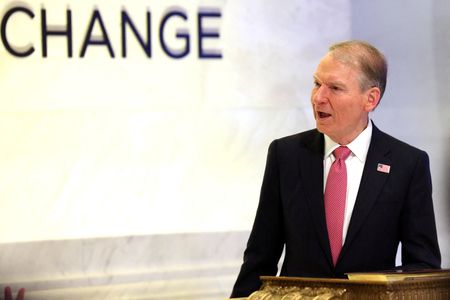
American stock markets could be in for a major transformation as the Securities and Exchange Commission prepares to release a new policy that would open the door for crypto companies to offer blockchain-based versions of traditional stocks, according to analysts and legal experts.
These so-called tokenized stocks are digital instruments built on blockchain technology that mirror the value of regular equities. Proponents in the crypto industry argue they could fundamentally change how stock markets work — enabling trading around the clock, settling transactions instantly, improving liquidity, and cutting down on costs.
Industry insiders are expecting SEC Chair Paul Atkins, appointed by President Donald Trump, to announce what’s being called an “innovation exemption” in the near future. Atkins has described the exemption as a way for companies to test out new digital asset business models without needing to follow all of the SEC’s standard disclosure and investor-protection requirements. Most significantly, the exemption is expected to let firms offer trading in tokenized versions of existing U.S. stocks.
Crypto Exchanges Gearing Up
Several major names in the crypto world have already signaled their intentions. Coinbase has indicated it plans to launch tokenized stocks in the United States once regulations permit. Meanwhile, Robinhood, Kraken, and other crypto exchanges are already offering these products in markets outside the U.S. Coinbase announced on Tuesday that it would soon be launching similar offerings internationally.
While Atkins has described the innovation exemption as temporary and limited in scope, analysts and attorneys say it could set the stage for lasting structural changes to equity markets over the long haul. It could put crypto firms in direct competition with established brokerages. Some regulatory experts and traditional financial institutions have cautioned that tokenized stock trading could introduce new risks to the financial system and to everyday investors, depending on how the exemption is ultimately structured.
The overall value of tokenized public stocks aimed at retail investors has surged dramatically. At the end of 2024, the market was worth just a few million dollars, according to RWA.xyz, a firm that tracks tokenized assets. Today, that market capitalization has climbed to more than $6.4 billion, according to data provider CoinMarketCap.
Ladan Stewart, global head of fintech and a partner at the law firm White & Case, called the innovation exemption a “significant win” for the crypto industry. She noted it could potentially allow crypto firms to handle multiple stock market functions at once — such as trade execution and clearing — without having to comply with the full rulebook that applies to SEC-registered intermediaries like exchanges and broker-dealers.
The SEC declined to offer any comment on the matter.
Concerns About Investor Safety and Market Stability
The innovation exemption fits into a broader reversal of SEC crypto policy under the Trump administration. During his campaign, President Trump actively courted support from the crypto industry by promising to roll back the crackdown that had taken place under the previous administration.
Atkins has also signaled that the agency is working on a proposed rule that would create a safe harbor allowing certain crypto companies to raise capital without adhering to traditional securities offering requirements. Analysts say both policy efforts have grown more urgent as the timeline for Congress to pass major crypto legislation continues to shrink.
Not everyone is on board, however. Several prominent Wall Street firms and industry organizations, including Citadel Securities and the Securities Industry and Financial Markets Association, have come out against the innovation exemption. They argue that changes of this magnitude should not be made on a case-by-case basis and should instead go through a formal rule-change process.
Atkins acknowledged last month that, beyond the innovation exemption, the SEC may also pursue a formal rulemaking process.
Citadel Securities previously raised concerns with the SEC that tokenization could pull liquidity away from public markets. Both Citadel Securities and the Securities Industry and Financial Markets Association declined to comment for this report.
Legal and regulatory experts have also flagged potential dangers for investors. Most tokenized stocks are tied to publicly traded companies and issued by outside parties. Some are backed one-to-one by actual shares, while others provide exposure through financial derivatives. Although many are marketed similarly to traditional stocks, they don’t always come with the same rights, disclosures, and legal protections that standard equities carry.
SEC Commissioner Hester Peirce addressed some of those concerns in a social media post last month, indicating she expects the innovation exemption would only apply to tokenized stocks that provide investors with the same rights and protections as conventional equities. Peirce declined to comment further.
Senate Republicans are pressing for a rapid confirmation vote on Jay Clayton, President Trump’s choice to serve as Director of National Intelligence, but Democrats are holding off on any commitments until after his scheduled Senate Intelligence Committee hearing on Wednesday.
Trump put forward Clayton’s name less than a week ago, following a political storm over his selection of a close ally to temporarily fill the intelligence director role. That interim pick, Federal Housing Finance Agency director Bill Pulte, has no background in national security — a fact that drew concern even from some Republicans, who worried he could use access to classified information to go after Trump’s political opponents.
Clayton’s nomination was widely seen as a relief. While he doesn’t have deep national security credentials, he is generally well-regarded by members of both parties. He currently holds the position of U.S. attorney for the Southern District of New York, one of the most prestigious prosecutor roles in the country.
Democrats made clear Tuesday that they plan to press Clayton with tough questions, but stopped short of announcing whether they would support or oppose him before the hearing takes place.
Senator Ron Wyden of Oregon, a senior Democrat on the Intelligence Committee, told reporters: “I favor a full vetting… a thorough examination of all of the issues.”
Senate Democratic leader Chuck Schumer of New York said his caucus would determine its next steps only after the hearing concludes.
On the Republican side, Senate Majority Leader John Thune of South Dakota is urging Democrats to agree to bypass standard Senate procedures so a confirmation vote could happen as early as this week. At a Tuesday news conference, Thune described Clayton as “eminently qualified” and pointed out that his role as a U.S. attorney already puts him in contact with intelligence matters.
Clayton’s swift confirmation could also open the door for renewal of Section 702 of the Foreign Intelligence Surveillance Act — a law that permits law enforcement agencies to gather foreign intelligence, which can sometimes include information on American citizens, without needing a court order. Democrats had previously signaled they would block renewal of that law while Pulte remained in the acting DNI role.
“It needs to be fixed quickly, and I hope that the Democrats will work with us in order to make that happen,” Thune said.
Clayton’s office is currently overseeing the legal case against former Venezuelan President Nicolas Maduro, who was apprehended in a swift operation on January 3. That case could come up during Wednesday’s hearing.
Clayton may also face questions about a false claim he made on television shortly before his nomination, in which he suggested there may have been fraud in the vote count for the Los Angeles mayoral race. Election officials note that vote tallying in California often takes time because mail-in ballots can be postmarked by Election Day and still arrive up to seven days afterward.
Trump has echoed similar statements recently and has continued to repeat unverified claims that the 2020 presidential election was stolen — allegations that Democrats warn could signal an intent to interfere in future elections.
It remains uncertain whether Pulte will serve any time as interim intelligence director following the departure of Tulsi Gabbard, whose last day in the role is June 19. Gabbard, a former Democrat who also lacked deep intelligence experience, faced Democratic accusations that she used the position to further Trump’s efforts to retaliate against his critics and spread debunked claims about election fraud.
Senators are also expected to question Clayton about reported plans to dramatically reduce staffing at the DNI’s office — or potentially shut it down altogether. Trump had previously indicated he wanted Pulte to pursue significant cuts during his time as interim director.
WASHINGTON — As the Federal Reserve prepares to announce its latest interest rate decision, economists who help manage billions of dollars in investments are finding themselves on opposite ends of the spectrum when it comes to what the central bank should do next.
The core question dividing the financial community: Will American consumers start pulling back in the second half of 2026 and drag the economy down with them — or will stubborn inflation and a strengthening job market force the Fed to raise rates to cool things off, much like what happened during the COVID-19 pandemic era?
Chris Hodge, the top U.S. economist at Natixis CIB Americas, believes the Fed’s next move will be a rate cut. “The next move will be lower. (Inflation) expectations are anchored, real wage gains are negative,” he said, pointing to consumer weakness and declining inflation-adjusted wages as reasons for two quarter-point cuts in the coming months. He added, “Are they going to want to hike in an environment when inflation is driven by supply considerations?”
That view gets additional support from economists at Citi, who are forecasting an even more aggressive series of rate reductions — sequential cuts at the Fed’s September, October, and December meetings.
Part of the backdrop for that outlook involves oil prices. Since the U.S. and Iran reached a deal to reopen the Strait of Hormuz, global oil prices have dropped sharply to below $80 a barrel. That’s only about 10% higher than where prices stood before U.S.-backed military action caused Iran to close the crucial waterway — erasing most of the 70%-plus price spike that occurred during the conflict.
Taking the opposing view, Robert Sockin, Chief Economist at PGIM, believes the Fed will need to raise rates three times. He describes an economy that “continues to power along with above-trend growth, above-target inflation, and now a warming labor market” that, after a slow start to the year, is now adding jobs at a pace resembling the pre-pandemic years.
The wide range of professional opinion reflects just how many moving parts are in play right now. Ongoing uncertainty surrounds U.S. import tariffs, which remain under legal challenge even as President Donald Trump pursues new avenues to enforce them. Meanwhile, a massive wave of investment in artificial intelligence is creating tension with the declining share of economic growth going to workers.
Wednesday’s announcement will mark the conclusion of the first Fed meeting chaired by new Chairman Kevin Warsh. Rates are broadly expected to stay within the current range of 3.50% to 3.75%, but attention will be focused on a fresh set of economic projections and Warsh’s debut press conference for any hints about whether the Fed sees lower inflation ahead or the need for higher borrowing costs. Investors currently anticipate just one quarter-point rate increase before year’s end.
Thomas Simons, chief economist at Jefferies, captured the uncertainty well. “There are 19 Fed policymakers, and it wouldn’t be a stretch to say that they have 19 different views on the balance of risks regarding the conflict in Iran, the impact on the outlook for growth and inflation, and the appropriate policy response,” he wrote. He added that “solid labor market fundamentals and a lack of bleed-through of high energy prices to core inflation gives the FOMC breathing room to maintain their wait-and-see approach.”
With so much uncertainty in the air, the new Fed chairman may have every reason to keep his cards close to his chest at his first press conference.
Fifty people have died inside U.S. immigration detention facilities since President Donald Trump launched his mass deportation effort in January 2025, according to Immigration and Customs Enforcement records — and the rate at which detainees are dying has more than doubled compared to the previous 15 years.
A Reuters analysis of ICE data found that between 2009 and 2024, one detainee died for every 3,848 people held in immigration facilities, based on average daily population figures. Since Trump returned to the White House, that rate has surged to roughly one death per 1,630 detainees, based on preliminary figures through early June.
The data was obtained by the Deportation Data Project through a public records request and later processed by the Vera Institute of Justice, a nonprofit that advocates for reduced incarceration.
Three experts in detention-related deaths who reviewed ICE records and autopsies for Reuters said the climbing death rate and other findings raised serious questions about the level of supervision and medical care being provided at facilities whose populations have expanded dramatically under the Trump administration.
Detention numbers had already been rising in the final year of the Biden administration amid election-year pressure to increase enforcement. ICE was holding roughly 40,000 immigrants when Trump took office, up from a low of about 14,000 in February 2021 during the COVID-19 pandemic. Under Trump, that number climbed to a peak of approximately 70,000 in January during an aggressive crackdown in Minneapolis, before dropping back to about 57,000 by early June.
Of the 50 deaths, 21 were discovered only after the detainee was already deceased or unresponsive, ICE records show. That group included 10 suicides. Sanjay Basu, an associate physician at the University of California, San Francisco, who has studied ICE detention deaths and reviewed the data for Reuters, said those cases are particularly alarming because they may point to failures in both physical and mental health monitoring.
Heart attacks and cardiovascular-related problems accounted for 16 of the deaths. Medical experts said that pattern suggests possible shortcomings in initial health screenings and the management of chronic conditions.
Chanelle Diaz, an assistant professor of medicine at the Columbia University Irving Medical Center, said the data and records indicate the agency is choosing to hold medically vulnerable individuals, producing what she called a “spike in preventable deaths.”
“The system is not designed for chronic-care management,” Diaz said, adding that at least two detainees who died had dementia and posed no threat to public safety.
The Department of Homeland Security declined to provide detailed records of the Trump-era deaths that Reuters reviewed. The agency said it remains committed to maintaining a “safe, secure and humane” environment in its detention facilities.
“Comprehensive medical care is provided from the moment individuals arrive and throughout the entirety of their stay,” DHS spokesperson Lauren Bis said in a statement.
Experts reviewing the Trump administration’s detention death reports said those documents contained less information than reports from prior administrations. Many were missing critical details such as the detainee’s medical history, current medications, and specifics about emergency responses.
Michele Heisler, medical director at the nonprofit Physicians for Human Rights, highlighted the case of Santos Reyes Banegas, a Honduran man who died at the Nassau County Correctional Center on Long Island, New York, last September. According to an ICE report, a nurse noted symptoms of alcohol withdrawal during his intake at 11:22 a.m. on September 17, 2025. About two hours later, a doctor observed tremors and prescribed withdrawal medications, though the report does not name the medications or confirm they were given. At 6:25 a.m. the next day, Reyes was found unresponsive in his cell and was pronounced dead 20 minutes later.
Heisler said prompt hospital treatment can dramatically reduce the dangers of alcohol withdrawal. “It raises the question of why wasn’t he immediately sent to an emergency department,” she said. DHS said the death is still under investigation but that “the preliminary cause appears to be liver failure complicated by alcoholism.” An investigation by the New York State attorney general’s office found that the officer on duty did not cause Reyes’ death.
Among those who died was Tuan Van Bui, a 55-year-old Vietnamese man who arrived on November 19 at the Miami Correctional Facility in Bunker Hill, Indiana — a repurposed maximum-security prison the Trump administration has nicknamed the “Speedway Slammer.” Bui had suffered a stroke in late 2023 and had been prescribed medication for high blood pressure and cholesterol after being detained. In February, he filed a federal court petition seeking his release, saying he relied on a cane to walk and that detention was making his health worse. In March, a physician diagnosed him with chronic obstructive pulmonary disease.
On April 1, Bui collapsed. Fellow detainees called out to a nearby guard for help. Ibrahim Ibrahim, an Iraqi detainee who had learned CPR while working as a military translator during the Iraq War, immediately began chest compressions. According to Ibrahim and two other detainees who spoke with Reuters, it took approximately 15 minutes for a guard to arrive, and medical staff did not appear until 10 minutes after that.
“By the time medical came, he was dead,” Ibrahim said in a phone interview.
Federal immigration detention standards require a four-minute response time for medical emergencies. When asked about the timeline in Bui’s case, DHS spokesperson Bis said staff “immediately initiated” life-saving measures and “immediately contacted emergency services personnel, who swiftly responded.” The ICE death report on Bui stated that detention staff began CPR, started defibrillation, and called emergency medical services before a supervising physician declared him dead around 6 p.m. The report made no mention of Ibrahim performing CPR first. The local coroner attributed Bui’s death to natural causes stemming from cardiovascular disease.
Bui’s stepdaughter, Ly Wang, said her family had been bracing for the possibility he would be deported to Vietnam. “The worst case scenario for us was that he was going to get deported,” she said, “not that he was going to die.”
In another case, staff at the Moshannon Valley Processing Center in Pennsylvania discovered the body of 32-year-old Chinese immigrant Chaofeng Ge hanging in a shower stall early on the morning of August 5. Ge had been transferred to the immigration facility less than a week earlier after spending seven months in a Pennsylvania county prison awaiting trial on fraud charges involving $154.62 in gift cards. His brother said through a translator that Ge had crossed the U.S.-Mexico border illegally in 2023 and had been working as a delivery driver in New York City.
Records from the county prison where Ge had been held show he attempted suicide by hanging on January 25 of last year. Emergency care was provided at a University of Pittsburgh Medical Center facility, which noted in a summary: “Patient should be monitored for suicidal ideation/plan.” Two days after that attempt, a social worker documented signs of depression and bipolar disorder, and a psychiatrist later prescribed an antipsychotic drug and an antidepressant.
Tom Weber, CEO of PrimeCare Medical, which provided medical services at the county prison, said his facility sent Ge’s records to ICE when he was transferred. Reuters was unable to independently confirm delivery of those records. ICE stated in a press release that Ge arrived at the immigration detention center without medical records from his prior incarceration, and that a nurse conducting his intake interview — through an interpreter — recorded that he had no prior medical or mental health conditions and placed him in the general population.
In a separate case, Mohammad Paktiawal, 41, a former Afghan special forces soldier who had been evacuated to the United States by the U.S. military during the Taliban’s 2021 takeover, was detained by ICE on March 13 in a Dallas suburb while driving five of his six children to school. That same day he was transferred to a hospital for chest pain and shortness of breath. The following morning, hospital staff noticed his tongue was swollen, administered an allergy medication, and began life-saving measures three minutes later, but he was pronounced dead.
Experts who reviewed the ICE records found no indication of a failure in emergency response in Paktiawal’s case. However, his brother Naseer Paktiawal said the family is still waiting for answers from ICE and the Dallas County medical examiner three months after his death. Paktiawal had applied for asylum and was the sole provider for his family, working at a local Afghan market, his brother said.
Paktiawal had been indicted in September on a felony charge of improperly using more than $200 in federal food stamps for business purposes. Two months later he was arrested for attempted theft of roughly $220 in groceries and then released. Under the Laken Riley Act, enacted shortly after Trump took office, ICE is required to detain anyone arrested for shoplifting and similar offenses — a policy that would have made Paktiawal a detention priority under the new rules.
In a press release confirming Paktiawal’s death on March 15, ICE highlighted his criminal record. The release read: “Criminal illegal alien from Afghanistan with previous arrests for fraud and theft passes away at Texas hospital.”
WASHINGTON — The Federal Reserve is widely anticipated to leave interest rates unchanged on Wednesday, wrapping up the first policy meeting led by new Fed Chair Kevin Warsh. A fresh policy statement and updated economic forecasts are expected to signal growing worry about inflation driven by the war with Iran, even as global oil prices have pulled back on optimism surrounding a potential peace agreement.
Recent economic data has shown solid job growth in the United States, an unemployment rate sitting at a relatively modest 4.3%, and inflation running well above the Fed’s 2% target. Given that backdrop, many analysts expect the Fed to drop wording from its policy statement about “additional adjustments” to its benchmark rate — language that had previously signaled the likelihood of future rate reductions.
Warsh has publicly expressed skepticism about the practice of giving forward guidance on monetary policy, and several Fed officials have recently suggested it’s time to drop the so-called “easing bias” in favor of more neutral language that leaves open the possibility of rate increases down the road.
Markets currently expect the Fed’s policy-setting Federal Open Market Committee to raise rates by a quarter percentage point in December.
Michael Feroli, chief U.S. economist at JP Morgan, wrote ahead of the meeting: “We expect a more neutral bias.” He added that “it’s possible the committee, under Warsh, takes a cleaver” to the statement and eliminates rate guidance entirely, either at this meeting or a future one.
Feroli also noted that changes to the statement could bring aboard the three policymakers who dissented in favor of tougher language at the April 28-29 meeting. That would give Warsh — who has described dissent as a sign of institutional health and wants Fed meetings to resemble a “family fight” — a unanimous vote in his debut as chair.
The Fed’s rate decision, updated policy statement, and revised economic projections will be made public at 2 p.m. Eastern time Wednesday. Warsh, who took over from former Fed chief Jerome Powell last month, will hold a press conference 30 minutes later, keeping to the schedule his predecessor established.
Powell will remain a voting member of the policy committee in his continuing role as a Fed governor.
During his Senate confirmation hearing, Warsh said he believes Fed officials speak too frequently and contribute too little to meaningful policy debate — a possible sign he may scale back his own public appearances and reduce media access going forward.
Warsh, 56, was confirmed last month to a four-year term as Fed chair and a 14-year term on the Board of Governors. He stepped into the role amid significant tension between Powell and the White House, stemming from Powell’s refusal to deliver the steep rate cuts demanded by President Donald Trump.
That friction included Trump’s effort to gain greater influence over the central bank by attempting to remove Fed Governor Lisa Cook — an unprecedented presidential move — as well as the launch of a criminal investigation into Powell that has since been dropped.
The U.S. Supreme Court is expected to rule this month on whether Cook can remain in her position. Although the decision is anticipated to favor her, it could carry significant consequences for how the Fed is governed in the future.
Powell, who attended Cook’s Supreme Court hearing, has been widely praised for standing firm against White House pressure. Warsh has not publicly commented on the Cook situation or the broader pressure campaign directed at his predecessor.
ECONOMIC UNCERTAINTY COMPLICATES THE OUTLOOK
Although Warsh begins his tenure on better terms with the White House than Powell did, the window for potential rate cuts appears to be closing.
The quarterly projections being released this week are expected to show that the median Fed official no longer foresees the policy rate declining this year. Instead, rates are projected to stay in the current 3.50%-3.75% range, reflecting expectations of higher inflation and potentially a lower unemployment rate by year’s end. Some officials may indicate they expect a rate increase.
Warsh’s first press conference is likely to be dominated by sweeping questions about his agenda. In the period leading up to his nomination by Trump, Warsh repeatedly criticized the Powell-led Fed’s approach to policymaking and communications, called for reducing the central bank’s financial asset holdings, and promised wide-ranging reforms.
More immediate issues are also in play, particularly the apparent winding down of the U.S.-backed conflict with Iran and the reopening of the Strait of Hormuz. Although those developments have pushed global oil prices sharply lower — toward levels seen before the conflict began in late February — Fed officials must now evaluate how much inflationary pressure remains from the recent energy price spike and the anticipated slow resumption of global commodity shipments through the strategic waterway.
With global oil prices near $80 per barrel and some confidence that a Middle East ceasefire could hold, David Mericle, chief U.S. economist at Goldman Sachs, wrote in an analysis of this week’s meeting that “so far the impact on inflation looks more like the usual pass-through from large oil shocks” and likely won’t force Warsh to raise rates.
Still, rate cuts appear unlikely until at least mid-next year — if they happen at all — given that headline inflation is projected to climb above 4% in the coming months and stay above 3% through 2026.
“A long pause would increase the probability that the FOMC could instead decide that the (federal) funds rate is already in an appropriate place if the economy continues to perform well,” Mericle wrote. “We see a flat path as a plausible alternative.”
The 2026 World Cup is only days old, but the scoring has already reached spectacular heights. Argentina’s Lionel Messi put on a dazzling display, finding the net three times as his team opened defense of its 2022 championship title against Algeria in Kansas City, Missouri.
On that same remarkable day, France’s Kylian Mbappé added to the offensive fireworks by scoring twice in his squad’s contest. The back-to-back performances from two of the sport’s biggest names signaled that the world’s premier goal scorers arrived at this tournament ready to compete at the highest level.
Messi’s hat trick included what was recorded as Argentina’s second and third goals in the match, helping propel his squad forward as they look to repeat as world champions. The early days of the tournament have given soccer fans around the globe plenty to talk about as the competition continues to heat up.
Good morning, Delmarva! We’re heading into a mostly sunny Wednesday with just a slight chance of rain showers before 2 p.m. — so don’t let that minor morning uncertainty spoil your plans. Skies clear out nicely through the afternoon, with a pleasant high near 84°F and a gentle southeast breeze of 5 to 10 mph. Any rainfall would be minimal, less than a tenth of an inch.
Tonight stays comfortable and partly cloudy, with temperatures dipping to around 71°F — a nice evening to keep the windows open.
Now, heads up for Thursday: it’s going to be a hot one. We’re looking at a high near 93°F, so stay hydrated and limit time outdoors during peak afternoon heat. Afternoon and evening storms are possible as that heat builds, continuing into Thursday night. If you have outdoor plans, keep an eye on the sky and have a backup plan ready.
Stay cool out there, Delmarva — and we’ll keep watching those storms for you. Have a great Wednesday!
The United Nations World Food Programme announced Wednesday that it is welcoming an $800 million contribution from the United States — a major infusion of cash that comes after the Trump administration had previously slashed the agency’s American funding.
The WFP said the money would be used to scale up food assistance and respond quickly to emerging crises at a time when global hunger has reached record levels and the number of people facing severe food shortages is expected to climb further this year.
The United States is the WFP’s largest donor, but its contributions dropped by more than half between 2024 and 2025, falling to roughly $2 billion. The new $800 million grant would allow the agency to stockpile food supplies in advance, expand cash assistance programs, and keep supply chains running in crisis zones including Lebanon, Haiti, and the Democratic Republic of Congo.
The broader picture of U.S. humanitarian aid has also shifted dramatically. Overall U.S. humanitarian funding to the United Nations fell from $14.1 billion to approximately $3.38 billion in 2025 following significant spending cuts.
Just one day earlier, on Tuesday, the U.S. State Department announced a separate $218 million assistance package for UNICEF, the UN’s children’s agency.
The WFP is currently operating under temporary leadership as the United States works to install another American at the top of the organization. That search follows the resignation of Cindy McCain, who stepped down for health reasons.
Rebecca Simonitsch had just received life-changing news — she could be a candidate for brain surgery. As she made her way home, she had no way of knowing that the person sitting beside her on the plane would help her make sense of what was coming.
The stranger seated next to her on the flight took out a notebook and began walking her through what the process ahead might involve, offering a kind of clarity she hadn’t expected to find at 30,000 feet.
It was a chance encounter that ended up meaning far more than either of them may have anticipated — a quiet act of kindness during one of the most uncertain moments of her life.
A new El Niño weather pattern is now underway, triggered by unusually warm water temperatures in the tropical Pacific Ocean. While the phenomenon has officially begun, forecasters say the bigger question now is just how strong it will get — and which regions around the globe will bear the brunt of its effects.
El Niño is known for reshaping weather conditions across large parts of the world, with potential consequences including elevated heat and prolonged dry spells. Scientists and meteorologists are closely monitoring the developing pattern to determine the scope of its reach and intensity.
The arrival of El Niño puts forecasters on alert for a range of possible weather disruptions. Heat waves and drought conditions are among the most closely watched outcomes as the pattern continues to evolve in the months ahead.
W. Stein Highway is currently closed in both directions following a crash, according to traffic officials.
The closure affects the stretch of roadway between Chapel Branch Road and Sussex Avenue. Motorists traveling through the area should expect delays and plan for alternate routes until the road is cleared and reopened.
No additional details regarding the crash or an estimated time of reopening have been released at this time. Drivers are encouraged to stay alert for updates as conditions change.
The National Hurricane Center has issued updated wind speed probability graphics for Potential Tropical Cyclone One, with the latest data released on Wednesday, June 17, 2026, at 9:21 a.m. GMT.
The graphics show the probability of 34-knot wind speeds affecting various areas over a 120-hour forecast period. Forecasters will continue to monitor the storm system as it develops.
Residents in potentially affected coastal regions are encouraged to stay informed and follow guidance from local emergency management officials as the situation evolves.
LONDON (AP) — UK Prime Minister Keir Starmer stepped forward Wednesday to condemn the crew of a Russian warship for what he called reckless behavior, after the vessel fired warning shots near a British sailboat in the English Channel — though he suggested the situation was less alarming than it might appear.
The 40-foot sailboat involved, named Bright Future, was making its way across the English Channel toward Cherbourg, France, early Tuesday morning when its owners say they encountered a Russian warship that fired shots in their direction. Russia’s account confirms that the crew of the frigate Admiral Grigorovich discharged rounds into the air after the sailboat reportedly ignored repeated warnings to alter its path.
Nobody aboard was hurt, but the confrontation has drawn fresh attention to the growing friction between the United Kingdom and Russia.
Starmer, speaking from the G7 summit being held in France, described the incident as “deeply concerning,” while also noting that British defense officials had determined the shots were not “anything more sinister” than an attempt to prevent a collision between the two vessels.
“That doesn’t take away from the fact that clearly Russia is aggressive across Europe,” Starmer said.
The episode unfolded just two days after Britain seized a tanker linked to Russia’s so-called shadow fleet — a network of vessels that Western nations allege is used to dodge sanctions placed on Russian oil following the invasion of Ukraine. The UK has also leveled accusations at Russia of running a campaign of sabotage and disinformation aimed at destabilizing European countries that back Ukraine.
The British couple on board the Bright Future, Jane Kelvey, 68, and her husband Alan, 70, said the shots were fired roughly 20 nautical miles — about 23 miles or 37 kilometers — south of the Isle of Wight, in waters outside UK territorial boundaries.
Jane Kelvey described the moment to the i Paper: “It was a bit scary. I crouched down. I didn’t think our safety was in danger. But it was certainly unusual. As we sailed away, we said to each other, what the hell just happened?”
Russia’s Defense Ministry offered its own version of events, stating that the frigate’s crew had spotted the yacht traveling on what it called a “dangerous course in close proximity with the warship.” According to the ministry, the ship launched flares and sounded audio signals when the yacht failed to respond.
“After the distance had closed to 150 meters (500 feet), the frigate’s commander decided to fire warning shots across the vessel’s bow using small arms,” the ministry stated, adding that the yacht then changed direction and departed the area.
MADRID — Former Spanish Prime Minister José Luis Rodríguez Zapatero stood before a judge in Madrid on Wednesday, answering questions tied to his alleged role in a government airline rescue and jewelry uncovered during a police search of his office.
Wednesday’s court appearance marks the first time Zapatero has faced the National Court judge since being placed under investigation last month. He is accused of possible influence peddling, money laundering, and other financial misconduct connected to the Spanish government’s bailout of Plus Ultra airline.
Zapatero, 65, served as Spain’s prime minister from 2004 to 2011. He had been out of public office for roughly a decade when Plus Ultra received 53 million euros — approximately $61.5 million — in public funds in 2021 drawn from a COVID-19 economic recovery program.
Judge José Luis Calama is also looking into potential tax fraud and contraband charges related to jewelry valued at 1.3 million euros that officers found inside a safe when they searched Zapatero’s office in May.
Zapatero has flatly denied any involvement in wrongdoing related to the airline bailout. As for the jewelry, he has stated that the items were either inherited or given to him as gifts.
Despite the legal troubles, Zapatero continues to hold influence within the Socialist party, which is currently led by Prime Minister Pedro Sánchez. That party has faced a series of corruption scandals over the past two years.
Plus Ultra was an airline focused on routes connecting Spain with South America and had investors based in Venezuela.
Following his departure from office, Zapatero devoted much of his time to maintaining communication with Venezuela’s government, a country that had become largely cut off from Western nations after it moved to suppress its democratic opposition.
Under Spain’s legal system, an investigative judge examines evidence to determine whether suspected crimes warrant a trial. If the evidence is deemed sufficient, the case is forwarded to a separate judge who presides over the trial itself. The entire process can stretch from several months to well over a year.
ULAANBAATAR, Mongolia — A group of demonstrators in Mongolia brought copper exports to a standstill at a major Rio Tinto mining operation on Wednesday, cutting into the flow of a critical material that fuels China’s renewable energy industry.
The demonstrators belong to an organization known as the Radical Reform Movement, which has long pushed for Mongolians to receive a bigger cut of the wealth generated by the country’s mineral resources. Despite sitting atop enormous reserves of valuable minerals, Mongolia continues to struggle with widespread poverty. Copper plays a central role in manufacturing electric vehicles and building solar and wind energy systems — sectors where China holds a dominant global position.
Whether the demonstration would last only a single day as a way of raising awareness, or stretch into a prolonged blockade with serious economic consequences for both nations, remained unclear.
The Radical Reform Movement shared footage on Facebook showing a small number of protesters gathered around a barrier placed across a two-lane road cutting through a remote, open landscape under bright sunshine. A white banner bearing the words “Stop Rio Tinto” in red lettering was stretched across a large tree branch blocking the road, positioned in front of a wall of tires.
The Oyu Tolgoi mine is an enormous operation tapping into one of the world’s largest copper deposits, buried deep beneath the Gobi Desert roughly 80 kilometers — about 50 miles — north of the Chinese border. The site also holds substantial gold reserves and is expected to rank as the fourth largest copper mine on the planet once it reaches full production, according to Rio Tinto. The British-Australian mining company holds a 66% ownership stake in the mine, while the Mongolian government owns the remaining 34%.
The jointly operated mining company confirmed that shipments of copper concentrate were stopped after the road was blocked Wednesday morning. The company noted that the Oyu Tolgoi mine accounts for roughly 9% of Mongolia’s total tax revenue, and cautioned that a week-long disruption could cost the Mongolian government 35 billion Mongolian Tugrik, equivalent to approximately $13.3 million.
During a Cabinet meeting, Mongolian Prime Minister Uchral Nyam-Osor directed the minister of justice and internal affairs to uphold the law and pursue accountability for anyone unlawfully obstructing or interfering with business operations that are being carried out in compliance with existing laws and regulations, according to a post on the government’s official Facebook page.
While the Radical Reform Movement has gone so far as to call for foreign investors to be removed from the country entirely, not everyone shares that position. However, there are voices within the Mongolian government who are calling for the country’s agreement with Rio Tinto to be renegotiated so that Mongolia receives a greater share of the financial benefits.
WASHINGTON — A sweeping new national poll reveals that most Americans hold the rights outlined in the country’s founding documents close to their hearts — but worry deeply that those freedoms are slipping away.
The survey, conducted by The Associated Press-NORC Center for Public Affairs Research, found broad agreement across different groups of Americans that the right to vote, freedom of speech, and religious freedom are essential to what the United States stands for. However, fewer than one-third of those surveyed felt any of those rights were actually safe from threats today.
The poll was conducted April 16-20, before a recent Supreme Court decision that narrowed a portion of the Voting Rights Act. It paints a picture of a nation that still deeply values personal liberty but is increasingly anxious about the country’s direction — even as Americans prepare for a summer of celebrations marking the nation’s 250th birthday.
“Our idea of rights has been very consistent in this country until the last few years,” said Louise Rochon, 85, of Connecticut. “Now, they’re all under threat. Every single last one of them.”
Roughly 9 in 10 Americans said the right to vote is “extremely” or “very” important to the country’s identity. A similar share said the same about freedom of speech. About 8 in 10 said freedom of religion is central to American identity, while approximately 6 in 10 placed the right to keep and bear arms in that category.
Despite that widespread appreciation for these rights, many Americans feel they are in jeopardy. About two-thirds said voting rights are facing some level of threat — with around one-third calling it a “major threat” and about 3 in 10 describing it as a “minor threat.” Only about one-third said voting rights faced no threat at all.
Nearly half of Americans said freedom of speech is under major threat. About 3 in 10 said the same about gun rights and religious freedom.
Tracy Gonzales, an independent voter from San Antonio, Texas, said the country is going “down the drain.” She said Americans across the political spectrum have “thrown religion to the side at the moment” and allowed other civil liberties to erode amid heated debates over immigration and the economy.
“Given everything going on with our president, you really don’t have time to think of anything else,” said Gonzales, 37, referring to President Donald Trump’s immigration crackdowns. “There are so many other crimes that are being committed and people that actually need help, and you’re focused on the ones that are trying to get it together.”
The poll also uncovered nuanced views among Black Americans — perspectives that are likely shaped, at least in part, by the country’s long history of denying voting rights and full citizenship to people of African descent.
Black Americans were less likely than white Americans to describe the right to vote as “extremely” or “very important” to American identity — about three-quarters held that view, compared to roughly 9 in 10 white Americans. At the same time, about 4 in 10 Black Americans said voting rights face a “major” threat today, a higher proportion than any other racial group surveyed.
“You cannot feel like you are a total and full part of the American experiment unless you have the right to vote,” said Antonio Williams, a school administrator in Dallas, Texas, who is Black. “And African Americans didn’t fully get to enjoy the right to vote until about 60 years ago, and I feel like it’s under threat right now.”
Younger adults and independents were less likely than the general public to view voting and free speech as central to American identity.
“My age group has grown up a lot more with social media as part of their existence in life and the microcosms that that creates in politics,” said Julian Goodwin-Ferris, 28, a professional dancer from New Jersey. “I think we feel more like our voice doesn’t matter as much because it feels like we’ve grown up with our rights sort of being more ignored.”
On partisan lines, Democrats and Republicans differed on which freedoms concerned them most. Democrats were more likely to see free speech as under major threat — about 6 in 10 Democrats felt that way, compared to about 4 in 10 independents and roughly one-third of Republicans.
When it comes to gun rights, about 8 in 10 Republicans said the right to bear arms is at least “very important” to the nation’s identity, compared to about 4 in 10 Democrats and half of independents. About 4 in 10 Republicans said gun rights are currently under threat — an increase compared to October 2025 — a shift not seen among Democrats or independents.
“We have the Bill of Rights for a reason,” said Nuri Simmons, a warehouse worker in New York and a registered Democrat. Simmons, 31, said threats to different rights “bleed into each other,” and while he is most worried about voting rights, he acknowledged others may prioritize different concerns.
“Like when people try to bring some gun control into it, I think some people look at that as an attack on their rights. I guess that all depends on your politics,” he said.
The AP-NORC poll surveyed 2,596 adults from April 16-20, using a sample drawn from NORC’s probability-based AmeriSpeak Panel, which is designed to represent the U.S. population. The margin of sampling error for adults overall is plus or minus 2.6 percentage points.
President Donald Trump announced Wednesday that he is putting the brakes on Jay Clayton’s nomination to serve as the nation’s top intelligence official, using the delay as pressure on Congress to pass a voter ID measure that currently doesn’t have enough votes to clear either chamber.
In a lengthy post on his social media platform, Trump said Bill Pulte, who currently holds a senior position in U.S. housing, will remain as acting director of national intelligence. Members of both parties had pushed back against Pulte’s nomination, pointing to what they viewed as his lack of relevant intelligence experience — opposition that effectively pushed Trump toward Clayton as an alternative.
Clayton had been scheduled to appear before the Senate for a confirmation hearing on Wednesday, a process that had been fast-tracked following the expiration of a critical surveillance program. That program lapsed largely because of widespread bipartisan anger over Trump’s original choice of Pulte.
Democrats had previously indicated they would agree to renew the expired surveillance programs once Trump pulled back Pulte’s nomination.
In his social media post, Trump accused Democrats of going back on an agreement to restore the program after he put Clayton’s name forward. Trump also stated he does not want to remove Clayton from the U.S. attorney’s office before Clayton’s would-be replacement, Jamie McDonald, receives approval.
Trump then added yet another condition, saying he would not approve the surveillance program — known as FISA — unless Congress also passed the voter ID legislation he calls the Save America Act.
“Therefore, to add a slight bit of intrigue but, for the Good of the Nation, and the People of our Country, I will not approve FISA without THE SAVE AMERICA ACT going along with it,” Trump wrote in the post.
The voter ID bill has stalled in the Republican-controlled Congress because it lacks sufficient backing in both the House and Senate, particularly among Democrats.
Trump made his announcement from Evian-les-Bains, France, where he was attending the final day of the Group of Seven summit, a gathering of leaders from the world’s major industrial economies.
PARIS — The chairman of global advertising firm Publicis is urging France and Germany to take the lead in establishing a large-scale European artificial intelligence fund, warning that companies across the continent face serious risks from their heavy dependence on American technology providers.
Maurice Lévy made the call Tuesday at the VivaTech conference in Paris, arguing that Europe needs a 100 billion euro — roughly $115 billion — fund dedicated to supporting artificial intelligence development across the bloc.
Lévy said the urgency behind the proposal stems from what he described as a wake-up call: European companies losing access overnight to cutting-edge AI models from U.S. startup Anthropic, with no advance warning.
“There is a need to create a fund at a European scale,” Lévy told Reuters. “It’s a bit like having someone with an on/off switch… who can flip it at will.”
Lévy acknowledged the concept is not entirely new, pointing to previous efforts by France and Germany to strengthen digital cooperation, as well as a push he credited to European Commission President Ursula von der Leyen.
He stressed that Europe must treat artificial intelligence as a matter of strategic importance, arguing that continued reliance on foreign providers could undermine the competitiveness of European businesses — and in some cases, threaten their very survival.
BERLIN — A growing share of German businesses say they would choose a cloud computing solution based entirely within Germany, even if it meant giving up some features, rather than continue relying heavily on foreign providers — especially those based in the United States, according to a survey released Wednesday.
The poll, conducted by German digital industry association Bitkom among 603 companies, found that 85% of respondents believe Germany is too dependent on U.S. cloud providers. That figure is up from 78% just one year ago.
The willingness to accept trade-offs for a Germany-only cloud solution has also grown sharply. Nearly 40% of companies said they would now use a cloud service that keeps all data processing within German borders, even if that came with drawbacks — a significant jump from 27% the previous year.
The survey also found that almost two-thirds of businesses currently using cloud computing feel pressured by U.S. government policies to reconsider how they manage their cloud operations. A year ago, that figure stood at 50%.
Bitkom President Ralf Wintergerst stressed the urgency of the situation. “Germany needs to break free from one-sided dependencies in the cloud sector, particularly in light of the growing importance of AI and data,” he said.
Leaders of the G7 nations gathered at a summit in the French town of Evian-les-Bains on Lake Geneva Wednesday, issuing a joint call for a ceasefire in Lebanon while expressing support for a preliminary agreement between Washington and Tehran aimed at ending the war between the two countries.
The interim deal, a memorandum of understanding signed by the United States and Iran this week, extends a ceasefire that was first announced in April by an additional 60 days. That window is intended to give negotiators time to work toward a lasting peace agreement. The conflict has resulted in more than 7,000 deaths, with most casualties occurring in Iran and Lebanon.
The full details of the agreement had not yet been made public as of Wednesday, but a formal announcement was expected Friday across the nearby Swiss border. In their joint statement, the G7 leaders said: “We underline the need for the negotiation … to address the threats posed by Iran in the region and beyond and ensure that they never obtain a nuclear weapon.”
The summit gave U.S. President Donald Trump an opportunity to present the agreement to key allies — Britain, Canada, France, Germany, Italy and Japan. While those nations broadly share American concerns about Iran’s nuclear activities, they never endorsed the decision to go to war. They have also expressed worry that Tehran gained a degree of leverage by withstanding the military campaign and asserting control over the Strait of Hormuz.
The G7 leaders said they are prepared to help put the agreement into practice. A coalition led by Britain and France is expected to assist in securing shipping lanes once the Strait of Hormuz reopens, which is anticipated to happen Friday.
Critics have noted that the U.S. president appears to have fallen short of several goals he outlined at the start of the conflict. Iran’s government remains in power, its stockpile of highly enriched uranium has not been handed over, its ballistic missile program has not been dismantled, and it has not cut ties with anti-Israel militant groups such as Hezbollah in Lebanon. Trump has stated that the agreement affirms Iran will not develop a nuclear weapon — a position Iran has officially held since the 1970s — and U.S. officials say further talks will lead to the removal or destruction of its enriched uranium supply.
Ending the war under these conditions could still draw criticism, including from within Trump’s own Republican Party, as the country heads toward midterm elections in November.
One of the most unresolved issues surrounding the truce involves Lebanon. Israel invaded the country in March in an effort to root out Hezbollah, after the militant group fired across the border in solidarity with Tehran following U.S. and Israeli strikes on Iran. Israeli forces continue to occupy a portion of southern Lebanon, where more than one million people have been displaced. Hezbollah has not been defeated.
Iran has insisted that any ceasefire must also bring an end to hostilities in Lebanon and that a permanent agreement must include an Israeli withdrawal. Israel, which was not included in the U.S.-Iran peace talks, has said it will not withdraw and maintains the right to use military force.
That stance has created a visible rift between Israel and the United States. Trump publicly criticized Israeli Prime Minister Benjamin Netanyahu, saying at the summit Tuesday that he was “not happy” with how Israel has conducted itself. He added: “Without us, without the United States, there would be no Israel. Without me, there would be no Israel, because no other president was willing to do what I did.”
In their joint statement, the G7 leaders called for an “immediate robust ceasefire” in Lebanon along with the disarmament of Hezbollah. A Hezbollah spokesperson told Reuters the group believes Iran would not agree to a permanent truce unless the Israeli occupation comes to an end.
The memorandum also includes a $300 billion reconstruction fund, to be financed by neighboring Gulf states, contingent on Iran meeting other terms of the agreement. A senior U.S. official confirmed that the deal includes a waiver on sanctions against Iranian oil, which could bring millions of additional barrels to the global market — though industry officials caution that full recovery of Middle East oil and gas production could take several months.
Oil prices dropped again Wednesday in anticipation of the Strait of Hormuz reopening, with Brent crude futures falling below $80 per barrel — their lowest point since the early stages of the U.S.-Iran conflict.
The G7 leaders also pledged to “accelerate the diversification of energy supply routes in order to reduce global vulnerability to the Strait of Hormuz and to increase our energy stocks.” Negotiations on more difficult issues, including the future of Iran’s nuclear program, are expected to resume during the 60-day ceasefire period. Iran’s support for regional militant groups and its missile capabilities do not appear to be part of those upcoming discussions.
BUDAPEST — Hungary has opened an internal investigation targeting its tax authority, counter-terrorism units, and other government agencies following the controversial detention of a Ukrainian bank’s routine cash transport earlier this year.
The incident occurred in March, when seven Ukrainian nationals transporting $82 million in cash and gold aboard two armored vehicles were briefly taken into custody on suspicion of money laundering. The detention took place while the government of Viktor Orban — a Russian ally who has since been removed from power — was in a bitter dispute with Ukraine.
Ukraine’s Oschadbank stated that the employees involved were conducting a standard operation, the same type of transfer the bank had been performing on a weekly basis since Russia’s invasion of Ukraine began.
Prime Minister Peter Magyar, who won April’s election by a wide margin, took to Facebook on Wednesday to demand action. He wrote that the prosecutor general “must address the matter without delay.”
During his time in office, Orban had made skepticism toward supporting Ukraine in its war with Russia a cornerstone of his political platform. He blocked new European Union sanctions against Moscow and opposed a financial loan intended for Kyiv.
Before Magyar was officially sworn into office, Hungary returned the seized cash and gold to Ukraine.
When the Bank of Japan’s second-highest official had to fill in for his ailing superior at a historic policy meeting this week, he wasted no time sending a stark warning: the central bank was at risk of falling behind on inflation.
Deputy Governor Shinichi Uchida — a career central banker considered a potential future head of the institution — stepped into the spotlight to address reporters following the BOJ’s decision to raise interest rates to 1%, their highest level in 31 years.
Though Uchida stopped short of signaling exactly when the next rate increase might come, his tone leaned hawkish enough to prevent a sharp drop in the yen, something analysts attributed to his well-honed understanding of financial markets.
Rather than using the cautious, layered language that Governor Kazuo Ueda has often employed at post-meeting briefings, Uchida — widely credited as a key architect of many BOJ policies — gave investors an unusually candid look at how the bank views inflation risks.
“Price rises are broadening, and there is a risk that underlying inflation may deviate from our target,” Uchida said, emphasizing the importance of keeping price growth anchored near the 2% goal.
He also noted the BOJ was closely monitoring movements in the yen, as businesses have grown more willing to pass along higher costs stemming from the currency’s weakness.
Former BOJ official Shigeto Nagai, now head of Japan economics at Oxford Economics, praised the deputy’s approach. “Uchida was as always, clear and stable. His remarks left no room for error, leaving FX markets with no opportunity to engage in speculative trading,” Nagai said.
That stands in sharp contrast to past statements by Ueda, which some markets interpreted as an acceptance of a weak yen — comments that sent the currency tumbling and prompted yen-buying intervention by Japan’s Ministry of Finance.
Having only recently been discharged from a hospital stay for leukemia treatment, the 63-year-old deputy read carefully from a prepared statement at the start of the briefing, making the case for continued rate increases to head off the risk of inflation running too hot.
The central message was consistent: with financial conditions still relatively loose, the BOJ intends to keep nudging borrowing costs higher while keeping a watchful eye on outside threats, including instability in the Middle East.
What differed was the delivery. Governor Ueda, who came to the role from academia, tends to offer detailed, model-driven explanations of his thinking. Uchida, by contrast, is known for a more practical, grounded approach — focused on real-world decision-making under uncertain conditions, according to those who have worked alongside him.
“While Ueda would add layers of explanations to make his case, Uchida keeps his comments simple and concise,” said Seisaku Kameda, a former senior BOJ economist who worked under both men. “Uchida will be clear and brief on what the BOJ knows or can say. For the unknowns, he’s completely silent.”
That difference showed clearly when Uchida flatly downplayed the usefulness of the BOJ’s neutral rate estimate as a guide for future policy decisions — a more blunt take than Ueda’s, who had previously suggested the bank should work to improve those estimates internally.
Before being appointed deputy governor in 2023, Uchida spent the bulk of his career in the BOJ’s monetary affairs department, the division responsible for developing policy ideas and drafting executive speeches. He played a role in both the launch and the eventual unwinding of negative interest rates and yield curve control — unconventional tools the bank had used to stimulate the economy.
Given his extensive background, some market observers view Uchida as a leading candidate to one day take over as governor when Ueda’s term concludes in 2028.
“Uchida’s remarks were solid and grounded on his long experience as a career central banker,” said Mari Iwashita, executive rates strategist at Nomura Securities. “Instead of elaborating on the various uncertainties, he laid out the BOJ’s focus on inflation risks very clearly.”
By expressing confidence that Japan is now experiencing a lasting cycle of moderate wage and price increases, Uchida pushed back against a perception in some corners of the market that he is a policy dove — a label tied in part to his earlier resistance to rate hikes.
Under former Governor Haruhiko Kuroda, Uchida had authored a speech attributing Japan’s prolonged deflation to sluggish wage growth, and he championed ultra-loose monetary policy designed to overheat the economy enough to force employers to raise pay.
This week, he declared that era of deflation effectively over, crediting the BOJ’s past stimulus, and pointed to upward pressure on prices as the new challenge to manage.
The BOJ has indicated that Governor Ueda is expected to return from the hospital in time to chair the next policy meeting in July.
Still, Uchida’s comments are expected to remain a focal point for markets, given his considerable influence over policy direction and his track record of offering clear hints about near-term shifts. Assuming his health permits, he is expected to make public appearances a few times per year, in line with other board members.
Some analysts now anticipate that Ueda may begin more openly echoing his deputy’s concern that the BOJ is not moving fast enough to address inflation.
“For the first time, the BOJ cited the risk of being behind the curve as among reasons to raise rates. That’s a big change showing its alarm over mounting price pressures,” said Kameda, who now works as an economist at Japan’s Sompo Institute Plus. “With such imminent and real risk looming, the policy message should be pretty clear with little room for ambiguity.”
FBI Director Kash Patel revealed that federal agents stepped in to stop a plot aimed at attacking a UFC fighting event held at the White House on Sunday.
The director’s announcement highlighted a serious security threat that was disrupted before it could be carried out. The event, which took place at the nation’s executive residence, was the target of what authorities described as a coordinated plan.
A former Homeland Security official, Juliette Kayyem, spoke about the foiled plot and its implications for security at high-profile public events.
As the United States prepares to mark 250 years since its founding, the organization StoryCorps has launched an ambitious new project to document the voices and stories of people across the country.
The initiative, known as “Connect 250,” is focused on recording conversations between Americans as a way of capturing a snapshot of life in the nation at this historic milestone.
StoryCorps founder Dave Isay spoke with NPR’s Steve Inskeep about the project and what it hopes to achieve — building what amounts to a time capsule of American experiences told in the words of the people living them.
A developing tropical system is tracking northeastward along the middle Texas coast and is raising serious concerns about life-threatening flooding across portions of the southeastern United States.
According to a 4:00 AM CDT update issued Wednesday, June 17, the center of Potential Tropical Cyclone One was positioned near latitude 28.0 north, longitude 96.7 west. The storm was moving to the northeast at approximately 6 miles per hour.
The system’s minimum central pressure was recorded at 1003 millibars, with maximum sustained winds of roughly 30 mph. While the winds remain relatively modest at this stage, forecasters are emphasizing the flooding threat as the primary danger for communities in the storm’s path.
Residents across the southeastern United States are urged to monitor updates from weather officials and be prepared for rapidly changing conditions as the system continues to move inland.
The National Hurricane Center in Miami issued Forecast Advisory Number 4 for Potential Tropical Cyclone One at 9:00 a.m. UTC on Wednesday, June 17, 2026.
As of that advisory, the center of the system was located near 28.0 degrees north latitude and 96.7 degrees west longitude, with the position considered accurate within 40 nautical miles. The storm was moving toward the northeast at approximately 5 knots, or about 6 miles per hour.
The system had a minimum central pressure of 1003 millibars at the time of the advisory. Maximum sustained winds were estimated at 25 knots, with gusts reaching up to 35 knots.
Forecasters expected the system to strengthen into a tropical cyclone by 6:00 p.m. UTC on Wednesday, with maximum sustained winds increasing to 35 knots and gusts up to 45 knots, placing it near 29.1 degrees north and 95.2 degrees west.
By early Thursday morning, June 18, the system was forecast to weaken into a post-tropical remnant low with maximum sustained winds dropping back to 25 knots. The storm was expected to fully dissipate by Wednesday evening, June 18.
The advisory was issued by forecaster Berg. Ships within 300 miles of the system’s center were asked to submit reports every three hours. The next full advisory was scheduled for 3:00 p.m. UTC on Wednesday.
A disorganized low pressure system hovering near the middle Texas coastline is showing little sign of developing into a tropical cyclone, according to a 4:00 AM CDT Wednesday forecast discussion issued by the National Hurricane Center.
Offshore buoy readings confirm the system’s maximum sustained winds are holding at 25 knots. While a band of deep thunderstorm activity has developed over the northwestern Gulf of Mexico since the previous advisory, powerful westerly wind shear — blowing at 25 to 30 knots — has displaced that convection more than 120 nautical miles to the east and southeast of the low’s center. Because of this separation, forecasters at the Tropical Analysis and Forecast Branch rated the system as “Too Weak To Classify,” meaning it lacks the organized storm structure required to be officially named a tropical cyclone.
The system is currently drifting to the northeast at about 5 knots. As low- to mid-level winds strengthen from the southwest and a weather trough approaches from the northwest, the system is expected to pick up speed throughout Wednesday. The low’s center is forecast to straddle the Texas coastline for much of the day before pushing inland over eastern Texas or Louisiana by Wednesday night.
Forecasters say the chances of this system achieving tropical cyclone status appear to be fading. With the center not expected to spend enough time over open Gulf waters and wind shear remaining strong through the next 12 hours, organization is unlikely before the system moves ashore. Even so, winds could still strengthen somewhat in areas well east of the center during the day, and the official forecast still shows a peak of 35 knots at the 12-hour mark. All major global weather models then show the system breaking apart into a trough over Louisiana by Wednesday night, with the official forecast classifying it as a remnant low at 24 hours — though complete dissipation before that point is also possible.
Looking further ahead, forecasters are watching the leftover low-level energy as it tracks eastward across the southeastern United States on Thursday and Friday. The European, Canadian, and United Kingdom weather models each suggest a new low pressure system could redevelop — particularly if the remnant circulation moves back offshore over the western Atlantic. Forecasters say they will continue monitoring model trends for any potential tropical development over the western Atlantic later this week or into the weekend.
Regardless of whether the system ever achieves tropical cyclone status, the National Hurricane Center is emphasizing that heavy rainfall and life-threatening flash flooding remain the primary dangers.
Key Hazards:
Life-threatening flash flooding and urban flooding are expected through Thursday across southern Louisiana, southern Mississippi, southern Alabama, southwestern Georgia, and the Florida Panhandle, with possible flooding also near the upper Texas coast. Ongoing heavy rain could keep the flood threat going into the weekend.
Tropical-storm-force winds are expected along the Louisiana coast between Sabine Pass and Morgan City, where a Tropical Storm Warning is currently in effect.
Minor to moderate coastal flooding is also anticipated along portions of the upper Texas and Louisiana shorelines on Wednesday.
This forecast discussion was prepared by Forecaster Berg at the National Hurricane Center.
The National Hurricane Center in Miami issued its fourth wind speed probability update Wednesday morning for Potential Tropical Cyclone One, a developing system being closely watched in the Gulf of Mexico.
As of 9 a.m. Coordinated Universal Time on Wednesday, June 17, 2026, the center of the system was positioned near latitude 28.0 North and longitude 96.7 West, with maximum sustained winds clocking in at approximately 25 knots — roughly 30 miles per hour or 45 kilometers per hour.
Forecasters are calculating the chances that several Gulf Coast communities could experience sustained wind speeds reaching tropical storm force or higher over the coming five days. The probability data covers wind thresholds of 39 mph, 58 mph, and 74 mph.
Among the locations being monitored, Galveston, Texas carries an 18 percent chance of seeing at least 39 mph winds during the first 12-hour forecast period, with a cumulative probability of 20 percent through the full five-day outlook. Matagorda, Texas shows an 11 percent onset probability for the same wind threshold in that opening period.
Cameron, Louisiana has a 10 percent cumulative probability of reaching tropical storm-force winds, while Lake Charles carries a 3 percent cumulative chance. Port O’Connor and High Island, Texas are also included in the tracking data with lower probability figures.
The forecast was prepared by forecaster Berg at the National Hurricane Center.
The National Hurricane Center has issued wind speed probability graphics for Potential Tropical Cyclone One, tracking the system’s potential impact over the next five days.
The graphic shows the probability of 34-knot wind speeds occurring within a 120-hour forecast window. The information was last updated Wednesday, June 17, 2026, at 8:41 AM GMT.
Residents are encouraged to monitor updates from the National Hurricane Center as the system continues to be evaluated.
The National Hurricane Center has issued wind speed probability graphics for Potential Tropical Cyclone One, tracking the system’s potential development and impact over the next five days.
The graphic, designated for Atlantic storm AL012026, shows the probability of 34-knot wind speeds occurring within a 120-hour forecast window.
According to the National Hurricane Center, the wind speed probability information was last updated on Wednesday, June 17, 2026, at 3:22 AM GMT. Residents and interests in potentially affected areas are encouraged to monitor the latest updates from the National Hurricane Center as the system continues to be evaluated.
Some of the biggest names in artificial intelligence are converging in France on Wednesday, as international pressure mounts over the United States’ commanding grip on the global AI industry.
While the ongoing conflicts involving Iran and Ukraine have been at the forefront of this week’s Group of Seven summit — a gathering of the world’s major industrialized nations — artificial intelligence is set to take the spotlight on the meeting’s closing day.
In an unusual assembly of AI heavyweights, the leaders of three of the most influential companies in the field are expected to sit down together for a working lunch centered on the theme of “Ensuring a safe, rapid and effective deployment of artificial intelligence.” Those attending include OpenAI CEO Sam Altman, Google DeepMind CEO Demis Hassabis, and Anthropic CEO Dario Amodei.
Joining them are the heads of several smaller AI firms, representing companies from Canada, France, Germany, Italy, Japan, and the United Kingdom, including Cohere AI, Mistral, Black Forest Labs, Domyn, Sakana AI, and Synthesia.
Across Europe, unease about American corporations controlling AI and broader technology infrastructure has been building. The European Commission recently introduced a tech sovereignty package aimed at nurturing homegrown AI development. Meanwhile, the Vatican drew attention last month when the pope called for strong regulation of artificial intelligence.
A recent episode involving Anthropic drew sharp international concern. The company was compelled to pull its two most advanced AI models — Fable 5 and Mythos 5 — offline after a Trump administration directive cited an unspecified national security issue. The order prohibited non-Americans, regardless of their location, from accessing the models, forcing Anthropic to cut off all users worldwide.
That incident underscored how nations outside the U.S. “can be put in an extremely vulnerable position” when their access to cutting-edge AI is suddenly severed, according to Zach Meyers, director of research at CERRE, a Brussels-based think tank.
“There is a general anxiety about the state of Europe, the fact that we’re relying on other countries for quite important strategic infrastructure and a desire to do something about it, whatever that is,” Meyers said.
Canadian Prime Minister Mark Carney referenced the Anthropic situation while traveling to the G7 summit, telling reporters during a stop in Ireland that it underscores the importance of efforts to “build out and diversify.” In a speech delivered in Dublin, he stated that true sovereignty demands “unhindered access to AI.”
Earlier this month, Canada unveiled a plan to help mid-sized and like-minded nations develop AI alternatives to the dominant American players. Just days before that announcement, a U.S. executive order was signed laying out a framework for overseeing advanced AI systems.
The G7 gathering offers an opportunity for both corporate and government leaders to discuss the potential rewards and dangers of AI, as nations work to leverage the technology for economic growth and geopolitical advantage.
Tech independence has long been a priority for French President Emmanuel Macron, who is hosting this year’s summit. His administration has even directed government workers to abandon platforms like Zoom and Microsoft Teams in favor of a domestically developed video conferencing tool.
Aidan Gomez, CEO of Cohere — which acquired German AI startup Aleph Alpha earlier this year — said the company’s goal at the G7 is “to expand our sovereign AI ecosystem partnerships beyond Canada and Germany to include all G7 nations — and companies — establishing a global standard that guarantees ownership of models, data, and local compute.”
The G7 includes France, the United States, Canada, Germany, Italy, Japan, and the United Kingdom. Several guest nations, including Brazil, India, Kenya, and South Korea, were also invited to take part in select discussions.
OSLO, Norway — Norway’s Crown Princess Mette-Marit has successfully undergone a lung transplant at an Oslo hospital, according to an announcement made Wednesday by the Norwegian royal house.
The 52-year-old princess was diagnosed in 2018 with pulmonary fibrosis, a progressive illness that causes damage and scarring to lung tissue, leading to serious breathing difficulties. There is currently no known cure for the condition.
Earlier this month, the royal house revealed that Mette-Marit had been placed on a waiting list for a lung transplant. Wednesday’s statement confirmed she received the transplant at the Rikshospitalet in Oslo.
Are Holm, who heads the hospital’s pulmonary department, said in the statement that “we are very pleased that everything has gone well so far.”
Holm noted that, like other patients who receive organ transplants, the crown princess will need to stay in the hospital for “several weeks.” He explained that “this is standard procedure to adjust medications, manage any complications and conduct rehabilitation.”
The royal house said Crown Prince Haakon, who is next in line to the Norwegian throne, will “adjust his schedule” so he can be by his wife’s side throughout her recovery. The royal house also indicated it plans to provide the next health update when she is released from the hospital.
Mette-Marit’s health has been declining in recent months, a period that has also brought significant personal difficulties.
Her eldest son, Marius Borg Høiby, was sentenced on Monday to four years in prison after being found guilty of two counts of rape — charges he denied — along with other offenses. His attorneys have indicated they will appeal both the rape and domestic abuse convictions.
Høiby, who was born from a previous relationship and holds no royal titles or official duties, became the center of a high-profile six-week trial that drew significant attention to the royal family.
At the same time, Mette-Marit faced renewed public scrutiny regarding her past connections to the late sex offender Jeffrey Epstein, raising questions about her judgment, though she has not been accused of any wrongdoing.
She issued an apology in February for the position she had put the royal family in, as part of a broader expression of regret to all those she felt she had “disappointed.” During a television interview in March, she stated that she had been manipulated and deceived by Epstein and that she felt unsafe during a 2013 meeting with him at his Palm Beach, Florida, mansion.
West Newton Road is closed at Sussex Highway after a tractor-trailer overturned at the location, according to traffic incident information.
Motorists traveling in the area are advised to avoid the intersection and plan for alternate routes until the roadway is cleared and reopened.
No further details regarding injuries, the cause of the overturn, or an estimated time for the road to reopen have been released at this time. Drivers should use caution and monitor for updates.
JOHANNESBURG — The leader of South Africa’s Democratic Alliance, Geordin Hill-Lewis, has formally called on President Cyril Ramaphosa to restructure which members of his party hold cabinet positions, the party announced on Wednesday.
The Democratic Alliance, which serves as the second-largest party within the country’s ruling coalition, released a statement outlining the requested changes. One of the most notable requests involves Hill-Lewis asking Ramaphosa to reassign John Steenhuisen — Hill-Lewis’s predecessor as party leader — from his current post as agriculture minister to a new role as deputy trade minister.
Norway’s Crown Princess Mette-Marit has come through a lung transplant procedure and is now in recovery, according to a statement released Wednesday by the royal household.
The 52-year-old is married to Crown Prince Haakon, who is next in line for the Norwegian throne. She was first diagnosed with pulmonary fibrosis back in 2018 — a chronic lung condition that causes scarring tissue to form in the lungs, reducing the body’s ability to absorb oxygen.
On June 5, Oslo University Hospital announced that Mette-Marit had been added to a transplant waiting list after her health took a serious turn for the worse. At that point, doctors indicated she likely had no more than a year to live without the operation.
Oslo University Hospital Professor Are Holm, in a statement released through the palace, noted that “like all newly transplanted patients, the crown princess will remain at the hospital for several weeks to come.”
Crown Prince Haakon had spoken publicly about his wife’s declining health back in December, saying the family had observed changes in her condition and that she was having increasing difficulty breathing.
Prime Minister Jonas Gahr Stoere previously commended the crown princess for being candid about her illness, saying her openness could provide comfort and help to others facing similar health challenges.
Mette-Marit’s path to royalty was far from traditional. She was 25 years old, a single mother without royal ties, when she first crossed paths with Haakon at a music festival in 1999. What began as a romance that drew intense media scrutiny eventually earned the admiration of most of the Norwegian public.
British Prime Minister Keir Starmer is speaking out after a Russian warship fired warning shots near a civilian yacht flying a UK flag close to British territorial waters, calling the episode reckless and deeply concerning.
The confrontation took place on Tuesday, according to statements released by the defense ministries of both Britain and Russia. Both countries said the shots were intended to prevent a potential collision after the Russian frigate Admiral Grigorovich was unable to make radio contact with the yacht.
Speaking to BBC News while attending the G7 summit in Evian-les-Bains, France, Starmer said, “What happened in the Channel was deeply concerning. It was reckless.” He added that his Ministry of Defence concluded the Russian vessel was “drifting, and they were warning shots.”
“That shouldn’t have happened. It is reckless, and the couple on the yacht must’ve been terrified,” Starmer said.
Russia’s defense ministry stated that the frigate’s crew observed the yacht on a path that posed a collision risk. After repeated radio contact attempts went unanswered, the ship fired warning shots — including small arms fire — in front of the yacht’s path. The yacht subsequently changed course and moved away, according to the Russian ministry.
Britain’s defense ministry characterized the event as “an isolated incident” and stated it had no connection to a separate operation over the weekend in which British commandos intercepted a Russian shadow fleet vessel.
Austria marked their long-awaited return to World Cup soccer with a hard-fought 3-1 victory over first-time qualifier Jordan on Tuesday evening in Santa Clara, California, with substitute Marko Arnautovic playing a pivotal role in the Group J showdown.
The match, played on a cool night in the San Francisco Bay Area, saw Austria draw first blood in the 21st minute when Romano Schmid launched a powerful shot into the top corner from outside the penalty area. Jordan answered back early in the second half with a stunning strike from Ali Olwan, who drove down the left flank and curled a beautiful shot off the far post to level the score.
Austria’s decision to bring on the 37-year-old Arnautovic at halftime turned the tide. He had a goal wiped out in the 69th minute following a VAR review that determined teammate Stefan Posch had handled the ball. But Arnautovic kept the pressure on, and seven minutes later that persistence paid off when Jordanian defender Yazan Al Arab was forced into an own goal off a Stefan Sabitzer corner kick. Arnautovic then added a penalty 12 minutes into stoppage time to seal the result.
Austria midfielder Konrad Laimer reflected on the challenge Jordan presented throughout the match.
“We knew that this was going to be a difficult match … there were situations where we did a good job, there were phases where we underperformed,” Laimer said. “What’s important is the mentality of the entire team — we never gave up, we kept going until the end and finally we came out on top.”
For Austria, the win was especially meaningful — it was their first World Cup appearance in 28 years. Jordan, making their debut on the world’s biggest soccer stage, gave a determined performance with the speed of forwards Olwan and Mousa Al-Tamari keeping Austria’s defense busy throughout the game. Jordan captain Ehsan Haddad nearly opened the scoring just two minutes in when his low shot grazed the side netting.
Despite the defeat, Jordan’s Olwan remained optimistic about what lies ahead for his squad.
“We didn’t deserve to lose in our first-ever World Cup appearance — a historic participation for us,” Olwan said. “We still have two matches ahead, and based on what I saw from our team today, we are capable of qualifying.”
BOGOTA, Colombia — Across some of Latin America’s most powerful economies, right-wing populist politicians are gaining momentum, offering iron-fisted solutions to crime and illegal immigration as a direct counter to the left-leaning movements that dominated the region just a few years ago.
While murder rates across Latin America have generally fallen compared to ten years ago, surges in specific countries — combined with a broader regional uptick in other types of crime — have created fertile ground for conservative politicians. Many are pointing fingers at migrants and borrowing the tough tactics made famous by El Salvador’s president, Nayib Bukele.
Voters who feel let down by their governments are rallying behind these approaches, even though critics caution that such strategies could open the door to human rights violations and democratic backsliding.
Latin America and the Caribbean saw their combined average homicide rate fall by more than 5% last year compared to 2024, with the median rate landing at roughly 17.6 killings per 100,000 people, according to InSight Crime, a think tank that tracks organized crime across the Americas.
However, there are notable exceptions to that downward trend. Drug-related killings have climbed in Peru and Colombia — the world’s two leading cocaine-producing nations — as well as in neighboring Ecuador, whose major ports have become attractive transit points for traffickers moving drugs to European markets.
Last year, authorities recorded 2,400 homicides in Peru and 14,780 in Colombia, the highest figures in each country since at least 2020. Ecuador saw an even more alarming jump, with killings rising 31% in a single year to reach 9,216.
Adam Isacson, director for defense oversight at the Washington Office on Latin America, noted that while populist movements across the political spectrum have found success, only the right has put forward short-term security plans capable of making citizens feel safer within months — even if those plans come at the cost of “democracy and human rights.”
Left-leaning proposals, such as community-based violence prevention, improved police training, and reforms to the justice and prison systems, tend to take longer to produce visible results, Isacson explained.
“It’s absolutely what you’re supposed to be doing, but people’s patience runs out,” Isacson said of those longer-term strategies. “So, there come the Bukeles of the world saying, ‘You want to feel better? We got this.’”
In Colombia, where large portions of the countryside have been pulled back into armed conflict, pro-Trump businessman Abelardo de la Espriella has led polls ahead of Sunday’s runoff election while closely following Bukele’s playbook.
In Peru, where extortion has skyrocketed fivefold over the past five years, Keiko Fujimori surged into a June 7 presidential runoff on a law-and-order message. She has pledged to send the military into prisons and deploy forces along the country’s borders, drawing on the authoritarian reputation of her late father, disgraced former President Alberto Fujimori.
Police in Ho Chi Minh City, Vietnam have broken up a major criminal operation involving the theft and slaughter of cats for human consumption, rescuing more than 500 animals in the process, according to animal welfare organizations and local media reports.
The multiday operation last week resulted in the detention of nine individuals and the discovery of 45 cages holding approximately 400 live cats. Officers also found four foam containers packed with ice containing around 80 dead cats, along with 21 additional live cats recovered at a second location, according to the Ho Chi Minh City Criminal Police Division.
Although more than 40 of the cats were successfully reunited with their families, about 100 of the rescued animals have since died as a result of the brutal conditions they were kept in, welfare groups reported.
The bust was triggered by a police investigation into a string of pet thefts in Ho Chi Minh City. Suspects confessed to trapping and collecting cats throughout southern Vietnam over the past three years, operating across Ho Chi Minh City and the cities of Tay Ninh and An Giang.
Karanvir Kukreja, who leads a campaign against dog and cat meat consumption for the international nonprofit Humane World for Animals, described the operation as “a sobering reminder of the enormous scale of Viet Nam’s cat meat trade.” He added that millions of animals fall victim to thieves in Vietnam each year who steal pets off the streets and slaughter them for food.
Chris Gindelhumer, with the nonprofit Vietnam Cat Welfare, is among those helping care for the surviving animals. He said he “saw quite a lot of tears in the last few days.”
“It’s really beautiful to see how many Vietnamese families are coming, looking for their cats,” Gindelhumer said. “But it’s also heartbreaking because many families were looking for their cats and didn’t find them.”
He noted that many veterinarians and volunteers have been working around the clock to care for the rescued cats.
While the consumption of dog and cat meat is legal in Vietnam — provided vendors hold permits verifying the animals’ origins — some cities, such as Hoi An in central Vietnam, are partnering with global animal welfare groups to end the practice locally. Vietnamese officials have also stated that the government plans to strengthen legal protections for pets and their owners, a move that came shortly after South Korea enacted a ban on dog meat in 2024.
An Pham, a master’s degree student and devoted cat lover in Ho Chi Minh City, said the bust has had a noticeable impact on public awareness. “This event surprised a lot of people and has raised awareness among many to stop consuming cat meat,” Pham said.
Canadian Prime Minister Mark Carney said Wednesday that the United States and President Donald Trump have shifted their perspective on the war in Ukraine, adopting what fellow G7 leaders considered a more grounded and realistic outlook on the ongoing conflict.
Carney spoke at the G7 summit taking place in Evian-les-Bains, France, where he revealed that he had engaged in seven or eight separate conversations with President Trump over the previous 36 hours. Those discussions covered a broad range of topics, including Canada’s policy capping Chinese electric vehicles — a structure that Trump reportedly found appealing.
On other matters, Carney noted that Canada is on pace to produce 150 megatons of liquefied natural gas before the year is out. He also expressed his intention to finalize a trade agreement between Canada and India ahead of the G20 summit scheduled for November.
Uzbekistan’s President Shavkat Mirziyoyev took the stage at the annual Tashkent International Investment Forum on Wednesday, pledging to press ahead with economic reforms and announcing the creation of a new international financial hub in the country’s capital.
“We are always open to investors interested in cooperating with Uzbekistan and ready for an equal and mutually beneficial partnership,” Mirziyoyev told the audience in his opening remarks.
The centerpiece of his announcement was the Tashkent International Financial Center — a zone that would operate free of taxes and customs duties and function under English common law.
“Profit tax, value-added tax, property tax, and customs duties will be set at zero percent. Free capital movement and the ability to make payments in any currency will be guaranteed unconditionally. A modern system for financial technologies, digital assets, and green finance will be created,” Mirziyoyev said.
He also revealed that an independent financial regulator, empowered to issue its own regulatory rules, would be established within the new center.
Uzbekistan is Central Asia’s most populous nation, home to nearly 40 million people, and posted impressive economic growth of 7.7% in 2025. The country’s economy has been strengthened by its young and expanding population as well as elevated gold prices — Uzbekistan ranks among the world’s significant gold-producing nations.
Earlier this year in May, a package of minority stakes in state-owned companies was listed on the London Stock Exchange, marking the country’s largest initial public offering since 2021.
Mirziyoyev, who came to power in 2016, has worked to dismantle the capital controls that restricted economic growth under his predecessor, Islam Karimov, though he has maintained firm control over the country’s political landscape.
NEW DELHI — The messaging app Telegram has gone to court to fight back against an Indian government order that temporarily cut off access to the platform, according to legal news website Bar and Bench, which reported the development on Wednesday.
Indian authorities put the block in place starting Tuesday, with the restriction set to remain until June 22. The move was designed to stop people applying to medical schools from cheating on their entrance exams.
Telegram did not respond to a request for comment from Reuters.
The court challenge comes on the heels of a significant controversy in India’s medical education system. Last month, the Indian government scrapped a major undergraduate entrance exam used by medical colleges after officials said they were looking into claims that exam questions had been leaked ahead of time.
U.S. drug maker Moderna is eyeing a possible investment in manufacturing facilities in Germany, and its top executive says plants that German competitor BioNTech is planning to shut down could be an attractive option.
CEO Stephane Bancel shared the company’s interest with the German business newspaper Handelsblatt on Wednesday, June 17, indicating that existing infrastructure could be more appealing than starting a new construction project.
“If we were to find the right partnership with the German government, these facilities would be an interesting option — compared with building a new one,” Bancel told the publication.
The comments signal Moderna’s ambition to expand its European manufacturing footprint by potentially stepping in where its rival plans to step back.
Shares of BMW dropped sharply in early Frankfurt trading on Wednesday, falling 8% after the German luxury automaker issued a profit warning the previous evening that caught Wall Street analysts off guard.
The automaker cited two major headwinds behind the downgrade: persistent weakness in the Chinese market and the ripple effects of the Iran war on vehicle pricing and consumer confidence.
Analysts at both Deutsche Bank and Jefferies noted the size of the profit outlook reduction was far larger than anticipated. The revision brought BMW’s operating automotive margin down to a range of 1% to 3%, compared to its previous forecast of 4% to 6%.
In addition to lowering its profit outlook, BMW announced it would step up its cost-cutting efforts. The company acknowledged those measures would result in a one-time negative financial impact during the second half of 2026, though it offered few additional details.
Analysts at Jefferies suggested the restructuring comments pointed to sweeping changes ahead, saying the overhaul “will largely impact German operations and may address a global assembly footprint business model that is still largely centered on exporting ICE powertrain components from Germany.”
The warning is being viewed by some market watchers as a sign that BMW may be rethinking its broader business strategy in response to shifting global conditions.
NAIROBI, Kenya (AP) — Despite billions of dollars in pledges to support Africa’s shift to clean energy, countless renewable energy projects across the continent are failing to launch — and experts say a little-known financial rule is largely to blame.
The rule, called the “sovereign ceiling,” links the credit rating of any project or company to the credit rating of the country in which it operates. Analysts and development finance specialists say this makes perfectly sound renewable energy projects look far more dangerous to international investors than they actually are.
Of Africa’s 54 nations, only Botswana and Mauritius currently hold investment-grade sovereign ratings, meaning the vast majority of African countries — and the projects within them — are automatically viewed as high-risk borrowers under this framework.
The consequences are significant. The rule is hampering government efforts to bring electricity to more people and honor climate commitments made under the Paris Agreement. According to the International Energy Agency, close to 600 million people across Africa still have no access to electricity.
“The financing environment is the problem,” said Dr. John Asafu-Adjaye, a senior fellow at the African Center for Economic Transformation. “A project with strong fundamentals, a long-term power purchase agreement and predictable cash flow ends up being priced as if it were inherently dangerous. Not because it is, but because of where it sits on a map.”
In practical terms, analysts explain, renewable energy projects in countries with weak sovereign ratings absorb the perception of that sovereign risk — even when the projects themselves are financially solid and backed by international guarantees.
Several high-profile projects have already felt the impact. Kenya’s Menengai Geothermal project, Zambia’s IFC-led Solar Scaling programme, and Nigeria’s Solar IPP pipeline all struggled to secure adequate funding as investors raised concerns about sovereign guarantees, creditworthiness, and financing terms.
The United Nations Development Program estimates that subjective credit rating assessments cost African nations as much as $74.5 billion each year through higher borrowing costs and missed investment opportunities. Analysts add that renewable energy projects in Africa frequently face financing costs two to four times higher than comparable projects in Europe or North America.
“The sovereign ceiling functions as a binding constraint that raises costs across all projects and limits scaling of clean energy deployment regardless of fundamentals,” said Dr. Sibusisi Nkomo, program director of the University of Cambridge Institute for Sustainability Leadership’s Africa Program.
“Our recent work on private finance and investment in Africa shows that international credit rating systems often overstate risk relative to actual project fundamentals, leading to inflated risk premiums and higher costs of capital,” Nkomo added.
The outsized influence of major credit rating agencies — including Moody’s, S&P, and Fitch — along with other Western financial institutions, also shapes how investors view African markets, potentially cutting off access to bond markets as another source of financing, analysts say.
Many African nations see solar, wind, and transmission infrastructure as essential to their economies and industrial growth.
“Electricity is the backbone of all modern economies and is therefore essential for development,” said Malango Mughogho, managing director of ZeniZeni. However, she noted that much of the available project financing comes in the form of loans that countries simply cannot afford to repay.
Maria Nkhonjera, a climate and development finance specialist at the Stockholm Environment Institute, said international credit ratings and what she calls “risk mispricing” unfairly inflate borrowing costs — even though African clean energy projects have relatively low default rates.
“The sovereign ceiling rule is an outdated credit rule that penalizes commercially viable clean energy projects for sovereign risks,” Nkhonjera said.
Beyond the sovereign ceiling, clean energy projects also face hurdles from complicated approval processes, fragmented funding sources, and limited local institutional capacity.
“Africa does not lack investable opportunities,” Asafu-Adjaye said. “What it faces is a system in which risk is systematically overestimated.”
Nkhonjera suggested that expanding low-cost financing, increasing lending in local currencies, and reforming international debt systems could meaningfully reduce borrowing costs. Multilateral institutions such as Afreximbank and the Trade and Development Bank could also play a bigger role by offering guarantees and credit enhancements that help separate individual projects from sovereign risk.
“In many African countries, the cost of capital is now one of the most important determinants of the pace of economic transformation,” Asafu-Adjaye said. “Fixing that system is not peripheral to the development agenda. It is central to it.”
BUNDIBUGYO, Uganda (AP) — Each time Ebola resurfaces, communities face a difficult divide: some of the sick head to the nearest medical facility, while others make their way to a traditional healer’s shrine — a choice that often proves fatal.
Across affected regions, many people interpret the onset of hemorrhagic fever as a spiritual problem rather than a medical one, turning to herbal remedies and prayer rather than hospital treatment. That dynamic is playing out right now in Congo, where the country’s seventeenth Ebola outbreak since 1976 is underway. The virus was first identified that year in the Congo Basin ecosystem.
Fifty years after its discovery, Ebola remains deeply misunderstood by many who fall ill, while religious figures have essentially become first responders in a life-or-death emergency. The current outbreak has claimed the lives of health workers who lacked protective equipment, as well as pastors and congregation members who gathered while the virus was actively spreading, according to humanitarian workers and others who spoke with The Associated Press.
The virus moves from person to person through close contact with the bodily fluids of someone who is sick or has died from the disease. The outbreak is particularly alarming in areas where residents are suspicious of health workers and refuse medical attention.
In Bunia, a town in Ituri province at the center of the outbreak, false information about how Ebola works has severely hampered containment efforts. The outbreak has killed at least 181 people so far. One piece of misinformation circulating in the area claims the virus is deliberately spread by people who drop magical charms attached to dollar bills into pit latrines.
“Some people still describe Ebola as something mysterious, spiritual, or brought by outsiders, rather than a disease that needs medical care,” said Onesphore Bangenza of the aid organization Mercy Corps, speaking from Bunia. “When people do not trust the health system, they often go first to traditional healers, faith leaders, or people they already know. The danger is that many only reach the hospital when they are already very sick.”
This outbreak is caused by the Bundibugyo virus, a rare Ebola strain for which no approved treatments or vaccines currently exist. It is unfolding in a remote part of Congo that is already dealing with armed rebel activity and population displacement. The disease adds another layer of suffering with symptoms that many compare to a modern-day plague.
Health officials confirmed the outbreak on May 15. Some specialists believe infections may have been occurring as far back as February, but early testing was focused on a different virus that also causes Ebola disease.
The World Health Organization quickly classified the situation as a public health emergency of international concern. The United States government has temporarily barred entry to non-U.S. passport holders who have recently traveled to Congo, Uganda, or South Sudan.
With so many community members seeking spiritual explanations for the illness, humanitarian organizations are calling on religious leaders to play an active role in fighting the outbreak.
A video circulating widely among residents of Ituri features a catechist leader from the Ebola hotspot of Mongbwalu who recently recovered from the disease and spoke openly about the choice that nearly cost him his life.
“I don’t usually rush to the hospital, so I decided to go to the fields,” said Deogratias Kasereka, who went on to explain that it was his children who ultimately persuaded him to seek medical care.
His symptoms included muscle weakness, headaches, and a high fever. In its later stages, Ebola can also cause both internal and external bleeding.
The symptoms are not only frightening but sometimes humiliating, which leads some patients to prefer the relative privacy of a traditional healer over a hospital setting, according to Vincent Isimbwa, an elder among Seventh-day Adventists in a Ugandan community that experienced the very first Bundibugyo outbreak back in 2007.
“They faced it so rough,” Isimbwa said. “The challenge with Ebola is that it is so bad that some people can believe that there are supernatural powers behind it.”
That 2007 outbreak killed at least 36 people and left lasting trauma on the community. Many residents also express regret that the Bundibugyo virus bears the name of their district — a mountainous home to roughly 200,000 people, most of whom work as farmers.
In Bundibugyo, a Ugandan nurse whose blood sample confirmed the 2007 outbreak recalled that his early symptoms puzzled medical staff. Some initially thought Samuel Kuule had food poisoning. While others in the community may have sought out traditional healers, Kuule was cared for in a small hospital room by a team of caregivers that included his pregnant wife, who never contracted the disease.
Kuule said his symptoms — peeling skin, bloodshot eyes, and a severe headache — were terrifying, yet they never shook his Seventh-day Adventist faith, as they might have for others who could have interpreted their illness as witchcraft.
“For those who are weak in faith, they may (think) that they are being bewitched,” he said. “Maybe they can believe it.”
Some community members recalled that one of the first victims of the 2007 outbreak was a woman carried down the mountains on a stretcher to a traditional healer’s shrine. That healer — an older man who survived the outbreak — lost three of his sons to Ebola. Speaking through his presumptive heir, Amon Balinda, the healer said he shifted from offering blessings and prayer to prescribing herbal remedies once he learned Ebola was spreading.
“For us in African traditional societies, in most cases when you fall sick and you go to the hospitals and they give you some injections and there is no improvement, there and then you switch to your neighbor, or anybody, and say maybe he is the one bewitching you,” he said. “Then you decide to go to the witch doctor.”
Scientists believe Ebola outbreaks typically begin when the virus jumps from an infected animal — such as a fruit bat — to a human host. These cross-species transmissions often occur when people handle or consume wild meat, according to experts.
The WHO is urging early testing and the isolation of anyone who may have been exposed in the current outbreak.
Both goals are difficult to achieve in communities with strong religious traditions, whether Christian or traditional. Many insist on following established burial customs, believing that departing from them could prevent the deceased from reaching the afterlife. Pastors whose standing depends on their ability to heal are expected to lay hands on the sick. Traditional healers face the same expectations.
These concerns prompted Ugandan President Yoweri Museveni to publicly criticize religious leaders in a recent televised address, telling them there was no need to physically touch the sick during an Ebola outbreak. He noted that the WHO chief, Tedros Adhanom Ghebreyesus, had told him during a visit to Uganda that many of the victims in Congo are people of faith.
“The pastors, the pastors, the pastors,” Museveni said, visibly frustrated. “The people of God — they are the ones who touch patients. … God is not deaf. You can pray without touching.”
BOGOTA, Colombia — Just a few years ago, Latin America appeared to be shifting decisively to the left. Progressive leaders, capitalizing on widespread anger over deep-rooted inequality made worse by the COVID-19 pandemic, rose to power in several of the region’s largest nations, including Brazil, Chile, Colombia, and Peru.
But the political winds are shifting again. While overall homicide rates across Latin America have generally fallen compared to a decade ago, sharp increases in violence in certain countries — combined with a broader regional rise in crimes like extortion — have given conservative populists fertile ground to campaign on promises of iron-fisted crackdowns on crime and immigration.
Campaign rhetoric portraying migrants as criminals and embracing the aggressive security tactics championed by El Salvador’s president, Nayib Bukele, has earned conservative candidates the endorsement of U.S. President Donald Trump and energized frustrated voters — even as critics raise alarms about the potential for human rights abuses and democratic backsliding.
“You have an emergent right wing that is very much in collaboration across the region and with the U.S. through the MAGA movement, which has also used crime as a rallying cry for political mobilization,” said Enrique Roig, vice president of the nonprofit Human Rights First and a former State Department official. “It’s easier to sell locking people up than it is to deal with the reasons why mainly young men join gangs in countries like El Salvador.”
Populist politicians across the political spectrum have found success, but only those on the right have offered quick security fixes that make voters “feel safer in six months” — even if that means having to “sacrifice democracy and human rights,” according to Adam Isacson, director for defense oversight at the Washington Office on Latin America organization.
He noted that left-wing proposals — such as community violence prevention programs, improved police training, and reforms to the justice system and prisons — require much more time before results are visible.
“It’s absolutely what you’re supposed to be doing, but people’s patience runs out,” Isacson said of those longer-term strategies. “So, there come the Bukeles of the world saying, ‘You want to feel better? We got this.’”
In Colombia, where large portions of the countryside have descended into renewed conflict, pro-Trump businessman Abelardo de la Espriella has led polls ahead of a presidential runoff election while closely mirroring Bukele’s approach.
In Peru, where extortion has jumped fivefold over the past five years, Keiko Fujimori surged into a June 7 presidential runoff on a law-and-order platform. She has pledged to station military forces in prisons and along the country’s borders, leaning on the authoritarian legacy of her late, disgraced father, former President Alberto Fujimori.
Costa Rica, shaken by record levels of drug-related killings, chose conservative populist Laura Fernández in February based on her hard-line stance on crime. In Honduras, businessman Nasry Asfura swept December’s election after Trump endorsed him as a partner in the battle against what Trump called “narco-communists.”
According to InSight Crime, a think tank focused on organized crime in the Americas, the combined average homicide rate across Latin America and the Caribbean dropped by more than 5% last year compared to 2024, with the median rate reaching approximately 17.6 deaths per 100,000 people.
However, notable exceptions exist. Drug-fueled killings have climbed in Peru and Colombia — the world’s two largest cocaine producers — as well as in neighboring Ecuador, whose major seaports are prized by traffickers as a gateway to European markets.
Last year, authorities recorded 2,400 homicides in Peru and 14,780 in Colombia — the highest totals in each country since at least 2020. In Ecuador, killings surged a striking 31% year over year, reaching 9,216.
Much of Ecuador’s violence is attributed to gangs that began expanding rapidly during the COVID-19 pandemic, as criminal organizations from Mexico, Colombia, and the Balkans moved in and recruited local members, igniting deadly battles over drug-trafficking corridors. Those conflicts have extended into prisons, where hundreds of inmates have been killed since 2021. Ecuadorian authorities also logged more than 16,100 extortion cases last year, down from 23,000 in 2024 — though experts caution that extortion is widely underreported.
In Chile, voters four years ago rejected ultra-conservative lawmaker José Antonio Kast in favor of then-candidate Gabriel Boric, a young former student protest leader who promised to tackle Chile’s deep social inequities. Last year, however, growing fears about rising crime — frequently linked in media coverage to the country’s expanding Venezuelan immigrant population — helped Kast mount a political comeback.
As Venezuelan criminal networks, including the Tren de Aragua gang, exploited their country’s mass migration to infiltrate human trafficking operations following the pandemic, Chile — long among the safest nations in Latin America — experienced an unprecedented wave of carjackings, kidnappings, and shootings.
Chile’s homicide rate climbed 30%, peaking at 6.7 per 100,000 people between 2021 and 2022, according to the country’s Interior Ministry. Though it has since declined, it remains above pre-2021 levels. Other violent crimes continue to rise — kidnappings, for example, have increased nearly 180% over the past four years.
Taking cues from Bukele — whose mega-prisons in El Salvador Kast visited during his campaign — Kast decisively defeated his Communist opponent in December by pledging to construct a massive border wall, harden prison conditions for gang members, and deport hundreds of thousands of undocumented migrants. Voters largely overlooked his opposition to abortion rights and same-sex marriage, as well as his defense of the late dictator Augusto Pinochet’s brutal regime.
In Peru, despite the divisive legacy of the convicted Alberto Fujimori, his daughter has capitalized on a surge in violent crime that occurred in the four years since she narrowly lost the presidency to schoolteacher Pedro Castillo. Running under the slogan “Peru with Order,” Keiko Fujimori captured the largest share of votes in April’s first round. Results from the June 7 runoff still show her in a statistical tie with nationalist Roberto Sánchez, the political successor of the imprisoned Castillo.
Analysts say that public appetite for tough measures — historically tied to the region’s brutal right-wing dictatorships of the 20th century — has grown in step with declining trust in government institutions and increasing ambivalence about democracy itself.
“The thinking is often, ‘democracy hasn’t been able to keep me and my family safe, so maybe democracy is part of the problem,’” said Eduardo Moncada, director of the Institute of Latin American Studies at Columbia University.
That sentiment presents a serious challenge for Latin America’s left, which in many countries has overseen sluggish economic growth, become entangled in corruption scandals, and fallen short on promises of social reform.
Even progressive politicians — such as Jeannette Jara in Chile and Sánchez in Peru — have adjusted to the shifting political climate. Uruguay’s president, Yamandú Orsi, described Bukele’s model as worth studying further. The center-left government of Guatemala declared a state of emergency to combat gang violence this year and welcomed assistance from the Trump administration in targeting drug traffickers.
Yet newly elected hard-liners have found that the realities of governing complex, cash-strapped democracies like Ecuador and Chile are far removed from the simplicity of campaign promises. These nations bear little resemblance to tiny El Salvador, where Bukele’s party commands a legislative supermajority.
Ecuador’s President Daniel Noboa campaigned in 2023 on promises to imprison gang leaders on floating barges and construct mega-prisons. He dropped the barge proposal after taking office, and his government didn’t open its first mega-prison until November.
“Building mega-prisons hasn’t been that easy or that straightforward because the country is in a very bad state financially and because President Daniel Noboa still sees himself as a democrat,” said Beatriz García Nice, a policy analyst at the Washington-based Stimson Center think tank.
Nearly three months into his time in office, Chilean President Kast is facing a skeptical public that says it cannot distinguish his security policies from those of his left-wing predecessor. His government has carried out only two deportation flights despite pledging to swiftly round up and remove Chile’s more than 300,000 undocumented immigrants. His public tone has noticeably softened, and last month he drew criticism after referring to his mass deportation promise as “a metaphor.”
Even as he unveiled new security proposals in a June 1 address — including stripping those convicted of attacking police officers of social benefits — he moved to temper his supporters’ expectations.
“Governing, as many of you know, means taking responsibility for reality, especially when it’s difficult,” he said. “I’m proceeding step by step because this isn’t something that happens overnight.”
The U.S. military carried out an attack Tuesday on a vessel suspected of transporting illegal drugs in the eastern Pacific Ocean, resulting in one fatality and two survivors, as the Trump administration presses forward with its ongoing campaign against alleged drug traffickers in Latin America.
With this latest strike, the total number of people killed in U.S. military boat attacks has reached at least 208 since the Trump administration began going after those it labels “narcoterrorists” in early September.
U.S. Southern Command, consistent with how it has handled most of its announcements about strikes in the eastern Pacific and Caribbean Sea, stated that the vessel was targeted along known drug smuggling routes. However, the military offered no evidence confirming the boat was actually carrying drugs. A video shared on X captured the boat moving through the water moments before the strike hit, sending it up in flames.
Southern Command stated that it “immediately notified U.S. Coast Guard to activate the Search and Rescue system for the survivors.”
President Donald Trump has described the U.S. as being in “armed conflict” with Latin American cartels, arguing the strikes are a necessary step to cut off the drug supply flowing into the country and reduce deadly overdoses among Americans. Despite those claims, his administration has provided little supporting evidence that those killed were in fact “narcoterrorists.”
Critics have raised doubts about both the legal basis for the strikes and whether they are actually working, pointing out that fentanyl — the drug responsible for many fatal overdoses — is typically brought into the United States over land from Mexico, where it is manufactured using chemicals sourced from China and India.
The strikes have come under heavy scrutiny from some Democratic members of Congress and legal experts who study military law. The very first strike in early September raised particular alarms among certain lawmakers and military law scholars.
In that initial attack, nine people were killed, and two men who initially survived were holding onto the wreckage when the boat was struck a second time, killing them both. The White House confirmed the follow-up strike, defending it as an act of “self-defense” aimed at ensuring the vessel was fully destroyed and conducted within the laws of armed conflict.
However, some legal scholars argued that striking survivors a second time would have been unlawful regardless of whether an armed conflict was underway.
The Pentagon’s internal watchdog announced in May that it intends to examine whether the military followed a proper targeting framework when conducting the strikes. That review, however, is focused narrowly on what is known as the six-phase Joint Targeting Cycle and does not address the broader question of whether the strikes were legal, according to the inspector general’s office.
EVIAN-LES-BAINS, France — The heads of government representing the G7 nations announced Wednesday that they stand firmly together in their support for Ukraine, reaffirming their commitment to the country’s territorial integrity while agreeing to turn up the heat on Russia’s war-driven economy.
In a joint statement released by the group, the leaders declared, “In this context, we will strengthen our sanctions (against Russia), including those on the oil and gas sectors.”
The announcement came as the G7 leaders convened for a summit in the French town of Evian-les-Bains. Beyond the conflict in Ukraine, the group also addressed broader global developments, expressing their support for the recently reached agreement between the United States and Iran and signaling their willingness to help carry out its terms.
The leaders also outlined steps to improve global energy security, stating their intention to work toward diversifying energy supply routes, reducing reliance on the Strait of Hormuz, and building up energy reserves.
WASHINGTON — When the leaders of the world’s seven largest economies sit down in France on Wednesday to talk about the global economy, one major topic will be conspicuously absent from direct criticism: the role that President Donald Trump’s war with Iran has played in rattling global markets.
Oil prices have surged 30% and inflation is climbing worldwide — both largely tied to the conflict that the U.S. and Israel launched against Iran in late February. Yet G7 leaders, already strained by disputes over U.S. tariffs, NATO, and Greenland, are expected to hold back from publicly blaming Trump for the economic turbulence, according to analysts.
Over the weekend, the U.S. and Iran announced a deal to halt the fighting and reopen the Strait of Hormuz, which gave global markets a much-needed boost. But economists caution that the damage is already done — energy costs have spiked, food supply concerns are mounting in developing nations, and central banks have been forced to act. Both the European Central Bank and the Bank of Japan raised interest rates within the past week in an effort to contain worsening inflation.
British Prime Minister Keir Starmer has publicly said he is “fed up” with how the conflict has driven up energy costs for his country. Italian Prime Minister Giorgia Meloni has warned of the war’s broader economic and social consequences. Rising prices have also taken a toll politically, denting approval ratings for Starmer, German Chancellor Friedrich Merz, and French President Emmanuel Macron.
Despite all of this, world leaders appear set to avoid a direct confrontation with Trump at the summit, largely because they still need his cooperation on critical issues including Ukraine, NATO, and trade negotiations.
Analysts say this reluctance is undermining the very purpose of the G7, which was founded after the 1973 oil shock specifically to help the world’s major economies navigate exactly these kinds of crises.
“U.S. policymaking has been hurting world economic activity,” said Marcelo Estevao, chief economist at the Institute of International Finance. “You have a country with the largest economy undermining what could have been a G7 agenda of collaboration,” he added, noting that the G7 must work harder to stay relevant as emerging market economies — which are not part of the group — now make up a growing share of the global economy.
France, serving as this year’s G7 host, has already moved to reduce the chances of open conflict by scrapping plans for a broad final statement, or communique. Instead, the focus will be on narrower topics such as global economic imbalances, critical mineral supply chains, and restructuring development aid programs.
The ceasefire deal reached just before Trump departed for France has further reduced the likelihood of a dramatic showdown. Still, economists warn that even with the deal in place, restoring normal trade flows could take months, and experts in the fuel and maritime sectors say bunker fuel supplies could take up to a year to normalize.
International Monetary Fund chief Kristalina Georgieva, attending the G7 summit in France, took a somewhat more optimistic tone in a blog post Monday, walking back some of the dire warnings she issued two months ago. She said the global economy was holding up so far, with no clear signs of a worldwide slowdown, even as some regions have been hit hard.
The IMF, whose largest shareholder is the United States, is set to release an updated global economic forecast on July 8. Georgieva’s post came shortly after a more pessimistic outlook from the World Bank. One of the IMF’s scenarios, based on a short-lived conflict, projects global growth of 3.1% in 2026, down from 3.4% in 2025. Its worst-case scenario shows growth dropping to just 2%, with inflation reaching 5.8%.
U.S. officials have pointed out that oil prices have come down from their peak and that the United States, as a fuel exporter, was somewhat insulated from the worst price increases. They argue the war’s economic impact will ease quickly once the Strait of Hormuz fully reopens, and believe even fuel-importing nations in Europe are likely to avoid severe shortages.
The G7 — made up of the major European economies along with the U.S., Canada, and Japan — has been grappling with questions about its relevance for years as economies like India, Brazil, and China have grown in global influence. The group now represents just 44.1% of global GDP, a sharp drop from 60.5% when it was first established, according to the Center for Strategic and International Studies.
Supporters of the group argue it still serves a vital function during moments of crisis, pointing to its response during the 2008-2009 global financial meltdown.
“The G7 has always been able, if needed, to come up with some real decisions that still govern half the world economy,” said Martin Muehleisen, a former IMF strategy chief who has participated in past summits, including some that included Trump. He noted that while European leaders would likely stay cautious in formal settings, unexpected moments of tension could still emerge during private meetings and dinners.
Eric LeCompte, executive director of Jubilee USA Network, a development organization, said economic concerns remain front and center regardless of the ceasefire. “The economy is in deep turmoil and you don’t have to be in a developing country to see it. You can just go to a grocery store and feel it,” he said.
ASTI, Italy — In just a matter of months, Irene Roggero Ugues watched helplessly as her daughter Rossella’s personality shifted dramatically, driven by a relentless stream of self-harm content pushed to her through social media. The 12-year-old ultimately died by suicide.
It was only after Rossella’s death that her parents unlocked her devices and discovered the full extent of her online activity. She had been using social media far more than they had realized, including a secret Instagram account she had named ‘Just a dead pers0n’ — spelling the word ‘person’ with a zero in place of the letter o.
According to her parents, Rossella began seeking out depressive content in September 2023, content that reflected her inner emotional state. Social media algorithms continued feeding her more of the same material, and within five months, she was gone.
“At some point, it seemed to take on a life of its own, growing until it overwhelmed the cheerful, sociable side of her — the brighter part,” Irene told Reuters during a meeting at a café in her hometown of Asti, in northern Italy.
Rossella’s family is among several Italian families who have joined a lawsuit against Meta — the company that owns Instagram and Facebook — and its major competitor TikTok. It marks the first collective legal action in Italy to directly challenge social media companies and the algorithms that drive their platforms. The families are pushing for stricter limits on minors’ access to these platforms and greater public awareness of the dangers they pose.
Both companies have rejected the lawsuit’s claims that their services cause harm to young people. They say they actively work to protect younger users by removing dangerous content, reducing exposure to risky material, and offering tools to help parents oversee their children’s accounts.
“We know parents worry about the safety of their teens online, which is why we’re consistently making changes to help protect teens,” a Meta spokesperson said, pointing to the company’s “Teen Accounts” feature and other built-in protections. “We strongly disagree with these allegations, which ignore our longstanding commitment to supporting young people.”
TikTok, for its part, said it strictly enforces guidelines designed to protect users’ mental and behavioral health, and that it removes more than 99% of content found to violate those standards. “We also continue to invest in safety measures to diversify recommended content, block potentially harmful searches and connect vulnerable users with support resources,” a TikTok spokesperson said, also referencing local suicide prevention resources.
When asked specifically about Instagram’s possible role in Rossella’s case, Meta said it would not comment on the matter while litigation is ongoing, but noted that young people’s mental health is influenced by many different factors. The company said the impact of social media depends on how platforms are used, what safeguards exist, and how involved parents are.
Irene described the tragedy as unfolding like a sudden and devastating “illness” that left her and her husband with no power to stop it. She believes the algorithm accelerated everything. “The progression of her distress — or psychosis, or whatever it was that I still cannot define — might have unfolded more naturally” without it, she said.
This legal battle is taking place against a broader backdrop of growing scrutiny of social media platforms across Europe. Britain recently announced plans to ban social media use for children under 16. In the United States, a court ruling found Meta and Alphabet’s Google negligent in designing platforms considered harmful to young people. Meanwhile, European Union regulators are increasing enforcement of the Digital Services Act, pushing online platforms to do more to protect minors and limit harmful content.
“The goal is not to dismiss the benefits of social media, but to remove the technological and marketing mechanisms that make it harmful to the most vulnerable users,” said lawyer Stefano Commodo, who is leading the lawsuit alongside the Italian parents’ association MOIGE.
Many parents involved in the case say the safety tools offered by these platforms are inadequate, pointing out that children can easily find online tutorials explaining how to bypass filters or get around screen time limits by switching to a different device.
“Monitoring social media use is a full-time job. It would require parents to spend all their time doing it, and that is simply unrealistic,” said Valentina Muraglie, a board member of Italy’s association of large families.
Muraglie shared her own experience with her son Antonio, who as a teenager put down his Harry Potter book collection and replaced reading with scrolling through social media. Now in his twenties, he struggles to read at length — something she attributes to the way social media algorithms eroded his attention span. “Once he had a phone in his hand, at 16, little by little books started to disappear,” she said. “Within a few years he stopped reading altogether.”
The World Health Organization has warned that addiction-like social media behavior is on the rise among adolescents and is associated with reduced well-being, disrupted sleep, and other health risks. Research published in JAMA Pediatrics, a U.S. medical journal, has identified measurable differences in brain development among teenagers who are heavy social media users — a population whose brains are still in the process of developing.
The Italian lawsuit argues that social media platforms use reward systems modeled after slot machines to keep users hooked, repeatedly stimulating the release of dopamine — a brain chemical associated with pleasure and reward. “Each ‘like’ or notification triggers dopamine release, tying users to the platform in a way that resembles addiction,” said Tonino Cantelmi, an advisor to the plaintiffs and director of the School of Specialisation in Cognitive-Interpersonal Psychotherapy in Rome.
The families involved in the case say brain imaging studies of social media users show activity in regions of the brain linked to addictive behavior. Spokespeople for both Meta and TikTok declined to address the scientific evidence on addiction presented in court, reiterating their earlier statements about their companies’ commitment to mental health.
Some mental health professionals urge caution when drawing sweeping conclusions about social media’s effects on young people. Federico Tonioni, who leads the Web Psychopathology Centre at Rome’s Gemelli hospital, said, “The healthiest approach when dealing with adolescents is to accept that we are unprepared.” He added that he could not say with certainty that his patients would be better off in a world without social networks, and cautioned against putting too much emphasis on parental control. “If there is something dangerous, it is control over children. Young people need to be listened to. Control is not a healthy form of presence. The healthiest distance is trust,” he said.
Irene Roggero Ugues said she joined the lawsuit so that other parents can be warned about dangers she only learned of after it was too late for her daughter. “We underestimated certain risks and didn’t know they existed, but others can still act. There’s no point keeping this to myself, and I don’t think Rossella would mind,” she said.
A boat believed to be smuggling drugs through the eastern Pacific Ocean came under U.S. military attack on Tuesday, leaving one person dead and two others alive.
The strike brings the running total of people killed in similar military boat attacks to a minimum of 208.
The National Hurricane Center has issued updated wind speed probability graphics for Potential Tropical Cyclone One, designated as system AL012026 in the Atlantic basin.
The graphics show the probability of 34-knot or higher wind speeds affecting various areas over a 120-hour forecast period. These probabilities help residents and emergency managers assess the likelihood of tropical-force winds reaching their locations.
The wind speed probability information was last updated Wednesday, June 17, 2026, at 3:22 a.m. GMT. Forecasters urge those in potentially affected regions to continue tracking the system as it develops and to follow guidance from local emergency management officials.
WASHINGTON — When the United States and Israel launched airstrikes against Iran on February 28, President Donald Trump outlined an ambitious set of goals: destroying Iran’s ballistic missile arsenal, dismantling its military power, and making certain Tehran could never develop a nuclear weapon.
Now, with more than three months of conflict behind them and a preliminary peace agreement on the table, the question is: how much of that agenda has actually been fulfilled?
MISSILES AND DRONES
Going into the conflict, Iran possessed the largest ballistic missile stockpile in the Middle East — somewhere between 2,500 and 6,000 missiles of varying types. Several had the range to strike Israel, reaching up to 2,000 kilometers (roughly 1,240 miles), and some were armed with cluster munition warheads that are especially difficult to intercept. Iran was also a major producer of long-range drones, including the Shahed drone used by Russia against Ukraine and by Iran itself.
About a month into the fighting, U.S. sources told Reuters that approximately one-third of that arsenal had been destroyed, with another third likely damaged, destroyed, or buried.
U.S. Admiral Brad Cooper testified before Congress on May 14 that Iran’s capacity to manufacture and stockpile missiles and long-range drones had been set back by years. He reported that more than 1,500 missiles and 6,000 drones had been intercepted by the U.S. and allied forces throughout the conflict.
Even so, Iran retains some strike capability. On June 6, it launched missile salvos at Kuwait and Bahrain, and on June 7, it fired missiles at Israel. All three countries reported no significant damage from those attacks.
CONVENTIONAL MILITARY
The U.S. military says it has significantly weakened Iran’s conventional ability to project force in the region or threaten American operations.
Admiral Cooper told Congress that U.S. forces had destroyed 161 Iranian naval vessels and eliminated 82% of Iran’s air defense systems. He added that Iran’s air force, which had been flying up to 100 missions per day before the war, is now conducting no flight operations at all.
Despite those losses, Iran managed to effectively close the Strait of Hormuz for the duration of the conflict — using speedboats, mines, drones, and missile boats to trap merchant ships in the waterway. That strait carries roughly one-fifth of the world’s oil and natural gas supply.
NUCLEAR PROGRAM
Trump has repeatedly identified preventing Iran from acquiring a nuclear weapon as his primary objective. Iran has consistently denied any intention to build one, insisting its nuclear program exists solely for peaceful purposes.
However, the war appears to have done little to change Iran’s nuclear timeline. U.S. intelligence estimated last month that Iran could produce a nuclear weapon in less than a year — the same assessment that followed the June 2025 strikes on Iranian nuclear facilities.
Iran’s nuclear program is expected to be a central sticking point as negotiators work toward formalizing the framework deal, set to be signed on Friday. Trump has demanded that Iran’s enriched uranium be removed from the country, while Iran’s Supreme Leader Ayatollah Mojtaba Khamenei has insisted it must remain inside Iran, according to sources.
IRANIAN PROXY FORCES
On March 2, Trump said from the White House that Iran must not be allowed to continue arming and financing the proxy armed groups operating in Iraq, Lebanon, Gaza, and Yemen — a network Tehran has used for decades to extend its influence and pressure its enemies.
Iran has shown no sign of cutting off support for those groups since the war began, but both U.S. military and independent assessments conclude that the proxy network is far less effective than it once was.
Much of that weakening had already occurred before the latest conflict. Israel had killed many of Hamas’s top commanders and thousands of its fighters in Gaza following the October 7, 2023 attack, and had also eliminated much of Hezbollah’s leadership in Lebanon. The fall of former President Bashar al-Assad’s government in Syria in 2024 cut off a key supply route Iran had used to arm Hezbollah. Economic troubles and international sanctions further limited Iran’s ability to fund these groups.
During the war, those groups played a limited role. Hamas did not launch attacks on Israel from Gaza, and the Houthis did not significantly disrupt Red Sea shipping from Yemen.
Hezbollah entered the conflict on March 2, firing missiles and drones into Israel. Israel responded with airstrikes and a ground invasion that has killed nearly 3,700 people and displaced 1.2 million in Lebanon. On the Israeli side, approximately 28 soldiers and four civilians have been killed.
Admiral Cooper told Congress in May that Iran can no longer reliably supply those proxy groups with advanced weapons, though he did not elaborate on what that assessment specifically means in practice.
REGIME CHANGE
Before the war, Trump had encouraged Iranian citizens to rise up against their government. After Supreme Leader Ayatollah Ali Khamenei died on February 28, Trump called it their “single greatest chance” to take control. On March 6, he declared the war would only conclude with “UNCONDITIONAL SURRENDER” from Iran and the installation of a new, “acceptable” leader.
The war did not topple Iran’s theocratic government, but Trump has argued he achieved his objective anyway — because Khamenei was succeeded by his son, Ayatollah Mojtaba Khamenei. Trump described the new leadership as “a new, and more reasonable, regime” in a March 29 statement.
In recent weeks, Trump has stopped calling for the removal of Iran’s leadership.
CASABLANCA, Morocco — Their bright red jerseys contrasted sharply against the green grass. Most of the players were teenage girls. Some had escaped a raging civil war. Others had never competed in an organized soccer league or stepped inside a major stadium before this moment.
But when they walked onto the pitch at Larbi Zaouli Stadium in Casablanca, Morocco, they made history — Sudan’s first appearance in international women’s soccer since civil war tore the country apart, in a nation where women playing sports has long been a deeply contested issue.
“My goal is to lift up soccer in my country,” said Nura Mohamed, the team’s 17-year-old captain, speaking to the Associated Press. “It’s a beautiful, unique feeling because, at the end of the day, I just love playing.”
Sudan’s under-17 women’s national team traveled to Morocco last week to compete in qualifying rounds for the 2028 Los Angeles Olympics. The inexperienced squad was overwhelmed by Comoros, giving up 30 goals across two matches. After the final whistle, with only a handful of fans cheering from the stands, many of the players wept.
They were up against an older, more physically developed, and far more experienced opponent. Sudan’s soccer federation, unable to field a senior women’s team in time, chose to enter the younger squad rather than forfeit their spot in the competition. The girls had only begun training a few weeks before the tournament.
“The difference between us and the others is huge. We cannot yet compete at the highest level,” said Burhan Tia, a veteran Sudanese soccer coach who oversees all of Sudan’s women’s national teams, speaking after the first match — a 17-0 loss. “Comoros has many players competing in Europe, our team is mainly made up of schoolgirls.”
Women’s soccer in Sudan effectively collapsed when the civil war broke out in 2023. For federation officials, getting this young team onto an international stage after years of conflict represents a meaningful step toward keeping the women’s game alive in the country.
“Some traveled long distances just to attend training. Many are separated from their families, yet they continue to work hard and pursue their dream,” said Manal Ali Bushra, a businesswoman who leads the women’s soccer committee, in comments to the AP.
Ali Bushra said the federation is pursuing infrastructure improvements, including a planned sports city and the renovation of key stadiums in more stable regions of the country. She declined to discuss the women’s program’s budget or financial backing.
Coach Tia understood the scale of the challenge when he agreed to take on the task of rebuilding a program that had fallen apart.
“First, I had to find girls who played soccer. Then, once I found girls who played, I had to make sure they were the right age,” he said. “Then I needed to convince their parents to let them miss classes for training.”
With the domestic league shut down, Tia’s search for players took him to schools throughout Sudan and to neighboring Egypt, where many Sudanese families had taken refuge from the fighting. He brought in 10 players from clubs and academies in Cairo, with the remainder coming from cities inside Sudan.
He had hoped to recruit from conflict-affected regions like Darfur or Kordofan — an area historically known for producing some of Sudan’s finest athletes — but many girls there had lost their identification documents, making it impossible to verify their ages under international soccer rules. The war has also devastated transportation infrastructure, turning trips that once took a few hours into dangerous journeys spanning several days.
On the field, the players’ limited experience showed. Several had difficulty with basic positioning, struggling to hold an offside line or maintain any tactical structure. Throughout the matches, they frequently looked to the sidelines for guidance from Tia and his assistant coach.
The United Nations has called the war in Sudan the world’s worst humanitarian crisis. The conflict began in 2023 when a power struggle between the military and the paramilitary Rapid Support Forces exploded into open warfare, bringing with it mass killings, rape, and ethnic violence. The U.N. reports more than 40,000 people have died, and over 14 million have been displaced, with famine and disease spreading across parts of the country.
The war brought all sports activity to a halt, including the women’s soccer league, which was formally established following the 2019 revolution that removed President Omar al-Bashir from power. His three decades of Islamist rule were defined by Public Order Laws that rights organizations said severely restricted women’s freedoms. Even after his removal, a prominent Sudanese religious figure publicly claimed the creation of a women’s football league was an attack on religion.
“The idea of women running, jumping, sweating, and even something as simple as their bodies being visible in motion, was seen by Bashir’s Islamist regime as producing fitna, which in a Sudanese context was understood as sexual or moral chaos,” said Liv Tønnessen, a political scientist who researches gender politics in Sudan, in comments to the AP.
“So when women step onto a soccer pitch, they are directly confronting that entire logic. They are not just present in a male-dominated sports arena, they are moving freely in it, on their own terms,” added Tønnessen, who previously served as a guest researcher at a women-only university in Sudan.
Beyond the institutional obstacles, players also faced a flood of sexist harassment online. Comment sections on the national team’s social media pages were filled with people mocking the squad over their lopsided losses. Others posted messages telling the players to “go back to the kitchen” — in multiple languages.
While Gen. Abdel Fattah al-Burhan’s military government has permitted international soccer travel for the teenage players, the U.N. has documented sexual and gender-based violence carried out by the Sudanese Armed Forces, which he commands.
Tønnessen views the government’s support for the team as a strategic move by the military to appear legitimate. By backing the squad, she argues, the military is trying to signal that the country is functioning normally and to associate itself with the spirit of the 2019 revolution.
Hala Al-Karib, a prominent Sudanese women’s rights activist, pushed back against critics who argue the team is simply being used to project a more progressive image on women’s rights.
“The main challenge for me is a reform of the federation,” she told the AP, pointing to what she described as a lack of real investment in and support for women’s soccer in Sudan.
But back on the pitch in Casablanca, the politics, the war, and the debate all seemed to fade into the background — leaving nothing but a group of teenagers chasing a ball.
BUCHAREST, Romania — A striking new exhibition now open in Romania’s capital city is pulling back the curtain on the terrifying methods used by the country’s communist-era secret police — and it’s doing so using the secret police’s own recordings.
On display at the National History Museum of Romania in Bucharest, the exhibition is titled “A.REST 1989: The Securitate Video Archive.” It draws on actual video footage to show how arrests and interrogations were conducted under the Securitate — the vast surveillance and enforcement network that kept Nicolae Ceausescu in power until he was toppled and executed in December 1989.
Visitors can watch original, grainy videotaped interrogations of four detainees, shown on wall-mounted monitors in the museum’s main hall. All of the recordings were made in 1989 by the Securitate’s Criminal Investigations Directorate.
At the center of the exhibition floor sits a reconstructed detention cell, outfitted with a small bed, a bare metal bowl, and a cup — a stark reminder of the isolation prisoners endured. The display also illustrates the sweeping reach of the Securitate and the methods its agents employed against those they investigated.
Many of the recordings capture coercive questioning and intimidation that sometimes veers into the absurd, as detainees are worn down or left confused. In one exchange, a woman whose husband had allegedly fled the country tells her interrogator: “I no longer have the strength to fight. I need logical arguments, not this nonsense.”
The exhibition’s organizers describe the Securitate’s version of justice as a system in which detainees “were merely prisoners, captives in the operational labyrinth of manufactured guilt.” They say the exhibition can serve as a long-overdue “memorial plaque” for victims, noting that “the victims, thus, gain a voice and a place.”
The show runs through mid-September and was organized as a joint effort between the National History Museum, Romania’s National Council for Studying the Securitate Archives — known as CNSAS — and the Ministry of Culture.
According to organizers, the 26 videotapes held by CNSAS are “a remnant, the accidental result of the disorderly and violent end” of socialist Romania, captured by the criminal investigations technical department in 1989.
Oana Demetriade, a historian at CNSAS and one of the exhibition’s curators, told the Associated Press that she originally envisioned using the tapes for a documentary aimed at students, but ultimately chose to create a museum exhibition instead.
“The project grew organically through the discussions I had with architects and designers,” she explained. “From the very beginning, the first discussions I had with my husband who works at CNSAS and everything I found in these tapes made me go ‘wow!’ … They were being watched in cells non-stop.”
She added: “That’s what this whole archive brings new. How it gets here and how people, those who are arrested, in the end, are repeatedly threatened, yelled at, threatened with beatings, threatened with the family suffering, and so on.”
Among the physical artifacts on display is a printing press that once belonged to journalist Petre Mihai Bacanu, seized by the secret police in early 1989. Bacanu and a group of associates had used the press to produce an underground newspaper critical of Ceausescu and his government.
In footage from a February 1989 interrogation, Bacanu is heard asking: “How could we, after 45 years of socialism, still be afraid of people’s opinions, even of their thoughts?”
Another item on display is a pair of specially designed glasses used to prevent detainees from “seeing where they were going or identifying” other individuals.
Mihai Demetriade, also a CNSAS historian and co-curator of the exhibition alongside his wife, explained that the detention facility featured two distinct types of holding areas. “Preventative detention” was used in political cases involving alleged crimes against the state, while “operational detention” units functioned more like kidnapping — locking up potential dissidents during sensitive occasions such as a government congress or a foreign dignitary’s visit.
“We are not talking about the testimonies of victims after the fall of communism, nor about documents, nor about books, nor about manuscripts,” he said. “We have something not open to manipulation … a live recording of events that occur in interrogation rooms or cells. It’s hard to fight against something like that as a denialist.”
He went on to say: “This space is important because it proves how rapacious, tough, aggressive the communist dictatorship remained even in the last moments of the communist system.”
The exhibition arrives at a notable moment. In recent years, a wave of nostalgia for life under communism during the Ceausescu era has grown in Romania, particularly among younger generations who have little or no personal memory of the country before 1989 — even as nationalism has simultaneously been on the rise.
Cornel Constantin Ilie, the manager of the National History Museum of Romania, says the exhibition has the potential to reveal the truth about that chapter of history and “reach the minds and, why not, the souls” of those who walk through it.
“It is an exhibition that puts you in front of facts that cannot be ignored,” he said. “It’s very important because we must not forget and we must not repeat. … What we see in this exhibition is an ugly face of history, it is a story in which human freedom, human dignity were suppressed.”
A developing low pressure system is tracking northeastward along the middle Texas coastline, and forecasters are warning it could bring life-threatening flooding to portions of Texas and Louisiana.
According to the National Hurricane Center, as of 1:00 AM Central Time on Wednesday, June 17, the center of the system — designated Potential Tropical Cyclone One — was located near the Texas coast at coordinates 27.7 degrees north, 97.2 degrees west.
The storm was moving to the northeast at approximately 5 miles per hour. It had a minimum central pressure of 1,004 millibars, with maximum sustained winds of around 30 miles per hour.
While the system has not yet reached tropical storm strength, forecasters say the flooding risk is significant and could prove deadly for residents in its path across the Gulf Coast region.
HONG KONG (AP) — Markets across Asia delivered mixed results Wednesday, with oil prices holding below $80 per barrel as investors monitored developments around an interim agreement between the United States and Iran aimed at ending the war between the two countries.
U.S. futures moved slightly upward ahead of the Federal Reserve’s scheduled interest rate announcement, following a mixed close on Wall Street that left major indexes hovering near record territory.
Japan’s Nikkei 225 index gained 0.8%, reaching 69,926.08 — close to its all-time high recorded earlier this week. The gains came after government figures revealed Japanese exports surged 17% in May compared to the same month last year, driven partly by strong overseas demand for high-tech goods.
South Korea’s Kospi dipped 0.2% to 8,706.10, weighed down by losses among major technology companies following a broader sell-off of artificial intelligence-related stocks on Wall Street. Samsung Electronics, the nation’s most valuable publicly traded company, dropped 1.9%.
Hong Kong’s Hang Seng index declined 0.8% to 24,273.95, while mainland China’s Shanghai Composite slipped 0.1% to 4,089.26. Australia’s S&P/ASX 200 rose 0.5% to 8,965.30. Taiwan’s Taiex fell 0.5%, while India’s Sensex gained 0.3%.
Crude oil prices found some footing after a steep drop earlier in the week, fueled by hopes that the war could be winding down and that the Strait of Hormuz — a critical passageway for global oil and gas shipments — might reopen. However, complications remain, including whether any peace deal will require Israel to withdraw from Lebanon.
Brent crude, the global benchmark, slipped 0.3% to $78.76 a barrel in early Wednesday trading, having already tumbled more than 5% on Tuesday. Despite the recent drop, prices remain elevated compared to the roughly $70-per-barrel level seen in late February before the conflict began.
U.S. benchmark crude fell 0.4% to $75.78 a barrel.
Economists at HSBC cautioned that a return to normal oil flows won’t happen overnight. “Normalizing (oil) flows will take time,” they wrote in a note this week. “Hurdles include mine clearance, insurance reinstatement, emptying excess Gulf oil storage, repositioning ships, and restarting idled production fields.”
Back in the United States, the Federal Reserve kicked off a two-day meeting on Tuesday — the first chaired by new Fed Chair Kevin Warsh — to deliberate on interest rates, with an announcement expected Wednesday.
President Donald Trump has been publicly pushing for rate cuts to give the U.S. economy a boost, but concerns are growing that inflation could worsen due to the energy price shock tied to the Iran war.
Most analysts expect the Fed to leave its benchmark rate unchanged for now. In the bond market, the yield on the 10-year U.S. Treasury note fell to below 4.44%, down from 4.47% late Monday.
Preston Caldwell, chief U.S. economist at Morningstar, offered a measured outlook in a recent commentary. “With weak wage growth and rent growth, underlying forces are pointing to inflation falling sharply once the energy price shock recedes. We don’t expect the Fed to hike rates in 2026,” he wrote.
On Tuesday, Wall Street’s S&P 500 slid 0.6% to 7,511.35 after reaching an all-time high earlier this month. The Dow Jones Industrial Average bucked the trend, adding 0.6% to close at 51,999.67 — another record high. The tech-heavy Nasdaq composite dropped 1.2% to 26,376.34 as several major technology stocks fell amid renewed fears of an AI market bubble.
Nvidia shares fell 2.4%, chipmaker Broadcom dropped 4.4%, and Micron Technology lost 6.2%.
On the upside, SpaceX — the rocket company founded by Elon Musk — climbed 4.8%, marking its third consecutive day of gains since making its Wall Street debut.
Yum Brands rose 1.9% after announcing plans to sell Pizza Hut for $2.7 billion, with the majority of the restaurant locations being acquired by private equity firm LongRange Capital.
In currency markets early Wednesday, the U.S. dollar slipped to 160.30 Japanese yen from 160.42 yen. The euro edged up to $1.1612 from $1.1608.
Georgia has become the next Southern state where Republicans are moving to reshape voting district boundaries in ways that critics say could weaken the political influence of Black and other minority voters — a push made possible after the U.S. Supreme Court dismantled key Voting Rights Act protections that had shaped existing district lines in racially diverse states.
The state’s General Assembly gathered Wednesday for a special session called by outgoing Gov. Brian Kemp, responding to the high court’s ruling in Louisiana v. Callais, which struck down Louisiana’s congressional district map as an unlawful racial gerrymander.
Kemp, wrapping up the final months of his second term, took a different approach than other governors who rushed to finalize new congressional maps ahead of the November midterms — partly in response to pressure from President Donald Trump to protect the Republican Party’s slim hold on Congress. Rather than targeting the upcoming elections, Kemp wants Georgia’s lawmakers to craft new district lines for the 2028 election cycle. However, he went further than his Southern counterparts by also asking the Republican-led Assembly to redraw its own legislative boundaries.
That step would make Georgia the first state in the nation to apply the Callais decision to its own legislature, highlighting the far-reaching consequences of the Supreme Court’s ruling across Southern states, which are home to the largest share of Black voters and Black elected officials in the country.
The issue carries particular weight in Georgia, where the state Capitol complex features a statue of the Rev. Martin Luther King Jr. and sits just blocks from where the slain civil rights leader lived, preached, and led the movement that ultimately produced the Voting Rights Act in 1965.
Despite the session’s start, neither Kemp nor Republican legislative leaders had released any proposed district changes as of late Tuesday evening, drawing sharp criticism from Democrats and activists who are planning daily protests throughout the proceedings.
“They have not been transparent,” said state Rep. Tanya Miller, a Black legislator from Atlanta who is the Democratic nominee for attorney general. “Something as fundamental as voters getting to choose their leaders ought not to be done in the dark, ought not happen in back rooms.”
When approached by The Associated Press, the governor declined to share specifics. “I’ll talk about redistricting on Wednesday,” Kemp said while campaigning for fellow Republicans ahead of Georgia’s primary runoff elections held Tuesday.
House Speaker Pro Tem Jan Jones, who has experience with previous redistricting cycles, described the final outcome as “a legislative prerogative” — a characterization confirmed by Kemp’s staff. But Jones acknowledged that even in her role as a senior Republican on the committee that would review new maps, she hasn’t “been in any room creating maps.” When asked directly who is actually drawing the new districts, she replied: “I don’t know.”
Before the Callais ruling, Section 2 of the Voting Rights Act was widely interpreted to require that district maps — for Congress, state legislatures, and local governing bodies — give historically marginalized minority communities a fair chance to elect candidates of their choosing. Across the country and in Georgia, these so-called “opportunity districts” have consistently produced Black and other nonwhite representatives at higher rates.
For context, roughly one-third of Georgia’s 180 state representatives are Black. When Latino, Asian, and other minority groups are included, nonwhite lawmakers make up about 40% of the chamber — a figure that closely mirrors the state’s overall population. Among Georgia’s 14 U.S. House seats, five have electorates that are majority or plurality nonwhite, and all five elected Black Democrats in 2024.
In the Callais decision, issued earlier this spring, a conservative majority on the Supreme Court concluded that drawing districts with racial composition in mind is discriminatory and violates the Constitution’s equal protection clause. The justices declared that redistricting must be conducted on a “race neutral” basis.
The court’s reasoning did not rest on partisan considerations, and federal courts have previously ruled that partisan gerrymandering is constitutionally allowed. But in Southern states in particular, party affiliation closely tracks with race and ethnicity. This reality has allowed Republicans — a party whose membership is predominantly white — to redraw maps in ways that scatter nonwhite voters, who tend to favor Democrats, across more districts in order to boost likely Republican outcomes.
Many civil rights advocates and legal scholars argue this makes it practically impossible for Southern legislatures to draw genuinely “race neutral” maps.
Emory University professor Carol Anderson drew a comparison between the Callais ruling and the redistricting push it has triggered to historical tools like poll taxes and literacy tests — measures used by white Southern conservatives and upheld by the Supreme Court during the Jim Crow era.
“They used racially neutral language for policies that were clearly racially targeted,” said Anderson, who also serves on the board of Fair Fight Action, an organization mobilizing opposition to the Georgia redistricting effort.
There is no guarantee, however, that Georgia Republicans will achieve their desired results through new maps. Partisan redistricting typically involves either packing certain voters into fewer districts or spreading them thinly across more. In the Atlanta metro area, dispersing nonwhite, Democratic-leaning voters could make more seats appear to favor Republicans — but it also risks creating more competitive battleground districts, since white suburban voters in the region are trending less conservative. That shift could give Democratic candidates of any background more opportunities to win.
That dynamic may be less of a concern in the Georgia state Senate, which is already viewed as gerrymandered to benefit Republicans, but it could factor more heavily into decisions about state House and U.S. House boundaries.
Kemp is effectively asking Republican lawmakers — particularly those representing metro Atlanta — to redraw their own districts and take on unfamiliar electoral terrain.
On the national level, the redistricting battle began last year when Trump pushed Republican-controlled states to redraw congressional boundaries to protect the GOP’s narrow House majority heading into November. Texas was the first to act. California’s governor and Democratic legislators responded with their own gerrymander, which voters later ratified, and a series of other states followed. The results might have been near even had the Virginia Supreme Court, which has a conservative majority, not struck down newly drawn Democratic maps that state voters had approved. In total, Republicans believe they could net as many as 16 seats through their redistricting efforts, while Democrats project gains of up to six seats from new maps in California and Utah.
Even so, those gains may not be enough for Republicans to hold their congressional majority, given the president’s declining approval ratings — though the effort could help limit Democratic gains and position the GOP favorably heading into 2028 and beyond.
RIVERHEAD, N.Y. — A Long Island architect who led a secret double life as the Gilgo Beach serial killer is facing sentencing Wednesday after confessing in court to the murders of eight women.
Rex Heuermann, 62, of Massapequa Park, is expected to receive a life prison sentence when he appears before a judge in Riverhead, New York. Relatives of his victims are anticipated to deliver statements to the court.
Wednesday’s proceedings mark the conclusion of a remarkable investigation that unraveled one of New York’s most baffling cold cases — one that began with a string of seemingly unrelated disappearances of young women and later captured widespread public attention through true-crime documentaries, books, and podcasts after police began uncovering skeletal remains in the sandy brush along a coastal parkway.
Heuermann, who has largely stayed silent throughout numerous court appearances since his arrest in 2023, will have the opportunity to speak at Wednesday’s sentencing, though it remains unclear whether he will do so. His attorneys did not respond to requests for comment.
His ex-wife, Asa Ellerup, along with their two adult children, have indicated through their attorneys that they will not attend the sentencing, citing respect for the families of the victims.
In April, Heuermann pleaded guilty to charges of murdering seven women: Megan Waterman, Melissa Barthelemy, Amber Lynn Costello, Maureen Brainard-Barnes, Valerie Mack, Jessica Taylor, and Sandra Costilla. Though he was never formally charged in connection with an eighth death, he also admitted in court to killing Karen Vergata. Heuermann stated that he strangled his victims — many of whom were sex workers — and dismembered some of their bodies.
The majority of the women vanished between 2000 and 2010, with most of their remains discovered along a remote parkway near Long Island’s Gilgo Beach, roughly 50 miles (80 kilometers) from Manhattan.
Two of the killings, however, occurred earlier. Costilla’s remains were recovered in 1993, more than 60 miles (100 kilometers) away in the Hamptons, while Vergata’s remains turned up in 1996 on Fire Island, over 20 miles (32 kilometers) east of Gilgo Beach.
The case first came to public attention in 2010 when investigators discovered remains along Ocean Parkway while searching for a missing sex worker named Shannan Gilbert, whose death was ultimately ruled an accidental drowning.
The hunt for the killer of the other women stalled for years before a reinvigorated investigation in 2022 identified Heuermann as a potential suspect. Detectives connected him to a pickup truck that a witness reported seeing around the time one of the victims disappeared in 2010.
A critical break came when DNA recovered from a pizza crust Heuermann had thrown away in a Manhattan trash can was matched to genetic material extracted from badly degraded hair fragments found on the victims’ remains.
Investigators also built a case using cellphone and location tracking data that showed Heuermann had arranged meetings with some of the victims shortly before they went missing.
Following his arrest, prosecutors in 2024 uncovered what they called a “blueprint” for the murders buried in his computer files. Among the documents was a set of checklists with notes reminding him to minimize noise, clean the bodies, and eliminate evidence.
As a condition of his guilty plea, Heuermann has agreed to work with the FBI’s behavioral analysis unit to assist in identifying other serial killers.
Since his arrest in July 2023, Heuermann has been held at the county jail in Riverhead. He will eventually serve his sentence at a state prison yet to be determined.
According to Suffolk County Sheriff Errol Toulon, who oversees the Riverhead jail, Heuermann has spent the past three years in a segregated cell, reading crime novels, receiving occasional visits from attorneys or family members, and briefly exchanging correspondence with the notorious “Happy Face Killer.”
When officers set out in 2010 searching for a missing woman along a barrier island parkway near New York’s Gilgo Beach, they made a grim discovery — human remains scattered in the brush. Almost immediately, investigators feared they were dealing with the work of a serial killer.
Over the following years, DNA testing and other investigative tools helped authorities identify the victims, and in some cases, connect those remains to other discoveries made on Long Island years before. That investigation ultimately led to the arrest of Rex Heuermann, who pleaded guilty to murdering seven women and acknowledged in open court that he had killed an eighth.
Below is a chronological account of how this case unfolded:
November 20, 1993: Two hunters come across the body of Sandra Costilla, 28, in a wooded area of North Sea, a hamlet located in the Hamptons. Costilla had been living in New York City at the time of her death.
April 20, 1996: Partial remains belonging to Karen Vergata, 34, are found on Fire Island, a barrier beach along the coast. Investigators would not learn her identity until 2022, when updated DNA technology allowed them to make a positive identification. Vergata had been involved in sex work when she disappeared.
June 28, 1997: The partial remains of a woman are found inside a plastic tub at a state park in West Hempstead, New York. Because of a tattoo found on her body, investigators give her the nickname “Peaches.” Her true identity goes unknown for years, until 2025 when police identify her as Tanya Jackson, a U.S. Army veteran who had been living in Brooklyn before she vanished.
September 2000: Partial skeletal remains of Valerie Mack, 24, who had been working as an escort in Philadelphia, are found in a wooded section of Manorville, New York. Her family last saw her in the spring or summer of that year in Port Republic, New Jersey.
July 26, 2003: Partial skeletal remains of Jessica Taylor, who was 20 years old when she disappeared and had been working as an escort, are discovered in a wooded area of Manorville.
July 9, 2007: Maureen Brainard-Barnes, 25, who had traveled to New York from her home in Norwich, Connecticut, to engage in sex work, is last heard from by a friend. She tells the friend she is leaving her hotel to meet a client. Investigators would later determine through cellphone records that her phone was last active on Long Island.
July 10, 2009: Melissa Barthelemy, 24, a sex worker, is last seen at her apartment in the Bronx. She tells a friend she is going to meet a man and expects to return by morning. Location data from her phone places her last known whereabouts on Long Island. Within days, someone begins using her phone to make taunting calls to members of her family.
May 1, 2010: Shannan Gilbert, a sex worker, vanishes from the barrier island community of Oak Beach, New York, after fleeing a client’s home and knocking frantically on a neighbor’s door. In a recorded 911 call, she tells the dispatcher that people are after her, though she can be heard refusing offers of help. Her pimp, the client, and the neighbor all report to police that she seemed disoriented and ran off into the night on her own.
June 6, 2010: Megan Waterman, 22, who had come to Long Island from Maine for sex work, is last seen at a motel in Hauppauge, New York.
September 2, 2010: Amber Lynn Costello, 27, is last seen leaving her West Babylon home to meet a sex work client. A male acquaintance later tells investigators he believed the client arrived in a Chevrolet Avalanche.
December 11, 2010: A police officer and his dog stumble upon human remains during a training exercise along Ocean Parkway. Authorities initially think they may have found Gilbert, but the remains are later identified as those of Barthelemy.
December 13, 2010: Police discover the bodies of Costello, Brainard-Barnes, and Waterman along the same quarter-mile section of Ocean Parkway where Barthelemy’s remains had been located.
December 14, 2010: Suffolk County Police Commissioner Richard Dormer publicly announces the discovery of the bodies and suggests that a serial killer may be responsible. Police expand their search efforts while continuing to look for any trace of Gilbert.
March 29, 2011: Some of Taylor’s remains are found along Ocean Parkway.
April 4, 2011: More of Valerie Mack’s remains surface along Ocean Parkway. Close to those remains, investigators also discover the remains of a 2-year-old girl, later identified through DNA testing as Tatiana Dykes, the daughter of Tanya Jackson. Elsewhere along the parkway, the remains of an Asian male are found. Investigators estimate he died somewhere between five and ten years earlier and was likely in his late teens or early twenties. He has still not been identified.
April 11, 2011: Additional remains of Vergata are found along Ocean Parkway, several miles to the west of Gilgo Beach. More remains of Jackson are also discovered along the same beach parkway.
December 13, 2011: Gilbert’s skeletal remains are found in a tidal marsh near Oak Beach. Following an autopsy, Suffolk County Police conclude that she accidentally drowned.
January 2022: The Suffolk County district attorney forms a new task force specifically to investigate the Gilgo Beach killings.
July 13, 2023: Heuermann is taken into custody and charged with the murders of Costello, Waterman, and Barthelemy. Critical evidence includes cellphone location data showing Heuermann and the victims were in the same locations at overlapping times, as well as DNA traces recovered from the remains.
January 16, 2024: Heuermann faces an additional charge in the death of Brainard-Barnes. Prosecutors reveal that a hair recovered with her body is genetically consistent with a DNA sample taken from Heuermann’s wife.
May 20, 2024: Investigators conduct a new search of Heuermann’s home, a process that continues for nearly a week.
June 6, 2024: Heuermann is charged with the murders of Costilla and Taylor.
December 17, 2024: A sealed indictment is made public, charging Heuermann in connection with Mack’s death.
December 18, 2025: A Florida man named Andrew Dykes enters a not guilty plea to charges of killing Tanya Jackson and Tatiana Dykes. Investigators say Andrew Dykes was Tatiana’s father, and that DNA evidence connected him to the crime. Though this case ultimately had no connection to the other Gilgo Beach killings, authorities say the investigation benefited from the additional resources that had been directed toward the serial killer probe.
April 8, 2026: Heuermann pleads guilty to seven counts of murder for the killings of Barthelemy, Brainard-Barnes, Costello, Costilla, Mack, Taylor, and Waterman. He also admits in court that he was responsible for the death of Vergata.
June 17, 2026: A judge is scheduled to formally sentence Heuermann to prison for the murders.
A small plane came down on a highway in Laredo, Texas Tuesday night and burst into flames, triggering a frantic rescue effort as drivers abandoned their cars and trucks to help free those trapped inside the burning aircraft.
The crash happened shortly after 10 p.m., according to Jose Baeza, an investigator with the Laredo Police Department. The roadway where the plane went down, Loop 20, was shut down in both directions following the incident. Baeza said there were no immediate reports of injuries among motorists on the highway.
Footage shared online shows the aircraft tipped on its side and wedged against a highway barrier, with flames visible.
Zayra Garza, an esthetician, happened to be driving her coworkers home when she came across the crash scene. She pulled out her phone and began recording as she approached, eventually stopping her vehicle across from the burning plane.
Garza watched as someone inside the cockpit desperately tried to break through the window to get out. Within moments, other drivers had gotten out of their vehicles and were attempting to smash the window open from the outside to help.
Garza’s husband jumped out to join the effort. She then watched as the plane’s door swung open. Three people who appeared to be teenagers came rushing out, followed by what looked to be the pilot. A crew member then struggled to pull another person from the wreckage — someone who appeared to be unconscious.
“It looked like part of a movie. I was in shock,” Garza said of the chaotic scene.
“What was worrying me was the fire,” she added. “I was concerned that it could have just exploded at any time.”
PARIS/STOCKHOLM — Europe’s push for independence in artificial intelligence is taking center stage this week as world leaders and technology executives descend on France for both the G7 summit and the VivaTech conference in Paris.
The timing is significant. Just days before these gatherings, the United States moved to tighten access to Anthropic’s most advanced AI systems for people outside the country — a move that has highlighted just how exposed Europe is to decisions made across the Atlantic.
“Tech sovereignty will be top of mind this week at VivaTech,” said Ana Paula Assis, a senior vice president at IBM. “For European organisations to get this right, it is vital to understand sovereignty is about having control where it matters — not where the technology is from.”
The underlying tension is one Europe has struggled with for years: how to preserve strategic independence while still leaning heavily on American companies that lead the world in cloud computing, chip design, and cutting-edge AI development.
G7 nations have convened in Evian, France, where government officials are sitting down with top executives from major AI firms including Anthropic, OpenAI, Alphabet’s Google, and French startup Mistral. Topics on the table include AI competitiveness, regulatory frameworks, and dependence on China for critical minerals.
Meanwhile, more than 180,000 attendees — including Amazon’s Jeff Bezos — are expected at VivaTech in Paris, where conversations are expected to center as much on geopolitics as on new technology.
Mistral, the French AI startup widely regarded as Europe’s strongest homegrown contender in the AI race, is deepening its ties with European businesses, especially in sectors where the region claims a competitive edge.
Still, despite billions of euros in investment, European AI companies continue to depend heavily on U.S.-controlled cloud systems, semiconductors, and foundational AI models.
France has emerged as one of the loudest voices calling for European technological self-reliance, with its government actively working to reduce its use of American providers in public services.
“We cannot rely on tools developed by foreign powers. France must have its own tools,” French Prime Minister Sebastien Lecornu said Tuesday.
The European Commission is currently reviewing the real-world impact of U.S. export control rules, insisting that any such measures should not unfairly target allied nations.
European officials have increasingly framed AI development as both an economic and a national security priority. The Commission has recently announced plans for AI “gigafactories” and large-scale computing facilities intended to give Europe sovereign control over its own computing power. Proposed legislation also aims to grow domestic cloud, AI, and semiconductor industries while reducing dependence on major U.S. technology companies — though critics argue Europe remains years behind its American rivals.
Telecoms company Orange captured the sentiment in a statement: “It’s patently clear, if it wasn’t before, how important it is for Europe to have access to an AI service that it can control, that will never be switched off on a whim.”
But building that independence comes with a price tag. Capgemini’s chief operating officer Karine Brunet noted that companies must weigh sovereignty goals against real costs, pointing out that European cloud alternatives can carry premiums of up to 40% compared to American options.
“The alternative is not simply replacing one provider with another,” said Francois Bitouzet, managing director of VivaTech. “It is about building more resilient technology strategies, where companies can draw on European innovation for the most critical parts of their stack while still working with global partners where it makes sense.”
Global drug manufacturers are applying pressure to European governments over medicine pricing policies — and they appear to be borrowing a strategy that recently worked in the United Kingdom: threatening to withdraw investment unless policymakers back down.
Germany has become the primary focus of that pressure. The country is currently debating legislation aimed at reining in rapidly rising costs within its public health insurance system. The pharmaceutical industry scored a notable victory in Britain after the government agreed to increase medicine spending as part of a broader arrangement designed to avoid tariffs imposed by Washington.
Pfizer sent a letter last week to the German chancellor warning that its investments in the country were at risk because of the proposed drug-pricing policy. AstraZeneca cautioned that it might not introduce new medications in Germany if the legislation moves forward.
Earlier this month, Eli Lilly announced it would cut a planned 2.3 billion euro ($2.7 billion) investment in half. Germany-based Boehringer Ingelheim separately announced it was canceling expansion plans valued at 900 million euros. Both companies pointed to the proposed legislation as the reason.
Diarmaid MacDonald of Just Treatment, a patient advocacy group based in the UK, was critical of the industry’s approach. “The industry is delighted with how the UK government folded in the face of their pressure,” he said. “They would love to see others replicate that capitulation.”
Germany’s health ministry said this week that no final decisions had been made and declined to elaborate on any ongoing parliamentary discussions.
The pressure appears to be having some effect. A government source told Reuters on Monday that Germany would abandon part of the plan the industry objected to, replacing a variable discount system with a fixed one to reduce the investment uncertainty that companies had flagged.
However, industry sources indicated that change alone does not resolve their wider concerns about Germany’s pricing environment. The proposed law still faces months of parliamentary debate and could undergo further revisions.
Those same sources said the UK agreement was seen favorably by drugmakers not just because of changes to how new medicines are valued and paid for, but also because it included commitments around innovation and patient access.
Healthcare analyst Diederik Stadig of ING Bank noted that the industry’s response in Germany appeared more reactive compared to what he described as a more deliberate strategy in Britain, though he acknowledged the two situations were comparable.
“The German government made a proposal, ‘we want to reform pricing’. And the industry said, ‘OK, that’s all well and good, but that affects our return on investment,’” Stadig said. He added that factors including tariffs, U.S. pricing policy, the rise of China, and the attractiveness of the American market were all making Europe a less appealing destination for pharmaceutical investment. “The industry is making Europe acutely aware of this,” he said.
The dispute in Germany is part of a wider conflict playing out across the continent. In France, the national health authority accused drugmakers in April of using what it called “coercive pressure” to influence clinical assessments, including threats to pull medicines from the market. In the Netherlands, the country’s biotech lobby warned that companies were growing more hesitant about seeking drug reimbursement approvals and that the country risked falling lower on pharmaceutical launch priority lists.
Adding to the tension is the impact of U.S. President Donald Trump’s most-favored-nation pricing initiative, which seeks to link prescription drug prices in the U.S. market to lower prices charged in other countries, including in Europe. Several major drug companies have already reached agreements with the White House to reduce U.S. drug costs in exchange for tariff relief, which is creating additional pressure to raise prices in other markets.
Some critics viewed Germany’s partial concession as a concerning sign of how much leverage the pharmaceutical industry currently holds. At the same time, they noted that European nations retain some bargaining power, since the continent remains a significant market even if it is less profitable than the United States.
Sally Gainsbury, an analyst at the healthcare think tank Nuffield Trust, offered a measured perspective. “America is not the only market in the world,” she said, while acknowledging that the UK-U.S. pricing agreement carried a cautionary message for Europe. “The depressing reality is that the ‘UK playbook’ here means health systems will spend more, but will get less health benefit for their populations,” she added.
Shareholders of Toyota Motor gathered Tuesday for the automaker’s first annual meeting under new CEO Kenta Kon, voting to re-elect Akio Toyoda as chairman and formally seating Kon on the company’s board of directors.
Investors also approved the re-election of four additional directors at the meeting, held in Toyota City, Japan. The results reflect strong shareholder confidence in the direction of the world’s top-selling automaker, which has experienced growing demand for hybrid vehicles in markets including the United States and Japan.
Following the meeting, Kon spoke with reporters and said the company plans to keep putting money into growth areas. “Hitting the brakes suddenly” is not something the company intends to do, he said, as Toyota continues its strategy of investing in artificial intelligence, robotics, and a variety of powertrain technologies.
Kon, who previously served as a secretary to Toyoda before being elevated to the CEO position in April, officially joined the board at Tuesday’s meeting. Meanwhile, former CEO Koji Sato, who now holds the title of vice chairman, departed from the board.
KANSAS CITY, Missouri — Lionel Messi made a powerful statement Tuesday night, scoring three goals to lead Argentina to a 3-0 victory over Algeria in World Cup action, putting to rest any questions about whether the 38-year-old legend still has what it takes at the highest level.
The performance came just one day after Argentina coach Lionel Scaloni declared that Messi was “even more” vital to the defending champions than ever before — and Messi wasted no time proving him right.
The milestone-filled evening included Messi tying Miroslav Klose’s record of 16 goals, giving him a share of the all-time men’s scoring mark at the World Cup. It also marked his record sixth World Cup appearance and his 200th cap for the Argentine national team — all of it coming exactly 20 years after he scored his very first World Cup goal.
Messi’s impact was felt from nearly the opening whistle. In just the second minute, he stripped Algeria of possession deep in their own territory, a moment that foreshadowed the intensity he would bring throughout the match. Midfielder Rodrigo De Paul assisted on Messi’s first goal in the 17th minute and spoke glowingly of his teammate afterward.
“It’s an advantage to have Leo, because of how he manages the group and drives it forward,” De Paul said. “He doesn’t pay attention to individual records. He prioritises the team, and for us that’s incredible.”
The night carried added emotional weight given that this World Cup — hosted across the United States, Mexico, and Canada — is widely expected to be Messi’s last. Argentine supporters inside the Kansas City stadium expressed their reverence openly, bowing repeatedly in his direction throughout the match. When Messi was substituted out for Nico Paz in the 80th minute, the crowd’s reaction was no less enthusiastic. The day before, fans had gathered at Mill Creek Park wearing shirts that read “Messiah.”
The match was played in a venue where Kansas City Chiefs quarterback Patrick Mahomes has long been a fan favorite — but Tuesday night, Mahomes himself was in the stands watching Messi. The NFL star took to social media to share a video of the Argentine along with a goat emoji, a widely recognized symbol meaning “greatest of all time.”
Messi arrived at the tournament still recovering from a muscle strain and had only recently been eased back into game action. His three-goal night erased any lingering concerns about his physical condition.
Coach Scaloni was at a loss for words when asked to describe what he witnessed. “Speechless for Leo. What can I say? He’s incredible. He’s been doing this for 20 years. Everyone in soccer wants to watch him and enjoys it,” Scaloni said after the final whistle.
Kevin Warsh is concluding his first Federal Open Market Committee meeting Wednesday, with declining oil prices and a fragile peace deal providing a somewhat favorable environment for keeping interest rates unchanged — which is what traders are broadly anticipating.
All eyes will be on how Warsh casts his vote, what he says during his post-meeting press conference, and how he handles the challenge of explaining the economic outlook to markets.
Warsh has historically been skeptical of so-called “forward guidance” — the practice of signaling where interest rates are headed — and he may opt not to include a rate projection in the quarterly economic outlook that the U.S. central bank releases.
However, Warsh was selected by U.S. President Donald Trump with the expectation that he would lower rates. With inflation still running above target and the job market holding steady, markets are actually pricing in a rate increase. That means Warsh will face pointed questions on the topic, and the dollar has been drifting this week in anticipation of his remarks.
If Warsh fails to push back on current market pricing, investors could interpret that as a signal he leans hawkish. On the other hand, if he does push back, it could stoke concerns about inflation — making this a tricky tightrope to walk.
Adding another layer of complexity, Warsh will be operating in a boardroom where his predecessor, Jerome Powell, still holds a vote.
One possible model for navigating the situation came Tuesday from the Bank of Japan’s Deputy Governor Shinichi Uchida, who managed to keep policy options open without rattling financial markets. Uchida also had some assistance from Japan’s finance ministry, which has been signaling it could step in to support the yen if the currency weakens further.
Asian markets moved mostly flat on Wednesday, with investors largely waiting on Warsh’s announcement. Meanwhile, oil sellers also paused, holding out for confirmed details on a reported U.S.-Iran agreement.
Brent crude futures have dropped below $80 per barrel following reports that the U.S. is considering lifting sanctions on Iranian oil exports. Beyond the Fed decision Wednesday, Sweden’s Riksbank is widely expected to hold rates steady but may hint that an increase could come later this year.
In the United Kingdom, inflation is expected to edge up toward 3%, driven partly by higher energy costs. Final inflation readings across Europe are not anticipated to differ significantly from earlier estimates.
Key developments to watch Wednesday include rate decisions from both the U.S. and Sweden, British inflation data, and U.S. retail sales figures.
The National Hurricane Center is tracking a developing weather system in the Atlantic Ocean, identified as Potential Tropical Cyclone One.
Wind speed probability graphics for the system were last updated on Wednesday, June 17, 2026, at 3:22 a.m. GMT, according to information released by the National Hurricane Center.
The graphics show the probability of 34-knot wind speeds affecting various areas over a 120-hour period as forecasters continue to monitor the storm’s development and potential track.
Residents along the Atlantic coast are encouraged to monitor updates from the National Hurricane Center as the system continues to be evaluated by meteorologists.
WARSAW, Poland — Germany and Poland were scheduled to put pen to paper on a new defense agreement Wednesday, setting aside a long and complicated shared history to deepen military cooperation across Europe at a time of heightened tensions with Russia and growing questions about how committed the United States will remain to European security.
The relationship between the two neighboring nations has grown increasingly practical in recent years, shaped by Russia’s full-scale invasion of Ukraine in 2022 and the rise of a liberal government in Poland in 2023.
As the United States considers a partial pullback of its military forces from Europe, Poland is pushing for major European allies to take on a bigger role in defending the continent’s eastern edge. Meanwhile, Germany is looking for partners as it works to rebuild its military — known as the Bundeswehr — after decades of underinvestment. Berlin’s goal is to develop the most capable conventional army on NATO’s European side, positioning itself as a cornerstone of European defense going forward.
Poland’s value as a logistics hub supporting Ukraine, combined with its expanding economy and significant defense spending, has made it an attractive partner for Germany and other major European nations.
“We Germans need a strong Poland as an equal partner,” German Chancellor Friedrich Merz said in Berlin following a December meeting with liberal Polish Prime Minister Donald Tusk. “This is in our fundamental interest.”
The new defense agreement is expected to outline plans for securing the Baltic Sea region and spell out cooperation on military movement and infrastructure, cyber defense, and emerging technologies.
Justyna Gotkowska, deputy director of the Warsaw-based think tank Center for Eastern Studies, noted that the two countries are already firmly linked through NATO’s defense planning, which assigns Germany a central role in protecting the Baltic region alongside Poland and other central and eastern European nations.
“Germany is largely responsible for the defense of the Baltic states and without cooperation with Poland, that will not happen,” Gotkowska said.
The Baltic countries are frequently cited as the most probable target for a Russian attack on NATO territory if such a conflict were ever to occur.
The agreement is expected to reaffirm the mutual defense commitments already established under NATO and European Union treaties, to which both Germany and Poland belong. However, unlike bilateral treaties each country has separately signed with France and the United Kingdom in recent years, this German-Polish deal is an inter-ministerial arrangement. It focuses on the practical side of military cooperation and does not include the political mutual defense declarations found in those other bilateral agreements.
When asked in June by Polish Radio Trojka why Poland was not pursuing a similar full treaty with Germany, Polish Foreign Minister Radosław Sikorski said that President Karol Nawrocki — who came to power with the backing of the national-conservative Law and Justice party — would never agree to it.
“Hell would break loose here” if such a German-Polish treaty were signed, Sikorski said.
During the period when Law and Justice held power, that government demanded $1.3 trillion in reparations from Germany for its World War II occupation of Poland — a claim Berlin has rejected. The issue is expected to resurface ahead of next year’s general election, and Tusk will be careful not to appear as though he is taking a soft stance or acting in Berlin’s interests. Tusk himself has called on Germany to move more quickly to compensate survivors of the wartime occupation.
Despite Poland’s growing role in Europe’s security framework, Germany has tended to make major decisions on issues like Ukraine or Iran alongside key Western European partners France and the United Kingdom, often leaving Warsaw out of the conversation.
On June 7, those three Western European nations hosted Ukrainian President Volodymyr Zelenskyy in London to discuss the potential role they could play in future peace negotiations with Russia.
At a news conference in Warsaw following that London gathering, Tusk said he had raised concerns directly with Merz that Poland deserved a seat at the table in discussions about Ukraine’s future and the broader region. “Any arrangements made without our participation will not be respected or binding for us,” Tusk said.
Rolf Nikel, a former German ambassador to Poland and vice president of the German Council on Foreign Relations, acknowledged that Poland’s standing within Europe and NATO has grown considerably.
“So Poland must be taken more seriously today and, above all, must be respected more than we have seen in the past,” Nikel said.
Gotkowska echoed that sentiment, pointing out that Germany needs to come to terms with the fact that its economy has stalled while Poland’s economy and military strength have grown.
“The balance of power has changed in Europe in recent years,” Gotkowska said.
When historian Geoffrey Ward visits the Franklin D. Roosevelt Presidential Library and Museum for research, he says he gets swept up in the atmosphere of FDR himself — a sense of comfortable, cheerful clutter that shaped how Roosevelt presented himself to the world.
“It feels like you’re stepping back into his world,” Ward said of the Hyde Park, New York property that was once the Roosevelt family home. “The library and home collections reflect all his many interests — stamps, coins, birds he shot and had stuffed as a boy, model ships, children’s books, books about naval history, the pony-drawn sleigh he rode in as a child, and on and on.”
Since Roosevelt helped establish the modern presidential library system in the late 1930s, a nationwide network of museums and research centers has taken shape. These sites are overseen in part by the National Archives and Records Administration, known as NARA, but each carries its own distinct character. They range from the scenic Ronald Reagan Presidential Library and Museum in California’s Simi Valley to the small-town Herbert Hoover Library and Museum in West Branch, Iowa, to the sprawling Obama Presidential Center, which opens its doors to the public on June 19 — Juneteenth — in Chicago.
Historian Douglas Brinkley, who says he has made a point of visiting every post-FDR presidential library, describes them as essential gathering places for lectures, research, school groups, and visitors from around the country.
“Each of the libraries have their own aura,” Brinkley said. “Roosevelt came up with a perfect idea by gifting his home in Hyde Park to the people of America, instead of having his papers stored in a warehouse in Virginia or Maryland. He started a tradition of having them go where the president lived.”
Each library reflects the personality and legacy of the president it honors. Brinkley and other historians point out that while the archival side of these libraries is managed by NARA, the museum portions are funded by private donors who may prefer to highlight a president’s achievements and downplay his shortcomings.
For example, the Hoover library’s website includes a page about the Great Depression that emphasizes how some of the policies later associated with Roosevelt — who defeated Hoover in a landslide — were originally proposed by Hoover. The Richard Nixon library, meanwhile, was the center of a prolonged dispute between museum administrators and the former president and his allies over everything from control of his records to how prominently the Watergate scandal, which led to Nixon’s resignation, should be featured.
Max Boot, who authored a 2024 biography of Reagan, drew a distinction between his experience using the Reagan archives versus visiting the museum itself. He said the late president’s official records were “administered by federal employees in an entirely professional and apolitical fashion. There is no attempt to hide anything.” The museum, however, “naturally focuses on Reagan’s achievements and shortchanges his failures.”
“It’s designed to present a positive portrait. Thus, volumes critical of Reagan are not sold in the library bookstore,” Boot said.
Historian Ted Widmer, who previously served as a speechwriter for President Bill Clinton, acknowledged that presidential libraries will inevitably put the best face on a presidency, but said there has been some movement toward greater openness in recent years.
He singled out the Lyndon Johnson library in Austin, Texas, for being willing to confront LBJ’s widely criticized decisions during the Vietnam War. In 2023, the library drew renewed attention to one of Johnson’s most controversial moments — his 1948 Senate campaign, now broadly believed to have involved election fraud — by posting recordings on its website of interviews conducted by Associated Press reporter James W. Mangan with a former Texas election judge who admitted to certifying fraudulent votes that helped Johnson win.
“It is hard to know if future libraries will continue that trend, in an era in which history is increasingly politicized and polarized,” Widmer said. “But it’s healthy for our democracy to encourage the study of history as it really happened — not a sanitized version.”
The Obama Presidential Center has faced its own share of criticism, both for its scale and its appearance. Writing in The Guardian, critic Oliver Wainwright described it this way: “The building has an ominous presence, its mostly windowless heft recalling a menacing sci-fi headquarters.” The center has also drawn scrutiny for the decision not to include a NARA facility on the grounds. A large portion of the former president’s records exist in digital form, a shift that historian Brinkley expects will only grow more common with future presidential libraries.
Up to one million visitors per year are expected at the center’s 20-acre campus. Highlights include a public library branch, a basketball court built to NBA standards, a fruit and vegetable garden, and a playground. Former President Barack Obama tested out one of the site’s tall metal slides during a visit in May.
“That was fantastic,” he said after sliding down, according to a video shared on the Obama Foundation’s social media. “I was a little tall for it.”
Obama was personally involved in shaping many of the center’s details, from the textured stonework on the museum’s 225-foot tower to a pair of high-backed reading chairs inside the library. One of his favorite features, though, is a set of charcoal grills that will be available for anyone to use. He first floated the idea at a community meeting in 2017, drawing warm laughter from the crowd.
“We don’t have any folks who grill here?” Obama said at the time. “I thought this was the South Side of Chicago.”
WASHINGTON — A short-term agreement between the United States and Iran is meant to kick off a two-month stretch of negotiations aimed at tackling one of the most stubborn disputes between the two longtime rivals: Iran’s nuclear program.
President Donald Trump has cited stopping Iran from obtaining a nuclear weapon as a central reason he launched military operations alongside Israel back in February. Yet the preliminary agreement he has been promoting leaves very little time to work through an issue that has defied resolution for years. For context, the last major nuclear agreement between Iran and world powers took well over a year to put together.
Details about the initial deal have been sparse, but what is known is that it calls for reopening the Strait of Hormuz to international oil shipments, financial incentives tied to benchmarks Iran must meet, and a 60-day window for negotiations aimed at ending Iran’s nuclear activities. The agreement is scheduled to be formally signed Friday in Switzerland.
Doubts about whether the deal is realistic or effective are widespread — among Republican and Democratic lawmakers alike, as well as pro-Israel advocates and Israel itself.
Republican Sen. Lindsey Graham of South Carolina, a close ally of Trump and a longtime critic of Iran, expressed his reservations clearly on Tuesday. “My skepticism is Iran itself. What would a good deal look like? No enrichment. And we’ll see if we can get there,” he said. “But whether or not we can get phase two, I don’t know.”
David Schenker, director of the Arab Politics Program at the Washington Institute for Near East Policy and a former assistant secretary of state for Near Eastern Affairs during the first Trump administration, raised doubts about whether the administration has the staying power to see complex nuclear negotiations through.
“This administration has proven that it has a hard time keeping its attention on these issues,” Schenker said. “This is the kind of thing that requires dogged attention, attention to detail and numerous technical experts involved. Trump loses his attention, moves on, and so does the administration. It’s like they don’t understand Iran’s strategy. They didn’t get it the first time, or the second.”
The Trump administration, however, remains confident. Vice President JD Vance said the technical specifics still need to be worked out, but stressed that Iran must take concrete steps before receiving any benefits such as sanctions relief.
“Our plan under this deal is, again, the Iranians are getting a lot of benefits so long as they dismantle that nuclear weapons program,” Vance said during an appearance on Megyn Kelly’s podcast Tuesday.
Vance also addressed skepticism about trusting Iran to follow through. “People always ask me, ‘Why do you believe it this time?’ I don’t believe them,” he said. “I don’t trust anything that anybody says. I trust what people do. And the way this deal is structured is that as they do more, they receive more. As they do less, they receive less.”
Iran has consistently said its nuclear activities are for peaceful purposes.
The 2015 nuclear agreement, formally known as the Joint Comprehensive Plan of Action or JCPOA, required more than 18 months of work before it was finalized. The process began with private conversations between U.S. and Iranian officials in Oman during the final stretch of then-President Barack Obama’s first term. It ultimately required heavy involvement from Secretary of State John Kerry and Energy Secretary Ernest Moniz, along with a large team of technical specialists who traveled across Europe before the talks concluded in Vienna, Austria.
Trump pulled the United States out of the JCPOA in 2018, before many of its more contentious provisions had taken effect. There is currently no sign that Iran is prepared to offer significantly more in a new agreement.
The JCPOA included highly technical provisions covering uranium enrichment limits, advanced centrifuges, and heavy water production, with Iran receiving substantial sanctions relief worth billions of dollars in return. Even critics who opposed the deal — Trump famously called it the “worst deal ever negotiated,” and all Republicans along with several prominent Democrats voted against it — acknowledge it still took more than 18 months to reach even an imperfect result.
Republican lawmakers are insisting that any nuclear deal with Iran must go through Congress, as required by law. GOP Sen. Ted Cruz of Texas said he “would certainly anticipate that” the Senate will have the final say on any agreement.
GOP Sen. John Kennedy of Louisiana said he had little faith that Iran would actually honor any deal it signs.
However, Sen. Roger Marshall, a Republican from Kansas who has spoken directly with Vice President Vance about the agreement, suggested the tight timeline could actually work in the administration’s favor.
“Iran’s modus operandi is to negotiate for the purpose of delaying, so they can rearm themselves,” Marshall said. “I think the president has to give them some type of a finite amount of time, or there’s going to be consequences. So I think it can be done.”
Sen. Tim Kaine, a Democrat from Virginia, noted that negotiators do have a foundation to build on from the Obama-era talks. Still, he pointed out the scale of what was involved previously.
“It took years to put together. You had allies and even adversaries — China and Russia — around the table, you had the IAEA at the table, the Obama chief negotiator had a Nobel Prize in physics, Ernie Moniz,” Kaine said. “I don’t know that either Jared Kushner or Steve Witkoff have a Nobel Prize. So it’s going to be hard.”
Trump envoys Witkoff and Kushner, neither of whom had prior experience in nuclear negotiations, made multiple but ultimately unsuccessful attempts to reach a deal through Omani mediation during the early months of Trump’s second term. Those efforts wound down after U.S.-Israel strikes on Iranian nuclear sites in June 2025, following which Pakistan stepped in as the primary go-between.
Beyond the nuclear issue, there is also uncertainty about other longstanding concerns — including Iran’s ballistic missile program, its backing of militant groups in the region, and its treatment of its own citizens. It remains unclear whether any of these matters will be addressed by either the current interim deal or any potential longer-term agreement.
Brian Katulis, a senior fellow at the Middle East Institute, offered a blunt assessment of where things stand. “A deal is better than more fighting, but the war America and Israel prosecuted against Iran has fallen short of achieving its stated objectives,” he said. “This agreement is mostly about cleaning up an unnecessary mess and putting the best face on it.”
WASHINGTON (AP) — A new chapter begins at the Federal Reserve on Wednesday as Kevin Warsh, President Trump’s chosen leader for the nation’s central bank, takes charge of his first policy meeting and steps before cameras for his inaugural press conference.
Despite the change in leadership, major policy shifts are not expected right away. Economists anticipate the Fed will hold its benchmark interest rate steady at roughly 3.6%, marking the fourth consecutive meeting without a change. However, policymakers may revise their post-meeting statement to remove any language suggesting the Fed’s next move will be a rate cut — a shift that could signal rates will stay put for a prolonged stretch, or possibly even climb higher if inflation remains stubborn.
The main event Wednesday is expected to be Warsh’s afternoon press conference, which Wall Street investors, economists, and likely the White House will be watching closely to gauge his approach. Warsh brings a background as a former investment banker, a stint on the Fed’s board of governors from 2006 to 2011, and time as a visiting fellow at the conservative Hoover Institution.
Fed observers will be looking for signals on several key questions: Where might interest rates be headed? How does Warsh plan to tackle elevated inflation fueled by the Iran war and the resulting spike in gas prices? And will he reshape how the Fed communicates with the public?
One possible change under Warsh: reducing the number of press conferences from eight per year — currently held after each meeting — down to four, mirroring the approach former chair Ben Bernanke used when he introduced the practice. Warsh has expressed a desire to lower the Fed’s public profile and pull back on economic commentary, arguing that public statements can trap officials into defending specific positions longer than is prudent.
Still, pulling back on communication carries its own risks. Financial markets and the broader public have grown accustomed to clear guidance from the Fed, and less transparency could unsettle both.
Warsh also finds himself in a very different economic climate than when he appeared to be positioning himself for the Fed chair role last year. At that time, he was vocal about supporting lower interest rates — a position aligned with Trump’s repeated demands — and argued that advances in artificial intelligence could dramatically boost economic output and bring inflation down over time. Many economists were skeptical of that argument even then, noting that surging investment in semiconductors and computing equipment was itself contributing to inflationary pressure.
Since the Iran war began on February 28, inflation has climbed to a three-year high of 4.2%, driven largely by rising gas prices tied to the conflict. The Fed’s traditional response to elevated inflation is to raise its key rate to slow spending and economic growth.
Trump has announced a preliminary peace agreement that could end the three-month conflict, but whether the ceasefire will hold remains uncertain. Even if oil supplies from the Middle East resume flowing normally, it could take months before consumers see relief at the gas pump, in grocery stores, or on airline tickets. By the Fed’s preferred inflation measure, prices have already been running above its 2% target for more than five years.
Meanwhile, the job market has shown surprising strength, which reduces the urgency for rate cuts. Back in January, the Fed projected it would cut rates twice this year, partly out of concern that employers were cutting jobs and unemployment would rise. But a government report released earlier this month showed employers added 172,000 jobs in May — the third consecutive month of solid hiring gains.
Trump has consistently pushed for lower rates since returning to the White House, but as inflation has picked up in recent weeks, he has said he wants “Kevin” to act independently and make his own calls. At the same time, he stated earlier this month that the Fed should not raise rates, even in the face of higher inflation.
Trump was a persistent critic of Warsh’s predecessor, Jerome Powell, for not cutting rates aggressively enough. In January, the Department of Justice launched an unprecedented investigation into Powell over brief testimony he gave last July about a building renovation project. A federal judge ultimately threw out the DOJ’s subpoenas, and the government dropped the case.
The effort largely backfired. Powell chose to remain on the Fed’s board of governors after his term as chair concluded on May 15, with the ability to serve as a governor through January 2028. By staying on, Powell denied the Trump administration the chance to fill an additional seat on the seven-member board. Powell is expected to participate in Wednesday’s rate decision vote.
EVIAN-LES-BAINS, France — World leaders meeting at the G7 summit in France are working toward a joint statement on critical minerals that could include steps to lessen the West’s dependence on China and protect investors from retaliatory trade measures and price undercutting, according to diplomats familiar with the discussions.
The final day of the June 15-17 summit in Evian-les-Bains features discussions on securing mineral supply chains — a top priority of France’s G7 presidency — along with efforts to correct what leaders see as dangerous imbalances in the global economy.
Alarm over Western dependence on China intensified last year when Beijing placed export restrictions on rare earth permanent magnets, nearly halting operations in some industries. The episode exposed just how deeply the energy, defense, and technology sectors rely on materials largely controlled by China.
“We are negotiating texts that are significant on critical minerals and, as a consequence, on economic sovereignty,” a French presidency official said ahead of the summit.
Options that have been on the table in recent months include price supports, market standards, government subsidies, guaranteed purchase agreements, and ways to attract more private investment into mineral supply chains outside of China. Analysts expect any announcements from the summit to represent early-stage commitments rather than sweeping solutions.
China has been steadily tightening its grip on exports of niche materials and battery metals. In addition to rare earth restrictions, Beijing has also limited American companies’ access to tungsten and antimony, among other materials.
Western nations are scrambling to secure supply agreements with mines and build their own processing and recycling capacity. However, experts warn it could take years to meaningfully challenge China’s dominant position — one that was built up over several decades.
The United States proposed a critical minerals trading bloc in early 2026, but disagreements remain among participating countries over how such a group would function, particularly given the White House’s “America First” policy priorities.
Beyond minerals, G7 leaders are also taking aim at what France describes as “predatory competition” from China. France has characterized the core imbalance this way: China overproduces, the United States overconsumes, and Europe underinvests.
European officials are increasingly worried about China’s record trade surplus and its expansion into higher-value industries — a trend analysts are calling a “second China shock,” recalling China’s earlier takeover of low-value manufacturing in the 2000s.
French President Emmanuel Macron made a last-minute push to engage China before the summit in hopes of finding common ground. Beijing has pushed back against European Union claims of unfair subsidies and has repeatedly promised “strong” countermeasures against the EU’s proposed “Buy European” policy and updated technology sovereignty rules.
EU leaders are scheduled to hold separate discussions Thursday in Brussels on using trade defense tools more aggressively against a surge of Chinese imports. Last year, the EU posted its largest-ever trade deficit with China, topping €360 billion.
“This is, of course, not sustainable. As you know, in Europe, our strategy is very clear: de-risk not decouple,” European Commission President Ursula von der Leyen told reporters at the opening of the summit.
G7 leaders are also set to discuss artificial intelligence over a Wednesday lunch, covering topics such as the legal liability of AI bots and agents, and how AI systems present information as true or false. OpenAI founder Sam Altman and Anthropic CEO Dario Amodei are expected to take part in the lunch.
MEXICO CITY — A tame duck named Merlin, decked out in a pint-sized Mexico soccer jersey and specially made duck socks, has captured the imagination of football fans around the world, emerging as an unlikely unofficial symbol of Mexico’s World Cup run.
The little duck’s rise to fame began during outdoor celebrations in Mexico City after the co-host nation defeated South Africa 2-0 in the tournament’s opening match last week. As crowds flooded Reforma Avenue in the capital to celebrate the victory, Merlin was spotted waddling through the festivities alongside his owner.
Bystanders pulled out their phones to capture the unexpected sight, and the video quickly spread across the internet. Soon, fans were calling for Merlin to be named Mexico’s official World Cup mascot.
His owner, street vendor Karla Gomez, who typically sells drinks along Mexico City’s streets with her son Christian and their duck, had no idea the moment would go viral. “It was a normal day for us,” she said. “We thought we were passing by unnoticed, because obviously we never thought Merlin would have that boom.”
Gomez was careful to note that she isn’t looking to stir up any controversy over mascot status. “We are very respectful,” she said. “We respect the axolotl as much as the jaguar. We don’t like controversy, honestly.”
These days, Gomez has fully embraced her role as the mother of a feathered celebrity. Fans regularly stop the family to snap selfies with Merlin, who has also been photographed splashing around in public fountains to beat the heat.
“I’m Merlin’s mum. I already consider myself as such,” Gomez said. “For us it has been a surprise, truly. The fact that Merlin is the unofficial mascot of the World Cup … we feel very pleased about such a situation and above all that people love my duck.”
Taking a page from the legendary Paul the Octopus, Merlin has also tried his hand — or rather his beak — at predicting match outcomes. When presented with flags from both Mexico and South Korea, he chose Mexico’s flag.
Mexico is set to face South Korea on Thursday in Group A play, followed by a match against the Czech Republic on June 24.