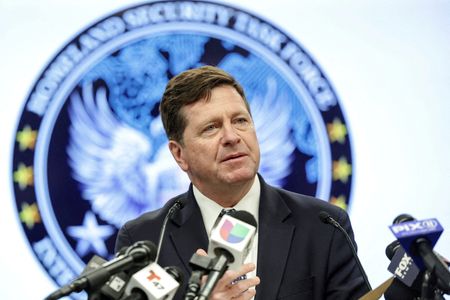

Senate Republicans are pressing for a rapid confirmation vote on Jay Clayton, President Trump’s choice to serve as Director of National Intelligence, but Democrats are holding off on any commitments until after his scheduled Senate Intelligence Committee hearing on Wednesday.
Trump put forward Clayton’s name less than a week ago, following a political storm over his selection of a close ally to temporarily fill the intelligence director role. That interim pick, Federal Housing Finance Agency director Bill Pulte, has no background in national security — a fact that drew concern even from some Republicans, who worried he could use access to classified information to go after Trump’s political opponents.
Clayton’s nomination was widely seen as a relief. While he doesn’t have deep national security credentials, he is generally well-regarded by members of both parties. He currently holds the position of U.S. attorney for the Southern District of New York, one of the most prestigious prosecutor roles in the country.
Democrats made clear Tuesday that they plan to press Clayton with tough questions, but stopped short of announcing whether they would support or oppose him before the hearing takes place.
Senator Ron Wyden of Oregon, a senior Democrat on the Intelligence Committee, told reporters: “I favor a full vetting… a thorough examination of all of the issues.”
Senate Democratic leader Chuck Schumer of New York said his caucus would determine its next steps only after the hearing concludes.
On the Republican side, Senate Majority Leader John Thune of South Dakota is urging Democrats to agree to bypass standard Senate procedures so a confirmation vote could happen as early as this week. At a Tuesday news conference, Thune described Clayton as “eminently qualified” and pointed out that his role as a U.S. attorney already puts him in contact with intelligence matters.
Clayton’s swift confirmation could also open the door for renewal of Section 702 of the Foreign Intelligence Surveillance Act — a law that permits law enforcement agencies to gather foreign intelligence, which can sometimes include information on American citizens, without needing a court order. Democrats had previously signaled they would block renewal of that law while Pulte remained in the acting DNI role.
“It needs to be fixed quickly, and I hope that the Democrats will work with us in order to make that happen,” Thune said.
Clayton’s office is currently overseeing the legal case against former Venezuelan President Nicolas Maduro, who was apprehended in a swift operation on January 3. That case could come up during Wednesday’s hearing.
Clayton may also face questions about a false claim he made on television shortly before his nomination, in which he suggested there may have been fraud in the vote count for the Los Angeles mayoral race. Election officials note that vote tallying in California often takes time because mail-in ballots can be postmarked by Election Day and still arrive up to seven days afterward.
Trump has echoed similar statements recently and has continued to repeat unverified claims that the 2020 presidential election was stolen — allegations that Democrats warn could signal an intent to interfere in future elections.
It remains uncertain whether Pulte will serve any time as interim intelligence director following the departure of Tulsi Gabbard, whose last day in the role is June 19. Gabbard, a former Democrat who also lacked deep intelligence experience, faced Democratic accusations that she used the position to further Trump’s efforts to retaliate against his critics and spread debunked claims about election fraud.
Senators are also expected to question Clayton about reported plans to dramatically reduce staffing at the DNI’s office — or potentially shut it down altogether. Trump had previously indicated he wanted Pulte to pursue significant cuts during his time as interim director.