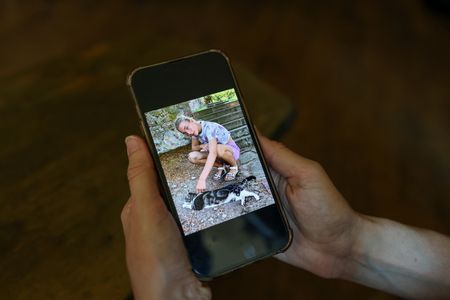

ASTI, Italy — In just a matter of months, Irene Roggero Ugues watched helplessly as her daughter Rossella’s personality shifted dramatically, driven by a relentless stream of self-harm content pushed to her through social media. The 12-year-old ultimately died by suicide.
It was only after Rossella’s death that her parents unlocked her devices and discovered the full extent of her online activity. She had been using social media far more than they had realized, including a secret Instagram account she had named ‘Just a dead pers0n’ — spelling the word ‘person’ with a zero in place of the letter o.
According to her parents, Rossella began seeking out depressive content in September 2023, content that reflected her inner emotional state. Social media algorithms continued feeding her more of the same material, and within five months, she was gone.
“At some point, it seemed to take on a life of its own, growing until it overwhelmed the cheerful, sociable side of her — the brighter part,” Irene told Reuters during a meeting at a café in her hometown of Asti, in northern Italy.
Rossella’s family is among several Italian families who have joined a lawsuit against Meta — the company that owns Instagram and Facebook — and its major competitor TikTok. It marks the first collective legal action in Italy to directly challenge social media companies and the algorithms that drive their platforms. The families are pushing for stricter limits on minors’ access to these platforms and greater public awareness of the dangers they pose.
Both companies have rejected the lawsuit’s claims that their services cause harm to young people. They say they actively work to protect younger users by removing dangerous content, reducing exposure to risky material, and offering tools to help parents oversee their children’s accounts.
“We know parents worry about the safety of their teens online, which is why we’re consistently making changes to help protect teens,” a Meta spokesperson said, pointing to the company’s “Teen Accounts” feature and other built-in protections. “We strongly disagree with these allegations, which ignore our longstanding commitment to supporting young people.”
TikTok, for its part, said it strictly enforces guidelines designed to protect users’ mental and behavioral health, and that it removes more than 99% of content found to violate those standards. “We also continue to invest in safety measures to diversify recommended content, block potentially harmful searches and connect vulnerable users with support resources,” a TikTok spokesperson said, also referencing local suicide prevention resources.
When asked specifically about Instagram’s possible role in Rossella’s case, Meta said it would not comment on the matter while litigation is ongoing, but noted that young people’s mental health is influenced by many different factors. The company said the impact of social media depends on how platforms are used, what safeguards exist, and how involved parents are.
Irene described the tragedy as unfolding like a sudden and devastating “illness” that left her and her husband with no power to stop it. She believes the algorithm accelerated everything. “The progression of her distress — or psychosis, or whatever it was that I still cannot define — might have unfolded more naturally” without it, she said.
This legal battle is taking place against a broader backdrop of growing scrutiny of social media platforms across Europe. Britain recently announced plans to ban social media use for children under 16. In the United States, a court ruling found Meta and Alphabet’s Google negligent in designing platforms considered harmful to young people. Meanwhile, European Union regulators are increasing enforcement of the Digital Services Act, pushing online platforms to do more to protect minors and limit harmful content.
“The goal is not to dismiss the benefits of social media, but to remove the technological and marketing mechanisms that make it harmful to the most vulnerable users,” said lawyer Stefano Commodo, who is leading the lawsuit alongside the Italian parents’ association MOIGE.
Many parents involved in the case say the safety tools offered by these platforms are inadequate, pointing out that children can easily find online tutorials explaining how to bypass filters or get around screen time limits by switching to a different device.
“Monitoring social media use is a full-time job. It would require parents to spend all their time doing it, and that is simply unrealistic,” said Valentina Muraglie, a board member of Italy’s association of large families.
Muraglie shared her own experience with her son Antonio, who as a teenager put down his Harry Potter book collection and replaced reading with scrolling through social media. Now in his twenties, he struggles to read at length — something she attributes to the way social media algorithms eroded his attention span. “Once he had a phone in his hand, at 16, little by little books started to disappear,” she said. “Within a few years he stopped reading altogether.”
The World Health Organization has warned that addiction-like social media behavior is on the rise among adolescents and is associated with reduced well-being, disrupted sleep, and other health risks. Research published in JAMA Pediatrics, a U.S. medical journal, has identified measurable differences in brain development among teenagers who are heavy social media users — a population whose brains are still in the process of developing.
The Italian lawsuit argues that social media platforms use reward systems modeled after slot machines to keep users hooked, repeatedly stimulating the release of dopamine — a brain chemical associated with pleasure and reward. “Each ‘like’ or notification triggers dopamine release, tying users to the platform in a way that resembles addiction,” said Tonino Cantelmi, an advisor to the plaintiffs and director of the School of Specialisation in Cognitive-Interpersonal Psychotherapy in Rome.
The families involved in the case say brain imaging studies of social media users show activity in regions of the brain linked to addictive behavior. Spokespeople for both Meta and TikTok declined to address the scientific evidence on addiction presented in court, reiterating their earlier statements about their companies’ commitment to mental health.
Some mental health professionals urge caution when drawing sweeping conclusions about social media’s effects on young people. Federico Tonioni, who leads the Web Psychopathology Centre at Rome’s Gemelli hospital, said, “The healthiest approach when dealing with adolescents is to accept that we are unprepared.” He added that he could not say with certainty that his patients would be better off in a world without social networks, and cautioned against putting too much emphasis on parental control. “If there is something dangerous, it is control over children. Young people need to be listened to. Control is not a healthy form of presence. The healthiest distance is trust,” he said.
Irene Roggero Ugues said she joined the lawsuit so that other parents can be warned about dangers she only learned of after it was too late for her daughter. “We underestimated certain risks and didn’t know they existed, but others can still act. There’s no point keeping this to myself, and I don’t think Rossella would mind,” she said.