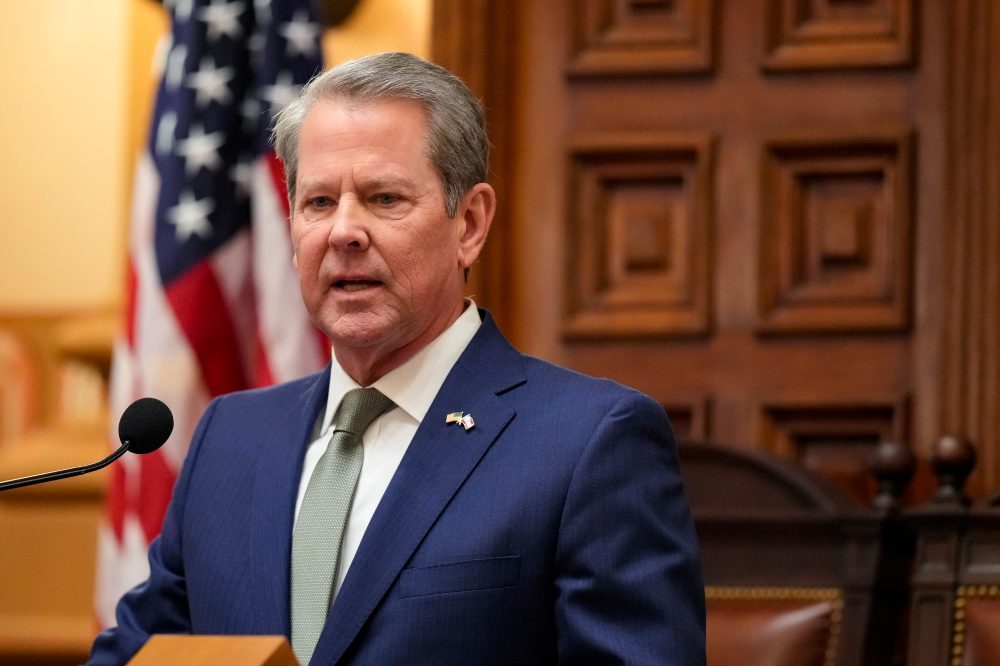

Georgia has become the next Southern state where Republicans are moving to reshape voting district boundaries in ways that critics say could weaken the political influence of Black and other minority voters — a push made possible after the U.S. Supreme Court dismantled key Voting Rights Act protections that had shaped existing district lines in racially diverse states.
The state’s General Assembly gathered Wednesday for a special session called by outgoing Gov. Brian Kemp, responding to the high court’s ruling in Louisiana v. Callais, which struck down Louisiana’s congressional district map as an unlawful racial gerrymander.
Kemp, wrapping up the final months of his second term, took a different approach than other governors who rushed to finalize new congressional maps ahead of the November midterms — partly in response to pressure from President Donald Trump to protect the Republican Party’s slim hold on Congress. Rather than targeting the upcoming elections, Kemp wants Georgia’s lawmakers to craft new district lines for the 2028 election cycle. However, he went further than his Southern counterparts by also asking the Republican-led Assembly to redraw its own legislative boundaries.
That step would make Georgia the first state in the nation to apply the Callais decision to its own legislature, highlighting the far-reaching consequences of the Supreme Court’s ruling across Southern states, which are home to the largest share of Black voters and Black elected officials in the country.
The issue carries particular weight in Georgia, where the state Capitol complex features a statue of the Rev. Martin Luther King Jr. and sits just blocks from where the slain civil rights leader lived, preached, and led the movement that ultimately produced the Voting Rights Act in 1965.
Despite the session’s start, neither Kemp nor Republican legislative leaders had released any proposed district changes as of late Tuesday evening, drawing sharp criticism from Democrats and activists who are planning daily protests throughout the proceedings.
“They have not been transparent,” said state Rep. Tanya Miller, a Black legislator from Atlanta who is the Democratic nominee for attorney general. “Something as fundamental as voters getting to choose their leaders ought not to be done in the dark, ought not happen in back rooms.”
When approached by The Associated Press, the governor declined to share specifics. “I’ll talk about redistricting on Wednesday,” Kemp said while campaigning for fellow Republicans ahead of Georgia’s primary runoff elections held Tuesday.
House Speaker Pro Tem Jan Jones, who has experience with previous redistricting cycles, described the final outcome as “a legislative prerogative” — a characterization confirmed by Kemp’s staff. But Jones acknowledged that even in her role as a senior Republican on the committee that would review new maps, she hasn’t “been in any room creating maps.” When asked directly who is actually drawing the new districts, she replied: “I don’t know.”
Before the Callais ruling, Section 2 of the Voting Rights Act was widely interpreted to require that district maps — for Congress, state legislatures, and local governing bodies — give historically marginalized minority communities a fair chance to elect candidates of their choosing. Across the country and in Georgia, these so-called “opportunity districts” have consistently produced Black and other nonwhite representatives at higher rates.
For context, roughly one-third of Georgia’s 180 state representatives are Black. When Latino, Asian, and other minority groups are included, nonwhite lawmakers make up about 40% of the chamber — a figure that closely mirrors the state’s overall population. Among Georgia’s 14 U.S. House seats, five have electorates that are majority or plurality nonwhite, and all five elected Black Democrats in 2024.
In the Callais decision, issued earlier this spring, a conservative majority on the Supreme Court concluded that drawing districts with racial composition in mind is discriminatory and violates the Constitution’s equal protection clause. The justices declared that redistricting must be conducted on a “race neutral” basis.
The court’s reasoning did not rest on partisan considerations, and federal courts have previously ruled that partisan gerrymandering is constitutionally allowed. But in Southern states in particular, party affiliation closely tracks with race and ethnicity. This reality has allowed Republicans — a party whose membership is predominantly white — to redraw maps in ways that scatter nonwhite voters, who tend to favor Democrats, across more districts in order to boost likely Republican outcomes.
Many civil rights advocates and legal scholars argue this makes it practically impossible for Southern legislatures to draw genuinely “race neutral” maps.
Emory University professor Carol Anderson drew a comparison between the Callais ruling and the redistricting push it has triggered to historical tools like poll taxes and literacy tests — measures used by white Southern conservatives and upheld by the Supreme Court during the Jim Crow era.
“They used racially neutral language for policies that were clearly racially targeted,” said Anderson, who also serves on the board of Fair Fight Action, an organization mobilizing opposition to the Georgia redistricting effort.
There is no guarantee, however, that Georgia Republicans will achieve their desired results through new maps. Partisan redistricting typically involves either packing certain voters into fewer districts or spreading them thinly across more. In the Atlanta metro area, dispersing nonwhite, Democratic-leaning voters could make more seats appear to favor Republicans — but it also risks creating more competitive battleground districts, since white suburban voters in the region are trending less conservative. That shift could give Democratic candidates of any background more opportunities to win.
That dynamic may be less of a concern in the Georgia state Senate, which is already viewed as gerrymandered to benefit Republicans, but it could factor more heavily into decisions about state House and U.S. House boundaries.
Kemp is effectively asking Republican lawmakers — particularly those representing metro Atlanta — to redraw their own districts and take on unfamiliar electoral terrain.
On the national level, the redistricting battle began last year when Trump pushed Republican-controlled states to redraw congressional boundaries to protect the GOP’s narrow House majority heading into November. Texas was the first to act. California’s governor and Democratic legislators responded with their own gerrymander, which voters later ratified, and a series of other states followed. The results might have been near even had the Virginia Supreme Court, which has a conservative majority, not struck down newly drawn Democratic maps that state voters had approved. In total, Republicans believe they could net as many as 16 seats through their redistricting efforts, while Democrats project gains of up to six seats from new maps in California and Utah.
Even so, those gains may not be enough for Republicans to hold their congressional majority, given the president’s declining approval ratings — though the effort could help limit Democratic gains and position the GOP favorably heading into 2028 and beyond.