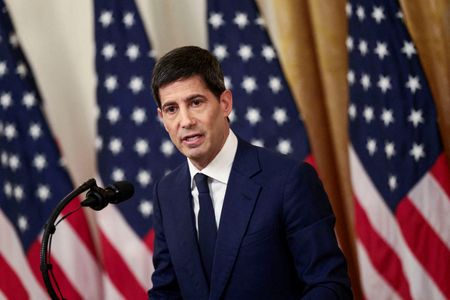

Kevin Warsh is concluding his first Federal Open Market Committee meeting Wednesday, with declining oil prices and a fragile peace deal providing a somewhat favorable environment for keeping interest rates unchanged — which is what traders are broadly anticipating.
All eyes will be on how Warsh casts his vote, what he says during his post-meeting press conference, and how he handles the challenge of explaining the economic outlook to markets.
Warsh has historically been skeptical of so-called “forward guidance” — the practice of signaling where interest rates are headed — and he may opt not to include a rate projection in the quarterly economic outlook that the U.S. central bank releases.
However, Warsh was selected by U.S. President Donald Trump with the expectation that he would lower rates. With inflation still running above target and the job market holding steady, markets are actually pricing in a rate increase. That means Warsh will face pointed questions on the topic, and the dollar has been drifting this week in anticipation of his remarks.
If Warsh fails to push back on current market pricing, investors could interpret that as a signal he leans hawkish. On the other hand, if he does push back, it could stoke concerns about inflation — making this a tricky tightrope to walk.
Adding another layer of complexity, Warsh will be operating in a boardroom where his predecessor, Jerome Powell, still holds a vote.
One possible model for navigating the situation came Tuesday from the Bank of Japan’s Deputy Governor Shinichi Uchida, who managed to keep policy options open without rattling financial markets. Uchida also had some assistance from Japan’s finance ministry, which has been signaling it could step in to support the yen if the currency weakens further.
Asian markets moved mostly flat on Wednesday, with investors largely waiting on Warsh’s announcement. Meanwhile, oil sellers also paused, holding out for confirmed details on a reported U.S.-Iran agreement.
Brent crude futures have dropped below $80 per barrel following reports that the U.S. is considering lifting sanctions on Iranian oil exports. Beyond the Fed decision Wednesday, Sweden’s Riksbank is widely expected to hold rates steady but may hint that an increase could come later this year.
In the United Kingdom, inflation is expected to edge up toward 3%, driven partly by higher energy costs. Final inflation readings across Europe are not anticipated to differ significantly from earlier estimates.
Key developments to watch Wednesday include rate decisions from both the U.S. and Sweden, British inflation data, and U.S. retail sales figures.