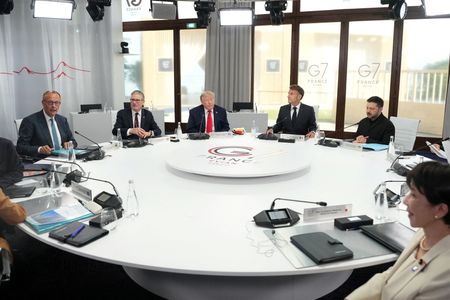

WASHINGTON — When the leaders of the world’s seven largest economies sit down in France on Wednesday to talk about the global economy, one major topic will be conspicuously absent from direct criticism: the role that President Donald Trump’s war with Iran has played in rattling global markets.
Oil prices have surged 30% and inflation is climbing worldwide — both largely tied to the conflict that the U.S. and Israel launched against Iran in late February. Yet G7 leaders, already strained by disputes over U.S. tariffs, NATO, and Greenland, are expected to hold back from publicly blaming Trump for the economic turbulence, according to analysts.
Over the weekend, the U.S. and Iran announced a deal to halt the fighting and reopen the Strait of Hormuz, which gave global markets a much-needed boost. But economists caution that the damage is already done — energy costs have spiked, food supply concerns are mounting in developing nations, and central banks have been forced to act. Both the European Central Bank and the Bank of Japan raised interest rates within the past week in an effort to contain worsening inflation.
British Prime Minister Keir Starmer has publicly said he is “fed up” with how the conflict has driven up energy costs for his country. Italian Prime Minister Giorgia Meloni has warned of the war’s broader economic and social consequences. Rising prices have also taken a toll politically, denting approval ratings for Starmer, German Chancellor Friedrich Merz, and French President Emmanuel Macron.
Despite all of this, world leaders appear set to avoid a direct confrontation with Trump at the summit, largely because they still need his cooperation on critical issues including Ukraine, NATO, and trade negotiations.
Analysts say this reluctance is undermining the very purpose of the G7, which was founded after the 1973 oil shock specifically to help the world’s major economies navigate exactly these kinds of crises.
“U.S. policymaking has been hurting world economic activity,” said Marcelo Estevao, chief economist at the Institute of International Finance. “You have a country with the largest economy undermining what could have been a G7 agenda of collaboration,” he added, noting that the G7 must work harder to stay relevant as emerging market economies — which are not part of the group — now make up a growing share of the global economy.
France, serving as this year’s G7 host, has already moved to reduce the chances of open conflict by scrapping plans for a broad final statement, or communique. Instead, the focus will be on narrower topics such as global economic imbalances, critical mineral supply chains, and restructuring development aid programs.
The ceasefire deal reached just before Trump departed for France has further reduced the likelihood of a dramatic showdown. Still, economists warn that even with the deal in place, restoring normal trade flows could take months, and experts in the fuel and maritime sectors say bunker fuel supplies could take up to a year to normalize.
International Monetary Fund chief Kristalina Georgieva, attending the G7 summit in France, took a somewhat more optimistic tone in a blog post Monday, walking back some of the dire warnings she issued two months ago. She said the global economy was holding up so far, with no clear signs of a worldwide slowdown, even as some regions have been hit hard.
The IMF, whose largest shareholder is the United States, is set to release an updated global economic forecast on July 8. Georgieva’s post came shortly after a more pessimistic outlook from the World Bank. One of the IMF’s scenarios, based on a short-lived conflict, projects global growth of 3.1% in 2026, down from 3.4% in 2025. Its worst-case scenario shows growth dropping to just 2%, with inflation reaching 5.8%.
U.S. officials have pointed out that oil prices have come down from their peak and that the United States, as a fuel exporter, was somewhat insulated from the worst price increases. They argue the war’s economic impact will ease quickly once the Strait of Hormuz fully reopens, and believe even fuel-importing nations in Europe are likely to avoid severe shortages.
The G7 — made up of the major European economies along with the U.S., Canada, and Japan — has been grappling with questions about its relevance for years as economies like India, Brazil, and China have grown in global influence. The group now represents just 44.1% of global GDP, a sharp drop from 60.5% when it was first established, according to the Center for Strategic and International Studies.
Supporters of the group argue it still serves a vital function during moments of crisis, pointing to its response during the 2008-2009 global financial meltdown.
“The G7 has always been able, if needed, to come up with some real decisions that still govern half the world economy,” said Martin Muehleisen, a former IMF strategy chief who has participated in past summits, including some that included Trump. He noted that while European leaders would likely stay cautious in formal settings, unexpected moments of tension could still emerge during private meetings and dinners.
Eric LeCompte, executive director of Jubilee USA Network, a development organization, said economic concerns remain front and center regardless of the ceasefire. “The economy is in deep turmoil and you don’t have to be in a developing country to see it. You can just go to a grocery store and feel it,” he said.