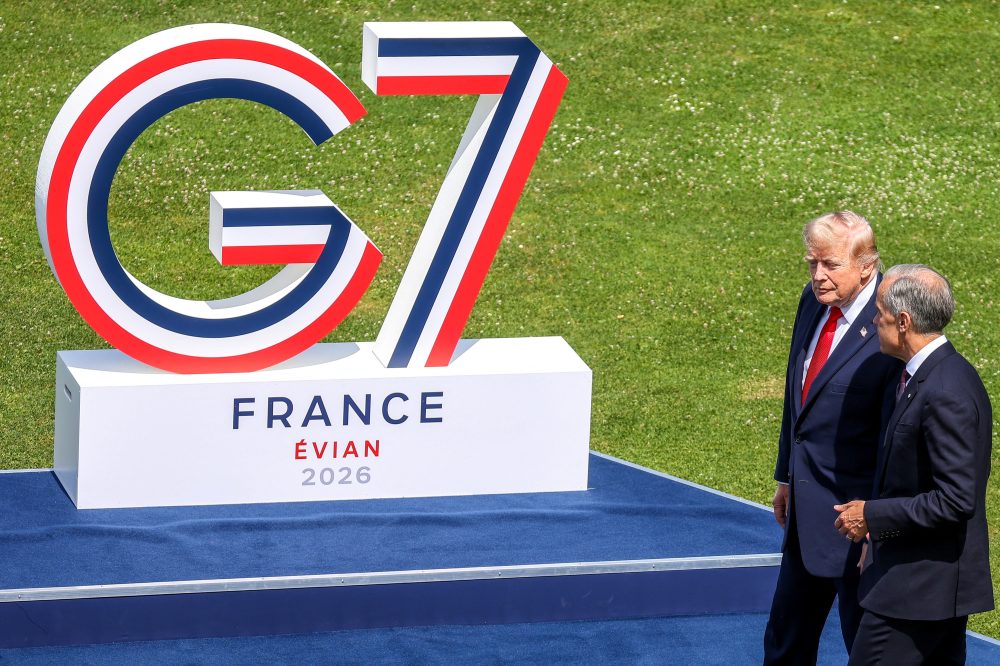

EVIAN-LES-BAINS, France — Canadian Prime Minister Mark Carney is heading home from the G7 summit this Wednesday without a formal bilateral sit-down with U.S. President Donald Trump, even as the future of a major free trade agreement between the two countries hangs in the balance.
While it has long been customary for Canadian leaders to hold one-on-one meetings with U.S. presidents at gatherings of the world’s top industrialized democracies, Carney pushed back on any interpretation that the absence of such a meeting was a diplomatic slight.
“I wouldn’t take a big message from that,” Carney said. “I had seven or eight discussions with President Trump over the course of last 36 hours. I’ll have more today, a wide range of subjects from the economy, relations, his birthday, artificial intelligence, Ukraine, obviously Iran.”
The timing is significant. The North American free trade pact — which has linked the economies of Canada, the United States, and Mexico since the early 1990s — is due for renewal on July 1. Trump indicated last week that he may choose not to renew the agreement, raising alarms for Canada, which sends roughly 75% of its exports to the American market.
On the trade negotiation front, Canada’s minister responsible for U.S. trade, Dominic LeBlanc, along with Canada’s chief negotiator Janice Charette, held talks at the summit with U.S. Trade Ambassador Jamieson Greer. LeBlanc reported that the discussions moved forward productively. He has previously expressed concern that the Trump administration may push for annual reviews of the trade deal, deliberately keeping its long-term status uncertain.
Among the G7 leaders, French President Emmanuel Macron — who is hosting the summit — was the only one to secure a formal bilateral session with Trump. Trump also held separate one-on-one meetings with leaders from Qatar, the United Arab Emirates, Egypt, and India, none of which are G7 members. Carney acknowledged that the host nation traditionally meets individually with the U.S. president.
Despite the absence of a formal meeting, Carney found moments to connect with Trump on trade issues, sometimes using humor. At one point, a microphone picked up the two leaders joking about stealing Macron’s watch. The conversation then shifted to a more serious topic — Chinese electric vehicles entering the Canadian market.
A recording captured Carney explaining to Trump that Canada had capped Chinese electric vehicle imports at fewer than 49,000 cars, representing less than 3% of Canada’s market, following a deal struck with Beijing.
“It’s a cap, we capped, a hard line,” Carney told Trump. “I thought you’d actually like that.”
“That’s good, I like it,” Trump replied.
Earlier this year, Canada broke from the U.S. approach by agreeing to reduce its 100% tariff on Chinese electric vehicles in exchange for lower Chinese tariffs on Canadian agricultural products. Carney said he raised the subject with Trump on two separate occasions during the summit.
“I’m not surprised that the president of the United States doesn’t follow every detail of every agreement that Canada has, and he likes the structure. Actually, we had a follow-up conversation about it as well,” Carney said.
Peter Boehm, a Canadian senator who has overseen multiple G7 summits on Canada’s behalf, said Carney likely had ample opportunity for meaningful exchanges with Trump throughout the event.
“I wouldn’t see it as a snub,” Boehm said. “It’s amazing how much time leaders can actually have to have conversations.”