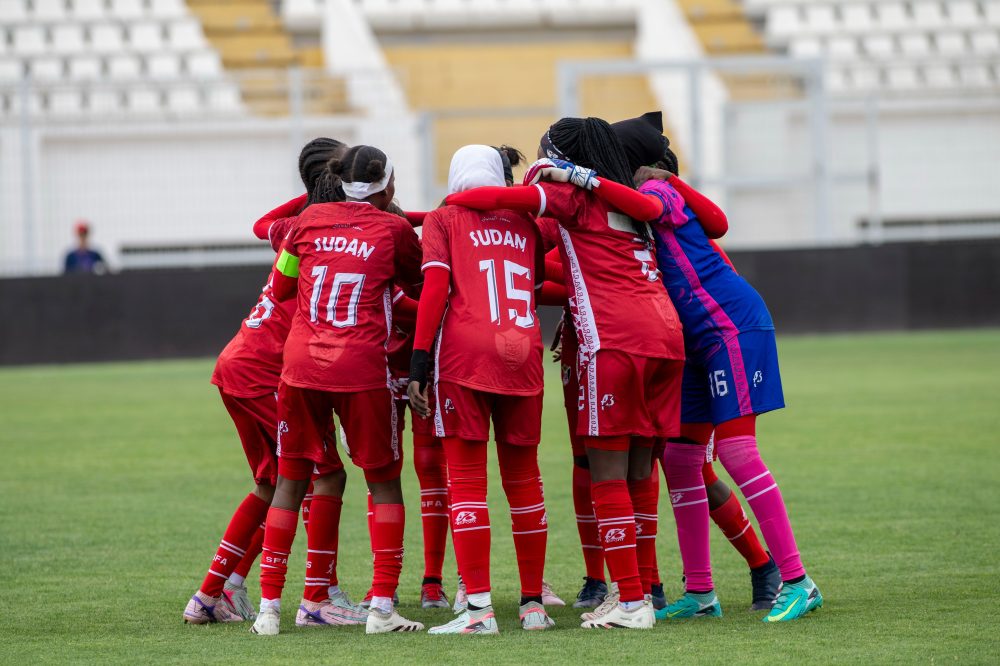

CASABLANCA, Morocco — Their bright red jerseys contrasted sharply against the green grass. Most of the players were teenage girls. Some had escaped a raging civil war. Others had never competed in an organized soccer league or stepped inside a major stadium before this moment.
But when they walked onto the pitch at Larbi Zaouli Stadium in Casablanca, Morocco, they made history — Sudan’s first appearance in international women’s soccer since civil war tore the country apart, in a nation where women playing sports has long been a deeply contested issue.
“My goal is to lift up soccer in my country,” said Nura Mohamed, the team’s 17-year-old captain, speaking to the Associated Press. “It’s a beautiful, unique feeling because, at the end of the day, I just love playing.”
Sudan’s under-17 women’s national team traveled to Morocco last week to compete in qualifying rounds for the 2028 Los Angeles Olympics. The inexperienced squad was overwhelmed by Comoros, giving up 30 goals across two matches. After the final whistle, with only a handful of fans cheering from the stands, many of the players wept.
They were up against an older, more physically developed, and far more experienced opponent. Sudan’s soccer federation, unable to field a senior women’s team in time, chose to enter the younger squad rather than forfeit their spot in the competition. The girls had only begun training a few weeks before the tournament.
“The difference between us and the others is huge. We cannot yet compete at the highest level,” said Burhan Tia, a veteran Sudanese soccer coach who oversees all of Sudan’s women’s national teams, speaking after the first match — a 17-0 loss. “Comoros has many players competing in Europe, our team is mainly made up of schoolgirls.”
Women’s soccer in Sudan effectively collapsed when the civil war broke out in 2023. For federation officials, getting this young team onto an international stage after years of conflict represents a meaningful step toward keeping the women’s game alive in the country.
“Some traveled long distances just to attend training. Many are separated from their families, yet they continue to work hard and pursue their dream,” said Manal Ali Bushra, a businesswoman who leads the women’s soccer committee, in comments to the AP.
Ali Bushra said the federation is pursuing infrastructure improvements, including a planned sports city and the renovation of key stadiums in more stable regions of the country. She declined to discuss the women’s program’s budget or financial backing.
Coach Tia understood the scale of the challenge when he agreed to take on the task of rebuilding a program that had fallen apart.
“First, I had to find girls who played soccer. Then, once I found girls who played, I had to make sure they were the right age,” he said. “Then I needed to convince their parents to let them miss classes for training.”
With the domestic league shut down, Tia’s search for players took him to schools throughout Sudan and to neighboring Egypt, where many Sudanese families had taken refuge from the fighting. He brought in 10 players from clubs and academies in Cairo, with the remainder coming from cities inside Sudan.
He had hoped to recruit from conflict-affected regions like Darfur or Kordofan — an area historically known for producing some of Sudan’s finest athletes — but many girls there had lost their identification documents, making it impossible to verify their ages under international soccer rules. The war has also devastated transportation infrastructure, turning trips that once took a few hours into dangerous journeys spanning several days.
On the field, the players’ limited experience showed. Several had difficulty with basic positioning, struggling to hold an offside line or maintain any tactical structure. Throughout the matches, they frequently looked to the sidelines for guidance from Tia and his assistant coach.
The United Nations has called the war in Sudan the world’s worst humanitarian crisis. The conflict began in 2023 when a power struggle between the military and the paramilitary Rapid Support Forces exploded into open warfare, bringing with it mass killings, rape, and ethnic violence. The U.N. reports more than 40,000 people have died, and over 14 million have been displaced, with famine and disease spreading across parts of the country.
The war brought all sports activity to a halt, including the women’s soccer league, which was formally established following the 2019 revolution that removed President Omar al-Bashir from power. His three decades of Islamist rule were defined by Public Order Laws that rights organizations said severely restricted women’s freedoms. Even after his removal, a prominent Sudanese religious figure publicly claimed the creation of a women’s football league was an attack on religion.
“The idea of women running, jumping, sweating, and even something as simple as their bodies being visible in motion, was seen by Bashir’s Islamist regime as producing fitna, which in a Sudanese context was understood as sexual or moral chaos,” said Liv Tønnessen, a political scientist who researches gender politics in Sudan, in comments to the AP.
“So when women step onto a soccer pitch, they are directly confronting that entire logic. They are not just present in a male-dominated sports arena, they are moving freely in it, on their own terms,” added Tønnessen, who previously served as a guest researcher at a women-only university in Sudan.
Beyond the institutional obstacles, players also faced a flood of sexist harassment online. Comment sections on the national team’s social media pages were filled with people mocking the squad over their lopsided losses. Others posted messages telling the players to “go back to the kitchen” — in multiple languages.
While Gen. Abdel Fattah al-Burhan’s military government has permitted international soccer travel for the teenage players, the U.N. has documented sexual and gender-based violence carried out by the Sudanese Armed Forces, which he commands.
Tønnessen views the government’s support for the team as a strategic move by the military to appear legitimate. By backing the squad, she argues, the military is trying to signal that the country is functioning normally and to associate itself with the spirit of the 2019 revolution.
Hala Al-Karib, a prominent Sudanese women’s rights activist, pushed back against critics who argue the team is simply being used to project a more progressive image on women’s rights.
“The main challenge for me is a reform of the federation,” she told the AP, pointing to what she described as a lack of real investment in and support for women’s soccer in Sudan.
But back on the pitch in Casablanca, the politics, the war, and the debate all seemed to fade into the background — leaving nothing but a group of teenagers chasing a ball.