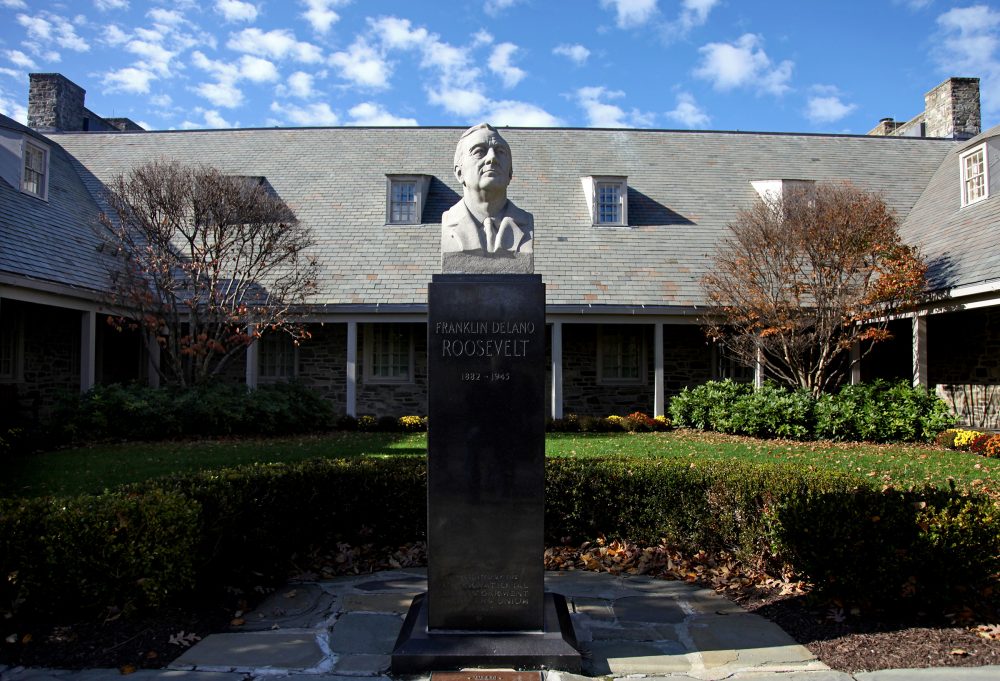

When historian Geoffrey Ward visits the Franklin D. Roosevelt Presidential Library and Museum for research, he says he gets swept up in the atmosphere of FDR himself — a sense of comfortable, cheerful clutter that shaped how Roosevelt presented himself to the world.
“It feels like you’re stepping back into his world,” Ward said of the Hyde Park, New York property that was once the Roosevelt family home. “The library and home collections reflect all his many interests — stamps, coins, birds he shot and had stuffed as a boy, model ships, children’s books, books about naval history, the pony-drawn sleigh he rode in as a child, and on and on.”
Since Roosevelt helped establish the modern presidential library system in the late 1930s, a nationwide network of museums and research centers has taken shape. These sites are overseen in part by the National Archives and Records Administration, known as NARA, but each carries its own distinct character. They range from the scenic Ronald Reagan Presidential Library and Museum in California’s Simi Valley to the small-town Herbert Hoover Library and Museum in West Branch, Iowa, to the sprawling Obama Presidential Center, which opens its doors to the public on June 19 — Juneteenth — in Chicago.
Historian Douglas Brinkley, who says he has made a point of visiting every post-FDR presidential library, describes them as essential gathering places for lectures, research, school groups, and visitors from around the country.
“Each of the libraries have their own aura,” Brinkley said. “Roosevelt came up with a perfect idea by gifting his home in Hyde Park to the people of America, instead of having his papers stored in a warehouse in Virginia or Maryland. He started a tradition of having them go where the president lived.”
Each library reflects the personality and legacy of the president it honors. Brinkley and other historians point out that while the archival side of these libraries is managed by NARA, the museum portions are funded by private donors who may prefer to highlight a president’s achievements and downplay his shortcomings.
For example, the Hoover library’s website includes a page about the Great Depression that emphasizes how some of the policies later associated with Roosevelt — who defeated Hoover in a landslide — were originally proposed by Hoover. The Richard Nixon library, meanwhile, was the center of a prolonged dispute between museum administrators and the former president and his allies over everything from control of his records to how prominently the Watergate scandal, which led to Nixon’s resignation, should be featured.
Max Boot, who authored a 2024 biography of Reagan, drew a distinction between his experience using the Reagan archives versus visiting the museum itself. He said the late president’s official records were “administered by federal employees in an entirely professional and apolitical fashion. There is no attempt to hide anything.” The museum, however, “naturally focuses on Reagan’s achievements and shortchanges his failures.”
“It’s designed to present a positive portrait. Thus, volumes critical of Reagan are not sold in the library bookstore,” Boot said.
Historian Ted Widmer, who previously served as a speechwriter for President Bill Clinton, acknowledged that presidential libraries will inevitably put the best face on a presidency, but said there has been some movement toward greater openness in recent years.
He singled out the Lyndon Johnson library in Austin, Texas, for being willing to confront LBJ’s widely criticized decisions during the Vietnam War. In 2023, the library drew renewed attention to one of Johnson’s most controversial moments — his 1948 Senate campaign, now broadly believed to have involved election fraud — by posting recordings on its website of interviews conducted by Associated Press reporter James W. Mangan with a former Texas election judge who admitted to certifying fraudulent votes that helped Johnson win.
“It is hard to know if future libraries will continue that trend, in an era in which history is increasingly politicized and polarized,” Widmer said. “But it’s healthy for our democracy to encourage the study of history as it really happened — not a sanitized version.”
The Obama Presidential Center has faced its own share of criticism, both for its scale and its appearance. Writing in The Guardian, critic Oliver Wainwright described it this way: “The building has an ominous presence, its mostly windowless heft recalling a menacing sci-fi headquarters.” The center has also drawn scrutiny for the decision not to include a NARA facility on the grounds. A large portion of the former president’s records exist in digital form, a shift that historian Brinkley expects will only grow more common with future presidential libraries.
Up to one million visitors per year are expected at the center’s 20-acre campus. Highlights include a public library branch, a basketball court built to NBA standards, a fruit and vegetable garden, and a playground. Former President Barack Obama tested out one of the site’s tall metal slides during a visit in May.
“That was fantastic,” he said after sliding down, according to a video shared on the Obama Foundation’s social media. “I was a little tall for it.”
Obama was personally involved in shaping many of the center’s details, from the textured stonework on the museum’s 225-foot tower to a pair of high-backed reading chairs inside the library. One of his favorite features, though, is a set of charcoal grills that will be available for anyone to use. He first floated the idea at a community meeting in 2017, drawing warm laughter from the crowd.
“We don’t have any folks who grill here?” Obama said at the time. “I thought this was the South Side of Chicago.”