
BUCHAREST, Romania — A striking new exhibition now open in Romania’s capital city is pulling back the curtain on the terrifying methods used by the country’s communist-era secret police — and it’s doing so using the secret police’s own recordings.
On display at the National History Museum of Romania in Bucharest, the exhibition is titled “A.REST 1989: The Securitate Video Archive.” It draws on actual video footage to show how arrests and interrogations were conducted under the Securitate — the vast surveillance and enforcement network that kept Nicolae Ceausescu in power until he was toppled and executed in December 1989.
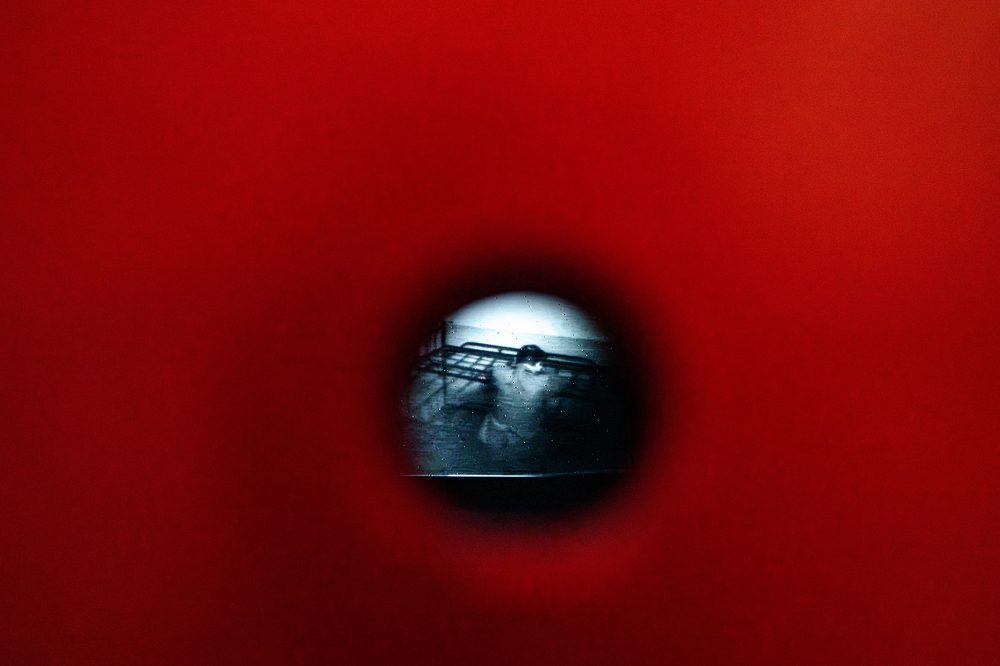
Visitors can watch original, grainy videotaped interrogations of four detainees, shown on wall-mounted monitors in the museum’s main hall. All of the recordings were made in 1989 by the Securitate’s Criminal Investigations Directorate.
At the center of the exhibition floor sits a reconstructed detention cell, outfitted with a small bed, a bare metal bowl, and a cup — a stark reminder of the isolation prisoners endured. The display also illustrates the sweeping reach of the Securitate and the methods its agents employed against those they investigated.
Many of the recordings capture coercive questioning and intimidation that sometimes veers into the absurd, as detainees are worn down or left confused. In one exchange, a woman whose husband had allegedly fled the country tells her interrogator: “I no longer have the strength to fight. I need logical arguments, not this nonsense.”
The exhibition’s organizers describe the Securitate’s version of justice as a system in which detainees “were merely prisoners, captives in the operational labyrinth of manufactured guilt.” They say the exhibition can serve as a long-overdue “memorial plaque” for victims, noting that “the victims, thus, gain a voice and a place.”
The show runs through mid-September and was organized as a joint effort between the National History Museum, Romania’s National Council for Studying the Securitate Archives — known as CNSAS — and the Ministry of Culture.
According to organizers, the 26 videotapes held by CNSAS are “a remnant, the accidental result of the disorderly and violent end” of socialist Romania, captured by the criminal investigations technical department in 1989.
Oana Demetriade, a historian at CNSAS and one of the exhibition’s curators, told the Associated Press that she originally envisioned using the tapes for a documentary aimed at students, but ultimately chose to create a museum exhibition instead.
“The project grew organically through the discussions I had with architects and designers,” she explained. “From the very beginning, the first discussions I had with my husband who works at CNSAS and everything I found in these tapes made me go ‘wow!’ … They were being watched in cells non-stop.”
She added: “That’s what this whole archive brings new. How it gets here and how people, those who are arrested, in the end, are repeatedly threatened, yelled at, threatened with beatings, threatened with the family suffering, and so on.”
Among the physical artifacts on display is a printing press that once belonged to journalist Petre Mihai Bacanu, seized by the secret police in early 1989. Bacanu and a group of associates had used the press to produce an underground newspaper critical of Ceausescu and his government.
In footage from a February 1989 interrogation, Bacanu is heard asking: “How could we, after 45 years of socialism, still be afraid of people’s opinions, even of their thoughts?”
Another item on display is a pair of specially designed glasses used to prevent detainees from “seeing where they were going or identifying” other individuals.
Mihai Demetriade, also a CNSAS historian and co-curator of the exhibition alongside his wife, explained that the detention facility featured two distinct types of holding areas. “Preventative detention” was used in political cases involving alleged crimes against the state, while “operational detention” units functioned more like kidnapping — locking up potential dissidents during sensitive occasions such as a government congress or a foreign dignitary’s visit.
“We are not talking about the testimonies of victims after the fall of communism, nor about documents, nor about books, nor about manuscripts,” he said. “We have something not open to manipulation … a live recording of events that occur in interrogation rooms or cells. It’s hard to fight against something like that as a denialist.”
He went on to say: “This space is important because it proves how rapacious, tough, aggressive the communist dictatorship remained even in the last moments of the communist system.”
The exhibition arrives at a notable moment. In recent years, a wave of nostalgia for life under communism during the Ceausescu era has grown in Romania, particularly among younger generations who have little or no personal memory of the country before 1989 — even as nationalism has simultaneously been on the rise.
Cornel Constantin Ilie, the manager of the National History Museum of Romania, says the exhibition has the potential to reveal the truth about that chapter of history and “reach the minds and, why not, the souls” of those who walk through it.
“It is an exhibition that puts you in front of facts that cannot be ignored,” he said. “It’s very important because we must not forget and we must not repeat. … What we see in this exhibition is an ugly face of history, it is a story in which human freedom, human dignity were suppressed.”