
BOGOTA, Colombia — Just a few years ago, Latin America appeared to be shifting decisively to the left. Progressive leaders, capitalizing on widespread anger over deep-rooted inequality made worse by the COVID-19 pandemic, rose to power in several of the region’s largest nations, including Brazil, Chile, Colombia, and Peru.
But the political winds are shifting again. While overall homicide rates across Latin America have generally fallen compared to a decade ago, sharp increases in violence in certain countries — combined with a broader regional rise in crimes like extortion — have given conservative populists fertile ground to campaign on promises of iron-fisted crackdowns on crime and immigration.
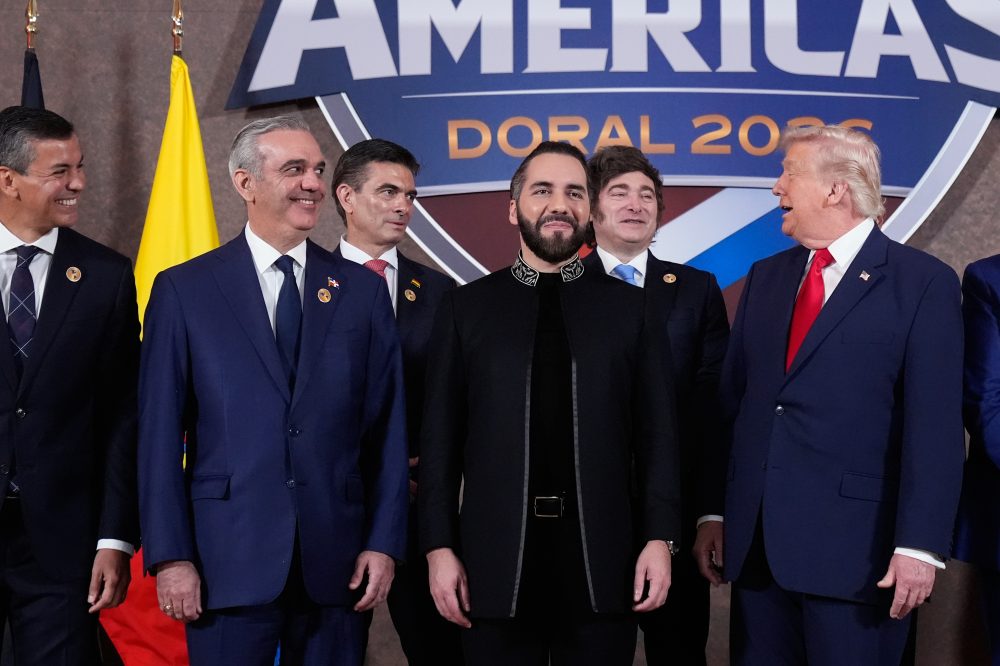
Campaign rhetoric portraying migrants as criminals and embracing the aggressive security tactics championed by El Salvador’s president, Nayib Bukele, has earned conservative candidates the endorsement of U.S. President Donald Trump and energized frustrated voters — even as critics raise alarms about the potential for human rights abuses and democratic backsliding.
“You have an emergent right wing that is very much in collaboration across the region and with the U.S. through the MAGA movement, which has also used crime as a rallying cry for political mobilization,” said Enrique Roig, vice president of the nonprofit Human Rights First and a former State Department official. “It’s easier to sell locking people up than it is to deal with the reasons why mainly young men join gangs in countries like El Salvador.”
Populist politicians across the political spectrum have found success, but only those on the right have offered quick security fixes that make voters “feel safer in six months” — even if that means having to “sacrifice democracy and human rights,” according to Adam Isacson, director for defense oversight at the Washington Office on Latin America organization.
He noted that left-wing proposals — such as community violence prevention programs, improved police training, and reforms to the justice system and prisons — require much more time before results are visible.
“It’s absolutely what you’re supposed to be doing, but people’s patience runs out,” Isacson said of those longer-term strategies. “So, there come the Bukeles of the world saying, ‘You want to feel better? We got this.’”
In Colombia, where large portions of the countryside have descended into renewed conflict, pro-Trump businessman Abelardo de la Espriella has led polls ahead of a presidential runoff election while closely mirroring Bukele’s approach.
In Peru, where extortion has jumped fivefold over the past five years, Keiko Fujimori surged into a June 7 presidential runoff on a law-and-order platform. She has pledged to station military forces in prisons and along the country’s borders, leaning on the authoritarian legacy of her late, disgraced father, former President Alberto Fujimori.
Costa Rica, shaken by record levels of drug-related killings, chose conservative populist Laura Fernández in February based on her hard-line stance on crime. In Honduras, businessman Nasry Asfura swept December’s election after Trump endorsed him as a partner in the battle against what Trump called “narco-communists.”
According to InSight Crime, a think tank focused on organized crime in the Americas, the combined average homicide rate across Latin America and the Caribbean dropped by more than 5% last year compared to 2024, with the median rate reaching approximately 17.6 deaths per 100,000 people.
However, notable exceptions exist. Drug-fueled killings have climbed in Peru and Colombia — the world’s two largest cocaine producers — as well as in neighboring Ecuador, whose major seaports are prized by traffickers as a gateway to European markets.
Last year, authorities recorded 2,400 homicides in Peru and 14,780 in Colombia — the highest totals in each country since at least 2020. In Ecuador, killings surged a striking 31% year over year, reaching 9,216.
Much of Ecuador’s violence is attributed to gangs that began expanding rapidly during the COVID-19 pandemic, as criminal organizations from Mexico, Colombia, and the Balkans moved in and recruited local members, igniting deadly battles over drug-trafficking corridors. Those conflicts have extended into prisons, where hundreds of inmates have been killed since 2021. Ecuadorian authorities also logged more than 16,100 extortion cases last year, down from 23,000 in 2024 — though experts caution that extortion is widely underreported.
In Chile, voters four years ago rejected ultra-conservative lawmaker José Antonio Kast in favor of then-candidate Gabriel Boric, a young former student protest leader who promised to tackle Chile’s deep social inequities. Last year, however, growing fears about rising crime — frequently linked in media coverage to the country’s expanding Venezuelan immigrant population — helped Kast mount a political comeback.
As Venezuelan criminal networks, including the Tren de Aragua gang, exploited their country’s mass migration to infiltrate human trafficking operations following the pandemic, Chile — long among the safest nations in Latin America — experienced an unprecedented wave of carjackings, kidnappings, and shootings.
Chile’s homicide rate climbed 30%, peaking at 6.7 per 100,000 people between 2021 and 2022, according to the country’s Interior Ministry. Though it has since declined, it remains above pre-2021 levels. Other violent crimes continue to rise — kidnappings, for example, have increased nearly 180% over the past four years.
Taking cues from Bukele — whose mega-prisons in El Salvador Kast visited during his campaign — Kast decisively defeated his Communist opponent in December by pledging to construct a massive border wall, harden prison conditions for gang members, and deport hundreds of thousands of undocumented migrants. Voters largely overlooked his opposition to abortion rights and same-sex marriage, as well as his defense of the late dictator Augusto Pinochet’s brutal regime.
In Peru, despite the divisive legacy of the convicted Alberto Fujimori, his daughter has capitalized on a surge in violent crime that occurred in the four years since she narrowly lost the presidency to schoolteacher Pedro Castillo. Running under the slogan “Peru with Order,” Keiko Fujimori captured the largest share of votes in April’s first round. Results from the June 7 runoff still show her in a statistical tie with nationalist Roberto Sánchez, the political successor of the imprisoned Castillo.
Analysts say that public appetite for tough measures — historically tied to the region’s brutal right-wing dictatorships of the 20th century — has grown in step with declining trust in government institutions and increasing ambivalence about democracy itself.
“The thinking is often, ‘democracy hasn’t been able to keep me and my family safe, so maybe democracy is part of the problem,’” said Eduardo Moncada, director of the Institute of Latin American Studies at Columbia University.
That sentiment presents a serious challenge for Latin America’s left, which in many countries has overseen sluggish economic growth, become entangled in corruption scandals, and fallen short on promises of social reform.
Even progressive politicians — such as Jeannette Jara in Chile and Sánchez in Peru — have adjusted to the shifting political climate. Uruguay’s president, Yamandú Orsi, described Bukele’s model as worth studying further. The center-left government of Guatemala declared a state of emergency to combat gang violence this year and welcomed assistance from the Trump administration in targeting drug traffickers.
Yet newly elected hard-liners have found that the realities of governing complex, cash-strapped democracies like Ecuador and Chile are far removed from the simplicity of campaign promises. These nations bear little resemblance to tiny El Salvador, where Bukele’s party commands a legislative supermajority.
Ecuador’s President Daniel Noboa campaigned in 2023 on promises to imprison gang leaders on floating barges and construct mega-prisons. He dropped the barge proposal after taking office, and his government didn’t open its first mega-prison until November.
“Building mega-prisons hasn’t been that easy or that straightforward because the country is in a very bad state financially and because President Daniel Noboa still sees himself as a democrat,” said Beatriz García Nice, a policy analyst at the Washington-based Stimson Center think tank.
Nearly three months into his time in office, Chilean President Kast is facing a skeptical public that says it cannot distinguish his security policies from those of his left-wing predecessor. His government has carried out only two deportation flights despite pledging to swiftly round up and remove Chile’s more than 300,000 undocumented immigrants. His public tone has noticeably softened, and last month he drew criticism after referring to his mass deportation promise as “a metaphor.”
Even as he unveiled new security proposals in a June 1 address — including stripping those convicted of attacking police officers of social benefits — he moved to temper his supporters’ expectations.
“Governing, as many of you know, means taking responsibility for reality, especially when it’s difficult,” he said. “I’m proceeding step by step because this isn’t something that happens overnight.”