Motorists traveling on Route 1 should expect intermittent traffic delays near the intersection with Broadkill Road (Route 16) due to active construction work in the area.
Delaware Department of Transportation officials report that flagging operations are currently in place to manage traffic flow through the construction zone. The traffic control measures are expected to remain in effect until 3 PM today.
Drivers are advised to allow extra travel time when passing through this section of Coastal Highway and to exercise caution in the work zone for the safety of construction crews and other motorists.
American Airlines announced Tuesday it will increase baggage fees for domestic and short-distance international flights as jet fuel costs continue to climb dramatically due to Middle East tensions affecting global oil supplies.
The Dallas-based carrier becomes among the final major U.S. airlines to implement cost-protection measures as operational expenses mount from elevated fuel prices. The disruptions stem from Middle East conflicts that have impacted shipping routes through the Strait of Hormuz, a critical waterway handling approximately 20 percent of worldwide oil transportation.
Aviation fuel costs have skyrocketed from roughly $85-$90 per barrel in February to approximately $209 per barrel currently, data from the International Air Transport Association shows.
Beginning Thursday, American will implement a $10 increase for both first and second checked bags on domestic routes and short-haul international destinations. The carrier also announced a $50 hike for third checked bags, bringing that fee to $200, though this pricing already existed for certain markets including Canada.
Starting May 18, passengers flying basic economy will face an additional $5 charge for checked luggage. These travelers will also lose access to complimentary seat selection and automatic system-wide flight upgrades.
Customers purchasing premium cabin tickets will maintain free baggage allowances on both domestic and international routes, the airline noted.
BLACKSBURG—Agricultural producers and landowners throughout Virginia now have access to financial incentives this spring season for adopting conservation methods that enhance soil quality, improve pasture output, and build long-term agricultural sustainability. Statewide registration has begun for the Alliance to Advance Climate-Smart Agriculture, which provides landowners with compensation of either $100 or $300 per acre when they implement qualifying agricultural techniques.
This Alliance represents a program backed by the U.S. Department of Agriculture Advancing Markets for Producers initiative and managed by Virginia Tech, providing monetary rewards to farmers who adopt climate-conscious practices on active farmland through two distinct offerings.
“The General Program is a good fit if you want flexibility,” said Jamie Lucero, Alliance project director at the College of Agriculture and Life Sciences.
Under this program structure, property owners can register as many as 120 acres using a single practice—either nutrient management, grazing management, or pasture and hay planting—while receiving $100 for each acre enrolled.
“The Pasture Renovation Subpilot is a better fit if you are able to implement all three practices within one year,” she added.
This alternative provides enhanced compensation at $300 per acre while mandating the completion of all three practices and limiting enrollment to a maximum of 50 acres.
Registration remains available until April 30, with participant selection occurring on May 1. Operating with an anticipated $5.6 million funding allocation, the Alliance projects receiving approximately 700 applications while targeting the enrollment of 500 to 600 agricultural producers statewide in Virginia.
“Spots are limited,” Lucero continued. “With a limited budget and strong interest expected, producers are encouraged to apply early.”
Virginia Tech distributes payments directly to participants, and enrolled producers contribute to developing a nationwide framework for climate-conscious agriculture.
The Alliance operates as a three-year demonstration program created to showcase the benefits of compensating farmers for stewardship activities that provide community advantages. These benefits encompass enhanced soil quality, improved water conservation and purity, decreased greenhouse gas production, and strengthened climate adaptability.
Agricultural producers and property owners seek practical resources that provide economic value while promoting lasting sustainability, according to Martha Moore, senior vice president of governmental relations for Virginia Farm Bureau Federation.
“Virginia Farm Bureau strongly supports programs that recognize farmers as part of the solution,” she said. “Initiatives like this provide real, workable incentives that help them invest in their land, strengthen their operations, and continue improving stewardship without sacrificing productivity.”
Registration must be submitted by April 30. Agricultural producers should obtain necessary FSA documentation immediately to prevent processing delays. Example documents and comprehensive program details can be accessed through the Alliance website.
Additional details regarding Virginia programs are accessible at Allianceforcsa.org/virginia or by contacting the Alliance team at 540-231-3990, extension 2.
Media: Contact Lucero at 540-231-0296; or Katelyn Jordan, VFBF governmental relations, at 804-290-1021.
Delaware Department of Transportation crews are conducting mobile road striping operations across three major roadways in northern New Castle County today.
The maintenance work is taking place on Foulk Road, Ebright Road, and Shipley Road, with operations expected to wrap up by 3 PM this afternoon.
Motorists traveling through these areas should expect potential delays and exercise caution around work crews and equipment. The mobile striping operations are part of DelDOT’s ongoing road maintenance efforts to ensure proper lane markings and traffic safety.
Drivers are advised to allow extra travel time and follow posted signs and flagging personnel directions while the work is in progress.
A new survey conducted by LifeWay Research has revealed that faith struggles are more common than many might expect among regular churchgoers across the United States. The research found that one quarter of Protestant church members admit to questioning God’s love and provision when facing challenging life situations.
The study’s findings show that 25% of Protestant attendees nationwide acknowledge that hardships in their personal lives sometimes lead them to wonder whether God truly cares for them or will meet their needs. Additionally, 24% of respondents indicated they frequently “doubt that God is involved” when confronted with circumstances they cannot understand or explain.
The research also uncovered that approximately 25% of Protestant churchgoers express uncertainty about God’s ability to transform the lives of their friends and family members who do not share their faith beliefs.
Legislators in Quebec, Canada have approved comprehensive legislation that prohibits prayer and all forms of religious expression in public spaces, marking a significant push toward complete secularization of the province. The new law creates wide-ranging restrictions that affect government employees, public institutions, and religious communities throughout the region.
Under the new regulations, public sector workers are prohibited from displaying religious symbols such as crosses, public medical facilities cannot offer religiously-specific food options like Kosher meals, and religious gatherings including prayer services are banned from taking place on public university grounds. Religious leaders and faith-based organizations mounted opposition efforts against the legislation but were unsuccessful in preventing its passage.
A new nationwide survey shows that nearly two-thirds of Americans continue to back legal marriage rights for same-sex couples, though support has dipped from previous highs. According to the Public Religion Research Institute poll, 65% of those surveyed believe gay and lesbian couples should have the legal right to marry.
The findings reveal a stark partisan divide on the issue. While 83% of Democratic respondents expressed support for marriage equality, only 49% of Republicans shared that view.
Geographically, support varies significantly across the country. According to PRRI, “The only states without majority support for same-sex marriage are Mississippi and Arkansas. The highest support is in Massachusetts and Rhode Island.”
RICHMOND—As flowers bloom and vegetation flourishes, Virginia farmers are taking their agricultural machinery onto public roads to begin the spring planting season.
This annual agricultural period brings increased activity as farmers transport equipment between fields to plant their crops, creating potentially dangerous situations on roadways.
Matt Nuckols, who leads the Virginia Farm Bureau Federation Farm Safety Advisory Committee, explained that motorists often make a critical error in timing. “One of the biggest mistakes drivers make is waiting too long to slow down,” Nuckols stated. “These machines are large, slow and need extra room to turn or stop safely. Slowing down sooner than you think you need to and giving extra space, even treating it like a brief escort to the next turn, helps protect everyone on the road.”
Motorists should expect to encounter various agricultural implements including sprayers, planters, discs and plows that may stretch across the entire roadway, with some reaching widths of 17 feet. Vehicles traveling at highway speeds rapidly approach farm machinery that typically moves at 20 to 30 miles per hour.
Statistics reveal that collisions involving agricultural equipment result in fatalities five times more frequently than standard traffic accidents.
Orange County farmer Garret Chambers, who raises cattle and grows hay and feed grains, shared his experiences with near-accidents. “We’ve had some close calls,” Chambers said, noting that particularly hazardous situations occur during left turns into fields.
“We’re signaling that we’re getting ready to slow down and turn, but a car will try to fly out past us,” he explained.
Limited sight lines from farm equipment cabs mean operators may not notice approaching vehicles while concentrating on safely crossing traffic and maneuvering through narrow field entrances.
Chambers emphasized the importance of driver patience and awareness when sharing roads with farm equipment. He suggested that approaching motorists consider pulling over when possible to allow machinery to pass, or give farmers opportunities to find safe places to move aside. This approach prevents equipment from stopping completely in traffic lanes, which creates additional delays.
Many agricultural operators schedule their road travel during less busy traffic periods to minimize congestion. Chambers put the inconvenience in perspective, noting that following farm equipment typically “adds five minutes to your day—the time difference of stopping for a cup of coffee.”
Safety recommendations for motorists:
Reduce speed and maintain generous following distances.
Attempt passing only when legally permitted and completely safe. Avoid passing in no-passing zones.
Watch for obstacles that may force farmers to shift lanes, such as mailboxes, fencing, trees and drainage ditches.
Exercise patience during left-hand turns and observe hand signals.
Stay alert for field access points.
Avoid phone use and maintain focus on driving.
Safety guidelines for agricultural operators:
Mount slow-moving vehicle emblems on machinery traveling 25 mph or slower.
Verify proper operation of brake lights, turn signals and warning lights.
Comply with all traffic regulations, signals and posted signs.
Pull over safely when possible to allow traffic to pass.
Use seatbelts and prohibit additional passengers on equipment.
Avoid equipment transport during poor visibility or heavy traffic periods.
Russia’s highest court took another step in its ongoing suppression of civil society Thursday, branding the Nobel Peace Prize-winning human rights organization Memorial as an extremist group and outlawing its operations within the country.
The Supreme Court’s decision came during a private session where justices considered a request from Russia’s Justice Ministry to classify what officials termed “the Memorial international civic movement” as extremist and prohibit its work throughout Russia.
In a statement released before the court session, Memorial argued that no such organization exists under that name, but warned the decision “would allow the authorities to crack down on any Memorial projects, their participants and supporters.”
Memorial stands as one of Russia’s most established and respected human rights organizations. The group received the 2022 Nobel Peace Prize alongside imprisoned Belarusian activist Ales Bialiatski and Ukraine’s Center for Civil Liberties, less than twelve months after Moscow began its comprehensive assault on Ukraine.
The Norwegian Nobel Committee issued a statement Wednesday denouncing the government’s actions against Memorial, describing them as “an affront to the fundamental values of human dignity and freedom of expression” while calling on Russia to “cease all harassment of Memorial and its members.”
Established during the late 1980s, Memorial originally worked to preserve the memory of those who suffered under Soviet political persecution, eventually expanding into a network of affiliated organizations operating both within Russia and internationally.
Russian authorities had previously labeled Memorial a “foreign agent,” a classification that brought increased government oversight and carried negative implications. The organization faced substantial financial penalties over alleged violations of foreign agent regulations. In December 2021, Russian courts mandated the closure of Memorial’s two primary branches — its human rights center and International Memorial.
Despite these obstacles, the organization persisted in its work. Memorial’s members established an international association in Geneva during 2023. Earlier this year, Russian authorities banned that Geneva-based association as “undesirable,” a classification that subjects anyone connected to it to potential criminal prosecution.
The extremist label creates even greater risks for the organization, as Russian law treats involvement in extremist activities as a serious crime that can result in lengthy prison sentences.
BRUSSELS — NATO’s top official Mark Rutte is navigating another challenging period with President Donald Trump, as tensions escalate over the military alliance’s response to the ongoing U.S.-Israel conflict with Iran — a war that doesn’t directly involve NATO and wasn’t discussed with the organization beforehand.
Following the conflict’s launch, Trump has criticized American allies as “cowards,” labeled NATO as “a paper tiger,” and drew comparisons between U.K. Prime Minister Keir Starmer and Neville Chamberlain, the British leader known for his appeasement policies toward Nazi Germany.
These criticisms add to existing tensions from Trump’s ongoing threats regarding Greenland, which have created significant strain among NATO partners and sparked concerns that forceful action could destroy the alliance entirely.
Recently, Trump — who essentially serves as NATO’s board chairman — hinted that America might exit the Atlantic partnership. This echoes his 2018 withdrawal threats during his initial presidency. His current grievance centers on allies failing to respond to his request for assistance when Iran effectively blocked the Strait of Hormuz, a crucial shipping corridor.
Following Wednesday’s discussions with Rutte, Trump expressed his frustration on social media, writing: “NATO WASN’T THERE WHEN WE NEEDED THEM, AND THEY WON’T BE THERE IF WE NEED THEM AGAIN.”
When CNN reporters pressed Rutte about Trump’s potential NATO exit plans, he responded: “He is clearly disappointed with many NATO allies, and I can see his point.”
Rutte has built a reputation as someone who can effectively communicate with Trump, particularly through developing strategies that encouraged European partners and Canada to purchase American military equipment for Ukraine while maintaining U.S. involvement in Europe’s largest conflict in recent decades.
Since assuming his position in 2024, one of Rutte’s primary challenges has been maintaining Trump’s engagement with NATO, especially as America focuses on security concerns in other regions including the Indo-Pacific, Venezuela, and now Iran.
Rutte’s approach includes using praise, commending Trump for pushing allies toward increased defense spending. He has also supported the U.S. leader regarding the war while avoiding criticism of Trump’s warning that “a whole civilization will die” if Iran doesn’t reopen the strait.
“This was a very frank, very open discussion but also a discussion between two good friends,” Rutte explained to CNN. He wouldn’t confirm reports suggesting Trump might relocate American forces from European nations that oppose the conflict.
When asked if global security has improved due to the U.S.-Israel war, Rutte responded: “Absolutely.”
What makes this Iran conflict particularly notable is NATO’s absence from any official role. While the defensive alliance has protected member Turkey when Iranian missiles targeted its territory in retaliation, the war was initiated by a NATO member rather than against one.
Rutte has stated that NATO won’t participate in the war, and no public evidence suggests the U.S. formally approached the Brussels headquarters about involvement, though Wednesday’s administration request for participation remains possible.
NATO officials declined to confirm whether strait security has been formally discussed, directing inquiries to the United Kingdom, which leads efforts outside the alliance to secure the trade route once ceasefire agreements take effect.
Estonian Foreign Minister Margus Tsahkna stated Thursday that his nation stands ready to consider providing NATO support to requesting partners in the region.
“If the U.S. or any other NATO ally is asking (for) our support, we are always read to discuss it,” he told CNBC. “But for that, we need of course the official ask to discuss then what is the mission, what is the goal?”
He emphasized that if allies “need our support, then we need to plan together.”
Rutte maintains that the alliance will focus solely on self-defense rather than engaging in conflicts beyond NATO boundaries, which encompass most of Europe and North America.
“This is Iran, this is the Gulf, this is outside NATO territory,” he explained.
While NATO has previously operated beyond Euro-Atlantic regions in Libya and Afghanistan, there’s little interest in repeating such missions following the chaotic 2021 Afghanistan withdrawal, which former NATO leader Jens Stoltenberg called a “defeat.”
Trump’s criticism appears primarily targeted at Spain and France rather than NATO itself. Spain has banned U.S. aircraft involved in the Iran conflict from its airspace and denied American forces access to jointly operated military facilities.
After the two-week ceasefire announcement, Spanish Prime Minister Pedro Sánchez posted on social media that his government “will not applaud those who set the world on fire just because they show up with a bucket.”
“What’s needed now: diplomacy, international legality, and PEACE,” he added.
France has expressed criticism, arguing the war began without proper international legal procedures and that Paris received no consultation. While France hasn’t imposed comprehensive restrictions on joint base usage or airspace access, French officials indicate they’re evaluating such decisions individually.
WASHINGTON — Prior to Donald Trump’s return to office, the Biden administration and numerous electric companies had been constructing a renewable energy-focused future. Their plan involved eliminating coal power to cut greenhouse gas emissions and decrease air pollution responsible for over 1,000 annual deaths.
Multiple coal facilities — generating pollution equivalent to 27 million vehicles — were scheduled for closure during Trump’s second presidency. However, according to officials and energy analysis firm Enverus, coal plant shutdowns may cease entirely while Trump remains in office.
America is experiencing a significant energy policy transformation as Trump exercises extensive governmental authority to support coal while hindering cleaner energy options. An Associated Press analysis of government information and expert interviews suggests this could result in costlier electricity, increased air pollution, and delayed climate action.
Trump administration officials are utilizing emergency authority to block five coal facilities from shutting down. This decision is increasing customer bills: maintaining one Michigan facility operational for approximately seven months required $135 million. Officials are spending millions in taxpayer funds on repairs and life extensions for additional coal plants while reducing pollution standards to help facilities continue operating without expensive improvements.
Interior Secretary Doug Burgum stated the objective for coal facilities “is 100% stay open, no more retirements, no more shutting down.”
These measures surpass Trump’s coal support during his initial presidency, when he eased certain environmental rules for temporary assistance. The administration contends that coal provides essential electricity even during severe weather conditions, offering advantages over renewables that they claim the Biden administration foolishly subsidized for climate purposes.
“The Trump administration this time around is much more organized and strategic in trying to bring about a revival of coal,” explained Robert Lifset, a University of Oklahoma energy history professor. “You’re seeing almost like a whole-of-government approach.”
This occurs while electricity consumption increases due to massive data center expansion. One Indiana community supervised extensive solar panel construction on agricultural land before the anticipated closure of the Schahfer Generating Station, a coal facility in Wheatfield, Indiana. The Trump administration now maintains this plant’s operation, declaring its power essential.
“I was really emotional about it because finally they weren’t going to be a threat to our air and to our water anymore,” expressed Barbara Deardorff, an activist raised approximately 2 miles from the facility. “Since then, everything’s gone upside down.”
Following World War II, American electricity consumption increased with economic expansion. These patterns diverged after the 2008 recession: economic growth resumed while electricity demand remained stable, partly due to enhanced efficiency, according to Seth Feaster from the Institute for Energy Economics and Financial Analysis, which advocates renewable energy.
Power companies extensively retired expensive older facilities, substituting them with more efficient natural gas and renewable sources. Coal’s portion of American electricity generation fell by over half.
Schahfer’s smokestacks had provided a recognizable presence among northern Indiana’s farmland since construction in the 1970s. In 2023, its operator envisioned a different future: the Northern Indiana Public Service Company announced plans to eliminate coal from 73% of energy production to zero while pursuing renewables. Schahfer would close.
As closure approached, the surrounding area was changing. Solar installations appeared on hundreds of agricultural acres nearby, representing a local character shift some mourned while others welcomed for cleaner energy and additional tax income.
In December, the Trump administration issued emergency directives to maintain Schahfer’s operation, claiming its coal-generated electricity was vital for meeting extreme weather demand.
“Today, the policies that get in the way of a reasonable energy development and mess up the math are things focused around climate change,” stated Energy Secretary Chris Wright during a February news conference regarding electric grid reliability.
The coal facility continues operating while Amazon has proposed a multi-billion-dollar data center complex nearby powered by gas generators producing more than double the former coal facility’s output. NIPSCO indicated an Amazon agreement would safeguard customers.
“It’s been a complete 180,” said Deardorff, noting her family can no longer farm land they’ve long leased near the plant.
Completely halting retirements, as Burgum suggested, would maintain approximately 34 gigawatts of coal power scheduled for retirement before 2029. This threatens to halt decades of declining coal pollution that significantly reduced deaths through plant closures or new equipment installations. Coal plants designated for retirement under Trump produced over 130 million tons of carbon dioxide annually, plus tens of thousands of tons of harmful sulfur dioxide and nitrogen oxides.
“If we retire all the coal plants we could avoid those 2,000 deaths per year from coal. And if we keep the plants online and they keep burning coal, then we’re going to get those emissions and see those same health impacts,” explained Lucas Henneman, a George Mason University environmental engineer who directed a government study on coal pollution deaths.
Beyond five facilities ordered to remain operational, the administration allocated $175 million in taxpayer money for upgrades extending seven other plants’ lifespans. Officials are reviewing applications for $350 million in similar expenditures.
Maintaining America’s aging coal plant fleet could ultimately cost approximately $1 billion yearly, according to Michelle Bloodworth from industry organization America’s Power. She justified the spending in an interview, noting “billions and billions” previously supported renewables.
The administration possesses broad authority in determining emergency situations and can “order almost any change in operation of the electricity system,” the Congressional Research Service reported in February.
This hasn’t prevented legal challenges from five Democratic-controlled states — Washington, Illinois, Minnesota, Michigan and Colorado.
Colorado Attorney General Phil Weiser argued Trump administration orders burden consumers with increased costs and obstruct sustainable energy development.
“We are going from a trajectory where we were going to lead the world on clean energy to one where we are becoming an isolated petrostate,” said Bob Keefe from renewable energy monitoring organization E2. “It’s costing jobs, it is costing investments, it is hurting us in the global marketplace and by the way it is resulting in higher electricity prices.”
Economists doubt coal’s resurgence will endure. No major American coal plant has been constructed since 2013, though one is planned for Alaska. Aging coal facilities don’t make economic sense when solar costs remain low, according to Tufts University associate professor Steve Cicala.
Portions of Trump’s agenda have already stumbled. The largest federal coal lease auction in over ten years failed, and courts have rejected some Trump efforts to block wind energy projects.
Industry leaders remain optimistic.
“It’s our time,” declared CEO Jimmy Brock from Core Natural Resources, among America’s largest coal mining companies.
Air travelers around the globe are confronting a challenging new landscape of escalating costs, reduced flight availability, and tough choices about whether journeys justify the expense.
The primary driver behind these changes is unstable oil and aviation fuel pricing, which has surged dramatically following the outbreak of Middle Eastern warfare and conflicts near the strategic Strait of Hormuz that have disrupted worldwide petroleum distribution.
“Volatility is the real story here,” said Shye Gilad, a former airline captain who now teaches at Georgetown University’s business school. “Right now, the airlines are trying to make bets on what they think will happen in the future.”
Carriers are implementing conservative strategies, reducing flight schedules and modifying ticket costs in methods that aviation analysts predict will create uneven market effects while eventually impacting virtually all passenger categories.
Aviation experts indicate that discount carriers and budget-minded travelers who depend on them will likely experience the most immediate and severe consequences, though passengers in first-class and business sections won’t avoid increased costs and less favorable scheduling.
Petroleum costs have fluctuated dramatically over recent weeks, momentarily reaching $119 per barrel before dropping Wednesday to under $95 following President Donald Trump’s announcement of a two-week Middle Eastern ceasefire that temporarily reopened the Strait of Hormuz. However, the underlying unpredictability driving these fluctuations persists, particularly after Iran again blocked the crucial shipping channel for global petroleum transport following Israeli military actions in Lebanon.
“When prices move quickly in both directions, it’s very hard for airlines to make predictions,” Gilad said. “That’s why there’s a lag between oil market moves and what passengers see in ticket prices.”
This means that even during petroleum price decreases, travelers might not experience immediate financial relief. Airlines can require months, occasionally up to a full year, to modify ticket costs and additional charges while waiting for energy markets to achieve stability.
“At this level of fuel, it’s hard to call anything temporary,” Delta Air Lines CEO Ed Bastian told reporters this week after the Atlanta-based carrier raised its checked baggage fees.
Bastian announced Wednesday as Delta initiated the earnings reporting period for American airlines that elevated fuel expenses are projected to increase operating costs by $2 billion during the second quarter exclusively.
United Airlines CEO Scott Kirby stated in a recent employee communication that sustained high aviation fuel prices would result in an additional $11 billion in yearly expenses. This amount exceeds double what United generated during its most successful year.
“For perspective,” he said, “in United’s best year ever, we made less than $5 billion.”
The International Air Transport Association reports that average worldwide jet fuel pricing climbed to $209 per barrel last week, increasing from approximately $99 at February’s conclusion when the conflict began.
Passengers traveling from the United States to Hong Kong and New Delhi are experiencing these cost increases directly.
American carriers are incorporating elevated operational expenses into ticket pricing and supplementary charges. Delta, United, Southwest Airlines and JetBlue have all increased their baggage checking fees.
United has expanded beyond additional charges to modify pricing in its premium sections. The airline announced last week it is implementing the “pay for what you want” strategy already common in economy class to its upscale cabins, converting benefits like early seat selection and completely refundable tickets into optional add-ons.
Hong Kong’s Cathay Pacific recently increased fuel surcharges by approximately 34% across all destinations, while Air India on Monday imposed up to $280 in additional fees on certain flights. Emirates, Lufthansa and KLM have similarly modified charges or ticket prices to address the pricing instability.
For certain travelers, the issue extends beyond expense to the unpredictability that’s altering their trip planning approaches.
Bill Moorehouse, 50, a solutions director at a global provider of business and technology services, routinely travels for work every four to six weeks.
“When you have business trips and you have a carefully coordinated schedule, you don’t want unknowns and disruptions. And right now, it just feels like it’s more likely that things could go wrong and throw your trip off course,” the Cupertino, California, resident said.
Currently, he’s limiting travel to nearby destinations.
“I think it’s a good time to do your spring cleaning and reconnect with friends locally.”
Meanwhile, airlines are also modifying their flight frequency.
BNP Paribas calculates that worldwide April schedules have been reduced approximately 5% compared to earlier projections. The global investment bank noted that most reductions occur in the Middle East, though smaller decreases have also appeared in Europe, Asia and North America.
United Airlines is eliminating about 5% of its scheduled flights in the immediate future, reducing less profitable destinations and temporarily halting some international service rather than “burning cash” on routes that cannot accommodate the increased fuel expenses. The airline’s CEO indicated the reductions will focus on overnight flights and routes during traditionally slower travel periods such as Tuesday, Wednesday and Saturday.
Delta is abandoning plans to increase flights and seating capacity this summer, resulting in approximately 3.5% fewer seats than initially scheduled.
These decisions demonstrate why major airlines are better equipped to handle fuel price increases than budget carriers, whose “no frills” approach provides limited flexibility for absorbing unexpected expenses. Larger airlines can utilize dynamic pricing strategies, market more seats at premium rates or substitute larger aircraft on specific routes, enabling flight reductions without losing overall capacity.
“Leisure travelers and budget conscious travelers are going to absolutely feel it first because it may make the difference between going and not going,” Gilad said.
This factor has already influenced Anna Del Vecchio’s decision. The 36-year-old Seattle resident has established an annual spring tradition of visiting family in Philadelphia before flying to Paris to see friends she met as a teenager during a volunteer internship.
Her credit card rewards typically cover the roundtrip flight, but ticket prices now approach $1,400 — nearly double her previous years’ costs.
“It wasn’t even scratching the surface for the flight this time,” she said, “so I decided to delay the trip.”
However, if airfare exceeds $1,500, she might be unable to make a journey she hasn’t missed in years.
“It might be the kind of thing where it just ends up being that I have to travel less.”
WASHINGTON – Following President Trump’s aggressive statements threatening Iran and its entire population, Democratic lawmakers have abandoned their previous restraint regarding discussions of presidential removal from office during his second term.
Numerous Democratic representatives have publicly stated that Trump should be ousted from the White House, either via impeachment proceedings or through the 25th Amendment, which permits the vice president and Cabinet to determine a president is incapable of fulfilling presidential duties.
Although Trump later stepped back from his threatening language and agreed to a two-week ceasefire arrangement with Iran, the incident has amplified Democratic demands for the strongest possible opposition to the Republican commander-in-chief. Lawmakers report their offices have been inundated with Iran-related calls from constituents.
The widespread Democratic response reflects the seriousness of Trump’s catastrophic threats against a nation with over 91 million citizens. It has also elevated the domestic political implications of an ongoing conflict. The Trump administration now confronts increasing pressure to provide congressional testimony about the military action and explain requests for hundreds of billions in additional defense funding.
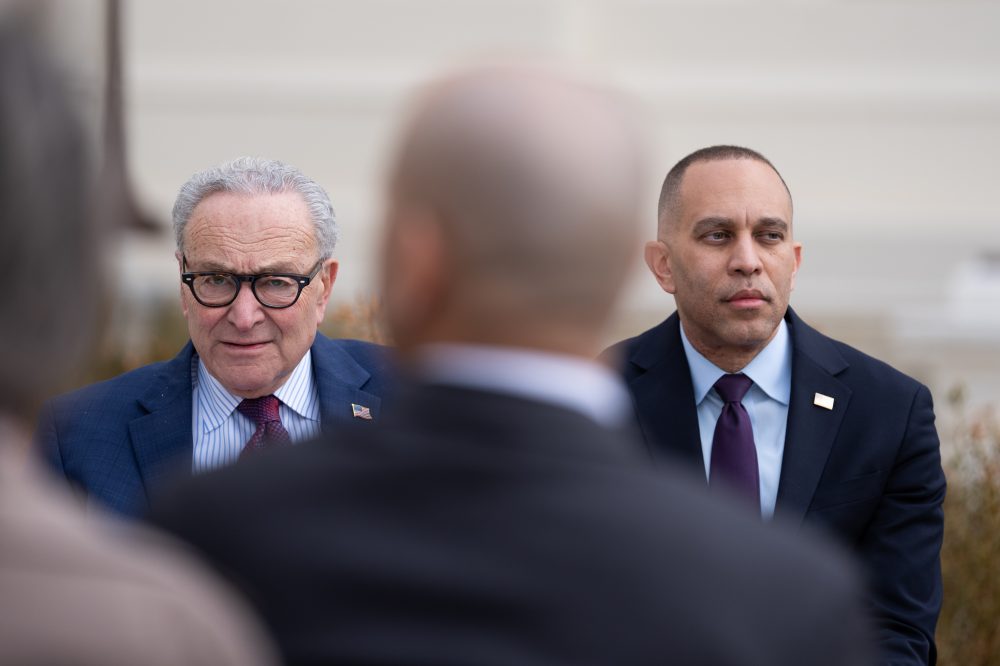
“A commander in chief who is truly in control would have never gotten into this colossal mess to begin with,” Senate Democratic leader Chuck Schumer stated during a Wednesday press conference in New York.
For now, both Schumer and House Democratic leader Hakeem Jeffries are avoiding impeachment discussions, instead urging Republicans to support legislation requiring Trump to obtain congressional authorization before launching additional Iranian strikes. Any removal effort would likely fail while Republicans maintain congressional control.
House Democrats intend to use Thursday’s brief session to push for rapid passage of war powers legislation, though Republican leadership is anticipated to block the effort.
“We will continue to unleash maximum pressure on Republicans to put patriotic duty over party loyalty and join Democrats in stopping the madness,” Jeffries wrote to Democratic members Wednesday.
White House press secretary Karoline Leavitt defended Trump’s language as successful strategy.
“I think it was a very, very strong threat from the president of the United States that led the Iranian regime to cave to their knees and ask for a ceasefire and agree to reopening the Strait of Hormuz,” she stated during a White House briefing.
As Democrats advance their opposition to Trump, they’re addressing concerns from their supporters and voters. Congressional offices experienced heavy contact from constituents this week, primarily from individuals disturbed by presidential rhetoric.
Rep. Suzan DelBene’s Washington state office received numerous calls and emails Monday and Tuesday, mostly regarding Iran but also concerning Trump’s impeachment or 25th Amendment removal, according to an anonymous aide.
District staff discovered 75 Iran-related voicemails after a one-hour Tuesday break, the aide reported.
“My office phones have not stopped ringing,” Rep. Maxine Dexter of Oregon said at a Portland press conference, calling for House members to immediately return to Washington.
Dexter’s office logged 257 Tuesday calls, exceeding any previous 24-hour period since the freshman representative’s team started tracking.
The citizen response appears spontaneous rather than coordinated pressure campaign.
While advocacy organizations have shared some talking points, including 25th Amendment legal specifics, no organized effort has targeted congressional offices with strategic messaging, according to an anonymous Democratic strategist familiar with the situation.
The “horror” of Trump’s statements and the magnitude of presidential threats apparently triggered the citizen mobilization, the strategist explained.
Several prominent conservative figures, including former Rep. Marjorie Taylor Greene of Georgia, have also suggested Trump’s removal through the 25th Amendment.
Democrats previously impeached Trump twice for first-term actions, though he was acquitted both times. They’ve avoided such discussions for 16 months while focusing midterm messaging on everyday economic concerns rather than opposing a president who narrowly secured the popular vote.
Then Trump issued Tuesday morning’s threat to eliminate “an entire civilization.”
“Whether by his Cabinet or Congress, the President must be removed from office. We are playing with the brink,” Rep. Alexandria Ocasio-Cortez of New York posted on social media.
Removal demands continued even after the ceasefire announcement.
“Temporary ceasefire or not, Trump already committed an impeachable offense. Congress needs to get back to work and remove him from office before he does more damage to our country and the world,” said Rep. Seth Moulton of Massachusetts, an Iraq War veteran.
Republicans hold the House majority and have successfully defeated two previous second-term Trump impeachment attempts. They may face another challenge as Rep. John Larson of Connecticut has filed a resolution containing 13 impeachment articles against Trump.
Last June, 128 Democrats joined all Republicans to table Rep. Al Green’s Texas-sponsored impeachment resolution charging abuse of power after Trump conducted Iranian military strikes without congressional authorization.
Green’s December impeachment resolution generated a 237-140 vote, but showed shifting dynamics with 47 Democrats voting “present” instead of outright opposition. Jeffries and other leaders argued proper impeachment groundwork hadn’t been established and they would vote “present” while maintaining focus on American affordability issues.
Jeffries’ approach to new impeachment pressure remains uncertain. However, Democratic leaders scheduled a Friday call with House Judiciary Committee members focusing on “Trump administration accountability and the 25th Amendment.”
Other Democrats have targeted Defense Secretary Pete Hegseth for removal. Hegseth has supported U.S. Iranian actions, claiming American and Israeli forces achieved “capital V military victory” and that Iranian military no longer significantly threatens U.S. forces or regional stability.
Democratic Rep. Yassamin Ansari, whose family emigrated from Iran, joined calls for Hegseth’s dismissal. She expressed being “momentarily relieved” that Iranian civilians would escape Trump’s widespread destruction threats.
“We need urgent action for the sake of our national security and the safety and security of the rest of the world,” Ansari stated.
MOSCOW – Masked security personnel conducted a search of the Moscow headquarters of Novaya Gazeta, one of Russia’s most prominent independent newspapers, the publication reported Thursday.
The newspaper announced via Telegram that it was unaware of the specific reasons behind the operation and that their legal representatives were being denied access to the premises.
According to statements from law enforcement sources cited by state news agency RIA, the search operation was connected to a probe involving the unauthorized handling of personal information. Russia has significantly strengthened its media censorship regulations and intensified its campaign against independent journalism organizations following the start of its military operation in Ukraine in 2022.
In another significant development Thursday, Russia’s Supreme Court declared Memorial, the country’s most prominent human rights organization, an extremist group. This ruling creates legal grounds for criminal charges against anyone who provides support, funding, or distributes the organization’s content.
Novaya Gazeta stands as one of Russia’s most recognized investigative journalism organizations. The publication’s editor-in-chief, Dmitry Muratov, shared the 2021 Nobel Peace Prize and honored six journalists from his newspaper who were killed while pursuing their reporting duties.
In 2023, Russian authorities labeled Muratov a “foreign agent,” a classification the government uses for individuals and organizations it considers to be engaging in activities against Russian interests with international backing.
Spanish leadership delivered sharp condemnation of Israeli military operations in Lebanon and wider Middle East hostilities on Thursday, solidifying Madrid’s position as a vocal opponent of U.S. and Israeli military actions even as Washington threatens retaliation against uncooperative NATO partners.
The Spanish government’s resistance to the Iranian conflict has deepened tensions with Washington, with members of President Donald Trump’s MAGA coalition increasingly calling for punishment against Madrid.
Speaking before parliament, Foreign Minister Jose Manuel Albares characterized the conflict as an assault on civilization itself, mirroring harsh words from Prime Minister Pedro Sanchez regarding Trump’s decision to target the Islamic Republic.
“We’re facing the greatest assault on the civilisation built upon the humanist ideals of reason, peace, understanding and universal law over the abuse of power, brute force and arbitrariness,” Albares stated.
“The prophets of war and violence seek to return to the values and practices of history’s darkest moments,” he continued, claiming Israel had broken international law and violated a newly negotiated two-week ceasefire following extensive airstrikes throughout Lebanon that resulted in over 250 deaths on Wednesday.
Sanchez, who has positioned himself as a prominent war opponent, has prohibited Spanish airspace access to any aircraft participating in what he calls a dangerous and unlawful confrontation.
Wednesday evening saw Sanchez renew his appeal for the European Union to abandon its association agreement with Israel, demanding an end to “impunity for (Israel’s) criminal actions”.
Through a social media post on X, Sanchez declared Israeli Prime Minister Benjamin Netanyahu’s “contempt for life and international law is intolerable”.
Wednesday also witnessed Spain and Italy both calling in Israeli diplomatic representatives to object to separate incidents involving UN peacekeepers in Lebanon. Madrid reported that Israeli forces had wrongfully detained a Spanish UNIFIL participant.
Spanish-American relations suffered damage last year when Madrid refused Trump’s requirement that NATO members increase defense expenditures to 5% of gross domestic product. This position prompted Trump to threaten complete trade cessation.
Republican Senator Lindsey Graham stated in March that America should withdraw from two jointly managed air bases in southern Spain and relocate “to a country that will allow us to use them”.
Earlier this week, Albares noted that Trump’s public consideration of alliance withdrawal was encouraging European nations to explore alternative security frameworks.
Within Spain, the government’s stance enjoys broad popularity, with polling data showing overwhelming public rejection of the war. Recent surveys indicate Sanchez’s Socialist Party has increased voter backing while far-right Vox, which supported the U.S. and Israel, has experienced declining support.
Though Sanchez has praised the Pakistani-mediated ceasefire, he also stated Spain would “not applaud those who set the world on fire just because they turn up with a bucket,” referencing the U.S. administration.
Albares announced Thursday morning that Spain would reopen its Tehran embassy in pursuit of regional peace.
However, his Israeli counterpart, Gideon Sa’ar, denounced the decision as “an eternal disgrace,” claiming Spain was collaborating with what he described as Iran’s terror regime.
WASHINGTON – A Chinese pharmaceutical company secured a significant victory against an American startup by employing a lobbying firm with close ties to Donald Trump Jr., according to federal documents reviewed by news outlets.
Grand Pharmaceutical Group hired Checkmate, a lobbying company led by Ches McDowell, who maintains a personal friendship and business relationship with the former president’s eldest son. The Chinese firm paid $30,000 for two weeks of lobbying work in December.
The lobbying effort helped Grand Pharma’s attorney secure a crucial meeting with Chris Pilkerton, who heads the Committee on Foreign Investment in the U.S. (CFIUS), in early January. During that meeting, the lawyer contended the dispute was purely commercial without national security concerns, sources familiar with the discussion revealed.
By the end of January, CFIUS denied Minnesota-based FastWave’s petition for a national security review of Grand Pharma’s investment, citing reasons unrelated to national security matters. FastWave had only managed to arrange calls with lower-level CFIUS staff members during the same period.
The rejection has brought FastWave to the edge of financial collapse, the company informed CFIUS officials.
While it remains unclear whether Checkmate’s lobbying directly influenced the CFIUS determination, the situation has raised eyebrows among China policy experts and Democratic legislators who learned of the circumstances.
Tim LaPira, a political science professor at James Madison University, described such lobbying as “very typical.” He explained, “If you want to speak to the party in power, you are going to need to hire somebody that has those partisan connections.”
However, six China specialists and three Democratic lawmakers expressed concern that Chinese companies might leverage lobbyists with Trump administration connections to gain influence.
Michael Sobolik from the Hudson Institute, a conservative research organization, characterized the situation critically. He stated that if a Chinese company can lobby the U.S. government into supporting it against an American firm on national security issues, “that is the height of the swamp.”
The White House dismissed such criticism. Spokesman Kush Desai said, “Nothing has changed with CFIUS’s diligence, investigation, or enforcement operations, which continue to robustly and vigilantly safeguard America’s national security interests.” He called any suggestion that the Trump administration would compromise CFIUS at special interests’ request “categorically false.”
McDowell, who leads Checkmate, has appeared in social media photographs hunting alongside Trump Jr. and co-owns property with him. A Checkmate representative clarified that while McDowell appears on Grand Pharma’s lobbying records, he didn’t personally handle the matter.
Grand Pharma’s lawyer, Jeff Bialos, characterized the process as “a lengthy fact-based investigation” with an outcome that wasn’t “politically driven.” He described the situation as “a private commercial dispute… being squeezed into the CFIUS box.”
FastWave CEO Scott Nelson criticized “the opaque and highly irregular procedural decisions” from CFIUS, saying they hampered his company’s ability to protect critical technology from a Chinese investor.
The dispute stems from Grand Pharma’s $12 million investment in FastWave in 2021. The American company later began producing specialized catheters for treating arterial calcium buildup using laser technology.
U.S. regulations control shipments of that laser technology to China because of potential military applications for enhancing warfare capabilities.
Initially welcoming Grand Pharma’s investment, FastWave later asked CFIUS in 2025 to review the arrangement. The company hoped officials would require Grand Pharma to sell its 40% ownership or become a passive investor, fearing intellectual property theft and blocked fundraising efforts.
FastWave’s concerns intensified after discovering a press release on Grand Pharma’s website announcing a partnership with Jiangsu Zhenyi Medical Technology Co., Ltd, a Chinese competitor.
CFIUS rejected FastWave’s filing, citing “material misstatements” in the company’s responses. The committee pointed to contradictory statements about Grand Pharma’s involvement in FastWave’s fundraising negotiations between July and August 2025.
FastWave defended itself in February 2026, arguing that Grand Pharma’s feedback consisted of minor termsheet edits that weren’t substantive and came after their July statement to CFIUS.
Notably, CFIUS didn’t address potential national security risks in its rejection.
CFIUS attorney Tatiana Sullivan called the committee’s rejection letter unusual, explaining that CFIUS typically collaborates with companies to resolve misunderstandings and only rejects filings outright for “serious inaccuracies” related to national security.
Nelson criticized the timing, noting the rejection came “months after the underlying statements were made” and that CFIUS “never informed us of these concerns, and gave us no opportunity to clarify or correct them before rejecting the filing on the very last day of an extensive review period that lasted over 200 days and included 29 question sets.”
McDowell met Trump Jr. at a conservative event in 2016 and developed their friendship by offering a superior hunting experience. The two have jointly owned North Carolina property since 2021, according to property records.
Social media posts show McDowell appearing with Trump Jr. and Health Secretary Robert F. Kennedy holding falcons in October 2024, and posing with rifles alongside Trump Jr. and Eric Trump over hunting trophies in January 2024.
The artificial intelligence company that created ChatGPT has shared bold financial forecasts with investors, anticipating $2.5 billion in advertising income for 2024 and a dramatic climb to $100 billion by 2030, according to a Thursday report from Axios citing sources familiar with investor presentations.
According to the financial projections presented to investors, OpenAI anticipates advertising income will climb dramatically over the coming years: $11 billion in 2027, $25 billion in 2028, and $53 billion by 2029. These ambitious targets assume the company’s artificial intelligence products will attract 2.75 billion weekly users by the decade’s end.
When contacted about the Axios findings, OpenAI representatives had not provided a response at the time of this report.
The AI company announced in January its plans to introduce advertisements within ChatGPT for select American users as part of an effort to increase overall income and support the expensive development costs of artificial intelligence technology. These promotional messages were initially tested among users of ChatGPT’s no-cost version and the more affordable Go subscription plan.
Just last month, an OpenAI representative revealed that the ChatGPT advertising trial program in America had achieved $100 million in yearly revenue projections within just six weeks of beginning. During that same period, the company had grown its advertiser base to more than 600 businesses.
OpenAI’s advertising push represents an attempt to compete in a market currently controlled by tech giants Alphabet’s Google and Facebook’s parent company Meta. To put this in perspective, Google’s advertising division brought in $294.69 billion during 2025, while Meta’s advertising revenue reached $196.18 billion for the same year.
While some industry experts have expressed concerns that incorporating advertisements into ChatGPT might frustrate users and damage confidence in the platform, OpenAI maintains that consumer trust measurements remain unaffected and that users rarely dismiss the promotional content.
The criminal corruption case against Israeli Prime Minister Benjamin Netanyahu will move forward again this Sunday, according to a court spokesperson who made the announcement Thursday. The resumption comes just hours after Israel ended its emergency declaration that was put in place during hostilities with Iran.
Tensions escalated when Iran launched ballistic missile and drone strikes against Israel following joint Israeli and U.S. airstrikes on Iranian targets on February 28. The allied forces cited goals of limiting Iran’s regional influence, halting its nuclear program, and supporting regime change efforts.
Israel’s emergency status, which shuttered educational institutions and businesses, was removed Wednesday night after no incoming Iranian projectiles were detected since 3 a.m. local time following a ceasefire agreement. However, Israel’s extensive military operations in Lebanon targeting Iran-supported Hezbollah forces have put the fragile truce at risk.
“With the lifting of the state of emergency and the return of the judicial system to work, hearings will resume as usual,” court officials announced, noting that sessions will occur from Sunday through Wednesday each week.
Netanyahu holds the distinction of being Israel’s first serving prime minister to face criminal charges. He maintains his innocence against accusations of bribery, fraud, and breach of trust filed in 2019 following extensive investigations. The trial started in 2020 and carries potential prison sentences, though it has faced numerous postponements due to Netanyahu’s governmental responsibilities, with no conclusion timeline established.
Former President Trump has supported Netanyahu’s appeals to Israeli President Isaac Herzog for a presidential pardon, arguing that mandatory court appearances interfere with his ability to perform his duties effectively.
Herzog’s administration stated that the justice ministry’s pardons office will collect input to present to the president’s legal counsel, who will develop a recommendation following established procedures. Presidential pardons typically are not granted while trials are ongoing.
The criminal allegations against Netanyahu, combined with Hamas’s October 2023 attacks on Israel, have weakened his political position. Israel faces elections in October where Netanyahu’s coalition government, considered the most conservative in the nation’s history, appears likely to face defeat.
A major Dubai-based aviation company has announced a significant partnership with investment giant Blackstone to create an ambitious aircraft leasing venture worth $1.6 billion per year.
Dubai Aerospace Enterprise and Blackstone Credit and Insurance revealed their collaboration Thursday, establishing a joint investment program called Equator that will focus on acquiring commercial aircraft to lease to airlines around the world.
Under the arrangement, Dubai Aerospace Enterprise will be responsible for acquiring aircraft from outside sources, while the company’s Aircraft Investor Services division will handle day-to-day management of the fleet assets.
This partnership represents the latest move by alternative investment firms to enter the aviation finance market, an industry that has seen increased attention from institutional investors as limited aircraft availability drives up leasing costs.
Blackstone Credit and Insurance operates through its Infrastructure and Asset Based Credit Group, which oversees more than $100 billion in assets. The Equator program will receive funding from various sources, including capital from funds overseen by ITE Management, which maintains a strategic partnership with Blackstone Credit and Insurance.
Dubai Aerospace Enterprise currently manages approximately 700 aircraft in its fleet. The company also handles more than 100 aircraft worth over $4 billion through third-party management agreements as of the end of 2025. The firm serves as the managing entity for seventeen different management contracts with institutional and financial investors.
Motorists traveling along Baynard Boulevard should expect delays and plan alternate routes as construction crews continue work that requires periodic lane closures.
The affected stretch runs between Marsh Road and Shipley Road, where workers are causing intermittent lane restrictions that began earlier today.
According to DelDOT officials, the construction-related lane closures are expected to wrap up by 4 p.m. this afternoon.
Drivers are advised to use caution when traveling through the work zone and allow extra time for their commute while crews complete the necessary roadwork.
Drivers traveling southbound on Old Orchard Road should expect delays this afternoon due to an active construction zone.
DelDOT reports that one southbound lane is currently blocked between Lewes Georgetown Trail and Austin Street as crews work on the roadway.
The lane restriction is expected to remain in place until 5:30 PM today. Motorists are advised to allow extra travel time and use caution when driving through the work zone.
Motorists traveling southbound on Kenton Road are encountering traffic delays today as construction crews have shut down one lane between Burning Tree Road and Carnoustie Road.
The Delaware Department of Transportation reports the lane restriction will continue through 5 PM this evening as work crews complete their project in the area.
Drivers are advised to expect delays and consider alternate routes if possible during the afternoon commute hours.
Drivers using Bluefield Road are experiencing traffic delays today as construction crews work along a busy stretch of the roadway.
According to DelDOT, intermittent lane restrictions are currently in place on Bluefield Road between Yellowstone Drive and Friar Road. The construction-related traffic pattern is scheduled to remain in effect until 3:00 PM today.
Motorists are advised to allow extra travel time when using this route and to exercise caution when driving through the work zone. Drivers should also consider using alternate routes if possible to avoid potential delays.
EQUIHEN BEACH, France — Tragedy struck the northern French coastline Thursday as four migrants—two men and two women—lost their lives while attempting to board an inflatable vessel for the dangerous journey across the English Channel to Britain.
Regional prefect François-Xavier Lauch of the Pas-de-Calais area confirmed that rescue teams pulled 38 survivors from the waters, with one person requiring emergency medical treatment. Lauch provided the update while search and rescue efforts were still underway at Equihen Beach Thursday morning.
According to Lauch, the victims were swept away by treacherous ocean currents while trying to board what officials call a “taxi-boat”—small motorized inflatable vessels that smugglers use to collect passengers along France’s northern coastline.
The deadly incident occurred on a vast sandy shoreline bordered by sand dunes and woodland where migrants often hide for days, waiting for boats and favorable weather conditions. Despite police patrols on beach buggies and surveillance from old World War II bunker positions, authorities cannot monitor every departure along the extensive coastline.
Recent days have seen a dramatic increase in crossing attempts and fatalities. French maritime officials reported Wednesday that 102 individuals were saved in two separate rescue missions while attempting channel crossings. Just last week, two people perished in a comparable incident off the coast near Calais.
The “taxi boat” method differs from traditional crossings where migrants carry their own inflatable boats into the water. Instead, these vessels depart nearly empty from hidden coastal locations and collect passengers at predetermined beach meeting points.
An Associated Press journalist witnessed such operations Wednesday at Malo-les-Bains, close to Dunkirk.
Migrants enter the ocean waters, with adults carrying children in their arms or on their backs, then climb aboard the waiting inflatable boats positioned offshore. After loading passengers, the vessels begin their cross-channel voyage, sometimes collecting additional people during the journey.
Weather conditions, tidal patterns, and police presence often force migrants to wade deep into the water—sometimes up to their chests—to reach the boats, significantly increasing dangers of losing balance, getting caught in currents, or venturing too far from shore.
Migrant advocacy organizations have repeatedly cautioned that intensified French police efforts to stop boat departures from beaches, including using knives to slash and destroy inflatable boats, are pushing smugglers toward “taxi boat” operations that create greater drowning risks, injuries, and rescue situations.
LONDON (AP) — Forces from Britain and Norway conducted an extended surveillance mission targeting Russian submarines believed to be engaged in suspicious activities near critical undersea infrastructure in the North Atlantic, according to Thursday announcements from U.K. military officials.
British Defense Secretary John Healey revealed that naval vessels, aircraft, and hundreds of military personnel tracked one Russian attack submarine and two intelligence-gathering submarines operating close to underwater cables and pipelines located north of British territory. The Russian fleet ultimately departed the area following the surveillance effort that extended beyond four weeks.
“We see your activity over our cables and our pipelines and you should know that any attempt to damage them will not be tolerated and will have serious consequences,” Healey stated as his warning to Russian forces.
Norwegian defense ministry, foreign ministry, and military representatives had not yet provided responses to media inquiries about the operation.
U.K. leaders have worked to maintain focus on Russian activities despite global attention shifting toward Middle Eastern conflicts. Officials have highlighted connections between various international disputes, noting that Russia has provided drone components and additional support to Iran.
During a press briefing, Healey emphasized that “Putin would want us to be distracted by the Middle East,” while asserting that Russia remains the primary security challenge facing Britain and allied nations.
“We will not take our eyes off Putin,” he declared.
Earlier this year in March, British authorities announced readiness to intercept vessels believed to operate within Russia’s unofficial fleet of ships transporting oil in defiance of international penalties imposed due to Moscow’s invasion of Ukraine. This marked an escalation from Britain’s previous role of simply assisting French and American forces in monitoring suspicious vessels.
“We are ready to take action” against these ships, Healey confirmed.
MANILA, Philippines — The Philippines launched a significant coast guard facility Thursday on a South China Sea island, establishing what officials called a “steadfast sentinel of our sovereignty” in waters contested by China.
Beijing has not yet responded to the Philippines’ establishment of its coast guard district headquarters on Thitu Island, an area controlled by Filipino military and residents for many years but also claimed by Chinese authorities.
Vessels from China’s coast guard and affiliated agencies regularly monitor the waters surrounding the island, which Vietnam and Taiwan also claim. Previous encounters between Chinese and Filipino forces in nearby waters have been tense but relatively minor.
Beijing asserts control over nearly the entire waterway, a crucial shipping corridor, despite a 2016 international arbitration decision that rejected its broad territorial claims under the 1982 U.N. Convention on the Law of the Sea. China refused to participate in the arbitration process, dismissed the ruling, and continues to ignore it.
Philippine Transportation Secretary Giovanni Lopez, Senator Erwin Tulfo, and coast guard leader Admiral Ronnie Gil Gavan traveled to Thitu for the dedication ceremony, timed to align with the nation’s Day of Valor observance.
“This is a permanent step for us to show that our coast guard is ready to defend our interest in the waters, our fishermen, their livelihood and, most importantly, our sovereignty,” Lopez stated.
A plaque inside the new coast guard facility described it as “established as the vanguard and steadfast sentinel of our sovereignty, sovereign rights and maritime jurisdiction.”
The new command will operate under a commodore with supporting staff, patrol vessels, and aircraft for law enforcement, surveillance, environmental protection, and rescue operations. Additional smaller coast guard stations will be constructed on other Philippine-controlled formations, according to officials.
The teardrop-shaped Thitu Island, encircled by white sand beaches, is known as Pag-asa — meaning hope in Tagalog — by approximately 400 Filipino residents. It represents one of nine islands, islets, and atolls under Philippine control since the 1970s.
Over ten years ago, China began converting seven contested reefs into military installations in the Spratly Islands. These included Subi Reef, now a major base featuring a military runway located roughly 24 kilometers (15 miles) southeast of Thitu.
“Everyday, our villagers see Chinese coast guard and militia ships all around the island,” stated MP Albayda, who serves as the island municipality’s vice mayor. “This new coast guard district command is a big morale booster for them.”
The Philippines considers the area its most distant offshore community, part of its western Palawan province. Decades ago, it incentivized fishing families to move there with benefits like free rice to strengthen its territorial claims.
The 37-hectare (91-acre) island now features internet and cellular service, improved electricity and water systems, a newly paved airstrip, a dock, elementary school, gymnasium, and storm shelter. Despite these improvements, Thitu remains a modest frontier community compared to China’s developed Subi installation.
ANN ARBOR, Mich. — Hundreds of young people lined up in the cold outside a University of Michigan lecture hall Tuesday evening, creating a scene that caught the attention of veteran Democratic Representative Debbie Dingell, who observed from the back of the crowded room.
The longtime congresswoman watched as progressive Senate hopeful Abdul El-Sayed held a campaign event alongside Hasan Piker, a well-known but polarizing internet personality. Students filled the lecture hall, creating an energetic atmosphere with desk-banging and foot-stomping.
Dingell, known for her accurate political predictions including Trump’s Michigan victories in 2016 and 2024, was studying the evolving political environment. The turnout impressed her significantly.
“Quite frankly, I haven’t seen that many people outside an event yet this year,” Dingell remarked, emphasizing her presence wasn’t an endorsement of the candidate.
The crowd extending down the street represented more than just progressive politics. Many attendees carried backpacks from classes, while others had traveled considerable distances to attend. What united them wasn’t strict ideology but rather deep disappointment with America’s two-party system.
This dissatisfaction reflects broader anger permeating contemporary American politics, now emerging among younger voters before crucial midterm elections that will decide congressional control.
High school senior Liam Koenig, who was just eight years old when Trump first won the presidency, described how that pivotal moment influenced his generation’s political perspective.
“It’s just become increasingly more inflammatory,” Koenig explained.
Living in Oakland County, Michigan’s traditional political barometer, Koenig characterized current times as filled with ongoing conflict and worry. He said his classmates frequently feel discouraged and angry.
“I think a lot of us have lost hope in, like, tangible change,” he stated.
February polling by AP-NORC shows younger Americans hold more negative opinions of both major parties compared to older citizens.
Despite his pessimism, Koenig remained politically engaged, waiting hours to attend El-Sayed’s rally. He praised the campaign’s fresh approach, comparing it to Zohran Mamdani’s victorious New York City mayoral campaign and hoping for similar momentum in Michigan.
“You’re not going to get people out with business as usual,” Koenig observed.
Artist Karol Molina, recently relocated from New York City, said she sought candidates similar to Mamdani when she moved to Michigan. She chose to support El-Sayed, who faces U.S. Representative Haley Stevens and state Senator Mallory McMorrow in the Democratic primary.
“We want to be able to live and, like, afford life without constantly scraping by,” Molina explained.
Molina advocated for completely abandoning past political approaches.
“I think the Democratic Party is losing because they’re not really listening to what the people really want,” she said. “They’re trying to keep a party that existed before Donald Trump. And that party doesn’t exist anymore.”
University of Michigan junior Ethan Schneider characterized modern politics as “a little unserious.”
“It’s difficult to remain positive or not be jaded at a young age,” Schneider noted.
Though Schneider supported Democrat Kamala Harris two years ago, he joined many rally attendees in criticizing her and the Democratic Party.
“Hate them,” he said regarding Democrats. “They feel very complicit, in terms of all the issues going on now. If not complicit, they’re just doing nothing.”
Recent Gallup research confirms younger Americans reject both parties at significantly higher rates than older generations. Over half of Generation Z and Millennials consider themselves political independents, while most older Americans align with a party.
The polling indicates these growing independent voters are primarily driven by dissatisfaction with whoever holds power — potentially helping Democrats this election cycle without guaranteeing future support.
University of Michigan undergraduate Jacob Abbott believes the Democratic Party has shifted toward “corporate interest politics.”
Abbott dismissed concerns about El-Sayed appearing with Piker, despite the 34-year-old streamer’s controversial statements. Piker, who has 3.1 million Twitch followers and 1.8 million YouTube subscribers, previously said “Hamas is a thousand times better” than Israel, called some Orthodox Jews “inbred,” and claimed “America deserved 9/11.”
For Abbott, the controversy highlights American politics’ broader problem — few people can capture attention and address young voters’ concerns, even imperfect ones.
“So is Hasan perfect? Probably not,” Abbott acknowledged. “But he’s much better than the alternative the Democratic Party has had.”
Drawing on decades of political experience, Dingell has witnessed large crowds and packed venues before. She wanted to determine whether El-Sayed and Piker’s event represented something more lasting.
Progressive candidates have historically generated enthusiasm without achieving electoral success. El-Sayed himself placed second in Michigan’s 2018 Democratic gubernatorial primary. Additionally, independent Vermont Senator Bernie Sanders, a prominent progressive leader, lost two Democratic presidential campaigns.
However, some Democrats believe this moment differs, citing recent wins by Mamdani in New York and Analilia Mejia, who won a competitive Democratic primary in a New Jersey special House election.
“There should be a progressive running everywhere that one exists,” said Pennsylvania Representative Summer Lee, who also appeared with El-Sayed.
“Every year, every race,” she continued. “We might not be victorious, but every single time we have to call the question.”
Dingell said she plans to monitor future developments.
“Is it something for the kids to do, or is it going to connect?” she wondered.
Political campaigns are spending dramatically more money on protection as threats against candidates and elected officials continue to escalate nationwide, according to new research published Thursday.
A study by the Public Service Alliance reveals that federal political committees allocated more than $40 million for security-related expenses during the 2023-24 election cycle – marking a five-fold increase compared to spending levels from ten years ago.
The nonpartisan organization, which specializes in public official safety issues, analyzed publicly available Federal Election Commission records to compile their findings. However, the research did not identify specific candidates with the highest security expenditures.
Report author Justin Sherman emphasized the troubling nature of these trends. “This is not a good place to be as a country,” Sherman stated.
The escalating security investments come following a series of violent incidents targeting political figures over recent years. These include the 2017 Alexandria, Virginia shooting during Republican congressional baseball practice, the 2022 hammer attack on Democratic then-House Speaker Nancy Pelosi’s husband in California, and the 2024 Pennsylvania rally assassination attempt against Republican then-candidate Donald Trump. Additional tragedies occurred last year with the killings of Minnesota Democratic state lawmaker Melissa Hortman and her spouse, plus conservative commentator Charlie Kirk in Utah.
Digital protection services represent one of the fastest-growing security categories. Spending on cybersecurity and online threat monitoring surged from just $50,000 during the 2015-16 campaign season to $900,000 in the most recent cycle.
Perhaps most concerning, campaigns invested nearly $1 million on residential security measures over the past decade after spending zero dollars in this category during 2015-16. These expenses cover response service contracts, window reinforcements, and surveillance equipment installation.
Sherman highlighted how home-based threats represent a disturbing new development. Critics increasingly publish elected officials’ residential addresses on social platforms – a practice called doxing – leading to attacks like those against Pelosi’s husband in San Francisco and the Minnesota lawmaker at their homes.
“It’s expected that, say, a GOTV event or a campaign rally is going to have metal detectors and security,” Sherman explained. However, targeting candidates’ and officeholders’ residences creates an unprecedented challenge.
The researcher noted that while current Congress members receive office budget allocations for security purposes, prospective candidates must now consider home protection costs when deciding whether to seek office.
“It’s a troubling time when the security spend is becoming a greater barrier for someone running for office,” Sherman concluded.
The report’s calculations focused only on explicitly labeled security expenses in FEC filings, meaning actual protection costs likely exceed the documented totals. These security expenditures remain a relatively small portion of the billions spent each election cycle, but Sherman believes the figures represent conservative estimates of true campaign security investments.
LONDON – British Defense Minister John Healey disclosed Thursday that the United Kingdom sent military personnel to monitor and discourage Russian submarine activity near critical underwater infrastructure during a month-long presence in UK territorial waters earlier this year.
According to Healey, British forces worked alongside allies, including Norway, to observe and prevent harmful actions by the Russian naval vessels. The defense minister stated he was publicly revealing the military operation to ensure Russian President Vladimir Putin understood their submarines had been discovered.
The defense minister confirmed the Russian submarines have since departed British waters, moving northward, with no evidence of harm to underwater infrastructure systems.
“To President Putin, I say ‘We see you. We see your activity over our cables and our pipelines, and you should know that any attempt to damage them will not be tolerated and will have serious consequences’,” Healey declared.
“Our armed forces left them in no doubt that they were being monitored, that their movements were not covert, as President Putin planned, and that their attempted secret operation had been exposed,” he added.
The British defense minister identified the Russian naval operation as involving one Akula class attack submarine along with two specialized vessels operated by Moscow’s Main Directorate for Deep Sea Research (GUGI).
Russia’s Supreme Court on Thursday officially classified the internationally recognized human rights organization Memorial as an extremist group during a private court session, according to reports from the state-run news agency TASS.
This classification represents another step in Russia’s extensive campaign to silence opposition voices and restrict civil liberties that has been ongoing for several years. The court’s decision creates a legal framework that allows Russian officials to pursue criminal charges against individuals who provide support to the Nobel Peace Prize-winning organization or distribute its publications.
Before the court’s decision was made public, Memorial expressed certainty about the anticipated outcome of the proceedings.
“The case against Memorial is yet another attempt to intimidate all dissent in the country and force civil society into silence,” the organization stated in an official release.
Financial markets experienced a setback Thursday as the fragile ceasefire between the United States and Iran showed signs of strain, with both nations disagreeing about the scope of their recent two-week agreement.
Energy prices climbed while stock markets retreated as the critical Strait of Hormuz shipping lane remained essentially blocked to maritime traffic. Tensions escalated with renewed verbal disputes between Washington and Tehran, despite planned peace negotiations scheduled for the weekend.
Both Brent and WTI crude oil benchmarks surged past $98 per barrel Thursday morning before pulling back slightly, driven by fresh uncertainty about the ceasefire’s stability. While current prices remain below earlier weekly peaks, the increase was sufficient to halt Wednesday’s worldwide stock market gains.
Asian markets led the decline, with Japan’s Nikkei and South Korea’s KOSPI indexes dropping after several days of increases. European markets opened lower, and U.S. stock futures traded in negative territory before the opening bell.
Currency markets showed mixed signals, with the dollar trading relatively flat as investors awaited clarity on whether the U.S.-Iran truce would survive. The Japanese yen retreated from Wednesday’s advances, settling near 159 against the dollar.
Questions about the ceasefire’s longevity intensified as the Strait of Hormuz remained blocked to shipping. Iranian maritime authorities warned Wednesday that unauthorized vessels would face targeting and destruction, while Tehran continues weighing toll charges for waterway passage.
Iran has also accused Israel of violating ceasefire conditions through continued strikes in Lebanon. Although weekend peace discussions remain scheduled to begin Saturday, Iran’s chief negotiator called proceeding “unreasonable,” while President Trump issued additional military warnings.
These developments are unlikely to comfort investors hoping the ceasefire would provide the market breakthrough they anticipated, or that the global energy crisis would ease soon. This maintains concerns about potential inflationary pressures and helped slow Wednesday’s Treasury bond rally.
Regarding inflation data, traders will monitor Thursday’s February personal consumption expenditures report, projected to show U.S. prices rising 0.4% for the second consecutive month, even before recent energy price spikes.
Federal Reserve meeting minutes released Wednesday revealed some policymakers favoring rate increases for the next policy move. However, “many participants” still supported rate reductions, with “most” recognizing potential economic growth risks from the conflict that could justify additional cuts.
Shipping data shows daily traffic through the Strait of Hormuz has plummeted to under 10% of normal levels since the U.S.-Iran conflict began. Tehran’s demonstrated capacity to disrupt Gulf energy supplies illustrates how the conflict has already shifted regional power balances.
Thursday’s key economic releases include U.S. February PCE inflation data at 8:30 a.m., weekly unemployment claims at 8:30 a.m., and final fourth-quarter GDP figures at 8:30 a.m. A 30-year Treasury bond auction is scheduled for 1 p.m.
MOSCOW, April 9 – Ukraine received the remains of 1,000 of its fallen soldiers from Russia in a prisoner exchange that saw 41 Russian bodies returned in the opposite direction, according to Russian parliament member Shamsail Saraliyev as reported by RBC news.
Such transfers of deceased military personnel between the warring nations have taken place on multiple occasions throughout the ongoing conflict.
Amazon disclosed Thursday that its cloud computing division’s artificial intelligence operations generated more than $15 billion in revenue during the first quarter of 2026, marking the first time the tech giant has revealed specific financial figures from its AI investments.
Chief Executive Andy Jassy told shareholders that these figures are “ascending rapidly” and noted that the company’s overall cloud operations would be expanding even more quickly if not for current capacity limitations affecting the technology sector.
The CEO also revealed that Amazon’s semiconductor division, which manufactures Graviton and Trainium processors, has reached an annual revenue rate exceeding $20 billion. This represents a doubling from the $10 billion figure the company announced earlier this year.
“There’s so much demand for our chips that it’s quite possible we’ll sell racks of them to third parties in the future,” Jassy stated.
These financial revelations demonstrate that Amazon’s substantial investments in artificial intelligence infrastructure are beginning to generate significant returns. Jassy has previously indicated he believes AI technology will help Amazon Web Services reach $600 billion in yearly sales, which doubles his earlier projections, according to exclusive reporting from Reuters last month.
Amazon Web Services recorded total revenue of $128.7 billion in 2025, representing approximately 20% growth compared to the previous year. Industry analysts project the division will reach $142 billion in sales this year.
The company announced in February it plans to invest roughly $200 billion in capital expenditures this year, with most funds directed toward AI development and related infrastructure. While this substantial spending initially concerned investors, Jassy assured shareholders Thursday that much of the AWS investment will generate revenue during 2027 and 2028.
“We already have customer commitments for a substantial portion of it,” he explained.
WASHINGTON – Smaller artificial intelligence companies specializing in defense applications are experiencing an unprecedented wave of interest from military officials and investors after the Pentagon severed its relationship with major AI contractor Anthropic, highlighting the military’s need to expand its roster of technology providers.
Following the public breakdown between the Defense Department and Anthropic, which resulted in the company’s removal from military projects, emerging defense AI firms including Smack Technologies and EdgeRunner AI report a dramatic transformation in how they’re being received by potential clients and backers who previously showed little interest.
The Pentagon’s deteriorating partnership with Anthropic has created new pathways for smaller competitors who have long attempted to break into what represents one of the world’s most profitable government contracting opportunities. Securing defense contracts often leads to additional business with other federal agencies and serves as a valuable endorsement for commercial customers.
Tyler Sweatt, who leads Second Front, a firm that assists technology companies in meeting Pentagon security requirements, described the change: “We’ve seen a massive increase in demand from customers and the government to get AI solutions fielded since Anthropic was declared a supply-chain risk. Our customers are turning to us as the Pentagon turns to them to deploy quickly in the wake of the Anthropic blowup.”
After the Pentagon labeled Anthropic’s products a “supply-chain risk” in March and legal disputes emerged between the parties, military officials have shown heightened interest in AI startups. Andrew Markoff, who co-founded and runs the 19-employee Smack Technologies in El Segundo, California, said the military’s message has been clear: “We want more, we want demos, let’s talk about how we can move faster.” A judge issued a temporary order in late March preventing the Pentagon’s blacklisting of Anthropic.
Tyler Saltsman, who co-founded and leads EdgeRunner AI, reported similar developments. His company had been waiting over a year for Space Force contract approval to navigate Pentagon procurement processes. The agreement was finalized within weeks of the Anthropic controversy becoming public. “I can’t prove that the Anthropic drama sped this up,” Saltsman noted, “but I have a sneaky suspicion it did.”
A Pentagon spokesperson stated: “The Pentagon will continue to rapidly deploy frontier AI capabilities to the warfighter through strong industry partnerships across all classification levels.”
A Pentagon technology official previously informed Reuters that the dispute with Anthropic, combined with the recognition that the Defense Department relied too heavily on a single AI provider, compelled the agency to broaden its supplier base.
MARINE CORPS CONTRACT ACCELERATION
Smack’s experience with the Marine Corps provides the most concrete illustration of post-Anthropic momentum. The company secured a Marine Corps contract in March 2025 and successfully delivered a prototype by October – software capable of condensing what typically requires months of operational planning into approximately 15 minutes.
Although the prototype proved successful, progress slowed considerably. Full-scale production had been scheduled for fiscal year 2027, meaning implementation wouldn’t begin until October 2027 at the earliest. Throughout the 2025 holiday season and into early 2026, the project lacked clear direction.
Following the Anthropic controversy, Smack received invitations to numerous Marine Corps meetings centered on one key question: how quickly could production begin this year? Markoff described “very specific guidance and movement and energy” toward preparing the prototype for combat deployment in 2026 – advancing the timeline by more than a year.
Interest expanded beyond the Marines. While Smack maintains contracts with the Navy and Air Force, Markoff said inquiries arrived almost immediately from U.S. Special Operations Command and other military branches.
EdgeRunner, which operates with Army Special Forces units and holds a Space Force contract, reported that Navy engagement has accelerated significantly. Previously biweekly or monthly meetings now occur several times weekly.
Both EdgeRunner and Smack are now working rapidly to achieve higher security clearance levels – the requirement for accessing the most operationally critical applications and largest military contracts.
EdgeRunner reported that military officials indicated the company could reach IL-6 status, a security designation allowing access to secret and top-secret information, within three months – a timeframe Saltsman called extraordinary, considering the process typically requires 18 months or longer. He attributed this acceleration to pressure from Pentagon leadership to streamline procurement procedures and the urgency the Anthropic situation has brought to the department’s artificial intelligence initiatives.
NASA’s historic Artemis II mission has sparked a wave of national enthusiasm that transcends America’s deep political divisions, offering a unifying moment of scientific achievement and shared wonder.
The groundbreaking lunar voyage, representing the first human journey to the moon in more than five decades, has generated widespread excitement through rocket-launch viewing events, educational programs, increased planetarium attendance, and booming sales of space-themed merchandise.
This crucial 10-day test flight serves as preparation for future lunar landing attempts planned for later in the decade, marking the first such mission since Apollo 17’s final moon landing in December 1972. The crew’s anticipated return on Friday via Pacific Ocean splashdown is expected to draw as much public attention as their April 1 departure from Cape Canaveral, Florida aboard the massive Space Launch System rocket.
“Everyone can be excited about humans extending their capabilities, learning new things, and doing so in a positive, peaceful way,” explained Gaza Gyuk, senior astronomer at Chicago’s Adler Planetarium, noting the hundreds of visitors who have come to witness the launch and explore the mission details.
Public enthusiasm for Artemis, NASA’s modern successor to the Apollo lunar program of the 1960s and 1970s, shows up clearly in recent survey results.
According to a Reuters/Ipsos poll conducted during the mission, 69% of Americans express excitement about space exploration, while approximately 80% view NASA favorably, including strong majorities from both major political parties. Similarly, 69% of survey participants believe returning astronauts to the moon holds importance.
Much like the original Apollo era, NASA’s current lunar goals are unfolding during a period of domestic political tension and social unrest, including an unpopular overseas military engagement.
This turbulent backdrop may contribute to Artemis’s broad appeal, serving as both a refreshing break from troubling political coverage and a celebration of American scientific and technological excellence.
Commercial retailers and independent vendors have capitalized on the lunar fever, offering everything from official NASA merchandise to mission-inspired custom items.
Rock ‘Em Socks markets Artemis II socks for $14.99 per pair, featuring the SLS rocket design against a starfield backdrop.
NASA’s own merchandise includes an “I AM ARTEMIS” baseball cap, mission pins, women’s bomber jackets, and playing cards.
The Etsy marketplace features Artemis II keychains, artwork, posters, and $135 custom “dangle and drop” 3D-printed earrings modeled after the gumdrop-shaped Orion spacecraft.
In Elkins Park, a Philadelphia-area community, space enthusiast Hector Ybe, 38, organized a launch celebration that drew approximately 225 attendees, including numerous families with children.
“For two hours, everybody forgot what was happening outside in the world, everybody was talking about space,” Ybe observed, noting the diverse ethnic, religious, and racial representation among participants.
Children arrived in astronaut costumes to witness the launch while older attendees shared memories of watching the historic 1969 moon landing.
The mission provides a positive contrast to widespread concerns that scientific facts face increasing challenges, and that emerging technologies like artificial intelligence and social media platforms inspire distrust and anxiety.
Gyuk highlighted the mission’s new Earth photographs taken from space, showing continents and oceans without political borders as a powerful reminder of human unity.
“That helps people sort of realize that we’re all in this together,” he noted.
Teachers nationwide have woven the Artemis mission into their curriculum.
At Northglenn, Colorado’s STEM Lab public school, engineering instructor Erin Brabant created hallway displays featuring SLS rocket images, astronaut profiles, and mission timelines, while assigning students to construct their own lunar lander prototypes.
“When we talk about Artemis, it’s like every kid stops what they’re doing,” Brabant observed. “Their little side conversations stop, and they have questions.”
The crew’s diversity has particularly inspired students from underrepresented groups, with pilot Victor Glover becoming the first Black astronaut to travel to the moon and mission specialist Christina Koch serving as the first woman on such a journey, according to Brabant.
In Pilot Mountain, North Carolina, fifteen Girl Scouts aged 5 to 11 watched the live launch during their troop gathering last week.
The girls had been preparing Women’s History Month presentations about notable Girl Scouts, and the launch highlighted Koch’s own Girl Scout background, explained troop leader Heather Willard.
Women nationwide are facing significant challenges obtaining estrogen patches for menopause relief as a nationwide shortage continues to worsen, potentially lasting up to three years according to industry experts.
The supply crisis stems from dramatically increased demand following the Food and Drug Administration’s policy shift last year. Federal health officials began promoting hormone replacement therapy as “lifesaving” treatment in July, then eliminated long-standing safety warnings in November.
Data from health analytics firm Truveta shows patch usage jumped 26% through February after the FDA’s November announcement. More than one million American women enter menopause annually, and growing numbers are turning to estrogen patches to manage hot flashes, mood changes, and sleep problems.
“When the FDA removed the safety warning in November, it created unprecedented demand that cannot fully be met at present,” explained a representative from Swiss pharmaceutical company Sandoz, which has increased shipments to help address the shortage.
The patches deliver estrogen directly into the bloodstream through the skin as a form of hormone replacement therapy.
Dr. Gillian Goddard from NYU Grossman School of Medicine noted the dramatic shift in usage patterns. “For 20 years, less than 5% of women took hormone therapy. Now those numbers are growing… and scaling up production of medications is not as easy as it might seem,” she said.
Although federal officials haven’t formally declared a shortage, women are visiting multiple pharmacies, adjusting dosages, and switching between different brands or treatment types to find available supplies, according to interviews with patients, telehealth providers, and industry specialists.
Medical experts warn that suddenly stopping treatment can cause symptoms to return, while changing brands may trigger new side effects.
Amy Satterlund, a 50-year-old product manager from Fort Pierce, Colorado, has relied on estrogen patches for approximately 18 months but recently encountered supply difficulties.
She described having to anticipate shortages at CVS locations and endure extended wait times through online pharmacy Cost Plus Drugs.
“I do get nervous if I were unable to get my prescription refilled, that side effects or that the symptoms of perimenopause would come back,” Satterlund explained.
CVS Health confirmed that manufacturers haven’t been able to provide adequate quantities in recent weeks. Cost Plus representatives said they’ve increased inventory to meet exploding demand but haven’t received information about prolonged shortages from suppliers.
Andrew Nixon, speaking for the U.S. Health and Human Services Department, said the FDA is working with companies to support efforts to increase patch availability.
FDA Commissioner Marty Makary reversed previous cautionary guidance about hormone replacement therapy last July. Through interviews and public statements, he argued that women had been discouraged from these treatments due to cancer concerns, but that scientific evidence had evolved.
The 2002 Women’s Health Initiative research had connected hormone therapy to elevated risks for certain cancers, dementia, heart attacks and strokes. Currently, the American College of Obstetricians and Gynecologists website outlines both risks and benefits of various hormone replacement therapies and recommends annual discussions between patients and doctors about continuing treatment.
Truveta’s analysis of electronic health records covering over 130 million patients nationwide found that most hormone replacement therapy forms have increased in recent years, with estrogen patches showing the steepest rise of 184% since 2023. Vaginal cream hormone therapy usage climbed 122% during the same timeframe.
By February 2026, approximately five out of every 100 women aged 45-54 had received estrogen-based hormone therapy prescriptions, nearly doubling since 2023 based on analysis of women who received medical prescriptions during that period.
Telehealth platform HRT Club, which connects patients with hormone therapies and physicians, reported patch sales increased 150% following the FDA’s November actions.
Estrogen patches are generic medications with minimal profit margins, giving manufacturers little financial motivation to rapidly invest in new production facilities or equipment that can require years to establish.
Long-term supply contracts can also prevent manufacturers from quickly responding to demand fluctuations, according to industry sources and medical professionals.
Leading patch manufacturers, including Amneal, Zydus, Sandoz, Noven, and Viatris, all have certain dosages in short supply, according to the American Society of Health-System Pharmacists.
Amneal and Viatris confirmed they’re working to increase patch production to satisfy demand. Zydus and Noven didn’t respond to requests for comment.
Dr. Mary Rosser, an obstetrician-gynecologist and director of Integrated Women’s Health at Columbia University, said the FDA has options to address shortages. These might include requiring manufacturers to maintain more diverse backup supply chains and mandating minimum stock levels with proactive monitoring systems.
The FDA declined to discuss such possibilities.
“People have waited a long time to make a decision… about whether they want to use hormones,” Rosser observed. “Then they make the decision and then they can’t get them.”
Viktor Orban’s decade-and-a-half stronghold on Hungarian politics faces its most serious threat this Sunday, as polling data suggests the longtime leader could be ousted in what many consider a pivotal moment for Hungary’s position within Europe.
The current prime minister, who has maintained power since 2010 and holds the distinction of being the EU’s most tenured leader, has constructed what he terms an “illiberal democracy” by restricting press freedoms and limiting democratic institutions. His approach has garnered support from far-right European factions and former President Trump’s political movement.
Yet three years of economic decline, rising inflation, and allegations that government-connected business figures have enriched themselves have sparked widespread voter frustration. Additional controversy has emerged from media accounts suggesting the administration has worked closely with Russian officials.
Peter Magyar, a former insider within Orban’s circle, has effectively channeled public dissatisfaction through his center-right Tisza party, which currently holds commanding leads in most surveys.
Political experts warn that several factors create electoral uncertainty, including uncommitted voters, redistricted boundaries that benefit Orban’s Fidesz party, and substantial overseas Hungarian populations who typically support the incumbent government. They note outcomes could range from a Tisza supermajority capable of constitutional amendments to continued Fidesz control.
The election carries enormous implications for Hungary’s 9.6 million citizens and the broader European continent.
“This is one of the most momentous elections in Europe and for Europe in many years,” said Gregoire Roos, director of the Europe, Russia and Eurasia Programmes at Chatham House.
“In Moscow, Hungary has been seen as a precious trouble-making interlocutor within the EU — maintaining energy ties… and adopting, by far, the toughest tone vis-a-vis Ukraine than any other EU country. In the United States, Hungary has drawn attention as a laboratory of sovereigntist politics.”
The Trump administration demonstrated its backing for Orban through a visit this week by Vice President JD Vance, who criticized what he termed “disgraceful” EU meddling in the electoral process. A European Commission representative responded that voting decisions belong “the sole choice of the citizens.”
Russian officials quickly echoed similar sentiments. Kremlin spokesperson Dmitry Peskov stated Wednesday that “many forces in Europe, many forces in Brussels, would not like Orban to win the elections again.”
Hungary has opposed EU sanctions against Moscow and continues depending heavily on Russian energy supplies. The 62-year-old Orban recently prevented an EU loan package to Ukraine that was approved in December, citing disagreements with Kyiv over a war-damaged petroleum pipeline, marking another clash with Brussels leadership.
Magyar, age 45, has committed to fighting government corruption, securing billions in withheld EU funding, implementing wealth taxes, and overhauling Hungary’s deteriorating medical system.
Speaking with Reuters, he characterized the election as determining whether Hungary will solidify its European identity and economic recovery, or continue moving toward authoritarianism.
“Just a few days and we will see a change of regime,” Magyar declared at a Wednesday campaign event in Baja, vowing to heal political rifts among Hungarians.
“This is a very last chance… to prevent our country being a Russian puppet state… Let’s not allow Fidesz… to lead Hungary out of the EU.”
Orban maintains he seeks EU reform from within rather than departure from the alliance. He has characterized this contest as a fundamental decision between “war or peace,” claiming his political rivals would involve Hungary in the ongoing Ukrainian conflict. Tisza representatives reject this characterization.
“This election is about Hungary’s future. The choice is clear: dependence and decline — or sovereignty, strength, and peace,” Orban stated Tuesday.
The far-right Our Homeland party aims to secure sufficient votes to become a potential “kingmaker,” which might enable Orban to retain power through coalition arrangements.
Should Tisza prevail, reversing the legal and structural modifications Orban enacted with constitutional authority would present significant challenges for any new administration operating with only a simple majority in the 199-member parliament, according to Mario Bikarski, Senior Europe Analyst at Verisk Maplecroft.
This scenario could create “an environment of persistent legislative blockade and policy uncertainty,” he explained.
Financial markets, however, are concentrating on potential benefits from a Tisza victory.
“An end to the Orban regime would provide a major boost to the Hungarian economy,” noted Berenberg chief economist Holger Schmieding.
“It would remove a key obstacle to closer European cooperation… and pave the way for tougher sanctions against Russia.”
While driving home from work Tuesday evening with her two young children, Zainab Haider found herself consumed with worry about President Donald Trump’s deadline for Iran to accept American demands. The question weighing on her mind was whether her family members still living in Iran would survive or face destruction.
Haider experienced a flood of intense feelings – from worry and terror to isolation – as she watched others continue their daily routines despite the potential catastrophe looming. In the end, Trump chose not to follow through on his warning that “a whole civilization will die tonight,” instead reaching a two-week ceasefire agreement in the conflict.
This represented yet another jarring shift for Haider and the hundreds of thousands of Iranian residents in America who find themselves in a perpetual state of worry about Iran’s destiny and the wellbeing of loved ones who remain in their homeland.
Many find that the recent heated rhetoric surrounding the conflict has dominated their thinking, making it difficult to complete work tasks or concentrate on other matters. While some are demonstrating against the war, others keep their views about their native country private, nervously observing developments and wondering about what lies ahead.
On Wednesday, Haider joined protesters in Austin, Texas, demanding an end to the conflict. Similar demonstrations took place in New York, Boston, Chicago, Los Angeles and additional cities.
Beyond voicing opposition to the war, Haider believes that organizing will generate “the kind of pressure that makes it harder for Trump to swing back to this aggressive posturing.”
“It’s a huge country,” she said of Iran. “Trump is not going to ever be able to defeat it or wipe it out, but it is possible to do damage. It is possible to do something that affects millions of people, millions of lives.”
Haider, who works as a municipal planner and organizes with the Austin for Palestine Coalition, described Trump’s ultimatum as terrifying.
She opposes regime change, believing this should be decided by Iranian citizens rather than the United States. Despite arriving in America from Pakistan with her parents during childhood, she felt compelled to speak out. She still recalls the local bakeries and juice stands she would visit with her mother and their neighbors.
Iranian-American Sheila Amir explained that Trump’s social media messages caused her alarm on several fronts.
Her primary worry centered on her Iranian family members. She has been unable to verify their safety over the past week due to an internet shutdown affecting the entire country.
However, the North Carolina writer also expressed concern that war escalation could endanger her American relatives serving in the military. Their obligation, she noted, is to “serve and protect the United States of America,” not to harm Iranian people.
Even individuals who support American actions targeting the Iranian government directly are having difficulty accepting the recent threats against civilians.
Roya Rastegar has engaged in numerous challenging family discussions about the conflict in recent weeks. Both Rastegar and her spouse are Iranian-American. Rastegar revealed that Iranian government forces have killed family members over the decades since the Islamic Republic gained control, while most of her wife’s relatives continue living in the country.
Rastegar, who works as a filmmaker and co-established a pro-democracy organization called the Iranian Diaspora Collective, said the constant policy reversals have complicated explaining the situation to their children.
“It’s very hard to hold on to the idea that we do not know what’s going to happen,” she said.
According to Rastegar, the war has created an impossible ethical dilemma. She worries deeply that increased attacks on Iran could inflict greater harm on civilians. However, she also thinks that reducing war tensions without eliminating the Islamic Republic will create the biggest danger for Iranians living in the country, who would continue experiencing brutal and fatal oppression.
“It’s really nauseating to just think about my people as being stuck between a regime that’s still killing them and an administration — the U.S. — that is issuing these kinds of threats,” Rastegar said.
NEW YORK (AP) — Legal representatives for music industry executive Sean ‘Diddy’ Combs will present arguments Thursday morning to federal appeals judges, contending the entertainment mogul received unjust treatment during proceedings that resulted in his imprisonment on prostitution-related charges, while invoking First Amendment protections for his release.
The hip-hop entrepreneur, who remains incarcerated at a federal facility in New Jersey, will not attend Thursday’s hearing where three appellate judges will consider his challenge to both his conviction and prison term exceeding four years.
Defense counsel maintains Combs’ guilty verdict warrants reversal, or alternatively, that he deserves freedom with a reduced sentence.
Government attorneys are fighting against these appeals.
In legal briefs, Combs’ defense team reiterated previous arguments made during trial proceedings, contending that recordings Combs made of intimate encounters between his romantic partners and male escort workers constituted ‘amateur pornography’ deserving First Amendment protection. The legal team argues courts should interpret ‘prostitution’ more restrictively to exclude what they characterize as voyeuristic and expressive conduct.
Defense attorneys additionally contend Combs received excessive punishment, claiming the presiding judge improperly considered factors including fraud, coercion, and leadership roles in criminal enterprises when determining sentencing. Combs was cleared of sex trafficking and racketeering accusations that could have resulted in life imprisonment.
His conviction came under federal Mann Act provisions, which prohibit transporting individuals across state boundaries for sexual offenses.
Government prosecutors stated in legal documents that Combs’ video recordings do not transform his situation into a free speech matter.
They argued that accepting Combs’ position that ‘creative,’ ‘elaborate’ and ‘highly staged’ sexual activities deserve First Amendment protection would mean ‘brothels offering elaborate and staged scenes for individuals to have sex with women for payment could claim First Amendment protection.’
Prosecutors maintain the imposed sentence was appropriate.
Last year’s trial proceedings revealed disturbing details about the private conduct of a major music industry figure. The case included disturbing witness accounts describing violence, drug use, and sexual performances that participants testified he labeled ‘freak-offs’ or ‘hotel nights.’
Combs chose not to take the witness stand. His legal team conceded he exhibited violent behavior while arguing prosecutors were overreaching to criminalize his private conduct under federal law.
The 56-year-old has remained in custody since authorities arrested him in September 2024. Federal Bureau of Prisons records indicate his scheduled release date is April 2028.
NEW YORK (AP) — Manhattan’s Bryant Park has become an unexpected wildlife spectacle as American woodcocks make their annual spring migration stop, enchanting city residents with their peculiar charm.
These distinctive birds, recognized for their rhythmic bobbing movements and distinctive kazoo-style vocalizations, have been captivating visitors to the Midtown Manhattan park since their arrival in late March. Each day, crowds of onlookers gather hoping to observe these grapefruit-sized creatures as they probe the earth with their elongated beaks searching for earthworms.
“It’s a very charismatic bird. I mean, it’s goofy-looking. It’s got eyes that are always looking at you no matter where you are. It does this nice little dance when it’s nervous,” said Bill Rankin, a Yale University professor who stopped by the park. “Having two of them together is a kind of nice little romantic story of spring.”
These migratory visitors make Bryant Park a regular stopover each year during their northward journey in early spring. The birds possess an unusual appearance that seems pieced together from various species — featuring plump bodies, oversized eyes, and slender, extended bills. Some enthusiasts refer to them by nicknames like “timberdoodles” or “bogsuckers.”
This year’s gathering has drawn larger audiences than typical, largely due to viral social media content featuring videos and photographs of the birds. Daily assemblies of wildlife enthusiasts armed with smartphones and cameras stretch their necks for glimpses of the birds’ amusing gait, while generally keeping a courteous distance.
The characteristic movement that propelled the woodcock to internet fame involves a swaying motion combined with head bobbing. While some admirers interpret this as courtship behavior, researchers offer alternative explanations. Scientists suggest it could serve as a predator deterrent or food-gathering strategy.
“What you’re seeing in Bryant Park when it’s sitting around when these crowds are looking at it, is mostly a little bit of foraging behavior,” said Andrew Farnsworth, a scientist with the Cornell Lab of Ornithology. “A little of roosting and stretching, and then some of this sort of, you know, kind of sensory stuff looking around, and a little bit of deception, too.”
The male woodcock’s mating ritual presents another remarkable spectacle. Males produce a buzzing sound that birdwatchers characterize as a “meep” or “peent” before launching into erratic nighttime flights designed to attract females.
The Manhattan woodcocks are expected to resume their northward migration around mid-April. Their widespread appeal has created educational opportunities about conservation challenges they encounter, including fatal collisions with building windows, according to Ryan F. Mandelbaum, a New York City naturalist and author of the book “Wild NYC: Experience the Amazing Nature in and around New York City.”
Although not classified as endangered, American woodcock populations have decreased over recent decades.
“I was also heartened to see that people are engaging with the conservation threats around light pollution and glass that woodcocks face,” Mandelbaum said. “I love the community and shared joy that’s been emerging from people seeing the bird.”
Texas state Representative James Talarico secured the Democratic nomination for U.S. Senate last month with strong backing from white college graduates and Hispanic voters. However, his path to victory in November’s general election may depend on winning over a demographic that largely didn’t support him during the primary: Black voters.
The white Presbyterian seminary student, who has made his Christian beliefs central to his campaign, prevailed over U.S. Representative Jasmine Crockett, an African American congresswoman known for her forceful attacks on former President Donald Trump and GOP lawmakers.
Since no Democrat has won a statewide Texas race since 1994, Talarico must build bridges with many of Crockett’s supporters, some of whom were offended when his backers questioned whether she could defeat a Republican opponent in the fall.
Though Crockett entered the race late and lacked her rival’s campaign organization and fundraising strength, many of her supporters viewed suggestions that a white state legislator was more electable than a Black member of Congress as evidence of racial and gender bias.
“A lot of people took offense to that. Me personally included,” said state Representative Lauren Ashley Simmons, whose Houston district includes several historically Black neighborhoods. “They have to do the work to invest resources in reaching Black voters and making them feel centered and a part of this campaign.”
Primary results showed Talarico earning 1.21 million votes versus Crockett’s 1.07 million. However, in Texas’s 15 counties where at least 20% of eligible voters are Black, Crockett dominated with 57% support compared to Talarico’s 42%, according to Reuters data analysis.
Texas Democratic strategist Dallas Jones believes Talarico doesn’t require an “overwhelming surge” from Black voters, but must ensure they participate on Election Day.
“He cannot win this state without the support of Black Texans,” Jones said.
The GOP currently controls the U.S. Senate 53-47, and while Texas isn’t central to national Democratic plans for retaking the chamber, an upset victory would create additional opportunities for November gains. Even a competitive race could force Republicans to redirect crucial resources from swing states to defend what might become the nation’s most expensive Senate contest.
A spokesperson for Senate Democrats’ campaign organization said candidates aren’t assuming any voter support.
At 36 years old, Talarico built his primary campaign around broadening appeal beyond traditional Democratic constituencies. Now he must balance courting swing voters while earning Black community trust.
“We have to remember Black voters are the base of the party,” said Democratic strategist Bakari Sellers.
Talarico’s team informed Reuters they’re investing in grassroots outreach across Harris and Dallas counties, which have substantial Black populations, plus rural Black areas like Sand Branch, where they’re volunteering for clean water delivery and attending small community events.
“It’s on me to ensure Black Texans feel welcomed in, represented by, and proud of this campaign. That’s why we’re out doing the work right now to build the coalition we need to win in November: showing up everywhere to listen and to learn,” Talarico said in a statement to Reuters.
Community organizers say Talarico must address Black voter priorities including joblessness, expensive housing, and healthcare affordability over the coming months.
“When it comes to Talarico, they are talking about what is he going to do to help those Black women who lost their federal jobs regain employment?” said Brianna Brown, executive director of the Texas Organizing Project, a nonpartisan organization that endorsed Crockett. “They’re talking about good-paying jobs — we’re still at a $7.25 minimum wage in Texas.”
Pearline Harper, a 72-year-old Dallas resident who voted for Crockett, said she believes the healthcare system has “neglected elders.” She holds Republicans, who control the White House and both chambers of Congress, responsible for her increasing medical expenses.
“I just want it to go back to when doctors were taking care of patients because they were sick, not because … insurance companies tell them what they can do,” Harper said.
Talarico has been meeting with religious leaders to connect with Black Christian communities.
“We’re working to get him scheduled to come preach at our church. There’s been feedback from pastors that he’s genuine and humble,” said Pastor Richie Butler, who organized a roundtable discussion for Talarico in north Texas last month.
Butler originally backed Crockett but plans to support Talarico in November and will organize voter mobilization activities to increase Black participation.
Harris County Commissioner Rodney Ellis, who initially endorsed Crockett, threw his support behind Talarico after the nominee reached out via text message.
During their conversation, Ellis advised Talarico that victory would require engaging inconsistent Harris County voters and energizing Crockett supporters in East Texas for Election Day turnout.
“I’ve told him you’ve got to figure out a way to get her involved,” he said. “There’s a difference between someone endorsing you and being for you.”
Political analysts warn Talarico’s challenge is just starting, with either Republican emerging from the May 26 runoff — U.S. Senator John Cornyn or Attorney General Ken Paxton — favored for November. Trump hasn’t endorsed either GOP candidate.
“James Talarico is the underdog. He can’t make the assumption that he’s destined to get somewhere around 90% of the Black vote,” said Andra Gillespie, an associate professor at Emory University.
Simmons, the state representative who supported Crockett, praised Talarico’s team for early outreach to Black officials and community leaders but told his campaign, “Y’all have a lot of work to do to get support and trust and rebuild some bonds in the Black community.”
“It’s not enough for people like me that have served with him and know him to go out in our communities and say, ‘Vote blue, no matter who,’” she told Reuters. “It can’t be assumed that we’re just going to support whoever’s on the ticket.”
Tesla is working on plans for a compact, budget-friendly electric SUV, according to four sources with knowledge of the project who spoke with Reuters.
The electric vehicle manufacturer has reached out to suppliers in recent weeks to discuss manufacturing processes and component specifications for the new compact SUV, which would be an entirely new model rather than a modified version of existing Model 3 or Y vehicles, the sources revealed.
Three sources indicated the compact SUV would be manufactured in China, while one source mentioned Tesla’s plans to eventually expand production to facilities in the United States and Europe. The vehicle would measure approximately 4.28 meters (about 14 feet) in length, making it notably smaller than Tesla’s popular Model Y SUV, which stretches about 15.7 feet long, according to two of the sources.
This development comes after CEO Elon Musk canceled plans for a much-anticipated affordable electric vehicle project in 2024, redirecting the company’s focus toward robotaxis and humanoid robots. The key question remains whether this new compact SUV represents a return to Tesla’s mass-market strategy for human-operated vehicles or aligns with the company’s autonomous vehicle ambitions.
According to one source familiar with the project and a Tesla employee knowledgeable about the company’s current product strategy, the new model could potentially fulfill both roles. While the Tesla employee wouldn’t confirm specific vehicle details, they explained that the company now designs models to be driverless while maintaining human-driving capabilities.
The employee noted that while Tesla pursues full autonomy across its vehicle lineup, the company recognizes that many international markets won’t embrace or regulate driverless vehicles for several years. Maintaining flexibility to produce vehicles with or without driving controls could boost sales and help keep manufacturing facilities operating at full capacity.
As Tesla pursues its autonomous future, industry analysts forecast a potential third consecutive year of declining sales for traditional electric vehicles, which currently generate most of the company’s revenue. Currently, Tesla operates a limited robotaxi service only in Austin, Texas, with many vehicles still requiring human safety operators.
Tesla did not respond to requests for comment regarding the new vehicle plans.
The four sources emphasized that the project remains in early development phases. Reuters could not confirm whether Tesla has approved the vehicle for production.
The automaker has previously begun development on products that faced significant delays or cancellation. Tesla unveiled concept versions of a Roadster sports car and Semi freight truck in 2017, but has yet to produce the sports car or achieve mass production of the Semi.
Two sources indicated Tesla plans to price the new vehicle substantially below its entry-level Model 3 sedan, which currently starts at $34,000 in China and approximately $37,000 in the United States. The company would reduce costs partly by incorporating a smaller battery, resulting in shorter driving range compared to the Model Y’s 306 to 327 miles.
One source added that the vehicle would feature a single electric motor instead of the dual-motor performance option available on current Tesla models. Tesla also aims to significantly reduce the vehicle’s weight to about 1.5 metric tons, compared to the Model Y’s approximately two-ton weight.
Three sources confirmed the new model would be manufactured at Tesla’s Shanghai facility. While timing remains uncertain, production is unlikely to begin this year, according to the sources.
For years following Tesla’s 2008 launch with luxury electric vehicles, Musk emphasized the company’s mission to create affordable, mass-market electric vehicles essential for addressing climate change. However, repeated attempts to achieve this goal have encountered setbacks.
Starting in 2020, Musk announced Tesla’s goal to sell 20 million vehicles annually by decade’s end, nearly doubling Toyota’s current global sales leadership. A project Musk promoted for a $25,000 electric vehicle, commonly called the “Model 2” by enthusiasts and investors, was expected to drive dramatic sales growth.
In 2024, Reuters reported Tesla had abandoned Model 2 plans, though the company still intended to develop a driverless robotaxi using the same platform. Tesla’s major Chinese competitors had already begun producing significantly cheaper electric vehicles. Later that year, Musk declared it would be “pointless” and “silly” for Tesla to manufacture a $25,000 electric vehicle for human drivers, given the company’s imminent driverless vehicle offerings.
A former Tesla manager described an entirely new affordable traditional vehicle as a significant shift from the company’s philosophy through mid-2025. Until recently, the manager explained, Tesla had abandoned mass-production efforts for entry-level vehicles in favor of robotaxis as the primary method for reducing per-mile costs for passengers and vehicle owners offering ride services.
After canceling the Model 2, Musk and other Tesla executives outlined various plans for new, “more affordable” electric vehicles using vague language. When these vehicles debuted last fall, they were simplified versions of current Model 3 and Y vehicles offered in new “standard” trim levels with modest price reductions.
U.S. pricing of $36,990 for the Model 3 Standard and $39,990 for the Model Y disappointed some investors who considered the prices too high to attract new buyer segments and haven’t significantly impacted Tesla’s overall sales performance.
Publicly, Musk and Tesla continue emphasizing robotaxi and humanoid robot plans, which has helped maintain Tesla’s remarkable stock market valuation.
Tesla’s market capitalization stands at approximately $1.3 trillion, far exceeding its financial fundamentals even compared to high-performing technology companies. Investors approved a compensation package last year granting Musk up to $1 trillion in Tesla stock tied to various product and financial milestones.
The company now plans to begin production this month of a two-door Cybercab robotaxi, initially revealed as a concept vehicle in 2024, featuring no pedals or steering wheel. However, the timeline for sales or deployment in Tesla’s robotaxi fleet remains unclear. The automaker has not requested the federal exemption required to sell vehicles without steering wheels or pedals, according to a National Highway Traffic Safety Administration spokesperson.
United Nations officials announced Thursday that more than one million Sudanese refugees could lose critical humanitarian assistance including food and water supplies due to a massive funding shortage exceeding $400 million.
Chad currently hosts approximately 1.3 million Sudanese refugees, with the majority having fled their homeland following the outbreak of fighting between Sudan’s military forces and the paramilitary Rapid Support Forces in April 2023. Many of these displaced individuals escaped mass violence and severe food shortages in the Darfur region.
According to a joint announcement from the World Food Programme and the UN refugee agency, both organizations lack sufficient resources to assist all refugees and anticipate additional service reductions in upcoming months without securing the necessary $428 million in funding.
“With less than half the resources we require, we cannot deliver sufficient food to the people who need it most,” stated Sarah Gordon-Gibson, WFP Chad Country Director. “This will force them into devastating coping strategies and put lives at risk.”
While the UN statement did not identify specific donors reducing contributions, the refugee agency has previously indicated that decreased American foreign aid represents a significant factor in current funding gaps. However, both Sudan and Chad remain among 17 nations scheduled to receive $2 billion in US assistance by 2026.
Additional Western donor countries have similarly reduced foreign aid allocations as they redirect resources toward defense spending.
Current conditions reveal the severity of the crisis, with UNHCR able to provide assistance to only 40% of Chad’s refugee population, leaving many without adequate housing while educational facilities struggle with more than 100 students per instructor. In Chad’s northeastern Ennedi Est province, refugees receive less than half the recommended daily water minimum.
The Norwegian Refugee Council highlighted extreme hunger conditions in Chad, referencing survey data indicating that 70% of refugee families reduced their meal frequency during the previous month.
The State Department has broadened its travel advisory for Nigeria and granted permission for non-essential U.S. embassy workers and their family members to depart from Abuja, the nation’s capital, as security conditions continue to deteriorate throughout the West African country.
Travel warnings issued by the United States frequently influence how investors, international organizations, and airline companies evaluate risks in various countries. The decision to permit embassy staff departures reflects escalating worries in Washington as kidnappings, criminal activity, and assaults on law enforcement continue, especially in Nigeria’s northern regions.
In a Wednesday evening update to its travel guidance, the State Department maintained Nigeria’s Level 3 status, which advises Americans to reconsider travel plans. However, officials added five more states to the ‘Do Not Travel’ designation: Plateau, Jigawa, Kwara, Niger, and Taraba. This expansion means 23 of Nigeria’s 36 states now carry the highest travel warning level.
American officials emphasized dangers from Islamic extremist groups operating in northeastern regions, criminal organizations in the northwest, and continued violence affecting parts of southern and southeastern Nigeria, including areas where oil production occurs.
Washington issued a warning last month about a potential terrorist threat targeting American facilities and associated educational institutions within Nigeria.
The United States conducts reviews of its travel advisories multiple times annually and has maintained Nigeria at either Level 3 or Level 4 status for most of the previous ten years due to ongoing security challenges.
American military forces currently operate several MQ-9 unmanned aircraft in Nigeria along with approximately 200 personnel who provide training and intelligence assistance to Nigerian forces combating Islamic militant groups across northern territories.
MOSCOW – Russian officials justified their country’s naval operations on Thursday following reports that a military vessel accompanied sanctioned oil tankers near British waters, with Moscow characterizing Western actions as maritime piracy.
According to Britain’s Telegraph newspaper, the Russian naval vessel Admiral Grigorovich provided escort services for two oil tankers under UK sanctions – the Russian-registered Universal and the Cameroon-registered Enigma – as they traveled through the English Channel.
When questioned about these reports, Kremlin spokesperson Dmitry Peskov defended Russia’s actions, claiming Moscow has witnessed numerous instances of what he termed piracy on the high seas and would take steps to safeguard Russian maritime operations.
“Over the past few months, we have witnessed repeated incidents of piracy in international waters. These incidents of piracy have, among other things, harmed the economic interests of the Russian Federation,” Peskov stated during a press briefing.
“The Russian Federation considers itself entitled to, and will certainly take, measures to protect its interests.”
The tensions stem from recent British actions, as Prime Minister Keir Starmer announced last month that he had given military forces permission to intercept and seize Russian vessels operating in UK territorial waters. Starmer’s government claims these ships are part of a fleet helping Russia continue oil exports despite international sanctions imposed by Western nations.
A Freeze Warning remains in effect until 9 AM this morning across much of the Delmarva Peninsula and South Jersey, with temperatures dropping as low as 30 degrees.
The National Weather Service issued the warning early this morning for New Castle, Kent, and Sussex counties in Delaware, along with Kent, Queen Anne’s, Talbot, and Caroline counties on Maryland’s Eastern Shore. The warning also covers extensive areas of South Jersey, including Atlantic, Cape May, Cumberland, Ocean, and Camden counties.
Sub-freezing temperatures could kill crops and other sensitive vegetation, while also potentially damaging unprotected outdoor plumbing. Residents are urged to take immediate steps to protect tender plants from the cold.
This late-season freeze comes as many gardeners have already planted spring flowers and vegetables, making the timing particularly concerning for local agriculture and home gardens.
The Freeze Warning will expire at 9 AM this morning as temperatures are expected to rise above freezing. However, residents should continue monitoring weather conditions and take precautions with sensitive plants and outdoor water fixtures.
Stay with TV Delmarva for continued weather updates throughout the morning as conditions improve across our region.
Good morning, Delmarva! We’re starting off this Thursday with some patchy frost across the peninsula, so if you’re heading out early, you might want to scrape those windshields or cover any tender plants. The good news is that frost will clear out by 10 AM as temperatures climb.
Expect a pleasant afternoon with partly sunny skies and highs reaching a comfortable 55 degrees. We’ll have light southeast winds between 0 to 10 mph, making it a nice day to get outside once we shake off that chilly start.
Tonight looks quiet with mostly clear skies and lows dropping to 38 degrees. We may see some patchy fog developing late, so drive carefully on your Friday morning commute.
Looking ahead to Friday, we’re in for a treat! Sunny skies return with a delightful high of 69 degrees – perfect spring weather for any outdoor plans you might have. Friday night stays mild with partly cloudy skies and lows around 52.
Stay warm this morning, Delmarva, and enjoy the beautiful weather heading our way!
Drivers traveling southbound on Interstate 495 in New Castle County should expect delays due to a lane closure that will last through the early morning hours.
The Delaware Department of Transportation has blocked the right lane of I-495 south starting at Exit 2, which serves Terminal Avenue, and continuing to New Castle Avenue. Officials say the lane restriction will remain active until 3 a.m.
Motorists are advised to use caution when approaching the work zone and to allow extra travel time. Traffic may be slower than usual as vehicles merge from the closed right lane into the remaining open lanes.
American seaports experienced a modest decline in shipping container activity during March, according to data released Thursday by supply chain technology firm Descartes Systems Group.
The nation’s ports processed 2,353,611 twenty-foot equivalent units during the month, representing a 1.1% decrease compared to the same period last year. These standardized containers serve as the industry benchmark for measuring cargo volume.
Despite the monthly decline, shipping activity for the first quarter of the year remains down 4.8% compared to 2025 levels. However, March’s container volumes still exceeded pre-pandemic figures from March 2019 by 32.3%, according to Descartes’ analysis.
The company noted that this sustained activity demonstrates consistent consumer demand, even as businesses navigate uncertainty surrounding potential tariff changes and ongoing conflict in Iran.
Container shipments arriving from China specifically totaled 711,652 units in March 2026, marking a 6.7% year-over-year reduction. Chinese imports represented 30.2% of all containers entering American ports last month.
Economists frequently monitor container import patterns as an indicator of overall economic health, with volumes typically increasing during periods of growth and declining when economic activity slows.
President Trump has delivered a stark ultimatum to Iran, threatening to restart military operations if the nation rejects his proposed peace agreement conditions.
The President outlined specific demands for any potential peace settlement, stating that Iran must halt all nuclear enrichment activities and guarantee that the Strait of Hormuz waterway stays accessible to international shipping traffic.
These developments come as mixed signals emerge regarding the actual terms of the current ceasefire arrangement between the two nations.
The strategic Strait of Hormuz serves as a critical shipping lane for global oil transportation, making its status a key concern for international commerce and energy markets.
Trump’s latest statements add uncertainty to the fragile diplomatic situation as both sides navigate the complex negotiations surrounding a potential long-term peace framework.
DORDRECHT, Netherlands — Authorities in the Netherlands are conducting a social media outreach initiative to locate and provide assistance to teenage girls and young women across multiple countries, including the United States, who fell victim to an international online blackmail scheme involving explicit photographs.
The investigation began after receiving information from U.S. Homeland Security Investigations and has identified over 50 female victims between ages 13 and 20 spanning six nations: the United States, Netherlands, United Kingdom, Germany, Montenegro, and Canada.
The accused is 22-year-old Damian A., whose full name is withheld according to Dutch privacy laws. He was taken into custody in early 2023 and began facing trial Wednesday in Dordrecht. Court officials expect a decision within weeks, and both prosecution and defense attorneys confirm he has admitted guilt.
“We are very worried because what these girls have had to endure is so extreme and so intense, and we know that there are more girls but we don’t know who they are,” Rotterdam Police Sexual Crimes Team member Milou van der Kolk told The Associated Press. She explained that evidence recovered from the defendant’s electronic devices suggests additional unidentified victims exist.
Operating under the online identity “Turpien,” the suspect allegedly forced victims to inscribe “Owned by Turpien” on their bodies or display signs while performing progressively humiliating acts. Authorities also allege he distributed images of his victims to third parties.
Van der Kolk noted that the Dutch initiative also serves to inform victims that their alleged abuser is now incarcerated and unable to cause further harm.
“This case highlights the importance of strong international cooperation, such as between U.S. and Dutch authorities, which is essential for protecting children online and effectively investigating and prosecuting offenders across borders,” Homeland Security Investigations attache in The Hague Eben Roberts stated in an email to AP.
“HSI is committed to solidify these partnerships to bring these child predators to face justice,” Roberts added.
Roberts explained that the Netherlands campaign, which provides contact information and resources for victims seeking assistance, coordinates with a U.S. initiative called Know2Protect that addresses online child exploitation.
Prosecutors revealed in a statement that psychological evaluation of the defendant determined he suffers from “an autism spectrum disorder and a sexual sadism disorder.” They are requesting a nine-year prison sentence plus mandatory psychiatric treatment. Charges include online assault and online rape, extortion, and creating, possessing and distributing child pornography.
Law enforcement officials allege the abuse began when the suspect deceived victims into sharing explicit photographs by posing as a female peer. He subsequently threatened to distribute the images unless they provided additional material.
The situation illustrates an expanding digital danger facing young people.
“Sextortion is an increasingly significant societal problem,” prosecutors stated, highlighting that 2025 witnessed a 46% surge in online sex crimes compared to the prior year, totaling more than 3,000 incidents in the Netherlands.
The German luxury automaker Mercedes-Benz experienced a decline in global vehicle sales during the opening quarter of 2026, as the company continues to face significant challenges in the Chinese automotive market while restructuring its product offerings there.
The luxury car manufacturer sold 419,400 vehicles worldwide during the first three months of the year, representing a 6% decrease compared to the same period in 2025, according to company data released Thursday from Berlin.
The automaker saw positive momentum in other key markets, with European sales climbing 7% and United States sales surging 20% during the quarter. However, these gains were overshadowed by a dramatic 27% collapse in Chinese sales.
The Chinese market has become increasingly competitive for Mercedes-Benz and its German competitor BMW, as both companies battle intense pricing pressure from domestic Chinese automotive brands in what represents the globe’s largest car market.
Company officials characterized 2026 as a “transition year” for Mercedes-Benz operations in China, explaining that the sales downturn stems partially from discontinuing certain entry-level vehicle models as the company prepares to introduce updated product lines.
Kenya’s government is challenging findings from a United Nations investigation that confirmed sexual abuse allegations against personnel in a UN-supported anti-gang operation in Haiti, which consists primarily of Kenyan police officers.
The UN released a report on February 16 stating that its Human Rights Office had confirmed four separate allegations of sexual exploitation and abuse from the previous year involving members of the international force.
Kenya’s Foreign Minister Musalia Mudavadi responded this week in correspondence to UN Secretary-General Antonio Guterres, stating that Kenya’s own inquiry board had examined the accusations and determined them to be “found to be unsubstantiated.”
“Investigations conducted were impartial and shared with all relevant stakeholders, including U.N. human rights offices,” Mudavadi stated in his letter.
UN representatives in Kenya have not yet responded to requests for comment regarding the dispute.
The international force, numbering approximately 1,000 personnel with Kenya providing the majority, began operations in June 2024 to fight gang organizations that have taken control of most of Haiti’s capital city.
This controversy echoes past problems with the previous UN peacekeeping mission called MINUSTAH, which operated in Haiti from 2004 through 2017. That mission faced numerous accusations of sexual abuse and exploitation, including cases involving children, though only a small number of peacekeepers faced prosecution in their home nations.
ROME, April 9 – Italy’s Prime Minister Giorgia Meloni addressed parliament Thursday, calling on European Union leadership to contemplate temporarily halting budget deficit restrictions should conflicts involving the United States, Israel, and Iran intensify.
During her parliamentary address, Meloni also indicated her administration stands prepared to implement measures aimed at preventing energy price manipulation, potentially including additional windfall taxes targeting energy sector companies.
“We believe that discussing a possible temporary suspension of the Stability and Growth Pact should not be taboo. Not a waiver for individual Member States, but a general measure,” Meloni stated during her speech.
The Prime Minister’s statements arrive as Italy prepares to reduce its economic growth projections for 2026 and subsequent years later this month. These revised estimates will complicate Italy’s efforts to reduce its deficit below the European Union’s mandated 3% of GDP threshold within the current timeframe.
Between 2020 and 2023, European Union officials implemented what they termed a ‘general escape clause’ that suspended standard budget requirements, enabling member nations to address the COVID-19 pandemic’s economic impact, which resulted in widespread lockdowns, economic decline, and border closures across Europe.
However, this emergency provision can only be utilized during significant economic downturns affecting the eurozone or the entire European Union – conditions that major economic forecasters do not currently anticipate.
Italy maintains the option to invoke a national emergency clause that would permit deviation from EU-agreed budget targets during extraordinary circumstances beyond the country’s control. However, the government has dismissed this possibility while Rome remains subject to the excessive deficit procedure.
“Italy remains ready to take every possible measure to prevent potential speculative behaviour (on energy prices), including, if necessary, further action regarding the profits of energy companies,” Meloni added during her address.
Both Meloni and her predecessor Mario Draghi have previously implemented windfall taxes targeting the energy industry, resulting in legal challenges from affected corporations.
Pope Leo begins an ambitious four-country African journey on Monday, aiming to encourage global leaders to focus on the continent’s pressing needs. With over 20% of the world’s Catholic population residing in Africa, papal visits to the region have a rich and sometimes turbulent history.
POPE PAUL VI (1963 to 1978)
Breaking a 150-year tradition of papal isolation in Italy, Pope Paul VI became the first pontiff to travel to Africa when he journeyed to Uganda in 1969. The historic three-day trip occurred seven years following Uganda’s independence from British rule. During his stay, the pope delivered 19 addresses and consecrated 12 new Catholic bishops. Speaking before Uganda’s parliament, he advocated for peaceful conflict resolution. “No longer should violence be the means of resolving disagreements among men, but reason and love,” the pope declared.
POPE JOHN PAUL II (1978 to 2005)
John Paul II conducted 15 African journeys, reaching 41 nations across the continent. A 1988 nine-day expedition through five southern African countries was disrupted by violence in Lesotho, where armed individuals seized a bus carrying pilgrims and demanded political discussions with officials. The rescue mission resulted in the deaths of three attackers and two hostages. During the same tour, John Paul II denounced South Africa’s apartheid policies. His 1982 visit remains the most recent papal trip to Equatorial Guinea.
POPE BENEDICT XVI (2005 to 2013)
Benedict XVI made two African journeys during his papacy. His 2009 trip to Cameroon and Angola, while greeted by enthusiastic crowds, generated international controversy due to remarks made during his flight. When questioned about potentially easing the Church’s prohibition on condom use to combat HIV/AIDS transmission, Benedict stated that permitting condoms would only “increase the problem.” Given that approximately 22.5 million Africans were HIV-positive at the time, his comments triggered worldwide criticism.
POPE FRANCIS (2013 to 2025)
Francis has completed five African visits during his tenure. His 2015 journey to the Central African Republic marked the first time a pope had entered an active conflict zone, as the nation was experiencing a two-year sectarian war. Vatican advisors had recommended against the trip. Traveling from Uganda, Francis told the aircraft pilot: “I want to go to CAR, if you can’t manage it, give me a parachute!” In 2023, Francis made history by visiting South Sudan alongside the Archbishop of Canterbury, marking the first joint international trip by leaders of the Catholic and Anglican churches.
Two major terrorist organizations operating in West Africa have engaged in combat for the first time within Niger’s borders, representing a dangerous expansion of their ongoing conflict, according to security analysts.
The Islamic State in the Sahel Province (ISSP) and the al Qaeda-affiliated Jama’at Nusrat al‑Islam wal‑Muslimin (JNIM) have been battling each other since 2019, but their confrontations had previously been limited to Mali and Burkina Faso. Last week marked the first instance of their rivalry extending into Niger.
According to data from Armed Conflict Location & Event Data (ACLED), a organization that tracks global conflicts, these two groups have engaged in hundreds of battles over the past five years, leading to more than 2,100 fatalities.
In a Monday statement, ISSP claimed responsibility for attacking a JNIM stronghold in Niger’s western Tillaberi region on April 2. The group reported eliminating 35 enemy fighters and capturing weapons along with motorcycles, stating the assault was retaliation for a JNIM attack on a local village in the same area.
Human Rights Watch has previously documented ISSP’s involvement in deadly civilian attacks throughout the Tillaberi region. JNIM has not responded to the recent incident and remains unavailable for comment.
Heni Nsaibia, who serves as ACLED’s senior West Africa analyst, described ISSP’s claims as having “quite high credibility” due to the organization’s track record of providing photographic proof of eliminated rivals and captured equipment.
The expansion of inter-group violence demonstrates the minimal government authority present across much of the Sahel region, Nsaibia explained.
“This competition will likely continue to fuel recruitment, expansion, and violence, making the jihadist insurgency increasingly difficult to contain,” he said.
JNIM released its own video statement describing an April 5 operation in Nigeria’s Kebbi state, where the group claimed to have eliminated one rival fighter and captured another. The statement referred to their targets using the Arabic term “khawarij,” meaning separatists, which JNIM commonly applies to ISSP members but could indicate other groups as well.
Beverly Ochieng, a senior analyst with Control Risks consulting firm, noted that inadequate security coordination between Nigeria and Niger has created opportunities for JNIM to establish operational bases and strategic positions in southern Niger and northwestern Nigeria.
This expansion is “leading to clashes with the more well-established IS branches and affiliates,” she explained.
A Freeze Warning remains in effect across the Delmarva Peninsula until 9 AM this morning, with temperatures expected to dip as low as 30 degrees.
The National Weather Service issued the warning early this morning for New Castle, Kent, and Sussex counties in Delaware, along with Queen Anne’s, Talbot, and Caroline counties on Maryland’s Eastern Shore. Areas of South Jersey are also under the warning.
These sub-freezing temperatures pose a significant threat to tender plants, crops, and sensitive vegetation. The freeze conditions could also damage unprotected outdoor plumbing, including exposed pipes and sprinkler systems.
Residents should take immediate action to protect their plants by covering them with blankets, tarps, or bringing potted plants indoors. Don’t forget to disconnect and drain garden hoses, and consider wrapping exposed pipes to prevent freezing and potential bursting.
This unseasonably cold snap is particularly concerning for local farmers and gardeners who may have already begun spring planting. The timing makes it especially important to check on any newly planted flowers, vegetables, or young trees.
Temperatures are expected to rise above freezing by mid-morning, with the Freeze Warning set to expire at 9 AM. Stay with TV Delmarva for continued weather updates.
The Squamish Nation in Vancouver recently had an opportunity that housing advocates across North America can only dream about – the chance to develop valuable urban property without the typical zoning restrictions that often limit construction projects.
When faced with this rare freedom to build on prime real estate within the city, the Nation made a decision that directly addresses one of the most pressing urban challenges: they chose to prioritize housing development.
This approach stands in stark contrast to the struggles many municipalities face when trying to increase housing availability, often hampered by complex zoning regulations and lengthy approval processes that can delay or prevent residential construction projects.
The captivating sight of Artemis II completing its lunar orbit and beginning the trip back to Earth has mesmerized countless observers worldwide. However, President Trump appears notably absent from those expressing excitement about the milestone achievement, leading some political analysts to question his motives.
According to critics, Trump’s restrained public reaction to the groundbreaking space mission appears to be a deliberate political strategy rather than genuine disinterest in the historic accomplishment.
Mental health professionals are raising concerns about a troubling trend among teenagers and young adults who are developing serious issues with sports wagering and online gaming activities.
Child development specialists stress that mothers and fathers should initiate discussions with their children about the dangers of gambling addiction before these behaviors escalate into serious problems.
The rise in accessibility to betting platforms and gaming applications has created new challenges for families navigating these potentially harmful activities with their youth.
President Trump’s military engagement with Iran has created unexpected fractures within his political base, with prominent MAGA movement leaders now turning their criticism toward the president himself.
The Iranian conflict has caused divisions among Trump’s typically loyal supporters, but instead of defending the administration’s foreign policy approach, several high-profile figures within the Make America Great Again movement have chosen to publicly oppose the president’s actions.
BUCHAREST, April 9 (Reuters) – Romania’s centrist leader Nicusor Dan selected seven new chief prosecutors and their deputies on Wednesday evening, moving forward with the appointments despite strong objections from advocacy groups and the nation’s highest judicial oversight authority. The decision has intensified worries about Romania’s weakening efforts to combat corruption.
Transparency International has consistently placed Romania among the European Union’s most corruption-plagued nations.
The European Union maintained special oversight of Romania’s judicial system following the country’s 2007 EU membership, but anti-corruption investigations have decelerated since this monitoring ended in 2023. Recent high-profile acquittals by the courts have heightened fears that the nation’s anti-corruption drive is losing steam.
Dan selected Cristina Chiriac for the role of prosecutor general, named Viorel Cerbu to head the DNA anti-corruption prosecution office, and chose Codrin Miron to lead DIICOT, the anti-organized crime prosecution unit, along with four deputy positions.
Chiriac’s selection as Prosecutor General drew the heaviest criticism, with advocacy organizations and investigative reporters alleging she concealed evidence regarding sexual abuse committed by a bishop who was subsequently found guilty. Chiriac has rejected these claims.
“The expectation I now have from the prosecuting units … is to speed up activity to meet Romanians’ expectations, because Romanians see corruption, both high-level and in their daily interaction with state authorities,” Dan stated to members of the press.
Romanian legal procedures require the president to select chief judges and prosecutors from candidates recommended by the justice minister, with review by the CSM judicial regulator, although CSM approval is not required by law.
Justice Minister Radu Marinescu, who belongs to the leftist Social Democrats – the dominant party in the coalition government – maintained his support for these candidates even after the CSM repeatedly declined to endorse them.
“The appointments … are a big mistake,” former justice minister Stelian Ion wrote on his Facebook page. “To so easily ignore CSM’s … negative opinion does not bode well.”
Dan has stood by his selections, explaining that he reached his conclusions following extensive conversations with prosecutors.
“(The appointments) are the right choice for the time we live in,” stated Dan, who secured his first five-year presidential term nearly a year ago. “If for some reason I am wrong, I will be penalised in four years.”
A prehistoric sea creature that held the distinction of being the planet’s most ancient octopus has been dethroned after researchers determined the fossil belongs to an entirely different species.
Recent scientific analysis has revealed that the 300-million-year-old specimen currently recognized by Guinness World Records as the earliest octopus discovery is actually the remains of a nautilus-related creature — a tentacled sea animal that also possessed a protective shell.
Thomas Clements, a zoologist from the University of Reading who spearheaded the investigation, explained that the fossil specimen known as Pohlsepia mazonensis has sparked controversy among scientists for years.
“It’s a very difficult fossil to interpret,” he said. “To look at it, it kind of just looks like a white mush.”
“If you look at it and you are a cephalopod researcher and you’re interested in everything octopus, it does superficially look a lot like a deep-water octopus,” Clements added.
The hand-sized blob was discovered in Illinois’s Mazon Creek region, located roughly 50 miles southwest of Chicago — an area known for its abundance of prehistoric fossils that predate the dinosaur era.
When paleontologists first classified the specimen as an octopus in 2000, it dramatically altered scientific understanding of how eight-armed cephalopods evolved, indicating they appeared far earlier in Earth’s history than experts had believed. The second-oldest confirmed octopus fossil dates back only 90 million years.
“It’s a huge gap,” Clements said. “And so that big gap got researchers sort of questioning, ‘Is this thing actually an octopus?’”
To unravel the puzzle of this “weird blob,” Clements and his research team employed a synchrotron — a device that accelerates electrons to generate light beams more intense than sunlight — to peer inside the fossilized rock. Their examination revealed a strip of feeding structures called a radula, containing rows of teeth found in all mollusks, including both nautiluses and octopuses. Each row contained 11 teeth, while octopuses possess either seven or nine.
“This has too many teeth, so it can’t be an octopus,” Clements said. “And that’s how we realize that the world’s oldest octopus is actually a fossil nautilus, not an octopus.”
The dental pattern corresponded with those of Paleocadmus pohli, a fossilized nautiloid species previously found in the same location. Clements suggested the misidentification likely occurred because the animal’s distinctive shell deteriorated before fossilization, making proper classification challenging.
Following the publication of these findings in this week’s edition of Proceedings of the Royal Society B, Guinness World Records announced it will remove Pohlsepia mazonensis from its listing as the earliest known octopus.
Managing Editor Adam Millward called the research “a fascinating discovery.”
“We will be resting the original ‘oldest octopus fossil’ title and look forward to reviewing this new evidence,” he said.
The specimen, named after its discoverer James Pohl, is housed at Chicago’s Field Museum.
Clements suggested the museum shouldn’t feel disappointed by the new findings, noting they now possess “the oldest soft tissue nautilus in the world.”
“The Field Museum have a small collection of these ancient nautiluses, which I think as a cephalopod worker is probably the best thing ever,” he said.
The museum has been contacted for their response to the discovery.
NAYPYITAW, Myanmar (AP) — Thursday marked the parliamentary confirmation of Myanmar’s new cabinet, which is overwhelmingly composed of ex-military generals and officials who served in the previous army-controlled administration under Min Aung Hlaing.
The cabinet formation comes after disputed elections held in December and January, yet shows minimal indication of a shift back to civilian control five years following the 2021 military coup that Hlaing orchestrated.
Friday’s ceremony will see Min Aung Hlaing take the presidential oath of office alongside two deputy presidents and the newly confirmed cabinet officials.
Aung Lin Dwe, the parliament’s speaker, announced that lawmakers unanimously endorsed all 30 ministerial appointments without any opposition.
The official roster reveals that 24 appointees are either active or retired military personnel, or legislators affiliated with the military-supported Union Solidarity and Development Party. Among these ministers, 18 previously held cabinet positions in the former military administration, while four additional appointees served as military and governmental officials during that same period.
Multiple cabinet members face international sanctions from foreign nations that have accused them of backing and participating in military rule or committing human rights violations.
Lawmakers additionally confirmed the reappointment of the constitutional tribunal’s chairman, the nation’s top prosecutor, and Supreme Court justices.
The Association of Southeast Asian Nations joined other international entities in refusing to acknowledge Myanmar’s recent elections, citing the exclusion of most opposition factions and severe limitations on political dissent. Combat zones affected by Myanmar’s continuing civil conflict prevented voting in certain regions.
BEIJING, April 9 – Chinese foreign ministry officials expressed optimism that involved nations will “grasp this chance at peace and bring the region back to stability as soon as possible” following the announcement of a US-Iran ceasefire agreement that ended weeks of Middle Eastern conflict.
Foreign ministry spokesperson Mao Ning told reporters during a daily briefing that China has kept open lines of communication with all involved parties and “actively sought to promote reconciliation and prevent further fighting.”
The two-week truce between the United States and Iran was announced Tuesday evening, bringing a temporary halt to hostilities that had disrupted international markets and created widespread geopolitical tensions.
Chinese officials urged the involved nations to take advantage of this peaceful moment to “resolve differences through dialogue and consultation and work towards to early restoration of peace and stability in the Gulf and the Middle East region,” according to Mao’s statement.
President Donald Trump announced plans to keep American military forces positioned in the Middle East until a permanent peace agreement with Iran can be established, while also issuing warnings about potential escalation should Iran violate ceasefire terms. Global oil markets continued to show volatility amid ongoing concerns about supply chains and potential restrictions affecting the Strait of Hormuz.
The Israeli Defense Forces announced Thursday that they successfully targeted and killed a high-ranking Hezbollah operative who was closely connected to the organization’s leadership.
According to Israeli military officials, Ali Yusuf Harshi was eliminated during an overnight operation in the Beirut region. Harshi held dual roles within the Iran-supported Lebanese militant organization, serving both as the personal secretary to Hezbollah Secretary-General Naim Qassem and as Qassem’s nephew.
“The IDF struck in the Beirut area and eliminated Ali Yusuf Harshi, the personal secretary and nephew of Hezbollah Secretary-General Naim Qassem,” military officials stated.
The operation represents another targeted action by Israeli forces against Hezbollah leadership figures in Lebanon.
CALAIS, France – A tragic incident in the English Channel has left four people dead after a vessel transporting migrants bound for Britain capsized on Thursday, according to French officials.
Authorities in Calais confirmed the deadly accident in an official statement, noting that the circumstances surrounding the incident continue to be evaluated. “A taxi-boat sinking occurred today. The situation is still being assessed and remains subject to change,” officials stated.
The term “taxi-boats” has become common terminology among authorities to describe a new trafficking method that has emerged over the past year. Criminal organizations now use motorized dinghies to travel along the coastlines of northern France and Belgium, collecting migrants at various points along the shoreline.
Migration data from the University of Oxford’s Migration Observatory reveals that approximately 2,200 people have successfully made the dangerous crossing through the Channel – one of the globe’s most congested shipping corridors – to reach Britain during the initial two months of 2026. The previous year saw roughly 41,500 individuals complete the treacherous journey.
The parent company of the popular 7-Eleven convenience store chain announced Thursday it will delay plans to publicly list its North American business operations until at least the fiscal year beginning in April 2027.
Seven & i Holdings, based in Tokyo, had originally planned to move forward with the stock listing during the latter half of 2026. A company representative cited unpredictable market conditions and challenges in forecasting consumer spending patterns as reasons for the postponement.
The Japanese retail giant confirmed it remains committed to its massive share repurchase program, planning to buy back approximately 2 trillion yen (equivalent to $12.59 billion) in company stock through fiscal year 2030. The company has already completed 600 billion yen of this buyback initiative in the financial year that concluded in March 2025.
Stock prices for Seven & i dropped 4.6% on Thursday following initial reports of the listing delay published by the Nikkei business publication just before market closing.
This development follows last year’s dramatic takeover attempt when Canadian retail company Alimentation Couche-Tard made an unsolicited $46 billion offer to acquire Seven & i Holdings. The proposed deal, which would have represented Japan’s largest foreign acquisition in history, ultimately collapsed when Couche-Tard withdrew its bid, stating that Seven & i had declined to participate in meaningful negotiations.
SHANGHAI – Chinese broadcasting authorities announced Thursday they have successfully eliminated all misleading medical advertisements from national television networks by the end of March.
The National Radio and Television Administration launched a comprehensive crackdown last August targeting deceptive healthcare advertising practices, including inflated benefits and fraudulent promotional content, according to an official statement posted online.
Regulators indicated they plan to maintain ongoing oversight to prevent future violations.
FUJIYOSHIDA, Japan (AP) — It all began with one stunning photograph.
A breathtaking image showing Japan’s iconic snow-covered Mount Fuji rising behind a crimson pagoda and delicate cherry blossoms quickly spread across social media platforms, capturing the essence of Japanese spring.
Before long, visitors seeking their own version of this picture flooded the quiet mountain town. Problems quickly followed: endless traffic backups, scattered trash, rude tourists knocking on residents’ doors asking to use bathrooms, and visitors using front yards as restrooms.
The situation became so overwhelming that Fujiyoshida officials decided in February to call off this year’s cherry blossom celebration — an event originally created ten years ago to attract visitors.
Residents now describe the situation as “tourism pollution,” highlighting a growing challenge across Japan: While government leaders seek tourism revenue to help the struggling economy, local communities lack preparation for managing waves of international visitors.
“This area is primarily an ordinary residential neighborhood, where balancing (tourism) with the safety of people’s living environment has become difficult,” Masatoshi Hada, manager of the Fujiyoshida Economics and Environment Department, told The Associated Press. “We decided not to promote a festival that would invite more visitors.”
Despite canceling the festival, international tourists still flooded the area during early April when cherry blossoms peaked. Narrow roads leading to popular Arakurayama Sengen Park became packed with visitors waiting in line to capture the famous scenic views.
Daily foreign visitor numbers have topped 10,000 in recent years, which has “threatened residents’ daily lives,” according to a February city statement.
Similar overcrowding issues plague other Japanese destinations including Kyoto and Kamakura. Kyoto residents report tourists with oversized luggage jamming public buses.
This “tourism pollution” coincides with Japan welcoming growing numbers of foreign workers as the nation’s population shrinks and ages. These changes have sparked xenophobia, with Prime Minister Sanae Takaichi’s nationalist administration proposing stricter foreign visitor regulations.
While promising to tackle overtourism problems, the government aims to increase current tourist numbers from 40 million to 60 million annual visitors by 2030.
Starting April 1, coinciding with cherry blossom season, Fujiyoshida deployed additional security personnel and banned tour buses and private vehicles from the scenic area, forcing visitors to walk to the park.
During a recent visit, security officer Hiroaki Nagayama directed pedestrians away from congested zones. He reminded tourists to dispose of cigarettes properly and assisted lost visitors.
“I’m struggling. I cannot communicate with them in Japanese. Some people buy food at stalls and leave litter behind,” Nagayama says. “I think what’s happening here is a typical example of overtourism.”
Sitting outside his home nearby, 93-year-old resident Hitoshi Mori describes having numerous visitors as “good but annoying.”
“It’s too crowded outside so I can only get groceries once a week and stock up on food,” he says.
Visitors appear thrilled with the magnificent scenery, despite numerous signs demanding better behavior. Many endure hours-long waits to reach prime viewing locations.
“It’s pretty (well) organized. When they let you come in, you have like five minutes to take as many pictures as you can, and it was amazing,” said Lisa Goerdert from Paris.
Melbourne, Australia visitor Vicky Tran, traveling with family and friends, explained they couldn’t reach the pagoda viewpoint with Mount Fuji and cherry blossoms due to crowds. Nevertheless, she appreciated the scenery and neighborhood atmosphere.
The tourist surge has created tensions between residents wanting tranquility and those launching businesses by converting yards into paid parking or opening new stores and food stands.
A nearby shopping district that previously featured numerous closed family businesses has experienced renewed activity after another viral social media image showed Mount Fuji towering over the street.
Crowds of tourists gather in the roadway photographing Mount Fuji, frequently blocking traffic while frustrated drivers honk their horns.
The visitor influx represents a dramatic shift “for people like us who are used to a quiet suburban lifestyle,” says Masami Nakamura, who operates a long-established school uniform store with her spouse. “I only hope the tourists respect our rules and manners.”
Even those benefiting from increased business find the crowds challenging.
“I once almost hit a tourist who jumped into the street without looking,” said Kyoko Funakubo, a 60-year-old employee at a local hotel and a part-time vendor selling Fuji-themed souvenirs. “This place used to be almost abandoned, with many shuttered shops. But now, with many stores reopened or new shops that have opened, I feel good seeing this area come alive again.”
MADISON, Wisconsin — A frank evaluation of Republican setbacks in this week’s elections came directly from within the party’s own ranks.
“We got our butts kicked,” stated U.S. Rep. Tom Tiffany, who is seeking the governor’s office.
Tiffany’s comments addressed Democratic wins in Wisconsin’s Supreme Court race and the mayoral contest in Waukesha, a traditionally conservative Milwaukee suburb. Republicans also expressed concern about a Georgia special congressional election, where their nominee won by a significantly narrower margin than the party has historically achieved.
These electoral shifts from Republican to Democratic control provide additional evidence of building Democratic energy as November’s midterm elections approach, with control of both chambers of Congress and numerous state governments at stake.
“In rural, urban, red, blue, Democrats have overperformed everywhere,” stated Jared Leopold, a Democratic consultant whose clients include Keisha Lance Bottoms, a candidate for Georgia governor. “That is a significant canary in the coal mine about what November of ’26 is going to look like.”
While some Republicans maintained there was no cause for alarm, noting their fundraising advantages over Democrats, others acknowledged challenges. Georgia strategist Stephen Lawson said “the sky is not falling.”
However, Lawson also acknowledged his party is trailing historical performance levels and Republicans must be “looking at these results carefully.”
Although special elections are often unreliable political indicators, Democrats have repeatedly shown unexpected strength. They captured a Texas state Senate district and secured a Florida state House seat in an area that encompasses President Donald Trump’s Mar-a-Lago resort in Palm Beach.
Tuesday’s results in the race to fill Greene’s seat, who left Congress in January following disagreements with Trump, showed continued Democratic gains.
Republican candidate Clay Fuller won by 12 points. In comparison, Greene had secured victory by 29 points two years earlier, and Trump carried the same district by nearly 37 points.
“That’s a red alarm for Republicans,” stated Democratic strategist Meredith Brasher.
Fuller defeated Shawn Harris, who intends to challenge him again in November.
Jackie Harling, the district’s Republican chairwoman, attributed Greene’s departure to energizing Democrats while her party experiences “election fatigue.”
“Marjorie Taylor Greene was like a freight train that you couldn’t stop, and when she pulled out, it gave Democrats hope and it gave them a shot at winning something they believed was unwinnable,” Harling stated.
Georgia faces important races this year, including an open gubernatorial contest. Democratic Sen. Jon Ossoff is also defending his seat.
There are indications that brewing dissatisfaction could work against Republicans just two years after Trump channeled voter frustration in his presidential comeback campaign.
In November, Democrats ousted two Republican incumbents in statewide Public Service Commission races, which oversee utility regulation. Increasing electricity costs have become a campaign issue, particularly as massive data centers are constructed to support artificial intelligence.
Georgia Democratic Party Chair Charlie Bailey is working to keep expectations realistic.
“We could cement ourselves, put ourselves, on the slightly bluer side of purple,” he stated. “We’re not going to overnight turn into Colorado.”
Wisconsin conducts statewide supreme court elections, and liberals increased their majority with a decisive 20-point victory Tuesday.
Democrats made gains across red, blue and purple counties compared to last year’s judicial race, which was also won by the liberal candidate.
“This to me was a very clear sign of momentum and enthusiasm for Democrats in the fall,” stated Wisconsin Democratic Party Chairman Devin Remiker.
The state has its own open gubernatorial race this year, with Democrats hoping to gain legislative control and defeat Republican U.S. Rep. Derrick Van Orden.
“It’s time for us to put this thing in overdrive,” stated Mandela Barnes, a Democratic former lieutenant governor seeking the governor’s office.
Milwaukee County Executive David Crowley, another Democratic gubernatorial candidate, said it’s evident that “people are really upset with the Republican Party and their brand right now.”
“But that doesn’t mean that they’re automatically going to come over to the Democrats,” Crowley stated. “And that’s why we have to continue to focus on the issues and speak to the values of all the voters here in the state of Wisconsin.”
Tiffany, the Republican gubernatorial candidate in Wisconsin, warned against overinterpreting Tuesday’s outcomes.
He stated “every election is unique,” and wasn’t modifying his campaign strategy. He said winning requires painting “that clear contrast of how we are going to help everyday Wisconsinites.”
Democrats appeared to be gaining ground, including in Waukesha. The city sits outside Milwaukee in the Republican stronghold of Waukesha County.
Democrat Alicia Halvensleben, president of the city’s Common Council, defeated Republican Scott Allen, among the state Assembly’s most conservative members.
She noted Trump came up “a lot” during her campaigning, though she believes her victory centered on local issues and the state legislature’s failure to address them.
“There’s so much uncertainty at the national level,” Halvensleben stated. “I think that level of uncertainty is causing people a lot of anxiety, all the way down to the local level.”
BUDAPEST, Hungary — President Donald Trump’s military actions against Iran have created unexpected friction with European conservative leaders who were once considered strong allies of his America First movement.
While Vice President JD Vance made a high-profile campaign appearance this week supporting Hungarian Prime Minister Viktor Orbán, such displays of solidarity have become increasingly rare among Europe’s right-wing political figures.
Several prominent conservative leaders across Europe have voiced opposition to Trump’s Iran strategy. Italian Prime Minister Giorgia Meloni blocked American forces from using a Sicilian air base for Iranian operations. Marine Le Pen, who leads France’s National Rally, characterized Trump’s military objectives as “erratic.” Meanwhile, Germany’s Alternative for Germany party leadership has demanded the withdrawal of U.S. military forces from German soil.
Despite a temporary ceasefire with Iran, Trump’s endorsement of Orbán might not benefit the Hungarian strongman, who confronts a challenging election this weekend. Orbán has long served as a model for global conservatives and American right-wing figures who admire his immigration restrictions and governmental restructuring that keeps his Fidesz party in control.
Charles Kupchan, who teaches international relations at Georgetown University and works as a senior fellow at the Council on Foreign Relations, believes Orbán’s historical relationship with Trump might shield him from some European anti-Trump sentiment, though this protection isn’t certain.
“Getting a blessing from Donald Trump is now a mixed blessing,” Kupchan stated.
The Iranian conflict backlash follows widespread European anger over Trump’s earlier threats against NATO member Denmark, demanding the country surrender Greenland to American control.
Trump connected both controversies on Wednesday, criticizing NATO’s lack of support during recent military operations.
“NATO WASN’T THERE WHEN WE NEEDED THEM, AND THEY WON’T BE THERE IF WE NEED THEM AGAIN,” Trump posted on social media. “REMEMBER GREENLAND, THAT BIG, POORLY RUN, PIECE OF ICE!!!”
Daniel Baer, who served as an ambassador and State Department official during Barack Obama’s presidency, believes this latest European tension demonstrates the limitations of Trump’s efforts to build a global nationalist movement.
“Building some sort of international coalition around national chauvinism is very difficult,” explained Baer, currently affiliated with the Carnegie Endowment for Peace. “It’s clear the majority of people in these countries, if not anti-American, have turned anti-Trump.”
Orbán has distinguished himself by refusing to join the growing European opposition to Trump.
During a recent interview with British conservative outlet GB News, Orbán suggested uncertainty about Trump’s Iran strategy, questioning “whether (Trump) has started a war or a peace.”
“It hasn’t (been) decided yet, historians will make a decision on that,” Orbán explained. “I think we need some time to understand whether we are moving to the peace by these strikes, or just the opposite. It’s too early to say.”
Orbán’s reluctance to criticize Trump extends beyond ideological alignment. The Hungarian leader has spent years convincing voters that his personal relationships with Trump and other world figures like Russian President Vladimir Putin make him uniquely qualified to advance Hungary’s global interests.
He has consistently highlighted Trump’s endorsements to his supporters and built his reelection campaign around promises that his Trump administration partnership guarantees national security and economic growth.
Orbán welcomed Vance’s visit enthusiastically this week. The vice president condemned European Union critics of Orbán for what he termed “foreign interference” in Hungarian elections while actively campaigning for the prime minister.
During a Wednesday appearance at a prestigious Hungarian university that receives significant government funding and operates under the prime minister’s political director, Vance addressed what he called a “fragile truce” in the Iran conflict.
Vance commended the institution for being “an institution that tries to build up the foundations of Western civilization.” The Trump administration has pursued similar influence over American elite universities, mirroring Orbán’s Hungarian educational policies.
Some experts question Orbán’s approach, pointing to declining American approval ratings even within Hungary.
“Vance’s visit could have the opposite effect on Orbán’s popularity than the one intended,” observed Mario Bikarsku, who analyzes European politics for risk intelligence firm Verisk Maplecroft.
Kupchan argues that most European far-right movements have developed independent political strength without American support and may lack motivation to support Trump’s policies.
“Trump’s effort to create a transnational movement of far-right populists may affect the margins, but the main reason you’re seeing Reform U.K. and AfD and National Rally and other far-right parties prosper has little to do with Trump and more to do with national factors,” he explained.
This reflects a worldwide trend against incumbent governments. While this has generally helped opposition far-right parties across Europe, it threatens Orbán’s position after 16 years in power.
“We’re living in an age,” Kupchan concluded, “where being an incumbent sucks.”
Russian security forces have taken into custody a former freelance correspondent for Radio Free Europe on Thursday, charging him with treason, according to state media reports from Moscow.
The Federal Security Service announced the arrest occurred in Chita, accusing the unidentified individual of betraying his country by working with Ukraine’s intelligence agency, the SBU. Ukrainian officials have not responded to the allegations.
According to the FSB’s statement reported by TASS, the detained journalist allegedly transmitted sensitive information to Ukrainian intelligence operatives using the encrypted Telegram messaging platform.
PARIS, April 9 – France’s Foreign Minister Jean-Noel Barrot declared Thursday that any ceasefire arrangement between Iran and the United States should encompass military operations in Lebanon, while also criticizing what he called “massive” Israeli military strikes from the day before.
Speaking during a radio interview with France Inter, Barrot outlined his expectations that Iran will need to make significant compromises during upcoming peace negotiations scheduled to begin in Pakistan.
“Iran must give up to have nuclear weapons and means to obtain them, must give up using its missiles and drones to threaten countries in the region and give up supporting groups like Hezbollah, Hamas and Houthis who destabilize the region,” Barrot stated during the broadcast.
The French diplomat also insisted that Iran must allow unrestricted passage through the Strait of Hormuz as part of any comprehensive agreement.
LONDON, April 9 – Britain’s Foreign Secretary Yvette Cooper condemned Israeli military strikes against Lebanon on Thursday, describing the attacks as “deeply damaging” and warning they could threaten the stability of a ceasefire agreement between the United States and Iran.
Speaking to Times Radio, Cooper emphasized the need to expand peace efforts to include Lebanon. “We want to see Lebanon included in the ceasefire,” Cooper stated. “We want it extended to cover Lebanon, because otherwise that will destabilise the whole region.”
Cooper specifically criticized Israeli actions from the previous day, saying “That escalation that we saw from Israel yesterday was deeply damaging, and we want to see an end to hostilities.”
The United Kingdom has come under intense scrutiny from President Donald Trump for what he sees as insufficient British support for America’s military campaign against Iran. Despite this pressure, Britain is collaborating with allied nations to help protect Gulf partners and explore options for reopening the strategically important Strait of Hormuz.
When questioned about tensions with the United States, Cooper indicated that Britain could maintain its strong relationship with Washington while pursuing its own regional strategy. However, she expressed concern about Trump’s aggressive language, particularly his threats against Iranian civilization.
“I think that the rhetoric that we’ve seen used has been completely wrong,” Cooper told Sky News. “That sort of escalatory rhetoric can have escalatory consequences.”
Edmonton superstar Connor McDavid delivered a spectacular five-point performance Wednesday evening, netting three goals and dishing out two assists as the Oilers defeated the San Jose Sharks 5-2 on the road.
The victory boosted Edmonton’s record to 40-29-10 for 90 points, extending their hot streak to 6-1-1 over their last eight contests. The win also pushed the Oilers two points clear of the idle Vegas Golden Knights for first place in the Pacific Division.
Jack Roslovic and Vasily Podkolzin each contributed one goal and one assist for Edmonton, while defenseman Evan Bouchard recorded two assists in the winning effort.
Between the pipes for Edmonton, Connor Ingram faced 10 shots and allowed two goals before being pulled for the final period. Tristan Jarry took over in the third and turned away all four shots he encountered.
San Jose got goals from Macklin Celebrini and Kiefer Sherwood in the losing effort. The Sharks fell to 37-33-7 with 81 points, suffering just their second defeat in seven games. Goaltender Alex Nedeljkovic made 21 saves in the loss.
Sabres 5, Rangers 3
Zach Benson found the net twice as Buffalo rallied for a victory against New York at Madison Square Garden.
Ryan McLeod and Jason Zucker each recorded one goal and one assist for the Sabres, who claimed sole possession of the Atlantic Division’s top spot. Goalie Ukko-Pekka Luukkonen turned aside 17 shots for the win.
New York got two goals from Alexis Lafreniere, while Adam Fox contributed one goal and one assist. Igor Shesterkin made 22 saves for the Rangers, who had been riding a two-game winning streak and had won five of their previous six matchups.
Capitals 4, Maple Leafs 0
Logan Thompson recorded 21 saves for his third shutout of the season as Washington kept their playoff hopes alive with a road victory over Toronto.
Thompson has now blanked the Maple Leafs twice this season. Dylan Strome and Martin Fehervary each tallied one goal and one assist for the Capitals, while Ryan Leonard and Cole Hutson added single goals. Washington now sits three points behind Ottawa for the second Eastern Conference wild card spot and three points back of Philadelphia for third in the Metropolitan Division.
Joseph Woll allowed three goals on 17 shots for Toronto, which has now dropped three consecutive games (0-2-1) and will miss the playoffs for the first time since 2016.
Weather officials have issued a freeze warning for Tuesday morning, alerting residents to prepare for potentially damaging cold temperatures.
The National Weather Service office in Mount Holly, New Jersey issued the warning at 2:34 AM on April 9th, with the advisory remaining in effect until 9:00 AM the same day.
The brief but intense cold snap comes as an unexpected weather pattern for this time in April, when temperatures typically begin warming for spring.
Residents should take precautions to protect sensitive plants, outdoor plumbing, and pets during the warning period. The freeze conditions could damage or kill unprotected vegetation and crops.
SAN JOSE, Calif. — Following a disappointing overtime loss where Edmonton surrendered multiple leads against Utah, the Oilers turned to their captain for a bounce-back performance.
Connor McDavid delivered exactly what his team required, recording his 15th career three-goal game while contributing two assists in Edmonton’s commanding 5-2 triumph over the San Jose Sharks on Wednesday night. The victory propelled the Oilers to the summit of the Pacific Division standings.
“He knows our team needed a win,” coach Kris Knoblauch said. “We’re playing a little short-handed and he’s going to be the guy. Tonight every shift he was really dialed in and played extremely well. I’ve seen him play a lot of good games and that was one of his best.”
McDavid wasted no time making his presence felt, finding the net during a power play on just his third shift of the game. He then set up Vasily Podkolzin for another man-advantage goal before the opening period concluded, and dominated the early portion of the second frame with two additional goals and another assist across his first seven shifts.
When Edmonton’s captain performs at such an elite level, his teammates understand their role becomes straightforward.
“Get him the puck,” Oilers defenseman Evan Bouchard said. “When you see him playing the way he was tonight, and honestly, most of the season, you want to get him the puck. He makes things happen when not many other people can.”
The matchup featured McDavid facing off against fellow Canadian Olympic team member and Hart Trophy candidate Macklin Celebrini, who opened the scoring with a power-play goal for San Jose.
McDavid responded with his first goal less than two minutes afterward, and the Sharks proved unable to contain him throughout the remainder of the contest.
“He’s the best player in the league and he’s also the fastest so if you don’t really slow him down or get in his way he’s just going to skate by you,” Celebrini said. “It’s simple as that. You’ve seen it his whole career. I loved watching it when I was a fan but it’s super frustrating when you play against it.”
McDavid’s season total now stands at 133 points, maintaining a six-point advantage over Tampa Bay’s Nikita Kucherov in the Art Ross Trophy competition. This marks his second-highest single-season output, trailing only his 153-point campaign in 2022-23.
With three games remaining, McDavid requires just three more goals to reach the 50-goal plateau for the second time in his career, though his attention remains focused on team objectives. Edmonton currently holds a two-point lead over Vegas in the division, although the Golden Knights possess a game in hand.
“We’ve got to punch our ticket,” McDavid said. “We’ve got three games left. We’ve still got to punch our ticket to the playoffs. Those individual things are nice but not at the top of mind.”
Despite reaching consecutive Stanley Cup Finals over the previous two seasons, Edmonton has experienced an inconsistent campaign. However, the Oilers have compiled a 6-1-1 record over their last eight contests to seize control of the Pacific Division lead.
With high-scoring linemate Leon Draisaitl potentially returning from injury before the playoffs begin, Edmonton aims to rediscover their championship form in time for another postseason run.
“It’s been kind of an up-and-down year for us, honestly,” McDavid said. “We still feel like our best hockey is ahead of us. We’re kind of finding it right now, which is a good time to do it.”
Intelligence researchers have identified Iranian-backed organizations utilizing artificial intelligence technology to produce sophisticated digital propaganda targeting American audiences and President Trump during recent military conflicts involving the United States and Israel.
Security experts believe these digital campaigns originate from Tehran-connected entities as part of Iran’s broader strategy to maximize impact despite limited conventional resources. This approach mirrors Iran’s tactics of threatening shipping lanes in the Strait of Hormuz to pressure global economic stability. While Wednesday’s ceasefire announcement offered hope for reduced tensions, numerous underlying conflicts remain unaddressed.
“This is a propaganda war for them,” said Neil Lavie-Driver, an artificial intelligence researcher at the University of Cambridge, speaking about Iran’s strategy. “Their goal is to sow enough discontent with the conflict as to eventually force the West to cave in, so it is massively important to them.”
Digital memes as warfare tools aren’t unprecedented, though AI-generated imagery represents a recent evolution. Similar artificial intelligence content flooded Ukrainian social media following Russia’s 2022 invasion. The term “AI slop” gained widespread usage last year describing the flood of imperfect digital images circulated online during Israel-Iran hostilities aimed at undermining the country’s nuclear capabilities.
Since the current conflict began February 28th with coordinated U.S.-Israel military actions, these digital campaigns have featured sophisticated animated content mocking American leadership.
The propaganda demonstrates fluency in both English language and American cultural references while mastering internet trolling techniques. Distributed across multiple social media platforms, these materials have generated millions of views, though their actual influence remains unclear.
Content has depicted President Trump as aged, disconnected, and globally isolated. References include speculation about bruising visible on Trump’s right hand that sparked health concerns, divisions within Trump’s MAGA coalition, and Defense Secretary Pete Hegseth’s contentious confirmation proceedings.
“They’re using popular culture against the No. 1 pop culture country, the United States,” explained Nancy Snow, a propaganda scholar who has authored over a dozen books on the subject.
Among the Iranian-linked content circulating online are animations mimicking “Lego” movie aesthetics. One features an Iranian military leader rapping, “You thought you ran the globe, sitting on your throne. Now we turning every base into a bed of stone,” while Trump falls into a target constructed from “Epstein files,” referencing government investigation records of the disgraced financier and convicted sex offender Jeffrey Epstein.
The production quality and internet infrastructure required suggest government connections, according to Mahsa Alimardani, director of WITNESS, a human rights organization focused on AI video evidence.
“If you’re able to have the bandwidth needed to generate content like that and upload it, you are officially or unofficially cooperating with the regime,” she explained, noting Iran’s severe internet restrictions implemented during nationwide protest crackdowns earlier this year.
Iranian state media has republished several memes, including content from Akhbar Enfejari (meaning Explosive News), the account responsible for the “Lego”-style videos.
Akhbar Enfejari identifies as Iranians creating and distributing content from within Iran to challenge Western media dominance spanning decades.
“They’ve long dominated the media landscape and, through that power, imposed narratives on many nations,” the organization told The Associated Press via Telegram messaging. “But this time, something feels different. This time, we’ve disrupted the game. This time, we’re doing it better.”
Following the ceasefire announcement, Akhbar Enfejari posted: “IRAN WON! The way to crush imperialism has been shown to the world. Trump Surrendered.”
Beyond meme campaigns from pro-Iranian groups, official Iranian government social media accounts have also targeted the United States, including Wednesday’s post from Iran’s South African Embassy stating, “Say hello to the new world superpower,” accompanied by an Iranian flag image. Both nations claimed victory following ceasefire agreements.
Intelligence analysts attribute this sophisticated understanding of American politics and culture to Iran’s long-established propaganda infrastructure: decades of government programs designed to promote anti-American and anti-Israeli narratives.
“This meme war comes from institutions that are very aware what the American public is aware of and pop cultural references that can appeal to them,” Alimardani noted.
Experts indicate the United States and Israel aren’t conducting similar campaigns, and Iran’s internet restrictions would make reaching ordinary Iranian citizens extremely challenging.
Early in the conflict, Israeli Prime Minister Benjamin Netanyahu released an AI-generated video appearing to show him speaking Farsi, urging Iranians to overthrow their government. The White House maintains steady meme production, but targets American audiences using clips from domestic television shows and sporting events.
The government-operated Voice of America, which historically broadcast news to countries lacking free press traditions for decades, continues Farsi-language programming, though operating with minimal staff since Trump ordered its closure.
“This world order is really changing overnight and the U.S. is not going to end up necessarily as the state that everybody listens to,” Snow observed.
Citizens of the West African nation of Benin cast ballots Sunday in a presidential election as departing President Patrice Talon concludes his ten-year tenure, leaving behind a complex record of economic advancement alongside rising Islamic extremist threats and increased restrictions on political dissent.
Finance Minister Romuald Wadagni, 49, represents the ruling coalition and is viewed as Talon’s chosen heir. His sole challenger is opposition candidate Paul Hounkpè.
The opposition suffered a significant setback in January’s parliamentary elections, failing to reach the required 20% threshold for legislative seats. This left Talon’s two allied parties controlling all 109 National Assembly positions, strengthening their position ahead of Sunday’s presidential contest.
Opposition leader Renaud Agbodjo of The Democrats party was prevented from running after being unable to gather enough parliamentary endorsements—a requirement that critics argue was deliberately designed to exclude challengers.
With major opposition figures excluded from the race, Wadagni enjoys frontrunner status, largely due to his solid economic credentials and backing from influential leaders across traditionally competing factions, according to political analyst Fiacre Vidjingninou from the Lagos-based Béhanzin Institute.
“Ten years at the Finance Ministry have given him something rare in African politics: a quantified record — verifiable and difficult to dismantle in a serious debate,” Vidjingninou said.
The initial voting round takes place April 12. A candidate must capture at least 50% of votes for an outright win, otherwise the top two contenders will face each other in a May 10 runoff.
Close to 8 million citizens are registered to participate in the election.
Wadagni’s campaign emphasizes the nation’s economic achievements during his finance ministry leadership. The International Monetary Fund reports Benin’s economy expanded 7% in the previous year, positioning it among West Africa’s most consistent economic performers.
Throughout Talon’s presidency, the country maintained strong economic growth for almost ten years, fueled by agricultural production, commerce, and significant port development in the commercial center of Cotonou. This expansion transformed Benin into a crucial transportation hub for landlocked neighboring countries, while infrastructure development accelerated nationwide.
Despite these achievements, economic benefits have not been distributed evenly, with widespread poverty persisting in rural communities and the impoverished northern regions.
Although Benin has traditionally ranked among Africa’s most stable democratic nations, opposition politicians and human rights advocates have criticized Talon for weaponizing the judicial system against political rivals following his 2016 inauguration and subsequent electoral law modifications.
Constitutional changes approved in November lengthened presidential terms from five to seven years, created a partially presidentially-appointed senate, and imposed additional barriers preventing opposition parties from gaining parliamentary representation.
International human rights organizations Amnesty International and Human Rights Watch have condemned Talon’s systematic suppression of dissent, documenting unlawful detentions, severe limitations on public gatherings, and increasing pressure on independent news organizations.
Recent years witnessed protests against increasing living costs, which government and security officials aggressively suppressed.
This past December, military officers launched an unsuccessful attempt to overthrow Talon’s administration, representing the most recent in a wave of military coup attempts across the African continent. These coups typically follow similar patterns involving contested elections, constitutional disruption, security breakdowns, and youth frustration.
The coup plotters specifically cited deteriorating security conditions in northern Benin as a primary grievance.
For several years, the country has experienced cross-border violence in its northern territory from conflicts in neighboring Burkina Faso and Niger, where governments battle the al-Qaeda-linked extremist organization Jama’at Nusrat al-Islam wal-Muslimin, known as JNIM.
The three-nation border region has remained a center of extremist activity, a situation worsened by limited security coordination with Niger and Burkina Faso, both currently governed by military leadership.
Islamic militants killed 54 soldiers in an attack on military installations last year.
Vidjingninou observed that while the failed coup attempt has damaged the outgoing administration’s stability reputation, the unstable environment might actually benefit the ruling party’s candidate.
“In a context perceived as unstable, cautious voters tend to choose continuity and familiarity over the risk of the unknown,” he said.
Cotonou civil servant Roch Gbenou identified two primary concerns ahead of Sunday’s election: fair wealth distribution and restoration of democratic liberties, which “appear to have been substantially restricted” recently.
However, Gbenou expressed pessimism about the election, stating it “will ultimately only serve to legitimize a choice already made,” questioning the process’s credibility.
Retired police officer Mathias Salanon praised Talon’s performance and expressed hope that the incoming president would stabilize both economic and political conditions.
“In more than 50 years of my life I have not seen such a fierce will to develop the country as during President Patrice Talon’s 10 years,” he said.
For Cotonou resident Sofiath Akadiri, healthcare access, education, and employment opportunities represent the most critical campaign priorities.
“We also need social justice and the restoration of democratic norms,” she said.
Dozens of Russians gathered outside a government building in Moscow during a bright spring weekend, closely monitored by law enforcement as they submitted formal grievances about escalating digital restrictions.
Citizens were filing complaints regarding the government’s expanding internet controls, which have included regular cellular internet blackouts, blocked messaging applications, and restricted access to thousands of websites and online services.
The demonstration represented another indication of mounting frustration and anger over digital limitations that have disrupted Russian citizens’ everyday routines, damaged commercial operations, and attracted criticism from government allies.
Understanding that unsanctioned protests face severe punishment, advocacy groups have attempted to organize approved demonstrations, posted notices on public boards, and pursued legal action. Business executives have appealed to officials to reverse these policies.
Armenia’s leader even delivered an indirect criticism of Russia during a broadcast meeting with President Vladimir Putin on April 1. Prime Minister Nikol Pashinyan observed that in Armenia, “our social media, for example, is 100% free. There are no restrictions whatsoever.”
Putin responded with a stern expression and slightly elevated eyebrows as he stared at Pashinyan.
The restrictions serve not only to regulate Russians’ online access but have also created chaos in digital services, complicating ride-hailing, delivery orders, electronic payments, and personal communication.
Opposition politician and Kremlin opponent Boris Nadezhdin expressed the sentiment of many frustrated Russians during an Associated Press interview: “This infuriates a huge number of people.”
Russia has pursued complete governmental internet control for years, potentially isolating it from global networks by blocking countless websites, messaging platforms, and social media services that decline to comply with official demands.
Citizens have adapted to bypassing these limitations through virtual private networks, or VPNs, despite government efforts to block these tools as well.
However, restrictions intensified dramatically last year with comprehensive cellular internet shutdowns — and occasionally broadband interruptions — leaving only select websites and applications on government-approved “white lists.”
Authorities justified these extreme actions as necessary to prevent Ukrainian drones from using Russian cellular networks for navigation during Kyiv’s counterattacks in Moscow’s 4-year-old full-scale invasion.
Yet the shutdowns affected distant regions never targeted by Ukrainian drones, with residents and businesses condemning the measures as harmful.
The Kremlin has targeted the nation’s two leading messaging applications — WhatsApp and Telegram — while promoting a government-supported “national” application called MAX, widely regarded as a monitoring device.
Initially, voice and video communications on WhatsApp and Telegram were restricted. Subsequently, text messaging became virtually impossible without VPN access.
Last week, Digital and Communications Minister Maksut Shadayev announced his ministry received instructions to further reduce VPN usage. Unverified media reports indicated his ministry suggested numerous additional anti-VPN measures. The ministry did not respond to AP’s comment request.
Attorney Sarkis Darbinyan, co-founder of the RKS Global digital rights organization, explained to AP that authorities aim to force internet users into a “digital ghetto” of Russian, government-monitored applications and platforms.
“The internet is no longer this universal digital good,” he stated.
Recently, increasing numbers of Russian business leaders have expressed concerns about comprehensive restrictions and encouraged authorities toward more moderate policies.
Alexander Shokhin, president of the Russian Union of Industrialists and Entrepreneurs, informed Putin at a recent organizational forum that cellular internet shutdowns “made life difficult for both businesses and citizens.”
“Given the high level of mobile technology penetration in our lives, we hope that a systemic, balanced solution will be found,” stated Shokhin, a former 1990s government minister and United Russia party member since the 2000s.
Putin appeared onstage with Shokhin and spoke directly after him but avoided addressing the concern.
Similar appeals came from executives of two of Russia’s four cellular providers during a telecommunications conference last week. Beeline’s Sergei Anokhin and Megafon’s Khachatur Pombukhchan suggested that instead of cellular internet shutdowns, operators could identify suspicious users and restrict them individually, according to Russian news agency Interfax.
“This would make life significantly easier for people, for clients,” Pombukhchan stated.
Notable IT entrepreneur Natalya Kasperskaya criticized Roskomnadzor, attributing a recent banking and service outage to its intensified VPN blocking efforts.
“There’s no technical way to block VPNs without disrupting the entire internet,” she posted on Telegram. “So, comrades, take screenshots of interesting websites, withdraw as much cash as possible, and get ready to listen to radio reports about foreign enemies who have blocked our once-beloved RuNet,” — referencing the Russian internet.
Roskomnadzor denied responsibility, and Kasperskaya later issued an apology in another post, but she advocated for communication between authorities and the IT industry, emphasizing that “technical decisions sometimes cause downright shock and a desire to at least get an explanation.”
Activists from Moscow to Far East Vladivostok have attempted organizing anti-internet restriction rallies since late February.
Recognizing that unauthorized protests face harsh suppression and government opponents routinely face imprisonment, they proceeded carefully and requested authorization for gatherings according to strict demonstration regulations. Most applications were denied, and some activists faced arrest on various accusations.
However, citizens managed small demonstrations in several cities. Elsewhere, activists posted flyers and banners on walls and public boards condemning the restrictions.
Opposition politician Nadezhdin, his supporters, and other activist organizations have requested permission for rallies in dozens of cities on April 12, when Russia celebrates Cosmonautics Day, commemorating Yuri Gagarin’s 1961 flight as the first human in space.
“We’re filing for authorization (and saying) we’re marking Cosmonautics Day,” Nadezhdin says with a knowing smile. “Our slogans will be (about the fact that) cosmonautics is impossible without science, technology and progress, and progress, science and technology development is impossible without connectivity, without communication, without the internet.”
Nadezhdin says he remains committed to increasing pressure on authorities despite the crackdown. Public frustration over restrictions is “enormous,” and citizens are prepared to participate in authorized and secure protests, he added.
Moscow-based opposition politician Yulia Galyamina shared his perspective in a video recorded last weekend near the presidential administration, where she and others submitted formal complaints, describing the discontent as “truly widespread.”
“The more there is public outcry over the blocking of the internet, Telegram in particular, and depriving us of the possibility to communicate with each other, interact, express our political position, the bigger the effect will be,” she stated.
LIMA, Peru — Peru’s voters head to the polls Sunday facing an unprecedented choice among 35 presidential candidates, including a former government official, an entertainer, and the daughter of a deceased former president, as the South American nation seeks its ninth leader in just one decade.
The historic election unfolds against a backdrop of escalating violent crime and corruption scandals that have left citizens deeply frustrated with their political system. Voters express little confidence in the candidates’ honesty or readiness to lead the country. The crime crisis has prompted many hopefuls to offer dramatic solutions, from constructing massive prison facilities to limiting inmates’ meals and bringing back capital punishment for severe offenses.
Construction worker Juan Gómez, 53, expressed the despair many feel while carrying groceries to feed his family of five children. “You can’t trust anyone anymore, nothing’s going to change,” he said. “(Criminals) come on motorcycles, put a gun to your head… you look around and there’s no police officer. What are you going to do? You just let them rob you.”
Over 27 million Peruvians between ages 18 and 70 are required to participate in the mandatory voting process, with approximately 1.2 million expected to vote from overseas, primarily from the United States and Argentina.
Given the fractured political landscape and enormous candidate field, no contender is expected to secure the necessary 50% majority for an outright victory, making a June runoff election almost certain.
The crime epidemic dominates public concerns and has sparked regular demonstrations across the country. Government statistics show homicides have doubled while extortion incidents have multiplied by five during the current decade.
Retiree Raúl Zevallos, 63, described the daily fear residents experience. “You get on the bus, and you have to sit far from the driver; you don’t know if you’ll make it home alive,” he explained. “Criminals drive by on motorcycles, shoot, kill the driver, and you could die, too.”
The violence claimed the lives of more than 200 public transportation operators in Peru during 2025. A government survey conducted by the National Institute of Statistics and Informatics revealed that 84% of urban residents fear becoming crime victims within the next year.
Among the 35 contenders is conservative politician Keiko Fujimori, a former legislative member and daughter of the late President Alberto Fujimori, making her fourth bid for the presidency.
Fujimori campaigns on tough anti-crime measures while simultaneously supporting legislation that legal experts argue hampers criminal prosecutions. Her political party has backed laws in recent years that eliminated pre-trial detention in specific situations and increased requirements for confiscating criminal proceeds.
Her proposed reforms include anonymous judges for criminal proceedings and requiring prisoners to work for their meals if she wins the presidency.
Another major candidate is Rafael López Aliaga, a conservative politician who previously served as Lima’s mayor. His platform includes establishing correctional facilities in Peru’s Amazon territory, permitting judges to hide their identities, and deporting foreign nationals residing illegally in the country.
Comedian-turned-politician Carlos Álvarez seeks voter support by pledging to bring together leaders from El Salvador, Denmark, and Singapore to share their security expertise with Peru.
This election also marks Peru’s return to a two-chamber legislative system for the first time in over three decades, following recent constitutional changes that will place significant authority in the new upper house. Unlike previous arrangements, the president cannot dissolve the Senate, though senators will possess the power to remove presidents from office.
The new bicameral structure actually makes presidential impeachment simpler, requiring only 40 of 60 senators for approval. The previous single-chamber system needed 87 of 130 lawmakers to vote for removal, a power they used repeatedly and contributed to the country’s presidential instability over the past ten years.
This legislative change proceeds despite 80% of voters rejecting the bicameral system in a 2018 public referendum. Lawmakers modified the Constitution in 2024 to enable the transition.
Alejandro Boyco, who studies politics at the Institute of Peruvian Studies, explained that senators will select and oversee senior government officials, including the national Ombudsman, Constitutional Court justices, and certain Central Bank leadership positions. The upper chamber will also examine and modify legislation from the lower house.
“They’ve concentrated too much power in a 60-people chamber,” Boyco observed. “They are not going to be immune to being corrupt.”
The Oklahoma City Thunder locked up the NBA’s best record Wednesday night, defeating the Los Angeles Clippers 128-110 in Inglewood, California, behind a dominant performance from Chet Holmgren.
Holmgren delivered 30 points and pulled down 14 rebounds, while Shai Gilgeous-Alexander contributed 20 points and dished out 11 assists in the victory. The win secured Oklahoma City’s third straight Western Conference top playoff seed and extended their winning streak to seven games.
Bench contributor Isaiah Joe chipped in 21 points and Jalen Williams provided 18 more for the Thunder, who captured their franchise’s first NBA championship last season. With the league’s best record now locked up, Oklahoma City will enjoy home-court advantage throughout the entire NBA Finals.
For Los Angeles, Kawhi Leonard managed 20 points while Kobe Sanders added 17 off the bench. The Clippers have already secured their spot in the play-in tournament despite starting the season with a dismal 6-21 record. Los Angeles was without Darius Garland due to a toe injury.
Brook Lopez and Jordan Miller each contributed 16 points for the Clippers, who remain in eighth place in the Western Conference standings. The final positioning for the eighth and ninth seeds will be determined Friday when Los Angeles travels to face the Portland Trail Blazers.
Suns 112, Mavericks 107
Devin Booker exploded for 37 points and nine assists while Dillon Brooks added 28 points, including a crucial late layup, as Phoenix defeated Dallas at home to secure the Western Conference’s seventh playoff seed.
Reserve players Royce O’Neale and Collin Gillespie scored 14 and 13 points respectively for Phoenix (44-36), who nearly squandered an 18-point advantage and trailed during the fourth quarter of their final regular-season home contest. The Suns will host either the Clippers or Trail Blazers in Tuesday’s play-in tournament opener.
John Poulakidas achieved career-highs with 23 points and five three-pointers for Dallas (25-55), while Marvin Bagley III added 20 points. The Mavericks have dropped 10 of their last 12 games. Cooper Flagg recorded 11 points, 13 rebounds and six assists, bolstering his Rookie of the Year candidacy in what has become a two-player race with former Duke teammate Kon Knueppel of Charlotte.
Cavaliers 122, Hawks 116
Donovan Mitchell poured in 31 points and Evan Mobley registered 22 points with a career-high-tying 19 rebounds, leading Cleveland past visiting Atlanta in what could preview an Eastern Conference playoff matchup.
James Harden contributed 21 points and Jarrett Allen added 16 for Cleveland, which cannot finish lower than fourth in the Eastern Conference. The Cavaliers have now won four consecutive games and six of their past seven, moving within half a game of the third-place New York Knicks.
Nickeil Alexander-Walker tallied 25 points and Jonathan Kuminga provided 24 off the bench for the fifth-place Hawks, who missed an opportunity to clinch a playoff berth. All-Star Jalen Johnson recorded 12 points, 11 rebounds and six assists before fouling out. Atlanta maintains a half-game lead over Toronto, though both teams risk falling into the play-in tournament.
Pistons 137, Bucks 111
Jalen Duren posted 21 points and nine rebounds to pace Detroit’s victory over visiting Milwaukee.
The Pistons, who already own the Eastern Conference’s top seed, captured their fourth win in five recent outings. Duncan Robinson contributed 20 points while star player Cade Cunningham returned from an 11-game absence due to a collapsed lung, adding 13 points and 10 assists.
Milwaukee suffered its second straight defeat and eighth loss in their last 10 contests. Michigan native Ryan Rollins paced the Bucks with 23 points, while Jericho Sims achieved a triple-double with 11 points, 11 rebounds and 10 assists.
Magic 132, Timberwolves 120
Paolo Banchero collected 20 points, eight rebounds and six assists as Orlando defeated visiting Minnesota for their fourth straight victory.
Desmond Bane scored 18 points and Franz Wagner added 17 for Orlando, which climbed to seventh in the competitive Eastern Conference standings, half a game ahead of Philadelphia with two games remaining. Goga Bitadze contributed 14 points and a season-best 15 rebounds, while Tristan da Silva, Jalen Suggs and Jevon Carter each reached double figures.
Terrence Shannon Jr. established career-highs with five three-pointers and 33 points for shorthanded Minnesota, which had already clinched the Western Conference’s sixth position Tuesday. Jaden McDaniels returned from a six-game knee injury absence to score 18 points in 19 minutes, while Naz Reid and Donte DiVincenzo added 15 and 12 points respectively.
Nuggets 136, Grizzlies 119
Jamal Murray scored 26 points while Nikola Jokic recorded his 34th triple-double of the season with 14 points, 16 rebounds and 10 assists, powering host Denver past Memphis for their tenth consecutive victory.
Cameron Johnson provided 18 points as the Nuggets established a 1.5-game lead over both the Los Angeles Lakers and Houston Rockets for the Western Conference’s third seed.
Cedric Coward finished with 27 points for Memphis, which has now lost six straight games and 19 of their past 21 contests.
Spurs 112, Trail Blazers 101
De’Aaron Fox scored 25 points and San Antonio’s bench players combined for 48 points as the host Spurs defeated Portland.
San Antonio played without Victor Wembanyama (rib injury) and Stephon Castle (knee injury) but still managed their 13th victory in 14 games. The Spurs became locked into the Western Conference’s second seed when Oklahoma City won their contest.
Deni Avdija led Portland with 29 points while Scoot Henderson added 20. The Trail Blazers remain ninth in the West, one game behind the Clippers ahead of Friday’s crucial meeting in Portland.
Economic analysts anticipate Chinese financial institutions dramatically increased their loan activity in March compared to the previous month, according to a new survey released Thursday.
Seventeen economists surveyed expect Chinese banks distributed approximately 3.4 trillion yuan (equivalent to $497.61 billion) in fresh yuan-denominated loans during March, representing a substantial jump from February’s 900 billion yuan total.
This lending surge follows predictable seasonal trends, as financial activity typically accelerates in March when business operations resume normal pace after Chinese New Year holidays and banking institutions work to achieve their quarterly lending goals.
Despite the expected increase, the projected lending volume remains below the 3.64 trillion yuan that banks issued during March of the previous year.
Citi Research analysts noted in their assessment: “Bills discounting rate has been moving sideways throughout March, indicating steady but not really strong credit demand.”
Recent economic data shows China’s manufacturing sector grew at its strongest rate in twelve months during the previous month, supported by rising consumer demand.
China’s central banking authority has committed to increasing financial support for domestic consumption, innovation initiatives, and small business enterprises, though officials have not indicated plans for immediate widespread interest rate reductions.
Goldman Sachs revised its economic forecast on Sunday, withdrawing its prediction for a 10 basis-point rate decrease this year. The investment firm stated the central bank would likely implement policy easing “if the growth outlook deteriorates significantly.”
The survey also projected the broader M2 money supply indicator would expand 8.9% in March compared to the same period last year, slightly down from February’s 9% growth rate.
Economists estimate outstanding yuan loans increased 5.9% year-over-year in March, moderating from the previous month’s 6% expansion.
Total social financing, which measures overall credit availability and market liquidity, likely more than doubled to reach 5.4 trillion yuan in March, up from February’s 2.38 trillion yuan.
A diplomatic team from Iran is set to arrive in Pakistan’s capital city Thursday evening for discussions aimed at resolving ongoing tensions with the United States and Israel, according to Iran’s ambassador to Pakistan.
Ambassador Reza Amiri Moghadam announced the planned diplomatic mission in a social media post Thursday, stating the delegation would engage in substantive discussions.
“Despite skepticism of Iranian public opinion due to repeated ceasefire violations by Israeli regime … Iranian delegation arrives tonight in Islamabad for serious talks based on 10 points proposed by Iran,” Moghadam wrote on the social media platform X.
The diplomatic initiative comes as regional tensions continue to escalate in the Middle East, with Iran seeking to address conflicts through negotiations in Pakistan’s capital.
Global financial markets are experiencing a sobering moment as initial optimism about Middle East peace negotiations gives way to harsh realities on the ground.
Following yesterday’s market rally based on diplomatic hopes, Asian equities and Wall Street futures have declined, though they’re maintaining most of their previous gains. The dollar remains steady while Treasury bonds failed to keep pace with European bond market improvements.
Federal Reserve officials continue signaling patience regarding interest rate cuts, with some even discussing potential rate increases, which has dampened bond market enthusiasm.
The weekend diplomatic talks between Iran and the United States face significant obstacles. Tehran is questioning the value of Saturday’s scheduled negotiations while Israel continues military operations in Lebanon. The negotiating positions remain far apart, with the two sides’ 10-point and 15-point proposals sharing virtually no common ground. Reports indicate that Tehran’s proposal differs significantly between its English translation and original Farsi version.
A critical issue undermining market confidence involves the Strait of Hormuz shipping situation. Contrary to some U.S. officials’ claims about normal operations, the vital waterway remains severely restricted. Ship tracking data reveals vessels still backed up on both sides of the strait, with minimal traffic flowing through Iran’s controlled checkpoint at the northern entrance.
The shipping disruption represents a massive decline from pre-conflict levels. Daily vessel transits have plummeted from approximately 138 ships to fewer than 10. Iran’s Revolutionary Guards are leveraging their newfound control over the waterway, requiring tanker inspections and approval along with fees of $1 per barrel or $2 million for very large crude carriers.
These payments must be made in yuan or cryptocurrency, creating complications for those concerned about challenges to dollar dominance in oil markets. Ship owners face a difficult situation, as paying these fees would violate multiple international sanctions regimes even if they were willing to comply.
The situation raises broader concerns about maritime freedom, a cornerstone of international trade. If Iran succeeds in charging transit fees through Hormuz, it could set a precedent for other nations to impose similar charges on strategic waterways like the Taiwan Strait, Bab el-Mandeb, Cape of Good Hope, or Cape Horn, potentially fragmenting global supply chains further.
Thursday’s economic calendar includes several key data releases that could influence market direction, including U.S. personal spending, income and core inflation data for February, weekly unemployment claims, and the final fourth-quarter GDP revision. Germany will release February industrial output figures, while IMF Managing Director Kristalina Georgieva will deliver opening remarks ahead of the spring IMF and World Bank meetings.
Toronto rallied for a crucial 4-3 victory over the Los Angeles Dodgers on Wednesday afternoon, with the winning run crossing the plate in the eighth inning thanks to a defensive miscue.
The Blue Jays managed to claim the final game of their three-contest series against Los Angeles, which was a rematch of the 2025 World Series that the Dodgers captured. Toronto’s victory snapped a six-game losing streak while also halting Los Angeles’ five-game winning run. Relief pitcher Jeff Hoffman navigated through a single and walk in the final frame to secure his second save of the season, while Tyler Rogers (1-0) earned the victory after working 1 2/3 innings.
The decisive sequence unfolded in the eighth when Davis Schneider drew a walk with one out against Ben Casparius (0-1), then advanced to third base on Andres Gimenez’s base hit. Schneider came home to score when catcher Will Smith’s throw sailed away during Gimenez’s successful steal of second base. Earlier offensive contributions came from George Springer and Jesus Sanchez, who each connected for RBI doubles, plus Daulton Varsho’s run-scoring single.
Shohei Ohtani’s leadoff walk in the opening inning marked his 43rd consecutive game reaching base, dating back to August. This achievement matches Ichiro Suzuki’s 2009 record for the longest such streak by a Japanese-born player. On the mound, Ohtani worked six innings while surrendering just one unearned run on four hits and a walk, recording two strikeouts. Los Angeles got offensive production from Freddie Freeman and Will Smith with RBI singles, plus Teoscar Hernandez’s sacrifice fly.
Guardians 10, Royals 2
Angel Martinez delivered four hits including a grand slam as Cleveland dominated visiting Kansas City 10-2 in the deciding contest of their three-game set.
Rhys Hoskins contributed three doubles along with an RBI and run scored, while Jose Ramirez and Juan Brito each recorded two hits, an RBI and run scored for Cleveland, which has captured three of its last four games. Guardians southpaw Joey Cantillo (1-0) surrendered two runs (one earned) and three hits across 5 2/3 innings, striking out nine while walking two.
Bobby Witt Jr. managed two hits and an RBI for Kansas City, which has dropped three of four contests. Royals starter Cole Ragans (0-3) faced only five batters before exiting with a thumb contusion on his pitching hand after being struck by a Ramirez comebacker.
Padres 8, Pirates 2
Nick Castellanos knocked in two runs and Jake Cronenworth belted his first home run of the season to power San Diego past host Pittsburgh 8-2.
The defeat continued Pittsburgh starter Mitch Keller’s run of hard luck, despite throwing six shutout innings. Through three starts this season, Keller owns a 1.00 ERA and has permitted only two runs across 18 innings, yet has just one victory to show for his efforts. Rookie Konnor Griffin and Joey Bart provided RBIs for Pittsburgh.
San Diego’s Michael King (1-1) worked six innings while allowing two runs on four hits and three walks, striking out four batters on 95 pitches. Mason Miller handled a scoreless ninth inning, though his streak of 11 straight strikeouts ended when Mangum grounded out to conclude the game. Luis Campusano and Fernando Tatis Jr. each contributed an RBI.
Red Sox 5, Brewers 0
Sonny Gray delivered 6 1/3 scoreless innings and Trevor Story drove in two runs as Boston blanked visiting Milwaukee 5-0.
Gray (2-0) held Milwaukee to three hits while walking two and striking out two. The triumph gave Boston consecutive victories for the first time this season, following their 3-2 win over the Brewers on Tuesday. The series finale victory also delivered Boston’s first series win of the campaign.
Milwaukee starting pitcher Shane Drohan (0-1) made his major league debut but was removed with two outs in the third inning. He surrendered three runs on three hits while issuing four walks and striking out two. Three of those four walks came during Boston’s three-run third inning.
Rangers 3, Mariners 0
A three-run inning provided all the offense Texas needed to shut out Seattle 3-0 in Arlington, completing a three-game series sweep of the struggling Mariners.
A bases-loaded throwing error by Mariners first baseman Connor Joe allowed two runs to score, and Texas tacked on another run in the fifth inning against Seattle starter Bryan Woo (0-1). The Rangers received five scoreless innings from starter MacKenzie Gore (2-0), who permitted one hit while striking out nine and walking two. Their bullpen then completed the shutout with four scoreless frames.
The Mariners managed just three total runs throughout the series despite solid pitching performances. Seattle has now lost five consecutive games and seven of their last eight. The Mariners have been shut out three times during that eight-game stretch and haven’t scored more than three runs in any of those contests.
Additional Scores:
Rockies defeated Astros 9-1, with Hunter Goodman homering and Michael Lorenzen (1-1) earning his first win with Colorado. The victory completed a three-game home sweep of Houston, Colorado’s first series sweep of the Astros since 2012.
Orioles topped White Sox 5-3, with Taylor Ward going 4-for-5 with three doubles and two RBIs as Baltimore completed a three-game series sweep in Chicago. Kyle Bradish (1-2) earned his first victory of the season.
Marlins beat Reds 7-4, ending Cincinnati’s five-game winning streak behind Griffin Conine’s two-run homer and Connor Norby’s solo shot. Michael Petersen recorded his first career save.
Cubs defeated Rays 6-2, with Nico Hoerner homering to highlight his three-hit performance as Chicago earned their first back-to-back wins and first series victory of the season.
Cardinals beat Nationals 6-1, as Jordan Walker homered again and Alec Burleson drove in three runs in the decisive game of their three-game series in Washington.
Athletics edged Yankees 3-2, with Brent Rooker delivering a tiebreaking sacrifice fly in the ninth inning for the victory in New York.
Giants shut out Phillies 5-0, as Tyler Mahle combined with four relievers on a four-hitter and Rafael Devers broke a sixth-inning tie with a three-run home run.
Braves defeated Angels 8-2, with Matt Olson homering and Ronald Acuna Jr. doubling twice in the rubber game of their series in Anaheim.
Diamondbacks beat Mets 7-2, as Ryne Nelson earned the win with 5 2/3 solid innings for visiting Arizona, cooling off surging New York.
Twins topped Tigers 8-6, with Royce Lewis going 2-for-3 with two RBIs as Minnesota won its third straight game in Minneapolis.
A pioneering figure in American mountaineering has passed away. Jim Whittaker, who achieved the historic distinction of becoming the first American to reach Mount Everest’s peak, died Tuesday at his residence in Port Townsend, Washington, according to his family.
Whittaker was 97 years old at the time of his death. Beyond his mountaineering achievements, he played a crucial role in the outdoor retail industry, serving as REI’s inaugural full-time staff member before eventually rising to lead the company as its president and chief executive officer.
The mountaineering legend’s passing marks the end of an era for American adventure sports and outdoor recreation. His groundbreaking Everest ascent opened doors for future generations of American climbers and helped establish the United States as a force in high-altitude mountaineering.
OLKILUOTO, Finland — Deep beneath the Finnish countryside, an elevator plunges hundreds of meters into darkness, reaching a groundbreaking facility that could reshape how the world handles nuclear waste.
“We are now at about minus 430 meters (1,411 feet),” said geologist Tuomas Pere as he navigated through a maze of artificial tunnels. “We are driving through 1.9-billion year old bedrock.”
Following years of development, Finland stands ready to activate the globe’s first permanent nuclear waste burial site, creating a final destination for massive quantities of hazardous radioactive materials.
Work on Onkalo — the Finnish word for “cave” — started along the western coastline in 2004. The facility occupies the remote Olkiluoto island within a thick forest. The nearest community, Eurajoki, lies approximately 15 kilometers (9.3 miles) away and houses roughly 9,000 residents, many employed at the nuclear plant or storage complex.
The 1 billion euro ($1.2 billion) venture may soon receive approval, with officials anticipated to issue operating permits in the coming months.
The Associated Press explored these underground chambers where human access will soon be permanently prohibited.
Pere explained that officials selected this location — adjacent to three of Finland’s five nuclear reactors — due to its migmatite-gneiss rock foundation, recognized for exceptional stability and minimal earthquake danger.
“It’s the isolation from civilization and mankind on the surface that’s important,” he explained while standing in a darkened storage tunnel destined for permanent sealing. “We can dispose of the waste more safely than by storing it in facilities located on the ground.”
Through automated equipment at a neighboring packaging facility, radioactive fuel rods will be enclosed within copper containers before burial in deep tunnels exceeding 400 meters underground, surrounded by protective layers of water-absorbing bentonite clay.
Posiva, the corporation managing Finland’s long-term nuclear fuel disposal, reports that Onkalo can accommodate 6,500 tons of used nuclear fuel.
The burial containers are engineered to stay intact “long enough for the radioactivity of spent fuel to decrease to a level not harmful to the environment,” according to the company.
“The solution that we have, it’s the missing point for sustainable use of nuclear energy,” stated Posiva communications manager Pasi Tuohimaa.
Finnish nuclear operators are funding the initiative, he noted, explaining they have accumulated resources for decades specifically for this purpose.
Posiva calculates that hundreds of thousands of years will pass before radiation levels return to natural background amounts.
A 2022 International Atomic Energy Agency study found that nearly 400,000 tons of used fuel have been generated worldwide since the 1950s, with two-thirds sitting in temporary storage and one-third undergoing complex recycling procedures.
Currently, global spent nuclear fuel remains in temporary storage within reactor pools and above-ground dry storage containers.
No permanent underground commercial nuclear waste facility exists anywhere else worldwide. Sweden started constructing a repository in Forsmark — roughly 150 kilometers north of Stockholm — last year, though operations won’t begin until the late 2030s. France’s Cigéo project hasn’t started construction and faces public resistance.
The Onkalo installation is scheduled to function until the 2120s before permanent closure.
However, Edwin Lyman, nuclear power safety director at the Union of Concerned Scientists, an American nonprofit, cautioned that underground nuclear waste disposal remains filled with “uncertainties.”
“My view of nuclear waste disposal is that there’s no good option, but it’s important to find the least bad option, and geologic disposal in general is going to be the least bad option among a range of, you know, bad options,” he explained.
Lyman noted that copper containers holding spent nuclear fuel will eventually deteriorate, with varying scientific views on the timeline for this process.
“The hope is that is such a slow process that most of the radioactive material will have decayed away by then. But again, there are uncertainties,” he said.
Nevertheless, Lyman emphasized that burying spent nuclear fuel deep underground surpasses “leaving it on the surface of the Earth forever,” since surface-stored nuclear materials remain “vulnerable to sabotage.”
“For many decades after spent fuel is discharged from a reactor, it’s so radioactive that it makes transporting and reprocessing very difficult,” Lyman explained. Eventually the primary radioactive elements will decay, he added, reducing handling risks.
“So over time the plutonium becomes more accessible either to terrorists or to a country that may want to use it,” he said, noting that terrorists or nations could theoretically weaponize the material only with “an off-site reprocessing capability.”
Reprocessing involves separating spent nuclear fuel to extract uranium and plutonium for new fuel production. This procedure creates proliferation dangers because isolated plutonium could potentially be redirected for nuclear weapon construction.
To address this concern, researchers have established nuclear semiotics, an interdisciplinary study focused on creating warning systems about nuclear waste sites that humans could understand 10,000 years from now — or longer, considering the hundreds of thousands of years needed for nuclear waste to become safe.
For perspective: early humans appeared roughly 300,000 years ago. Mesopotamians developed the first writing systems approximately 5,200 to 5,400 years ago. Britain’s Stonehenge dates back around 5,000 years, while Egypt’s Giza pyramids are about 4,500 years old.
Austrian artist and inventor Martin Kunze has directed an expert panel on long-term information preservation at the Nuclear Energy Agency of the Paris-based Organization for Economic Cooperation and Development. He has created what he terms the “nuclear message” — essential information for future generations etched onto solid ceramic plates beneath hardened glazed surfaces.
Kunze described the ceramic plates as “inexpensive and very robust” and recommended burying them “in large numbers” throughout the repository area and “inside the foundations” of every local residence. The objective involves distributing maximum ceramic plates across the region.
Finnish authorities say the Onkalo nuclear repository demonstrates the nation’s comprehensive nuclear energy strategy.
A 1994 law mandated that radioactive waste produced in Finland must be processed, stored and permanently disposed of within national boundaries.
“Back then… some of the waste was still exported, but we wanted to take care of it ourselves,” said Sari Multala, Finland’s environment minister. “We also stick to the decisions, unlike many other countries.”
Multala didn’t dismiss potentially accepting small quantities of nuclear waste from other nations. “In the small scale there could be some kind of possibilities, as long as it is allowed by the international regulators,” she said.
NEW DELHI (AP) — Polling commenced Thursday across India’s Assam and Kerala states, along with the federal territory of Puducherry, marking the beginning of crucial regional elections that will gauge Prime Minister Narendra Modi’s political influence beyond his party’s traditional base.
These contests feature Modi’s Bharatiya Janata Party and its regional partners competing against various opposition groups. Currently, the BJP-led National Democratic Alliance controls Assam and Puducherry, while opposition forces govern Kerala.
Voting will extend to two additional opposition-controlled regions, West Bengal and Tamil Nadu, before the month concludes. Official results across all five areas are scheduled for release on May 4.
The electoral process unfolds as citizens grapple with escalating fuel prices and reduced availability of cooking gas stemming from ongoing Middle Eastern conflicts.
These results may reveal whether Modi’s political organization can expand its influence by penetrating territories where opposition parties have historically held sway. Strong performance would strengthen his federal administration, particularly after the 2024 national elections required his party to depend on regional partnerships for government formation.
For opposition movements nationwide, these elections represent a vital opportunity to establish sustained resistance against BJP control.
In Assam, located in India’s northeast region, the BJP campaigns for re-election by promoting strict immigration policies, addressing a divisive topic in this state that shares borders with Bangladesh. The ruling party’s messaging centers on preventing illegal entry by Bengali-speaking Muslim populations.
Kerala state in southern India offers distinct challenges, where governance has historically shifted between coalitions led by the Indian National Congress and communist organizations. Modi’s party faces difficulties establishing influence there despite significant investment in regional expansion efforts.
Within Puducherry, the small federal territory, the BJP depends on partnership with local political groups to maintain its governing position.
West Bengal represents the most closely monitored and controversial upcoming contest, where the regional Trinamool Congress party has maintained control through three successive terms. Modi’s organization has never held power in West Bengal, and disputes over voter registration procedures have heightened political friction.
Opposition groups claim that election officials’ Special Intensive Revision process has prevented millions of citizens, particularly Muslim minorities, from participating in voting. India’s Election Commission has rejected these accusations, stating the review removed deceased, duplicate, and fraudulent voter registrations.
Comparable registration reviews have occurred in multiple states throughout the country.
Iranian state-affiliated media outlets released information Thursday indicating that the nation’s Revolutionary Guard forces deployed naval mines in the Strait of Hormuz amid ongoing hostilities, appearing to be a strategic move to apply pressure during a fragile two-week truce between Iran, Israel and the United States that precedes potential talks in Islamabad.
In a rare display of forceful criticism, United Nations Secretary-General António Guterres issued an “unequivocal” condemnation of Israeli military operations in Lebanon that resulted in hundreds of casualties Wednesday following the ceasefire announcement, his spokesperson Stéphane Dujarric confirmed.
Israeli officials maintain that their ceasefire deal does not cover their ongoing conflict in Lebanon against Hezbollah, the militant organization backed by Iran, though both Iran and mediating nation Pakistan assert it should. Warning sirens echoed across northern Israel early Thursday as Hezbollah announced rocket attacks on the region.
Iran responded to Israeli military actions against Hezbollah in Lebanon by shutting down the Strait of Hormuz once again on Wednesday.
President Donald Trump posted on his Truth Social platform Thursday, declaring that American naval forces and military personnel will stay positioned near Iran “until such time as the REAL AGREEMENT reached is fully complied with.”
Trump’s social media remarks seem designed to maintain pressure on Iran while questions surround the temporary two-week halt in fighting currently in effect.
“If for any reason it is not, which is highly unlikely, then the ‘Shootin’ Starts,’ bigger, and better, and stronger than anyone has ever seen before,” Trump wrote.
The president also emphasized that Iran would be prevented from developing nuclear capabilities and declared that “the Strait of Hormuz WILL BE OPEN & SAFE.” His statement comes while maritime traffic remains halted through the strategic waterway that serves as the narrow entrance to the Persian Gulf, previously handling 20% of global oil and natural gas shipments.
A New York-based research organization has issued a warning that the temporary halt in the Iran conflict “hovers on the verge of collapse.”
The Soufan Center indicated that Wednesday’s Israeli military operations in Lebanon could cause the agreement to unravel.
“Even if Lebanon was formally outside the deal, the scale of Israel’s strikes was likely to be viewed as escalatory, nonetheless,” the organization stated in Thursday’s analysis.
“Israel’s strikes can be understood both as an effort to drive a wedge between Iran and its proxies and as a response to being allegedly sidelined in the original ceasefire discussions.”
The Al-Aqsa Mosque complex welcomed worshippers for dawn prayers Thursday after remaining shuttered throughout the Iran conflict, according to Jerusalem’s Islamic Waqf, the Jordanian religious body overseeing the site.
Jerusalem police announced Wednesday that access limitations would be removed from all religious sites in the Old City beginning Thursday morning, with hundreds of officers and volunteers deployed throughout the area.
During the now-suspended fighting, entry to Christian, Jewish and Muslim holy places was either completely banned or limited to small groups of worshippers, as Iranian missile strikes frequently forced Jerusalem residents to seek shelter.
These limitations dampened Lent, Passover and Ramadan observances for many believers at some of the most sacred locations for Christianity, Islam and Judaism.
However, the timing allows Orthodox Christians to celebrate Easter (Pascha) on Sunday, one week following Catholic and Protestant commemorations.
HONG KONG (AP) — Crude oil climbed back above $97 per barrel while Asian stock markets declined Thursday as investors questioned the durability of a two-week ceasefire between the United States and Iran.
Market watchers expressed doubt about whether the recently announced truce was already unraveling following devastating Israeli attacks in Lebanon that resulted in hundreds of casualties. In response to the Lebanese strikes, Iran once again shut down the Strait of Hormuz shipping corridor.
Japan’s Nikkei 225 index declined 0.9% to close at 55,824.30, while South Korea’s Kospi index dropped 1.6% to finish at 5,776.03.
In Hong Kong, the Hang Seng index slipped 0.4% to 25,801.87, and China’s Shanghai Composite fell 0.7% to 3,965.70.
Australia’s S&P/ASX 200 dipped 0.1%, and Taiwan’s Taiex also retreated 0.1%.
U.S. stock futures pointed to a decline of more than 0.1% at Thursday’s opening.
Energy prices rebounded Thursday, erasing earlier losses that occurred when news of the temporary truce first emerged. Brent crude, the global benchmark, gained 2.4% to reach $97.02 per barrel after briefly dropping below $92 when the ceasefire was initially announced.
West Texas Intermediate, the U.S. oil standard, jumped 3.3% Thursday to $97.50 per barrel.
Concerns about worldwide energy supplies persisted as the Strait of Hormuz remained mostly blocked despite repeated U.S. demands for its reopening. This critical waterway typically handles about 20% of global oil shipments.
Diplomatic efforts to secure a lasting peace agreement could begin as early as Friday in Pakistan, with U.S. Vice President JD Vance anticipated to head the American delegation.
U.S. markets rallied Wednesday after President Donald Trump revealed the two-week ceasefire arrangement with Iran late Tuesday evening.
The S&P 500 surged 2.5% to 6,782.81, while the Dow Jones Industrial Average climbed 2.9% to 47,909.92. The Nasdaq composite advanced 2.8% to 22,635.00.
As optimism grew about potential conflict reduction, airline stocks soared Wednesday with United Airlines jumping 7.9% and American Airlines rising 5.6%. Carnival cruise line shares rocketed 11.2% higher, recovering some losses accumulated since the Iran conflict began amid worries about elevated fuel expenses.
Precious metals declined in Thursday trading, with gold dropping 0.7% to $4,743.20 per ounce and silver falling 1.6% to $74.18 per ounce.
Currency markets saw the U.S. dollar strengthen to 158.66 Japanese yen from the previous 158.57 yen. The euro traded at $1.1668, up from $1.1663.
A Guatemalan national admitted his guilt in federal court Wednesday for participating in a deadly human smuggling scheme that resulted in the deaths of more than 50 people in Mexico three years ago.
The defendant entered his plea and accepted responsibility for his role in the illegal operation to transport migrants toward the United States when the truck carrying them crashed in Mexico during December 2021.
The tragic incident claimed the lives of over 50 individuals who were being smuggled across the border as part of the illegal transportation network. The crash occurred in Mexico as the victims were being moved as part of the smuggling operation.
Federal prosecutors handled the case against the man, who now faces sentencing for his involvement in the human trafficking scheme that ended in one of the deadliest smuggling incidents in recent years.
The iPod is experiencing an unexpected resurgence among younger generations.
Apple’s discontinued music device has seen a dramatic spike in secondhand purchases four years after the company ended production. Young consumers are driving this trend, attracted not only to the device’s vintage aesthetic but also to its ability to provide focused music listening without algorithmic interference.
“There’s a growing trend, particularly amongst younger users, to mitigate the ease with which they can be distracted by smartphones, often driven by mental health and well-being concerns,” explained Ben Wood, chief analyst at CCS Insight. “Having a dedicated music device, such as an iPod, is a good way to reduce your dependence on a smartphone and avoid being drawn into other activities, like doomscrolling through social media feeds, when you only really want to listen to music.”
For those considering joining this retro movement, here’s what you need to know:
While new iPods are no longer manufactured, finding used models remains relatively straightforward. Apple’s two-decade production run resulted in 450 million units sold, creating a substantial supply for the resale market.
The secondhand marketplace is flourishing, with thousands of used iPod listings appearing on eBay. “Based on my discussions with people in the market, there has definitely been renewed interest in refurbished iPods,” Wood noted.
However, buyers should exercise caution with eBay listings claiming to offer new devices. Many originate from Chinese sellers, and some customers have reported receiving refurbished units in fake packaging instead of genuine new products.
Alternative purchasing options include Facebook Marketplace, peer-to-peer platform Mercari, and refurbished electronics retailer Back Market. The latter reported a 48% increase in iPod sales during the previous year compared to 2024, operating across the United States, Japan, and numerous European nations.
Specialized businesses focusing exclusively on refurbished iPods have also emerged to meet demand.
Sometimes the solution lies closer to home. One recent example involved a teenager discovering her grandmother’s silver iPod Nano, complete with original accessories, tucked away in a guest room drawer.
An active online community provides support for enthusiasts, sharing maintenance advice and showcasing customized devices with aftermarket modifications like colorful faceplates.
Apple produced several iPod variations throughout its lifespan.
The inaugural 2001 model featured the iconic scroll wheel design. By the sixth generation, Apple branded it as the Classic.
Subsequent releases included the compact Mini and Nano models, plus the screenless Shuffle. The Touch version introduced a glass touchscreen and iOS compatibility for app functionality, essentially creating an iPhone without cellular capabilities.
Apple’s identification webpage can help determine specific model types for uncertain owners.
Discovering an old iPod raises immediate functionality questions. Dead batteries require proper charging cables for revival.
Recent iPod Touch generations utilized Apple’s Lightning connector, while all other models needed the distinctive 30-pin cable with its wide, flat connector. Though Apple discontinued these cables, aftermarket replacements remain available.
If charging fails to restore function, battery replacement might be necessary. Additional issues could include damaged headphone ports or broken displays. Apple continues servicing only the final two iPod Touch generations.
Independent repair services offer alternatives, or ambitious users can attempt self-repair using iFixit’s comprehensive guides and sourced replacement components.
iPod Touch users face software restrictions. The seventh-generation model—the final version sold—supports only iOS 15, while earlier editions are limited to older operating systems. Other iPod variants avoid this limitation since they don’t use iOS.
Starting fresh often requires factory resets to eliminate previous content and restore default settings. This process requires either Mac or Windows computers, with Apple providing detailed instructions.
Windows users can manage their devices through iTunes, adding music files by dragging them into the iPod’s library or selecting “Add to Device” for previously purchased iTunes content.
Mac users must utilize Apple Music since iTunes was discontinued for MacOS in 2019, though the drag-and-drop process remains equally simple.
Apple Music subscribers can stream content on later iPod Touch models, but all other variants only support music files ripped from CDs or purchased from digital platforms.
Most iPods offer basic functionality due to firmware limitations.
However, their appeal partly stems from modification potential, Wood observed.
“There is definitely a movement of people looking to take iPods and modify them for modern use,” he stated.
Popular modifications include replacing factory firmware with open-source alternatives like RockBox, which Wood described as offering “greater control and add features that Apple had not included or did not exist at the time.”
These enhancements enable high-resolution audio support, iTunes-independent music management, and listening history tracking for platforms like Last.fm, according to Wood.
DUBAI, United Arab Emirates — Iranian media outlets released navigation charts on Thursday indicating that the nation’s Revolutionary Guard forces may have deployed underwater mines in the strategically important Strait of Hormuz during recent military operations.
The information appeared in reports from ISNA, a semiofficial Iranian news service, along with Tasnim, another news agency that maintains close ties with the Revolutionary Guard organization.
According to the published chart, a large area was designated as a “danger zone” written in the Farsi language, positioned directly over the Traffic Separation Scheme — the primary shipping corridor vessels typically use when navigating through the strait. This marked area reportedly indicates where the Guard forces placed the explosive devices.
The chart recommended that maritime traffic should instead travel through northern waters closer to Iran’s coastline near Larak Island, an alternative path that maritime observers noted some vessels adopted during the conflict period.
The timeframe indicated on the navigation chart spanned from February 28 through Thursday, April 9.
Whether the Revolutionary Guard has removed the alleged mines from the shipping route remains unknown. Military analysts suggest this disclosure may represent a strategic pressure move as Iran, Israel and the United States currently maintain a fragile two-week ceasefire while preparing for potential diplomatic talks in Islamabad.
MELBOURNE, Australia (AP) — The Australian government has committed to supporting two major fuel companies in purchasing petroleum products at elevated costs, as Prime Minister Anthony Albanese cautioned Thursday that supply shortages will persist long-term regardless of whether the Iran ceasefire remains in effect.
Albanese announced that his administration has reached agreements with the nation’s top fuel suppliers, Ampol and Viva Energy, to guarantee contracts for gasoline and diesel purchased on spot markets at rates exceeding standard commercial prices.
Under these arrangements, the government will also maintain authority over fuel distribution strategies, prioritizing rural communities and agricultural regions where service stations have experienced shortages in recent weeks, according to Albanese.
“This will have a long tail, which is why after this we will travel to Singapore,” Albanese told reporters at an Ampol refinery in Australian city of Brisbane.
“I’m looking forward to a constructive meeting with Prime Minister Lawrence Wong tomorrow,” Albanese said.
“We don’t preempt one-on-one meetings at leaders’ levels, but the fact that we’re being welcomed at relatively short notice to Singapore speaks about the strength of the relationship,” he added.
Singapore officials indicated that Albanese’s upcoming visit represents part of ongoing regional efforts to maintain fuel supply chains by enhancing Australia’s energy access, according to a government statement from Singapore.
The two nations maintain significant energy trade relationships, with Australia serving as Singapore’s second-biggest liquefied natural gas provider while Singapore ranks as Australia’s primary source of refined petroleum products.
“This visit follows Australia and Singapore’s joint commitment to keep fuel flowing between both countries and to work together to strengthen energy supply chain resilience,” Singapore said.
The Prime Minister emphasized his administration’s rapid response to boost the country’s fuel availability.
Albanese characterized this week’s announcement regarding a two-week Middle East ceasefire as a positive development.
“If the ceasefire holds, that doesn’t mean that the world global capacity comes online in a week or a month. It will take as considerable period of time. This will have a long tail. That is very, very clear,” Albanese said.
NEW YORK — A parade of Democratic politicians eyeing potential 2028 presidential bids are making their pitch to Black activists this week at Rev. Al Sharpton’s National Action Network gathering in New York.
Pennsylvania Governor Josh Shapiro kicked off the four-day event by launching sharp attacks against President Donald Trump’s administration, arguing that Trump’s leadership has made “everyone is less safe” and pointing to rising levels of antisemitism, Islamophobia, racism and bigotry across the country.
“There’s more chaos, there’s more cruelty in our world,” Shapiro told the audience. “Even if we disagree on health care policy or tax policy or whatever, we should at least, at a baseline, have an honorable president of the United States. We do not have that right now.”
The Pennsylvania governor, widely viewed as a leading contender for the next Democratic presidential nomination and positioned for reelection in his swing state this year, used his opening-day address to deliver harsh critiques of the Republican president. More than six potential White House hopefuls are addressing the conference to build relationships with Black community leaders, a crucial Democratic constituency.
While the next presidential primary cycle won’t gain momentum until after this November’s midterm contests, this week’s gathering is highlighting a group of Democrats already positioning themselves for what’s expected to be a competitive primary battle.
Currently, no obvious frontrunner has emerged.
“Everybody’s talking about who may run for president,” said Sharpton, who founded and leads the National Action Network. “I want to first know what their vision is now, and what they’re doing now. So I’ve invited all of the people that could run.”
Beyond Shapiro, the speaker lineup includes Maryland Governor Wes Moore, Illinois Governor JB Pritzker, former Transportation Secretary Pete Buttigieg, Kentucky Governor Andy Beshear, California Representative Ro Khanna, and Arizona Senators Mark Kelly and Ruben Gallego.
Former Vice President Kamala Harris, who was the Democratic Party’s 2024 nominee, is also set to address the gathering. California Governor Gavin Newsom, another potential candidate, will skip the event due to a family obligation, though his team noted he met with Sharpton earlier this year.
The significant role of Black voters in Democratic primaries is well-documented.
During the 2020 race, Buttigieg performed well in Iowa’s caucus and finished second in New Hampshire — states with predominantly white populations — before Joe Biden swept South Carolina thanks to strong African American support.
Biden’s established connections within the Black community, combined with perceptions of his general election viability, ultimately helped him overcome a strong challenge from progressive candidate Senator Bernie Sanders.
While all the 2028 hopefuls are eager to criticize Trump, there’s widespread consensus that Democrats must also articulate their own positive agenda rather than simply opposing the current administration.
The White House declined to comment on the conference.
Khanna, a Sanders supporter who also spoke Wednesday, told The Associated Press that progressive candidates in 2028 could strengthen their appeal to Black voters “by speaking to the Civil Rights tradition and offering a vision rooted in Black history.”
“A 2028 contender needs to articulate and run on a new moral vision for America,” Khanna explained. He added that any presidential candidate’s agenda “must be as much inspired by the greats of Douglass and King” — referencing abolitionist Frederick Douglass and Civil Rights icon Martin Luther King Jr. — while “offering a new vision for racial justice, economic justice, peace in the world, against militarism, against racism, against wealth inequality.”
Shapiro, who was among Harris’ finalists for vice president in 2024, emphasized both his electoral prospects and dedication to African American issues during his appearance.
He characterized Pennsylvania as “the ultimate swing state,” while supporting diversity, equity and inclusion initiatives and maintaining that law enforcement officers must be “held to account” for misconduct.
He repeatedly targeted Trump, arguing that the upcoming midterm elections should serve as “a national referendum on Donald Trump and on what is happening in Washington, D.C.”
Ashley Sharpton, Rev. Sharpton’s youngest daughter, expressed surprise at how engaged and energetic the audience was during Shapiro and Khanna’s presentations on the conference’s opening day. She said she’s anticipating speeches from Moore, Harris and Buttigieg.
“That’s why people come,” she explained. “They want to get some of that energy, that consistency, that base.”
The Department of Homeland Security is reassessing a controversial initiative to turn commercial warehouses nationwide into immigration detention facilities, following widespread community pushback and infrastructure challenges.
Secretary Markwayne Mullin has put new warehouse purchases on hold while reviewing contracts worth $1.074 billion for 11 facilities that were approved under his predecessor, Kristi Noem. The ambitious plan has encountered significant resistance from local officials and residents across multiple states.
In Arizona, federal agents purchased a massive 418,000-square-foot facility in Surprise for $70 million without informing local authorities, according to state prosecutor Kris Mayes in correspondence to former Secretary Noem. Initial plans called for housing 1,000 to 1,500 people daily with a renovation contract exceeding $313.4 million. Current proposals have been scaled back to accommodate 250 weekly arrivals with a maximum capacity of 542 beds, Mayor Kevin Sartor reported.
Florida officials discovered federal interest when a television crew observed contractors and government representatives touring a 439,945-square-foot industrial building in Orlando during January. ICE senior adviser David Venturella characterized the visit as “exploratory” when questioned by WFTV. City representatives confirmed they received no official communication about the facility through April.
Georgia has become a focal point for opposition after ICE acquired a warehouse in Social Circle for $128.6 million, intended to detain between 7,500 and 10,000 individuals. Water supply concerns prompted city officials to physically lock the facility’s water meter. Federal proposals to transport drinking water and waste by truck were criticized as impractical by Democratic Senators Raphael Warnock and Jon Ossoff. A second Georgia purchase in Oakwood cost $68.2 million for a 540,408-square-foot facility, with City Manager B.R. White learning of the federal acquisition only when a warehouse supervisor informed a city inspector about clearing the site for new government ownership.
Indiana warehouse owner Opus Holding LLC issued a statement denying negotiations with federal officials after Merrillville raised concerns about ICE representatives touring their 275,000-square-foot facility, citing legal restrictions on disclosure.
Maryland’s attorney general filed suit to halt work on a $102.4 million warehouse purchase in Washington County, approximately 60 miles northwest of Baltimore, despite a $113 million renovation contract. The facility has created community division, with county commissioners voting to support ICE operations during a heated public meeting.
Michigan officials in Romulus filed litigation after DHS spent $34.7 million on a 250,000-square-foot warehouse, arguing the location sits in a flood zone with inadequate sewage capacity for 500 detainees. The lawsuit also criticized federal officials for bypassing available state prison facilities and failing to consult local authorities.
Minnesota warehouse owners in Woodbury and Shakopee suburbs withdrew from potential ICE agreements following public opposition, according to local officials.
Mississippi plans were abandoned after Republican Senator Roger Wicker announced that Noem agreed to seek alternative locations following opposition from Byhalia elected officials and zoning authorities.
Missouri developers Platform Ventures canceled the sale of a Kansas City warehouse after sustained public pressure.
New Hampshire Governor Kelly Ayotte, a Republican, successfully opposed a proposed $158 million conversion of a Merrimack warehouse into a 500-bed processing center. Tensions escalated when an ICE official testified that DHS “has worked with Gov. Ayotte” and provided economic impact analysis, though Ayotte stated the document arrived hours after the testimony. The analysis contained errors referencing “ripple effects to the Oklahoma economy” and mentioned state sales and income taxes that don’t exist in New Hampshire.
New Jersey faced dual lawsuits after DHS purchased a 470,044-square-foot Roxbury warehouse for $129.3 million, with state and township officials alleging they were kept uninformed. “State and local officials might not have a veto over DHS’s decisions, but this utter lack of communication and consultation flies in the face of federal law,” the lawsuit stated. ICE acknowledged an error regarding a Chester warehouse announcement, with Assemblyman Brian Maher confirming the facility was no longer under consideration.
Oklahoma City Mayor David Holt announced in January that property owners informed him they ended discussions with DHS about potential warehouse acquisition or leasing.
Pennsylvania acquisitions include warehouses in Tremont Township for $119.5 million and Upper Bern Township for $87.4 million. Democratic Governor Josh Shapiro pledged to fight the federal plans, with the state’s Department of Environmental Protection temporarily blocking water and sewage services to both facilities.
Tennessee officials successfully opposed plans after ICE mistakenly announced completing a Lebanon warehouse purchase. Sheriff Robert Bryan warned that a facility housing 14,000 to 16,000 detainees would “significantly impact local law enforcement resources.” Mayor Rick Bell, identifying as a conservative Republican supporting border security, stated his town “is not the place” for such a facility. Republican Senator Marsha Blackburn later confirmed the deal was terminated.
Texas has seen mixed results, with ICE spending $122.8 million on three Socorro warehouses totaling 826,780 square feet and $66.1 million on a 639,595-square-foot San Antonio facility. Both mayors oppose the projects, with Socorro officials questioning water availability and San Antonio receiving no federal communication through April. However, community resistance killed a Dallas suburb deal when Hutchins-area property company Majestic Realty Co. confirmed contact about their buildings but refused to sell or lease to DHS for detention purposes, providing no explanation.
Utah officials were blindsided by a $145.4 million purchase of an 833,280-square-foot Salt Lake City warehouse, with no notification to Democratic city leaders or Republican state officials. Mayor Erin Mendenhall revealed that ICE later disclosed plans to house 7,500 to 10,000 people. The city responded by restricting water usage to a fraction of detention facility requirements. This purchase occurred two months after another Salt Lake City warehouse owner withdrew from federal negotiations amid protests.
Virginia saw Jim Pattison Developments cancel a planned Richmond suburb warehouse sale in January following boycott threats, stating they were unaware of the intended detention use until after agreeing to the transaction.
NEW YORK — A former New York City police sergeant will discover his punishment Thursday after being found guilty of manslaughter for hurling a beverage-filled cooler at a fleeing suspect, causing a fatal motorized scooter accident.
Erik Duran, the ex-sergeant, was found responsible for the 2023 death of Eric Duprey. Duran, who claimed he acted to shield fellow officers from the oncoming scooter, could receive a maximum prison term of 15 years.
The incident has created division between law enforcement supporters and police reform advocates. The Sergeants Benevolent Association reports that thousands of officers have endorsed an online appeal requesting Duran avoid incarceration. At the same time, a small gathering of protesters appeared at a Bronx courthouse Tuesday demanding the harshest possible sentence, according to the Daily News.
Duran was working with a narcotics unit conducting an undercover drug operation in the Bronx on August 23, 2023. Authorities stated that Duprey conducted a drug transaction with an undercover officer before attempting to escape on his scooter.
Video footage captured Duprey operating the motorized scooter along a sidewalk heading toward a cluster of individuals. When he drew near, Duran — who was not wearing his uniform — grabbed a nearby person’s cooler and launched it.
The container, packed with ice, water and soft drinks, hit Duprey. He lost command of his scooter, collided with a tree and fell to the ground.
Duprey, age 30, was not protected by a helmet. He suffered severe head trauma and died almost immediately, according to prosecutors from New York Attorney General Letitia James’ office.
Prosecutors contended that Duran had sufficient opportunity to alert others to move away but chose to throw the cooler out of frustration.
Duran, meanwhile, gave testimony that he acted instinctively to protect other officers from the scooter racing in their direction.
“He was gonna crash into us,” Duran stated during court proceedings, explaining that “all I had time for was to try again to stop or to try to get him to change directions.”
He testified that he quickly attempted to assist Duprey upon witnessing the collision and the severity of his wounds.
Duran chose to have his case decided by a judge rather than a jury. Judge Guy Mitchell declared him guilty, stating that his position as a police officer “has no bearing” on the proceedings.
However, Sergeants Benevolent Association President Vincent Vallelong stated the guilty verdict delivered “a terrible message to hard-working cops” regarding the consequences of protecting themselves and colleagues.
Duran served as a New York Police Department officer for 13 years until his suspension following the incident. He was terminated from the department after his conviction in February.
Duprey earned his living as a delivery driver and was father to three young children. His mother, who claimed she was speaking with him via video call moments before his death, challenged police assertions that he sold narcotics and ran from authorities.
Jon Roberts, an attorney representing Duprey’s family, expressed that they are “hopeful that the court will do justice for Eric and the loss that the entire family has endured and hope that this marks the beginning of the healing process.”