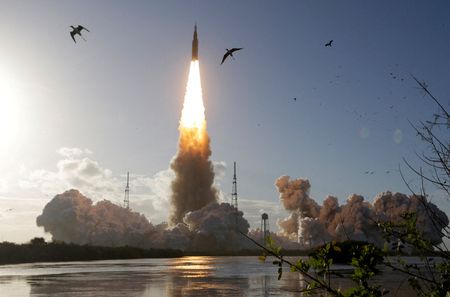

NASA’s historic Artemis II mission has sparked a wave of national enthusiasm that transcends America’s deep political divisions, offering a unifying moment of scientific achievement and shared wonder.
The groundbreaking lunar voyage, representing the first human journey to the moon in more than five decades, has generated widespread excitement through rocket-launch viewing events, educational programs, increased planetarium attendance, and booming sales of space-themed merchandise.
This crucial 10-day test flight serves as preparation for future lunar landing attempts planned for later in the decade, marking the first such mission since Apollo 17’s final moon landing in December 1972. The crew’s anticipated return on Friday via Pacific Ocean splashdown is expected to draw as much public attention as their April 1 departure from Cape Canaveral, Florida aboard the massive Space Launch System rocket.
“Everyone can be excited about humans extending their capabilities, learning new things, and doing so in a positive, peaceful way,” explained Gaza Gyuk, senior astronomer at Chicago’s Adler Planetarium, noting the hundreds of visitors who have come to witness the launch and explore the mission details.
Public enthusiasm for Artemis, NASA’s modern successor to the Apollo lunar program of the 1960s and 1970s, shows up clearly in recent survey results.
According to a Reuters/Ipsos poll conducted during the mission, 69% of Americans express excitement about space exploration, while approximately 80% view NASA favorably, including strong majorities from both major political parties. Similarly, 69% of survey participants believe returning astronauts to the moon holds importance.
Much like the original Apollo era, NASA’s current lunar goals are unfolding during a period of domestic political tension and social unrest, including an unpopular overseas military engagement.
This turbulent backdrop may contribute to Artemis’s broad appeal, serving as both a refreshing break from troubling political coverage and a celebration of American scientific and technological excellence.
Commercial retailers and independent vendors have capitalized on the lunar fever, offering everything from official NASA merchandise to mission-inspired custom items.
Rock ‘Em Socks markets Artemis II socks for $14.99 per pair, featuring the SLS rocket design against a starfield backdrop.
NASA’s own merchandise includes an “I AM ARTEMIS” baseball cap, mission pins, women’s bomber jackets, and playing cards.
The Etsy marketplace features Artemis II keychains, artwork, posters, and $135 custom “dangle and drop” 3D-printed earrings modeled after the gumdrop-shaped Orion spacecraft.
In Elkins Park, a Philadelphia-area community, space enthusiast Hector Ybe, 38, organized a launch celebration that drew approximately 225 attendees, including numerous families with children.
“For two hours, everybody forgot what was happening outside in the world, everybody was talking about space,” Ybe observed, noting the diverse ethnic, religious, and racial representation among participants.
Children arrived in astronaut costumes to witness the launch while older attendees shared memories of watching the historic 1969 moon landing.
The mission provides a positive contrast to widespread concerns that scientific facts face increasing challenges, and that emerging technologies like artificial intelligence and social media platforms inspire distrust and anxiety.
Gyuk highlighted the mission’s new Earth photographs taken from space, showing continents and oceans without political borders as a powerful reminder of human unity.
“That helps people sort of realize that we’re all in this together,” he noted.
Teachers nationwide have woven the Artemis mission into their curriculum.
At Northglenn, Colorado’s STEM Lab public school, engineering instructor Erin Brabant created hallway displays featuring SLS rocket images, astronaut profiles, and mission timelines, while assigning students to construct their own lunar lander prototypes.
“When we talk about Artemis, it’s like every kid stops what they’re doing,” Brabant observed. “Their little side conversations stop, and they have questions.”
The crew’s diversity has particularly inspired students from underrepresented groups, with pilot Victor Glover becoming the first Black astronaut to travel to the moon and mission specialist Christina Koch serving as the first woman on such a journey, according to Brabant.
In Pilot Mountain, North Carolina, fifteen Girl Scouts aged 5 to 11 watched the live launch during their troop gathering last week.
The girls had been preparing Women’s History Month presentations about notable Girl Scouts, and the launch highlighted Koch’s own Girl Scout background, explained troop leader Heather Willard.
“All of the girls were mesmerized,” Willard said.