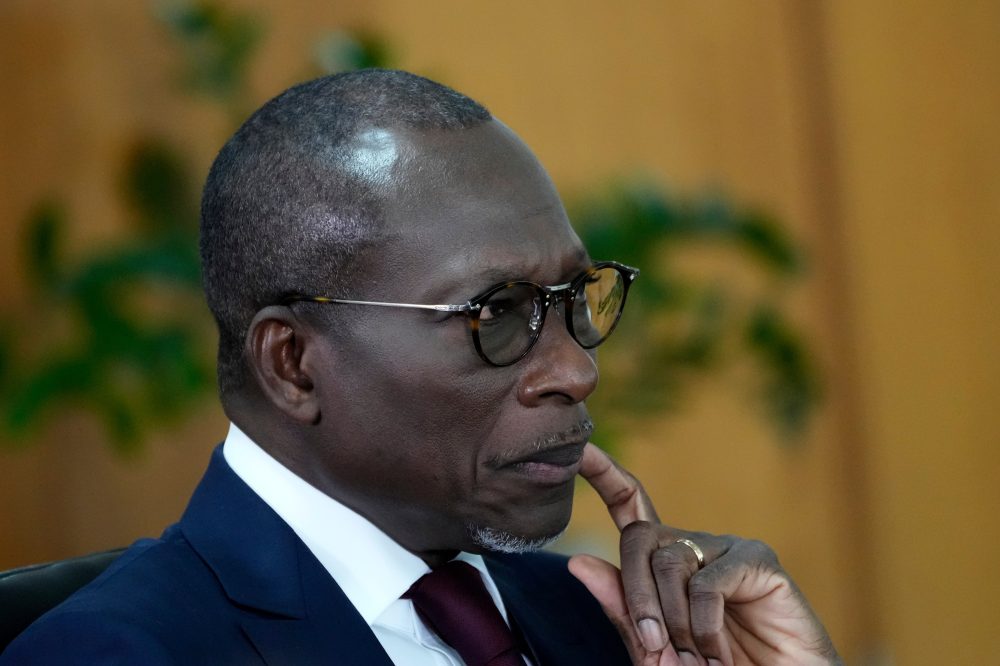

Citizens of the West African nation of Benin cast ballots Sunday in a presidential election as departing President Patrice Talon concludes his ten-year tenure, leaving behind a complex record of economic advancement alongside rising Islamic extremist threats and increased restrictions on political dissent.
Finance Minister Romuald Wadagni, 49, represents the ruling coalition and is viewed as Talon’s chosen heir. His sole challenger is opposition candidate Paul Hounkpè.
The opposition suffered a significant setback in January’s parliamentary elections, failing to reach the required 20% threshold for legislative seats. This left Talon’s two allied parties controlling all 109 National Assembly positions, strengthening their position ahead of Sunday’s presidential contest.
Opposition leader Renaud Agbodjo of The Democrats party was prevented from running after being unable to gather enough parliamentary endorsements—a requirement that critics argue was deliberately designed to exclude challengers.
With major opposition figures excluded from the race, Wadagni enjoys frontrunner status, largely due to his solid economic credentials and backing from influential leaders across traditionally competing factions, according to political analyst Fiacre Vidjingninou from the Lagos-based Béhanzin Institute.
“Ten years at the Finance Ministry have given him something rare in African politics: a quantified record — verifiable and difficult to dismantle in a serious debate,” Vidjingninou said.
The initial voting round takes place April 12. A candidate must capture at least 50% of votes for an outright win, otherwise the top two contenders will face each other in a May 10 runoff.
Close to 8 million citizens are registered to participate in the election.
Wadagni’s campaign emphasizes the nation’s economic achievements during his finance ministry leadership. The International Monetary Fund reports Benin’s economy expanded 7% in the previous year, positioning it among West Africa’s most consistent economic performers.
Throughout Talon’s presidency, the country maintained strong economic growth for almost ten years, fueled by agricultural production, commerce, and significant port development in the commercial center of Cotonou. This expansion transformed Benin into a crucial transportation hub for landlocked neighboring countries, while infrastructure development accelerated nationwide.
Despite these achievements, economic benefits have not been distributed evenly, with widespread poverty persisting in rural communities and the impoverished northern regions.
Although Benin has traditionally ranked among Africa’s most stable democratic nations, opposition politicians and human rights advocates have criticized Talon for weaponizing the judicial system against political rivals following his 2016 inauguration and subsequent electoral law modifications.
Constitutional changes approved in November lengthened presidential terms from five to seven years, created a partially presidentially-appointed senate, and imposed additional barriers preventing opposition parties from gaining parliamentary representation.
International human rights organizations Amnesty International and Human Rights Watch have condemned Talon’s systematic suppression of dissent, documenting unlawful detentions, severe limitations on public gatherings, and increasing pressure on independent news organizations.
Recent years witnessed protests against increasing living costs, which government and security officials aggressively suppressed.
This past December, military officers launched an unsuccessful attempt to overthrow Talon’s administration, representing the most recent in a wave of military coup attempts across the African continent. These coups typically follow similar patterns involving contested elections, constitutional disruption, security breakdowns, and youth frustration.
The coup plotters specifically cited deteriorating security conditions in northern Benin as a primary grievance.
For several years, the country has experienced cross-border violence in its northern territory from conflicts in neighboring Burkina Faso and Niger, where governments battle the al-Qaeda-linked extremist organization Jama’at Nusrat al-Islam wal-Muslimin, known as JNIM.
The three-nation border region has remained a center of extremist activity, a situation worsened by limited security coordination with Niger and Burkina Faso, both currently governed by military leadership.
Islamic militants killed 54 soldiers in an attack on military installations last year.
Vidjingninou observed that while the failed coup attempt has damaged the outgoing administration’s stability reputation, the unstable environment might actually benefit the ruling party’s candidate.
“In a context perceived as unstable, cautious voters tend to choose continuity and familiarity over the risk of the unknown,” he said.
Cotonou civil servant Roch Gbenou identified two primary concerns ahead of Sunday’s election: fair wealth distribution and restoration of democratic liberties, which “appear to have been substantially restricted” recently.
However, Gbenou expressed pessimism about the election, stating it “will ultimately only serve to legitimize a choice already made,” questioning the process’s credibility.
Retired police officer Mathias Salanon praised Talon’s performance and expressed hope that the incoming president would stabilize both economic and political conditions.
“In more than 50 years of my life I have not seen such a fierce will to develop the country as during President Patrice Talon’s 10 years,” he said.
For Cotonou resident Sofiath Akadiri, healthcare access, education, and employment opportunities represent the most critical campaign priorities.
“We also need social justice and the restoration of democratic norms,” she said.