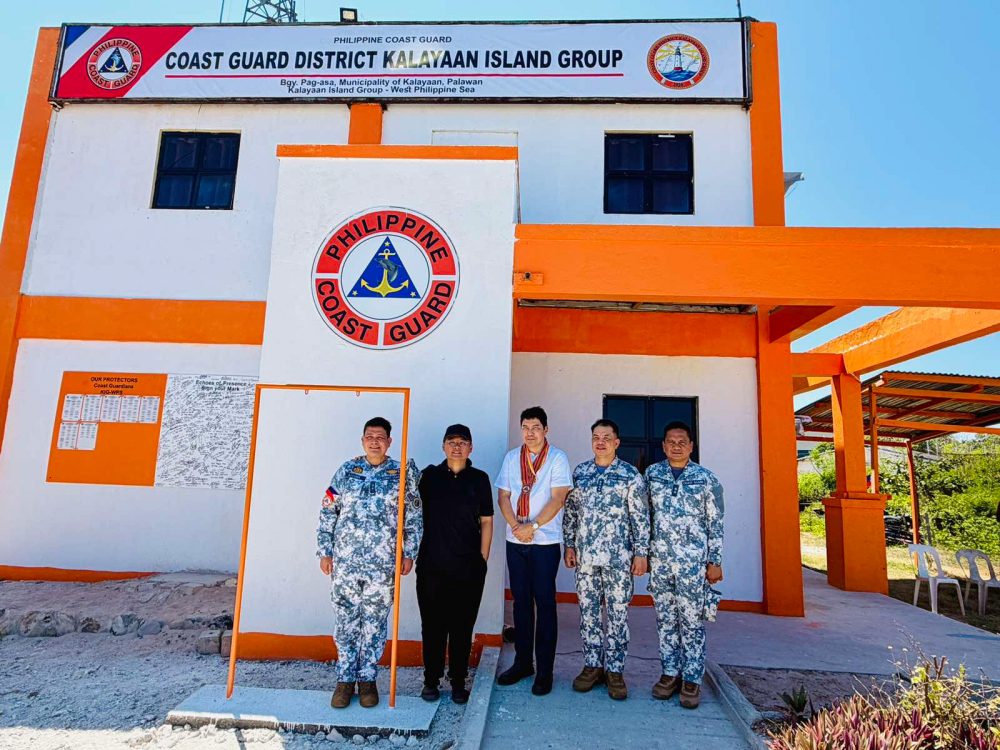

MANILA, Philippines — The Philippines launched a significant coast guard facility Thursday on a South China Sea island, establishing what officials called a “steadfast sentinel of our sovereignty” in waters contested by China.
Beijing has not yet responded to the Philippines’ establishment of its coast guard district headquarters on Thitu Island, an area controlled by Filipino military and residents for many years but also claimed by Chinese authorities.
Vessels from China’s coast guard and affiliated agencies regularly monitor the waters surrounding the island, which Vietnam and Taiwan also claim. Previous encounters between Chinese and Filipino forces in nearby waters have been tense but relatively minor.
Beijing asserts control over nearly the entire waterway, a crucial shipping corridor, despite a 2016 international arbitration decision that rejected its broad territorial claims under the 1982 U.N. Convention on the Law of the Sea. China refused to participate in the arbitration process, dismissed the ruling, and continues to ignore it.
Philippine Transportation Secretary Giovanni Lopez, Senator Erwin Tulfo, and coast guard leader Admiral Ronnie Gil Gavan traveled to Thitu for the dedication ceremony, timed to align with the nation’s Day of Valor observance.
“This is a permanent step for us to show that our coast guard is ready to defend our interest in the waters, our fishermen, their livelihood and, most importantly, our sovereignty,” Lopez stated.
A plaque inside the new coast guard facility described it as “established as the vanguard and steadfast sentinel of our sovereignty, sovereign rights and maritime jurisdiction.”
The new command will operate under a commodore with supporting staff, patrol vessels, and aircraft for law enforcement, surveillance, environmental protection, and rescue operations. Additional smaller coast guard stations will be constructed on other Philippine-controlled formations, according to officials.
The teardrop-shaped Thitu Island, encircled by white sand beaches, is known as Pag-asa — meaning hope in Tagalog — by approximately 400 Filipino residents. It represents one of nine islands, islets, and atolls under Philippine control since the 1970s.
Over ten years ago, China began converting seven contested reefs into military installations in the Spratly Islands. These included Subi Reef, now a major base featuring a military runway located roughly 24 kilometers (15 miles) southeast of Thitu.
“Everyday, our villagers see Chinese coast guard and militia ships all around the island,” stated MP Albayda, who serves as the island municipality’s vice mayor. “This new coast guard district command is a big morale booster for them.”
The Philippines considers the area its most distant offshore community, part of its western Palawan province. Decades ago, it incentivized fishing families to move there with benefits like free rice to strengthen its territorial claims.
The 37-hectare (91-acre) island now features internet and cellular service, improved electricity and water systems, a newly paved airstrip, a dock, elementary school, gymnasium, and storm shelter. Despite these improvements, Thitu remains a modest frontier community compared to China’s developed Subi installation.