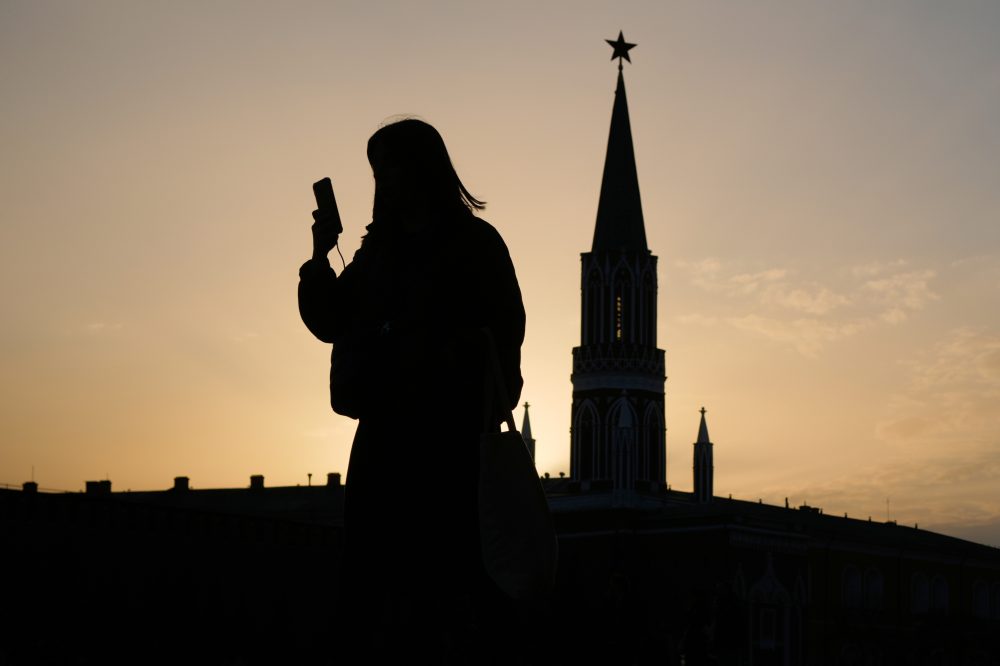

Dozens of Russians gathered outside a government building in Moscow during a bright spring weekend, closely monitored by law enforcement as they submitted formal grievances about escalating digital restrictions.
Citizens were filing complaints regarding the government’s expanding internet controls, which have included regular cellular internet blackouts, blocked messaging applications, and restricted access to thousands of websites and online services.
The demonstration represented another indication of mounting frustration and anger over digital limitations that have disrupted Russian citizens’ everyday routines, damaged commercial operations, and attracted criticism from government allies.
Understanding that unsanctioned protests face severe punishment, advocacy groups have attempted to organize approved demonstrations, posted notices on public boards, and pursued legal action. Business executives have appealed to officials to reverse these policies.
Armenia’s leader even delivered an indirect criticism of Russia during a broadcast meeting with President Vladimir Putin on April 1. Prime Minister Nikol Pashinyan observed that in Armenia, “our social media, for example, is 100% free. There are no restrictions whatsoever.”
Putin responded with a stern expression and slightly elevated eyebrows as he stared at Pashinyan.
The restrictions serve not only to regulate Russians’ online access but have also created chaos in digital services, complicating ride-hailing, delivery orders, electronic payments, and personal communication.
Opposition politician and Kremlin opponent Boris Nadezhdin expressed the sentiment of many frustrated Russians during an Associated Press interview: “This infuriates a huge number of people.”
Russia has pursued complete governmental internet control for years, potentially isolating it from global networks by blocking countless websites, messaging platforms, and social media services that decline to comply with official demands.
Citizens have adapted to bypassing these limitations through virtual private networks, or VPNs, despite government efforts to block these tools as well.
However, restrictions intensified dramatically last year with comprehensive cellular internet shutdowns — and occasionally broadband interruptions — leaving only select websites and applications on government-approved “white lists.”
Authorities justified these extreme actions as necessary to prevent Ukrainian drones from using Russian cellular networks for navigation during Kyiv’s counterattacks in Moscow’s 4-year-old full-scale invasion.
Yet the shutdowns affected distant regions never targeted by Ukrainian drones, with residents and businesses condemning the measures as harmful.
The Kremlin has targeted the nation’s two leading messaging applications — WhatsApp and Telegram — while promoting a government-supported “national” application called MAX, widely regarded as a monitoring device.
Initially, voice and video communications on WhatsApp and Telegram were restricted. Subsequently, text messaging became virtually impossible without VPN access.
Last week, Digital and Communications Minister Maksut Shadayev announced his ministry received instructions to further reduce VPN usage. Unverified media reports indicated his ministry suggested numerous additional anti-VPN measures. The ministry did not respond to AP’s comment request.
Attorney Sarkis Darbinyan, co-founder of the RKS Global digital rights organization, explained to AP that authorities aim to force internet users into a “digital ghetto” of Russian, government-monitored applications and platforms.
“The internet is no longer this universal digital good,” he stated.
Recently, increasing numbers of Russian business leaders have expressed concerns about comprehensive restrictions and encouraged authorities toward more moderate policies.
Alexander Shokhin, president of the Russian Union of Industrialists and Entrepreneurs, informed Putin at a recent organizational forum that cellular internet shutdowns “made life difficult for both businesses and citizens.”
“Given the high level of mobile technology penetration in our lives, we hope that a systemic, balanced solution will be found,” stated Shokhin, a former 1990s government minister and United Russia party member since the 2000s.
Putin appeared onstage with Shokhin and spoke directly after him but avoided addressing the concern.
Similar appeals came from executives of two of Russia’s four cellular providers during a telecommunications conference last week. Beeline’s Sergei Anokhin and Megafon’s Khachatur Pombukhchan suggested that instead of cellular internet shutdowns, operators could identify suspicious users and restrict them individually, according to Russian news agency Interfax.
“This would make life significantly easier for people, for clients,” Pombukhchan stated.
Notable IT entrepreneur Natalya Kasperskaya criticized Roskomnadzor, attributing a recent banking and service outage to its intensified VPN blocking efforts.
“There’s no technical way to block VPNs without disrupting the entire internet,” she posted on Telegram. “So, comrades, take screenshots of interesting websites, withdraw as much cash as possible, and get ready to listen to radio reports about foreign enemies who have blocked our once-beloved RuNet,” — referencing the Russian internet.
Roskomnadzor denied responsibility, and Kasperskaya later issued an apology in another post, but she advocated for communication between authorities and the IT industry, emphasizing that “technical decisions sometimes cause downright shock and a desire to at least get an explanation.”
Activists from Moscow to Far East Vladivostok have attempted organizing anti-internet restriction rallies since late February.
Recognizing that unauthorized protests face harsh suppression and government opponents routinely face imprisonment, they proceeded carefully and requested authorization for gatherings according to strict demonstration regulations. Most applications were denied, and some activists faced arrest on various accusations.
However, citizens managed small demonstrations in several cities. Elsewhere, activists posted flyers and banners on walls and public boards condemning the restrictions.
Opposition politician Nadezhdin, his supporters, and other activist organizations have requested permission for rallies in dozens of cities on April 12, when Russia celebrates Cosmonautics Day, commemorating Yuri Gagarin’s 1961 flight as the first human in space.
“We’re filing for authorization (and saying) we’re marking Cosmonautics Day,” Nadezhdin says with a knowing smile. “Our slogans will be (about the fact that) cosmonautics is impossible without science, technology and progress, and progress, science and technology development is impossible without connectivity, without communication, without the internet.”
Nadezhdin says he remains committed to increasing pressure on authorities despite the crackdown. Public frustration over restrictions is “enormous,” and citizens are prepared to participate in authorized and secure protests, he added.
Moscow-based opposition politician Yulia Galyamina shared his perspective in a video recorded last weekend near the presidential administration, where she and others submitted formal complaints, describing the discontent as “truly widespread.”
“The more there is public outcry over the blocking of the internet, Telegram in particular, and depriving us of the possibility to communicate with each other, interact, express our political position, the bigger the effect will be,” she stated.