
BUDAPEST, Hungary — President Donald Trump’s military actions against Iran have created unexpected friction with European conservative leaders who were once considered strong allies of his America First movement.
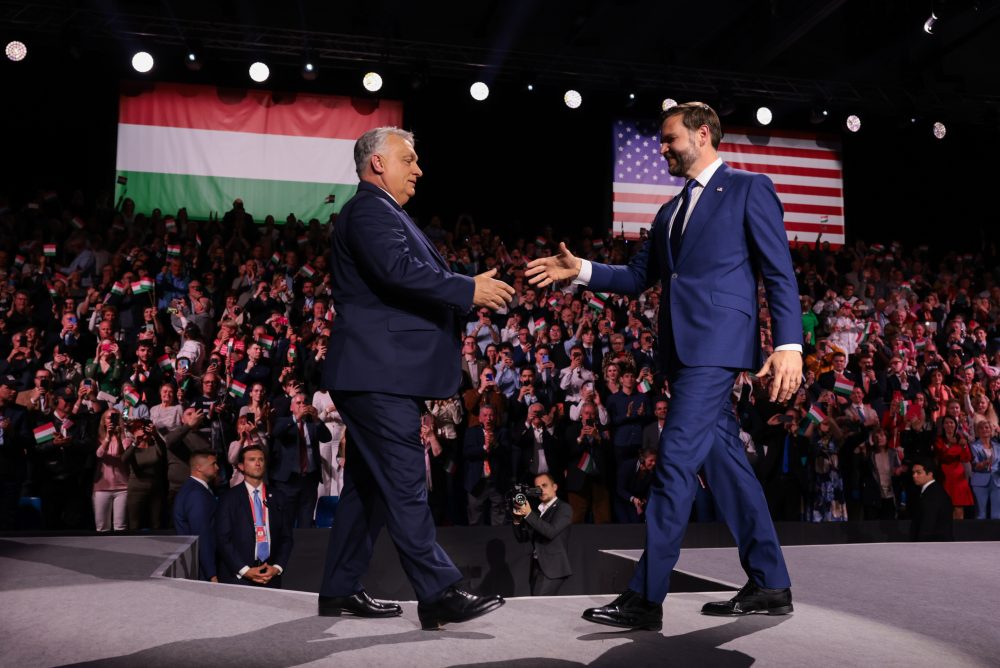
While Vice President JD Vance made a high-profile campaign appearance this week supporting Hungarian Prime Minister Viktor Orbán, such displays of solidarity have become increasingly rare among Europe’s right-wing political figures.
Several prominent conservative leaders across Europe have voiced opposition to Trump’s Iran strategy. Italian Prime Minister Giorgia Meloni blocked American forces from using a Sicilian air base for Iranian operations. Marine Le Pen, who leads France’s National Rally, characterized Trump’s military objectives as “erratic.” Meanwhile, Germany’s Alternative for Germany party leadership has demanded the withdrawal of U.S. military forces from German soil.
Despite a temporary ceasefire with Iran, Trump’s endorsement of Orbán might not benefit the Hungarian strongman, who confronts a challenging election this weekend. Orbán has long served as a model for global conservatives and American right-wing figures who admire his immigration restrictions and governmental restructuring that keeps his Fidesz party in control.
Charles Kupchan, who teaches international relations at Georgetown University and works as a senior fellow at the Council on Foreign Relations, believes Orbán’s historical relationship with Trump might shield him from some European anti-Trump sentiment, though this protection isn’t certain.
“Getting a blessing from Donald Trump is now a mixed blessing,” Kupchan stated.
The Iranian conflict backlash follows widespread European anger over Trump’s earlier threats against NATO member Denmark, demanding the country surrender Greenland to American control.
Trump connected both controversies on Wednesday, criticizing NATO’s lack of support during recent military operations.
“NATO WASN’T THERE WHEN WE NEEDED THEM, AND THEY WON’T BE THERE IF WE NEED THEM AGAIN,” Trump posted on social media. “REMEMBER GREENLAND, THAT BIG, POORLY RUN, PIECE OF ICE!!!”
Daniel Baer, who served as an ambassador and State Department official during Barack Obama’s presidency, believes this latest European tension demonstrates the limitations of Trump’s efforts to build a global nationalist movement.
“Building some sort of international coalition around national chauvinism is very difficult,” explained Baer, currently affiliated with the Carnegie Endowment for Peace. “It’s clear the majority of people in these countries, if not anti-American, have turned anti-Trump.”
Orbán has distinguished himself by refusing to join the growing European opposition to Trump.
During a recent interview with British conservative outlet GB News, Orbán suggested uncertainty about Trump’s Iran strategy, questioning “whether (Trump) has started a war or a peace.”
“It hasn’t (been) decided yet, historians will make a decision on that,” Orbán explained. “I think we need some time to understand whether we are moving to the peace by these strikes, or just the opposite. It’s too early to say.”
Orbán’s reluctance to criticize Trump extends beyond ideological alignment. The Hungarian leader has spent years convincing voters that his personal relationships with Trump and other world figures like Russian President Vladimir Putin make him uniquely qualified to advance Hungary’s global interests.
He has consistently highlighted Trump’s endorsements to his supporters and built his reelection campaign around promises that his Trump administration partnership guarantees national security and economic growth.
Orbán welcomed Vance’s visit enthusiastically this week. The vice president condemned European Union critics of Orbán for what he termed “foreign interference” in Hungarian elections while actively campaigning for the prime minister.
During a Wednesday appearance at a prestigious Hungarian university that receives significant government funding and operates under the prime minister’s political director, Vance addressed what he called a “fragile truce” in the Iran conflict.
Vance commended the institution for being “an institution that tries to build up the foundations of Western civilization.” The Trump administration has pursued similar influence over American elite universities, mirroring Orbán’s Hungarian educational policies.
Some experts question Orbán’s approach, pointing to declining American approval ratings even within Hungary.
“Vance’s visit could have the opposite effect on Orbán’s popularity than the one intended,” observed Mario Bikarsku, who analyzes European politics for risk intelligence firm Verisk Maplecroft.
Kupchan argues that most European far-right movements have developed independent political strength without American support and may lack motivation to support Trump’s policies.
“Trump’s effort to create a transnational movement of far-right populists may affect the margins, but the main reason you’re seeing Reform U.K. and AfD and National Rally and other far-right parties prosper has little to do with Trump and more to do with national factors,” he explained.
This reflects a worldwide trend against incumbent governments. While this has generally helped opposition far-right parties across Europe, it threatens Orbán’s position after 16 years in power.
“We’re living in an age,” Kupchan concluded, “where being an incumbent sucks.”