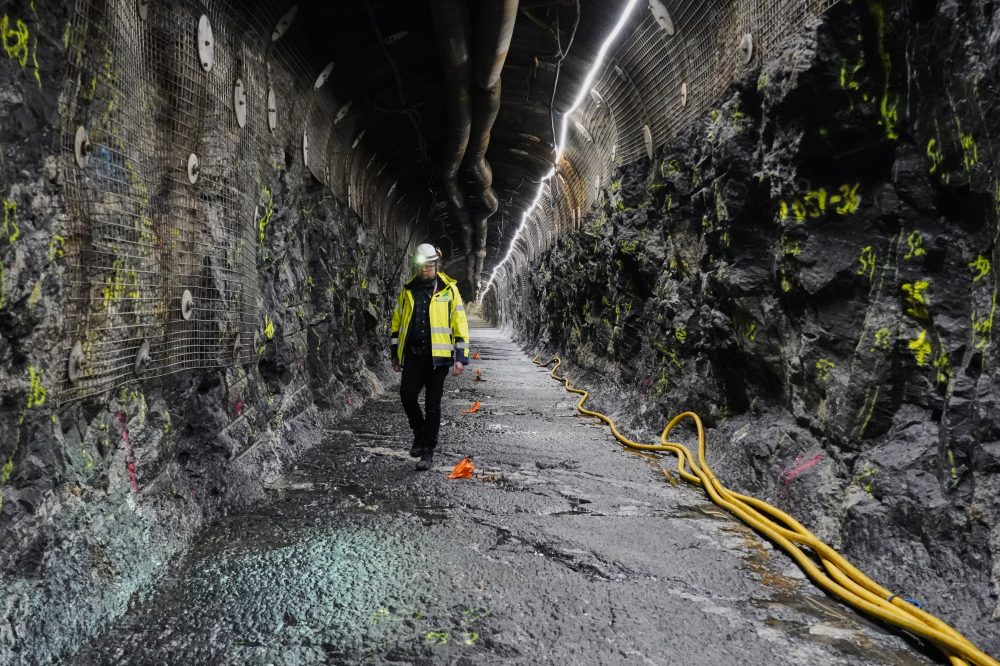

OLKILUOTO, Finland — Deep beneath the Finnish countryside, an elevator plunges hundreds of meters into darkness, reaching a groundbreaking facility that could reshape how the world handles nuclear waste.
“We are now at about minus 430 meters (1,411 feet),” said geologist Tuomas Pere as he navigated through a maze of artificial tunnels. “We are driving through 1.9-billion year old bedrock.”
Following years of development, Finland stands ready to activate the globe’s first permanent nuclear waste burial site, creating a final destination for massive quantities of hazardous radioactive materials.
Work on Onkalo — the Finnish word for “cave” — started along the western coastline in 2004. The facility occupies the remote Olkiluoto island within a thick forest. The nearest community, Eurajoki, lies approximately 15 kilometers (9.3 miles) away and houses roughly 9,000 residents, many employed at the nuclear plant or storage complex.
The 1 billion euro ($1.2 billion) venture may soon receive approval, with officials anticipated to issue operating permits in the coming months.
The Associated Press explored these underground chambers where human access will soon be permanently prohibited.
Pere explained that officials selected this location — adjacent to three of Finland’s five nuclear reactors — due to its migmatite-gneiss rock foundation, recognized for exceptional stability and minimal earthquake danger.
“It’s the isolation from civilization and mankind on the surface that’s important,” he explained while standing in a darkened storage tunnel destined for permanent sealing. “We can dispose of the waste more safely than by storing it in facilities located on the ground.”
Through automated equipment at a neighboring packaging facility, radioactive fuel rods will be enclosed within copper containers before burial in deep tunnels exceeding 400 meters underground, surrounded by protective layers of water-absorbing bentonite clay.
Posiva, the corporation managing Finland’s long-term nuclear fuel disposal, reports that Onkalo can accommodate 6,500 tons of used nuclear fuel.
The burial containers are engineered to stay intact “long enough for the radioactivity of spent fuel to decrease to a level not harmful to the environment,” according to the company.
“The solution that we have, it’s the missing point for sustainable use of nuclear energy,” stated Posiva communications manager Pasi Tuohimaa.
Finnish nuclear operators are funding the initiative, he noted, explaining they have accumulated resources for decades specifically for this purpose.
Posiva calculates that hundreds of thousands of years will pass before radiation levels return to natural background amounts.
A 2022 International Atomic Energy Agency study found that nearly 400,000 tons of used fuel have been generated worldwide since the 1950s, with two-thirds sitting in temporary storage and one-third undergoing complex recycling procedures.
Currently, global spent nuclear fuel remains in temporary storage within reactor pools and above-ground dry storage containers.
No permanent underground commercial nuclear waste facility exists anywhere else worldwide. Sweden started constructing a repository in Forsmark — roughly 150 kilometers north of Stockholm — last year, though operations won’t begin until the late 2030s. France’s Cigéo project hasn’t started construction and faces public resistance.
The Onkalo installation is scheduled to function until the 2120s before permanent closure.
However, Edwin Lyman, nuclear power safety director at the Union of Concerned Scientists, an American nonprofit, cautioned that underground nuclear waste disposal remains filled with “uncertainties.”
“My view of nuclear waste disposal is that there’s no good option, but it’s important to find the least bad option, and geologic disposal in general is going to be the least bad option among a range of, you know, bad options,” he explained.
Lyman noted that copper containers holding spent nuclear fuel will eventually deteriorate, with varying scientific views on the timeline for this process.
“The hope is that is such a slow process that most of the radioactive material will have decayed away by then. But again, there are uncertainties,” he said.
Nevertheless, Lyman emphasized that burying spent nuclear fuel deep underground surpasses “leaving it on the surface of the Earth forever,” since surface-stored nuclear materials remain “vulnerable to sabotage.”
“For many decades after spent fuel is discharged from a reactor, it’s so radioactive that it makes transporting and reprocessing very difficult,” Lyman explained. Eventually the primary radioactive elements will decay, he added, reducing handling risks.
“So over time the plutonium becomes more accessible either to terrorists or to a country that may want to use it,” he said, noting that terrorists or nations could theoretically weaponize the material only with “an off-site reprocessing capability.”
Reprocessing involves separating spent nuclear fuel to extract uranium and plutonium for new fuel production. This procedure creates proliferation dangers because isolated plutonium could potentially be redirected for nuclear weapon construction.
Ultimately, nuclear waste repository risks will primarily impact “future generations,” Lyman concluded.
To address this concern, researchers have established nuclear semiotics, an interdisciplinary study focused on creating warning systems about nuclear waste sites that humans could understand 10,000 years from now — or longer, considering the hundreds of thousands of years needed for nuclear waste to become safe.
For perspective: early humans appeared roughly 300,000 years ago. Mesopotamians developed the first writing systems approximately 5,200 to 5,400 years ago. Britain’s Stonehenge dates back around 5,000 years, while Egypt’s Giza pyramids are about 4,500 years old.
Austrian artist and inventor Martin Kunze has directed an expert panel on long-term information preservation at the Nuclear Energy Agency of the Paris-based Organization for Economic Cooperation and Development. He has created what he terms the “nuclear message” — essential information for future generations etched onto solid ceramic plates beneath hardened glazed surfaces.
Kunze described the ceramic plates as “inexpensive and very robust” and recommended burying them “in large numbers” throughout the repository area and “inside the foundations” of every local residence. The objective involves distributing maximum ceramic plates across the region.
Finnish authorities say the Onkalo nuclear repository demonstrates the nation’s comprehensive nuclear energy strategy.
A 1994 law mandated that radioactive waste produced in Finland must be processed, stored and permanently disposed of within national boundaries.
“Back then… some of the waste was still exported, but we wanted to take care of it ourselves,” said Sari Multala, Finland’s environment minister. “We also stick to the decisions, unlike many other countries.”
Multala didn’t dismiss potentially accepting small quantities of nuclear waste from other nations. “In the small scale there could be some kind of possibilities, as long as it is allowed by the international regulators,” she said.