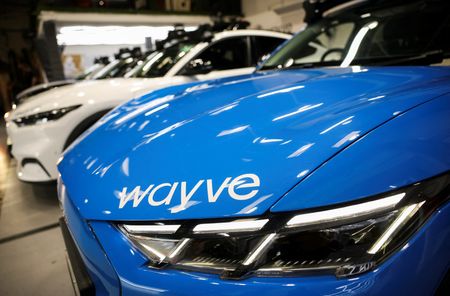

A London-based autonomous driving startup called Wayve is generating significant buzz in the tech and automotive worlds, backed by $2.8 billion from investors and partners that include Nvidia, Mercedes-Benz, and Nissan. Most recently, in June, the company announced its system will be used in robotaxis made by Stellantis — the company behind the Jeep brand — operating on Uber’s ride-hailing platform.
What makes Wayve stand out is its use of a technology called end-to-end machine learning. Rather than relying on pre-written rules and detailed maps to tell a car what to do, this approach feeds raw sensor data directly into an AI system that figures out driving decisions on its own — much the way a human driver processes what they see and reacts in real time.
This puts Wayve in similar territory to Tesla, which also adopted an end-to-end AI model several years ago. The key difference is that Tesla relies exclusively on cameras, while Wayve built its system to be compatible with a broad range of sensors and AI chips — making it potentially licensable to almost any driverless vehicle developer.
“We want to make full self-driving possible for any vehicle, any brand, and anywhere around the world,” said Wayve CEO Alex Kendall, speaking to Reuters earlier this year from the driver’s seat of a Ford Mustang Mach-E equipped with Wayve’s technology as it drove autonomously through neighborhoods in the San Francisco Bay Area. Kendall, a 33-year-old from New Zealand, co-founded Wayve in 2017, the same year he earned his doctorate in AI deep learning from Cambridge University in England.
The broader autonomous driving industry is experiencing renewed energy after years of broken promises and missed timelines. Much of that renewed interest has been sparked by the rapid growth of Alphabet’s Waymo, which now offers paid rides to the public in roughly a dozen cities after more than a decade of development.
End-to-end AI, once a niche concept explored by only a handful of researchers — including Kendall himself — has now become a mainstream approach that many autonomous vehicle developers are incorporating into their systems.
Still, the technology comes with a significant challenge: because end-to-end AI systems operate somewhat like a “black box,” it can be hard to understand exactly why the vehicle made a particular driving decision. Earlier systems, which used traditional software coding to guide vehicles, made it easier to trace the reasoning behind specific choices.
Wayve’s AI driving system generates what the company calls a safety map, identifying secure paths through evolving traffic situations. Wayve engineers argue that heavily coded, rule-based systems are actually less safe in unusual circumstances because it’s nearly impossible to write rules for every strange scenario a driver might encounter.
When those rare, hard-to-predict situations arise, the logic of a pre-programmed system “becomes brittle,” according to Wayve’s vice president of AI, Vijay Badrinarayanan. “Human drivers remain safe because they adapt conservatively when they do not know what comes next,” he told Reuters.
Waymo, which also uses end-to-end AI, still combines it with traditional rules-based coding and mapping, saying that combination remains necessary for safety. “End-to-end models aren’t enough to guarantee safety at scale,” the company said in a statement to Reuters.
One of Wayve’s current customers, Nissan, is still working through its comfort level with the approach. Nissan’s tech chief, Eiichi Akashi, said his team is carefully evaluating Wayve’s technology ahead of a planned rollout in Japan on a people-mover van called the Elgrand, slated for the fiscal year ending March 2028. He described Wayve’s system as the “most advanced” available, but acknowledged it is “difficult to peer into it and see how it makes decisions.”
Wayve CEO Kendall believes the company’s model — with major operations in Tokyo, Stuttgart, and Vancouver — allows it to enter new markets far more quickly than competitors because it doesn’t require the time-consuming process of pre-mapping roads or writing code to handle local driving quirks. Wayve says it has already tested its system in hundreds of cities worldwide without that kind of preparation.
Experts offer a measured view of the technology’s promise. Siddartha Khastgir, a professor of safe autonomy at the University of Warwick in England, said end-to-end models should reach the market faster than traditional approaches, but cautioned, “I wouldn’t say that one technology is safer than the other.”
Phil Koopman, a computer engineering professor at Carnegie Mellon University and an expert in autonomous technology, said Wayve’s method is just one of several potentially viable approaches. Even so, he believes it will take at least another decade before driverless systems can be safely deployed at scale across the United States. “It will most likely demand new innovations to get us there,” he said.