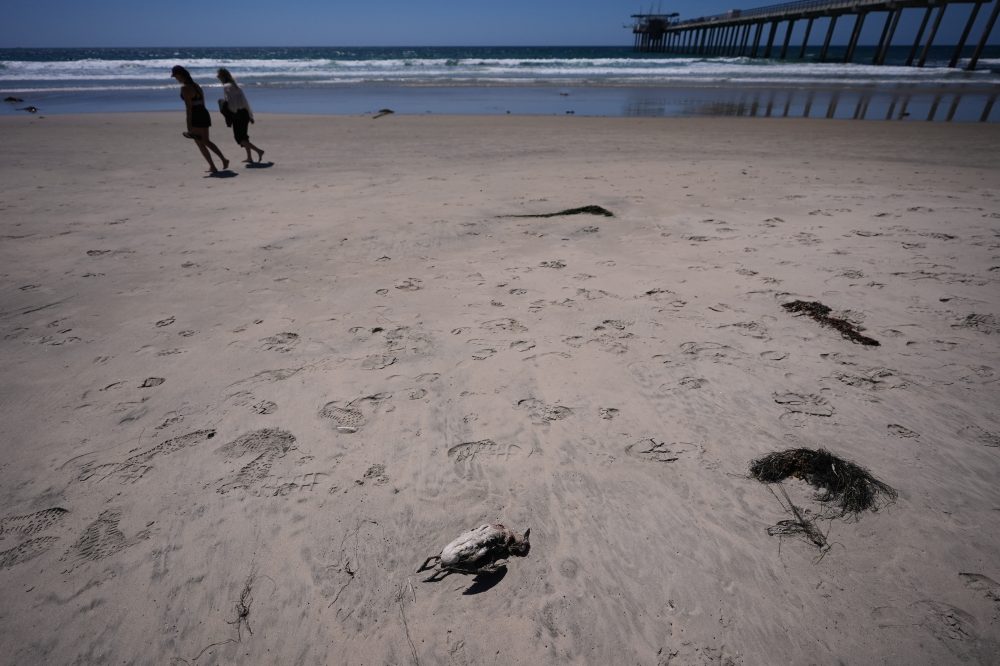

SAN DIEGO — Within just a few minutes of stepping onto a San Diego beach, marine ornithologist Tammy Russell began discovering dead seabirds — one lifeless body after another, some buried in washed-up kelp and others tucked beneath rocks.
Every month, researchers and volunteers walk these shores to tally the fallen birds. What they find, according to Russell, paints a disturbing picture of the toll being taken by a powerful marine heat wave that has gripped portions of the California coastline for months.
These beach surveys, conducted by various organizations over the course of decades, help establish a long-term baseline of data on stranded sea life — allowing scientists to spot emerging threats and measure their severity.
Numerous seabird species — among them California brown pelicans, loons, and grebes — have died of starvation in recent months. The cause, according to Russell, a postdoctoral scholar at the University of California, San Diego, Scripps Institution of Oceanography, is record-breaking ocean temperatures that have shrunk the band of cold, nutrient-dense surface water where prey like krill, anchovies, and sardines typically thrive near shore.
“We’ve been seeing cormorants walk to shore and then just die within the hour. I mean one time it happened within 15 minutes, and I’ve never seen that before,” Russell said. “That has been heartbreaking for me and we’re seeing this happening across the whole coast.”
Now scientists are worried the situation could deteriorate further. A new El Niño — the natural warming of portions of the central Pacific Ocean that disrupts weather patterns worldwide and drives up global temperatures — has recently taken shape. The U.S. National Oceanic and Atmospheric Administration confirmed the El Niño’s formation in June and has projected it could grow to historic intensity.
Seabird die-offs do happen from time to time, and not every death recorded along the California coast this year can be directly linked to the heat wave, according to scientists and wildlife officials. However, experts warn these events are happening with greater frequency as the planet heats up and ocean temperatures rise.
The current marine heat wave has already persisted along parts of the West Coast for a full year — only the third time on record that such an extensive stretch of coastal water has remained warm for that long, according to NOAA.
Scientists at Scripps track daily water temperatures at 10 coastal stations along California, with records spanning more than a century. This year, three of those stations broke temperature records for 40 or more consecutive days, said Melissa Carter, who oversees the monitoring program. Temperature readings are gathered through various methods, including dropping insulated buckets off piers, early morning surf measurements by lifeguards, and samples collected by researchers along rocky coastlines.
Robotic underwater gliders equipped with sensors also recorded elevated temperatures both offshore and at depth during the spring. Dan Rudnick, who manages the Scripps glider program, noted that the warm temperature anomaly off Southern California this past spring was comparable to what was recorded during the last El Niño in 2023 — and that was before this year’s El Niño even formed. The current El Niño could extend into 2027.
As cold-water species migrate deeper and push farther north, the combination of the marine heat wave and El Niño threatens to further unravel food chains for marine life ranging from gray whales to seabirds. A comparable pattern unfolded roughly a decade ago.
“We don’t know how bad this is going to get,” said Russell, who has also written about five species of Booby birds now regularly appearing off California due to warming ocean conditions.
Wildlife rehabilitation centers were flooded with hundreds of severely underweight birds this spring as the heat wave intensified.
“It’s not abnormal to see dead birds on the beach, but the quantity of dead birds is unusual,” said J.D. Bergeron, CEO of International Bird Rescue, a global wildlife conservation organization that operates two aquatic bird rehabilitation centers in California, in a May interview.
Bergeron also noted that brown pelicans are now turning up in inland lakes. “When birds starve, especially the pelicans, they start to look in unusual places for food,” he said. “They will chase fishing boats, they will go to piers and you end up with birds with fishing line and fish hook injuries.”
Most of the dead or weakened seabirds examined this year have been young and malnourished, and the vast majority have tested negative for avian flu, according to the California Department of Fish and Wildlife. Some showed signs of secondary infections linked to starvation.
Krysta Rogers, a senior state environmental scientist, said factors beyond warm water temperatures may also be at play. High death rates among young Brandt’s cormorants and common murres followed a strong 2025 breeding season, peaked after winter, and appeared to align with the heat wave’s timeline. Rogers suggested many of those deaths may simply reflect chicks failing to survive independently. That said, she does not rule out the heat wave’s role, pointing to a spring surge in reported deaths across multiple species — not just juveniles.
The U.S. Fish and Wildlife Service, which collects data from the dead seabird surveys and other sources, said a comprehensive report is not yet complete.
The current situation echoes what happened in 2013, when a warm water mass nicknamed “the blob” formed off Alaska and spread southward, persisting for years and devastating marine ecosystems as far south as Mexico’s Baja California peninsula. One of the most powerful El Niños ever recorded overlapped with it in 2015.
During that period, emaciated common murres began washing up on beaches in what biologists have identified as the largest seabird die-off ever documented in the world’s oceans.
Common murres resemble slender penguins. They are capable of flying long distances to find schools of small fish and can dive nearly 600 feet (183 meters) underwater to catch them. But their fast metabolism demands constant fueling — if they fail to consume prey equal to 10% to 30% of their body weight each day, they can exhaust their fat reserves and hit a starvation threshold within just three days.
Research has shown that only a small fraction of birds that die at sea ever wash ashore. It took scientists years to determine that more than half of Alaska’s common murre population — an estimated 4 million birds — perished during “the blob” event, according to a 2024 study published in the journal Science. That species is still working to recover.