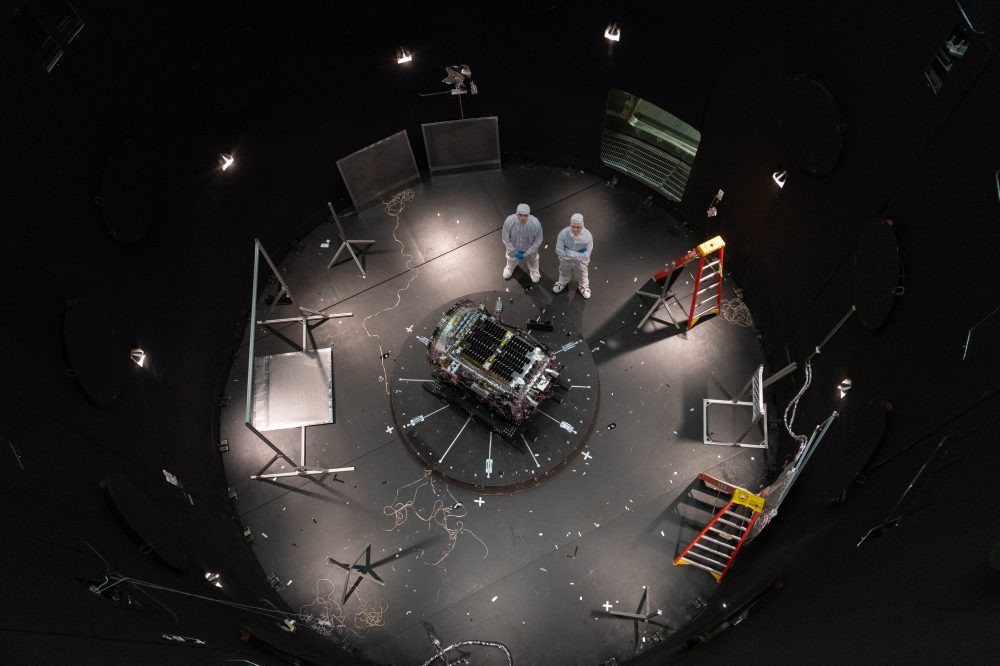

A specially designed three-armed spacecraft lifted off Friday on an ambitious mission to save a NASA telescope that is gradually losing altitude and risks crashing back into Earth’s atmosphere.
Northrop Grumman launched Katalyst Space Technologies’ Link spacecraft from the Marshall Islands in the Pacific Ocean. The Pegasus rocket carrying Link was released from beneath a modified aircraft before igniting and sending the spacecraft into orbit. Link is expected to intercept and capture NASA’s Swift Observatory within approximately one month.
The Swift telescope, which has been in operation since 2004, has been losing altitude more rapidly than usual due to a series of recent solar storms. NASA is spending $30 million for Katalyst to grab hold of the telescope and push it into a higher orbit, allowing it to continue its work studying some of the most powerful events in the universe — including gamma ray bursts and exploding stars.
If the mission succeeds, Swift could resume scanning the cosmos as early as September. For now, all observations have been paused in order to conserve the telescope’s remaining orbital altitude.
NASA’s Hubble Space Telescope may face a similar situation in the coming years. It too is slowly dropping in altitude due to increased atmospheric drag caused by heightened solar activity.
Swift currently weighs about 1.6 tons and is orbiting approximately 224 miles above Earth. Katalyst’s plan is to raise the telescope’s altitude by 150 miles, returning it to roughly where it started. The Link spacecraft will use its thrusters to gradually push Swift higher, avoiding any sudden jolts that could damage the observatory.
Katalyst assembled the entire mission in just nine months — a remarkably short timeframe. NASA pushed for the accelerated timeline because the telescope will drop too low to be saved if a rescue attempt is not made before autumn. Without a boost, Swift was projected to re-enter the atmosphere and be destroyed in October.
A string of bad weather and last-minute technical problems caused several delays before the launch finally took place.
Katalyst Space CEO Ghonhee Lee spoke about the stakes before liftoff: “This is a high-risk, high-reward mission. The biggest danger was always we don’t launch anything and we let Swift burn up in the atmosphere. So we were always trying to avoid that risk, and our team has done that.”