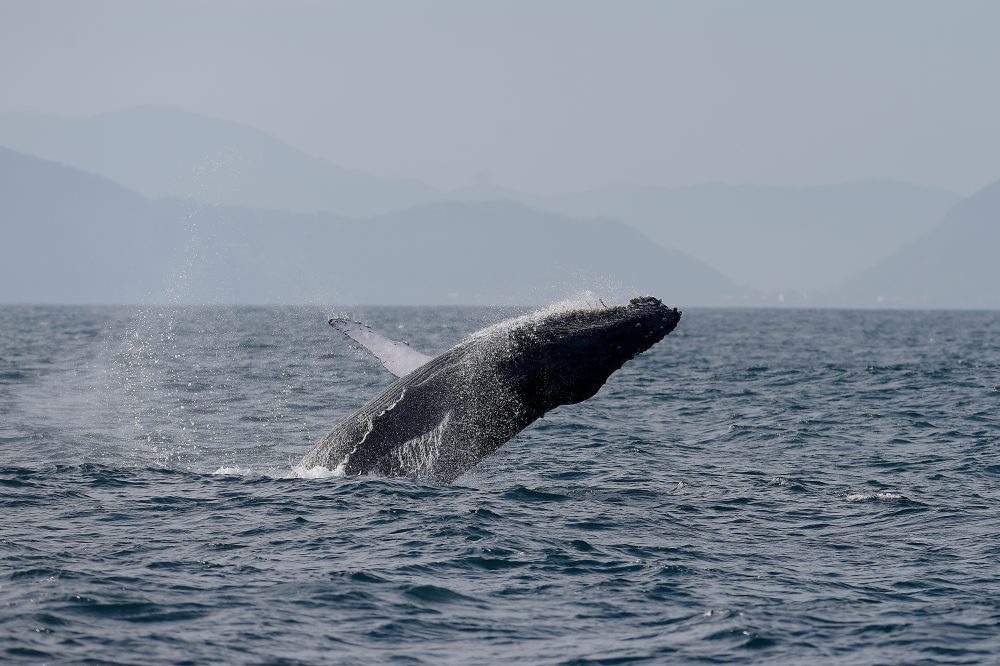

RIO DE JANEIRO — The waters off Rio de Janeiro are seeing a remarkable comeback story, as humpback whale sightings along the coast continue to climb following decades of population recovery after commercial whaling nearly wiped out the species.
According to Enrico Marcovaldi, co-founder of the Humpback Whale Project, the species’ numbers have grown from approximately 2,000 to around 35,000 over roughly 40 years — a figure approaching their pre-whaling population levels. As a result, the whales are being spotted with increasing frequency in Rio’s famous Guanabara Bay.
“It’s wonderful. It shows that the whales are making a recovery, are healthy and thriving, and hopefully they’ll continue to do so,” Marcovaldi said.
The turnaround traces back to 1982, when the International Whaling Commission voted to halt commercial whaling across all whale species and populations, with the ban taking effect beginning in the 1985/1986 season.
The whales’ growing presence hasn’t gone unnoticed by local entrepreneurs. Louise Raulais, who operates the Rio Ocean Club alongside her partner Theo Andrade, has begun capitalizing on the trend. This year, the company launched sailboat tours for groups of five to ten passengers to observe the whales up close. Raulais said a biologist is always on board to educate guests, with the goal of inspiring conservation efforts.
“These animals are so iconic and charismatic that they have the power to transform people, to change the way they see the world,” Raulais said.
Humpback whales are well-known for their long-distance migrations across major ocean basins, typically following routes passed down from mother to calf. During warmer months they feed on krill and small fish, then move to tropical waters during winter to breed.
Each year between June and November, thousands of humpback whales pass through Brazilian waters on a roughly 2,500-mile (4,000-kilometer) journey from their feeding areas in the Southern Ocean to breeding and calving grounds off northeastern Brazil.
The majority of the whales congregate around the Abrolhos Bank, a coral reef area stretching along the coasts of Bahia and Espirito Santo, considered one of the most biologically diverse marine environments in the South Atlantic.
The Humpback Whale Project launched a scientific expedition — scheduled to run from June 26 through July 9 — aimed at studying the animals’ behavior, size, and overall health, while also mapping their travel routes, key gathering spots, and how far from shore they tend to travel.
“They’re exploring this area,” said Pedro Fróes, a biologist with the Humpback Whale Project who is taking part in the expedition. “They want to find out whether, in the future, it could become a place for them to rest, to mate, or to give birth to a calf,” Fróes added.