
SEOUL, South Korea — When Lee Geon Hui wanted to give his father a meaningful gift, he came up with something far from ordinary. His father, who raised him alone and sacrificed greatly as a single parent, deeply missed Lee’s late grandfather. So Lee hired a Seoul-based technology company to bring that grandfather back to life — digitally.
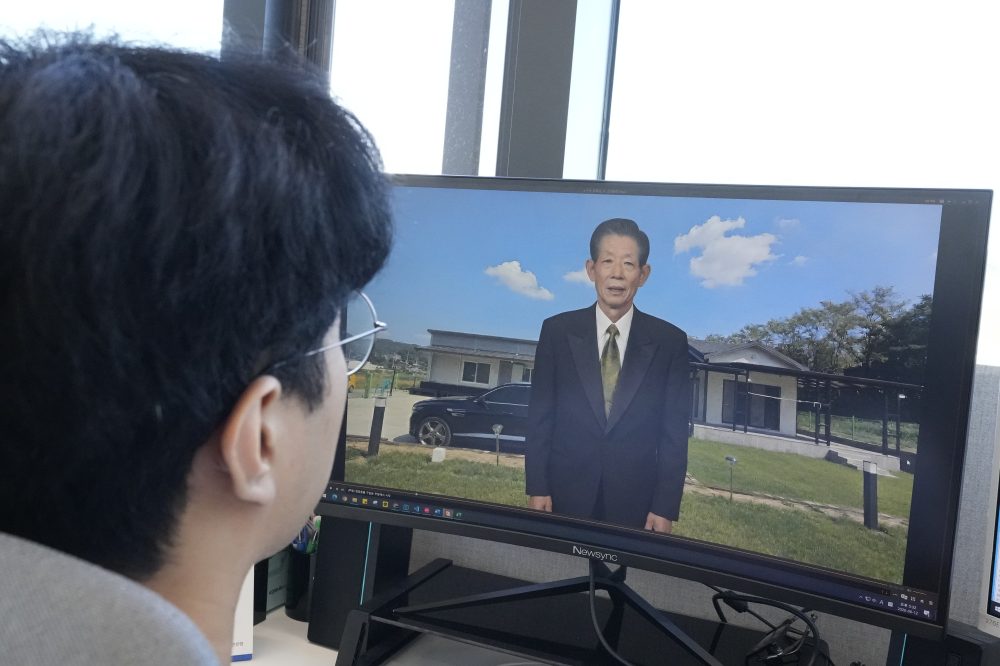
In December, Lee, 28, worked with the tech firm Vaice to produce a short AI-animated video clip featuring a digital version of his grandfather delivering a heartfelt message. In the video, the virtual likeness referred to Lee’s father as “my most precious son,” offered an apology for putting him to work on the farm as a child, and expressed regret for having opposed his son’s dream of becoming a hairstylist.
“My father said he wouldn’t watch the video. But then he did, and he shed tears. So I felt rewarded,” said Lee, an office worker. “I wrote the script … as it was what I actually wanted to tell my father.”
Lee’s story is not unique. A rising number of tech-savvy South Koreans are exploring AI’s power to recreate the deceased on screen. Several startups now offer services that produce video likenesses of late loved ones, and television programs have featured AI-generated versions of dead celebrities, including pop stars and actors.
The trend is generating both hope and concern. Supporters say the technology can bring comfort to people who are grieving, while critics raise difficult questions about the ethics, psychological impact, and legal implications of simulating the dead.
“It’s a double-edged sword, as it deals with human emotions,” said Yong Man Ro, an AI specialist at the Korea Advanced Institute of Science and Technology. “As AI technologies become part of people’s lives, they can also bring about cultural experiences and shocks that we have never experienced.”
Vaice’s CEO, Jeongu Won, said the company handles around 300 clients per month. Most are people in their 40s or 50s seeking videos of their deceased parents, while others — like Lee — commission videos of late grandparents to give as gifts to their own parents.
Won explained that creating a likeness requires only a handful of photographs and brief audio samples of the deceased. A standard video running three to five minutes is priced at 600,000 won, which comes to roughly $390.
Customers often play these AI videos during family memorial gatherings or major Korean holidays, Won said. Clients typically write the scripts themselves, and most include the phrase “I love you.” Some also address unresolved conflicts with their late parents or express hopes for healing.
Lee’s grandfather passed away unexpectedly in a car accident before Lee was even born. Lee said he sensed that his father carried regret — that he never got the chance to show his grandfather that he had succeeded as a hairstylist and had a son of his own.
“I don’t know much about my grandfather. But when I saw tears running down my father’s face, I felt a bit emotional as I realized my father still misses him,” Lee said.
Another company, JL Standard, launched a comparable service five years ago. According to company executive Choi Yu Ha, it initially faced skepticism from some grieving potential customers who worried the technology would reopen their wounds. However, acceptance has grown, partly driven by the appearances of deceased celebrities in AI-simulated form on television.
Won said he has not received any reports from customers saying the videos made their grief more difficult to handle.
Still, observers caution that recreating the dead digitally raises serious ethical concerns and could put vulnerable individuals at risk by blurring the boundary between what is real and what is virtual.
Choung Wan, an emeritus professor at Kyung Hee University Law School in Seoul, said legislation is urgently needed to protect the dignity and rights of deceased individuals. He argued that laws should prohibit creating AI versions of people who objected to such use before their death, and should place firm restrictions on the commercial use of a person’s image and voice.
Looking ahead, experts say the ethical challenges could become even more complicated as the industry moves toward so-called “griefbots” or “deathbots” — AI systems capable of simulating two-way conversations between a bereaved person and a digital version of someone who has died. Some startups are already testing these products.
“Psychologically, a healthy mourning involves a process to acknowledge the absence of the deceased and pass through the pains of their losses,” Choung said. “But speaking with an AI system simulating a living person could undermine the process of accepting deaths and rather cause a negative effect of leaving bereaved families trapped in a fantasy.”
Won said he is proceeding carefully when it comes to launching an AI chatbot service, noting that real-time conversations cannot be monitored by company staff and could lead to unforeseen ethical issues.
Nevertheless, both the technology and public acceptance of it continue to advance rapidly.
Choi noted that technological improvements now allow companies to replicate even fine details like wrinkles and skin pores, and that customers are increasingly saying the AI likenesses truly resemble their loved ones.
Ro said interactive chatbots still face technical obstacles, including mismatches between what the AI says and its facial expressions, as well as a tendency to seem less convincingly human as conversations grow longer.
“Some people ask why we can’t have an hour-long conversation with chatbots, though we can talk with them for five minutes. There are efforts to develop the technology to make an hour-long conversation possible,” Ro said.
Ro shared that he personally created a one-minute AI video featuring likenesses of both of his parents after they died last year, and screened it at a family gathering with his siblings. Seeing digital versions of their parents say “Don’t worry” and “Take care” moved the entire family deeply.
Even so, Ro said neither he nor his siblings have watched it since. “One time was enough to watch it to honor our late parents who were quite elderly. We moved on,” he said.