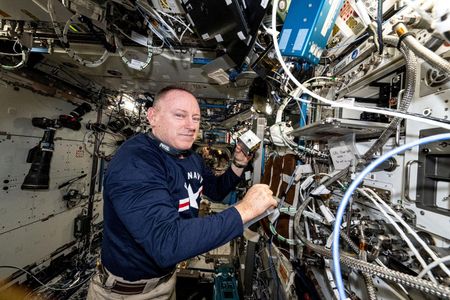

A biotechnology firm says it has reached a significant milestone in space-based medicine, successfully operating a 3D bioprinter aboard the International Space Station to create structures made up of human liver, kidney, and cartilage cells.
San Diego-based Auxilium Biotechnologies announced that a recently finished mission represented the first time liver and kidney tissues had ever been bioprinted in space. The cells used in the experiments were provided by researchers at Wake Forest University, according to Auxilium co-founder Jacob Koffler of the University of California, San Diego.
The central challenge the team tackled is one that has long frustrated tissue engineers working on Earth: getting cells to land precisely where they need to be inside a three-dimensional structure. Koffler compared the problem to blueberries sinking to the bottom of muffin batter — when cells cluster in the wrong spots or spread unevenly, the resulting tissue may not work correctly.
In real organs, cells occupy very specific positions. Scientists on Earth have not yet found a reliable way to control exactly where those cells end up, Koffler explained. In the microgravity environment of space, however, that level of control becomes achievable.
Auxilium first sent its bioprinter to the space station in 2024, originally with the goal of improving the company’s nerve-repair implants, which are currently in clinical trials. The company needed a way to distribute drug-containing particles evenly throughout those implants so that healing compounds would be released consistently as nerves regenerate. Because gravity causes the particles to sink under normal conditions, the team turned to the space station’s microgravity environment as a solution.
In the most recent mission, Auxilium sent up specialized bio-inks to expand its work into tissue printing. Koffler’s team monitored the process from Earth through cameras on the station and was able to send updated instructions to the printer when needed.
The liver and kidney tissue samples created on the ISS returned to Earth roughly two weeks ago and are currently being studied.
Dr. Anthony Atala of the Wake Forest Institute for Regenerative Medicine, whose team supplied the liver and kidney cells, commented on the results. “The uniform cell distribution achieved aboard the space station points to real possibilities for manufacturing medical devices and tissues in space,” he said.
Koffler noted that the structures produced are not functioning organs. He expects the field will first focus on smaller tissue patches capable of repairing damaged organs — such as a section of the liver — before scientists attempt to bioprint complete replacement organs.
The project also reflects a broader surge of commercial interest in manufacturing products in space, particularly as NASA moves toward eventually retiring the International Space Station. Auxilium has already signed agreements with companies that are developing commercial space stations and other orbital platforms intended to take the ISS’s place, Koffler said.
Space-manufactured medical products are still a long way from being used in patients. Regulatory frameworks are only beginning to be established, and Koffler said he participated in a U.S. Food and Drug Administration workshop on space biomanufacturing earlier this year.
“It’s going to take some years until we get to the clinic,” he said. “But it’s important to start building that framework now.”