
SRINAGAR, India — Each morning, slender wooden boats known as shikaras glide gracefully across the wide expanse of Dal Lake, set against a breathtaking backdrop of the Himalayan mountains. It looks like a scene from a travel brochure — but beneath that beauty, a crisis is unfolding.
Pollution from nearby structures, invasive plant species, and dropping water levels — driven in part by a warming climate — are putting the future of Dal Lake and hundreds of other lakes across Indian-controlled Kashmir in serious jeopardy.
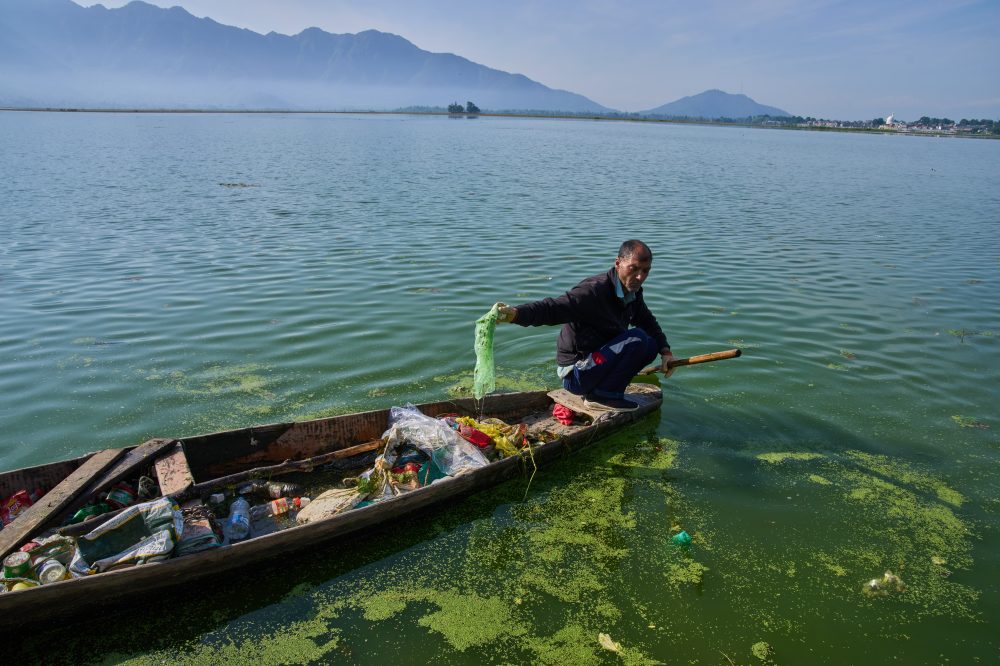
Keeping Dal Lake’s weed growth under control requires constant, daily labor from government-employed workers, who must wear protective gloves to avoid skin reactions from the contaminated water. Dal Lake, situated in Srinagar, Kashmir’s most populated city, is actually among the fortunate ones — it’s one of the few lakes in the region receiving any meaningful restoration efforts.
“We are afraid to touch the water with bare hands. Whenever we need to clean something by hand, we wear gloves, because without them our hands quickly develop allergies,” said Ghulam Rasool, a weed cleaner who works for the local government.
Rasool described the work as sometimes feeling hopeless. “Sewage drains flow directly into the lake, and water streams coming from the mountains are bringing waste such as diapers and other garbage,” he said.
Across India, a combination of climate shifts, contamination, and poorly planned development is speeding up the degradation of lakes — with consequences felt by ecosystems, fishing families, and the regional tourism industry alike.
A report released last year by the Indian government revealed a troubling picture: of the region’s 697 natural lakes, 315 have entirely disappeared and 203 have diminished in size since 1967. Many lakes documented in earlier decades have been reduced to shallow marshes, seasonal wetlands, or have been swallowed up by farmland and construction.
Kashmir’s lakes have historically been bustling centers of commerce and culture. Dal Lake’s floating markets, where vendors sell produce and souvenirs from their boats, are legendary. But in recent decades, the lakes have been shrinking — squeezed by unpredictable rainfall, increased sediment washing in from rivers, and the steady creep of farms and homes onto what was once open water.
From the air, the encroachment onto Dal Lake is clearly visible. Cattle now graze on newly formed patches of land while traditional fishers work nearby. Small islands of farmland and wooden bridges leading to unauthorized homes have become increasingly common sights.
Untreated sewage feeding into the lakes fuels weed growth, as the plants thrive on the nitrogen, phosphorous, and other nutrients found in waste. Plastics and trash further foul the water. Dozens of workers attempt to clear Dal Lake’s weeds daily, and small piles of removed vegetation dot the lakeshore. Heavy equipment including excavators is also brought in to pull weeds and debris from the water.
Local government officials acknowledged that more funding and effort are needed, but said they are doing what they can. A government lake authority, established in 1997, brings together civil engineers, scientists, forest officials, and law enforcement.
Muzamil Ahmad Rafiqui, superintending engineer for Kashmir’s Lake Conservation and Management Authority, noted that while more than 75% of Srinagar’s residents are connected to sewage treatment systems, waste from homes that aren’t connected remains a significant source of lake pollution.
The Himalayan region is warming faster than the global average, driven by some of the hottest years ever recorded worldwide. Earlier snowmelt, reduced snowfall totals, and more intense rain events are disrupting both the timing and the volume of water that flows into rivers and lakes.
Sher Muhammad, a glaciologist with the Kathmandu-based International Centre for Integrated Mountain Development, explained that these unpredictable patterns mean lakes now experience sudden surges of water followed by extended dry spells. Melting glaciers are also sending more sediment downstream into the lakes. While glacial melt can temporarily boost water flow, experts warn it will ultimately reduce the natural water reserves that keep rivers and lakes alive during dry periods.
“It has impacted every sector of our economy,” said Irfan Rashid, an environmental scientist at the University of Kashmir in Srinagar. He noted that hydropower generation, tourism, and the region’s prized apple and saffron industries have all suffered from increasingly erratic and extreme weather.
At Wular Lake, roughly 65 kilometers (40 miles) northwest of Srinagar, fishermen describe a lake that has grown shallower and more fragmented by vegetation. Parts of the surrounding area have been converted to tree plantations. Getting around by boat has become more difficult, and fish populations have declined sharply.
Abdul Rasheed, a 45-year-old fisherman, said his daily earnings have collapsed. He once brought in around 1,000 rupees (about $11) per day. Now, after a full night of fishing, he earns only 100 to 200 rupees — roughly $1 to $2. “There are a lot of changes since my childhood,” he said.
Like many other Kashmir lakes, Wular has been hemmed in by farming and residential development, while untreated sewage and agricultural runoff have degraded its water quality. In several areas, the lake’s surface is covered in a green, murky film. The most recent thorough study of Wular Lake, carried out by conservation group Wetlands International in 2007, found the lake had lost 45% of its size over the previous century. That report also warned that the lake’s decline raises flood risks in the Kashmir valley, since it has historically served as the largest natural buffer against overflow from the Jhelum River.
Many fishermen at Wular say they doubt the next generation will be able to make a living from fishing. Bashir Ahmed, 55, who has worked the lake for decades, recalled that in years past, even an inexperienced young person could come home with 4 kilograms (nearly 9 pounds) of fish. “Now even a skilled fisherman comes home with no more than 1 kilogram (2.2 pounds),” he said.