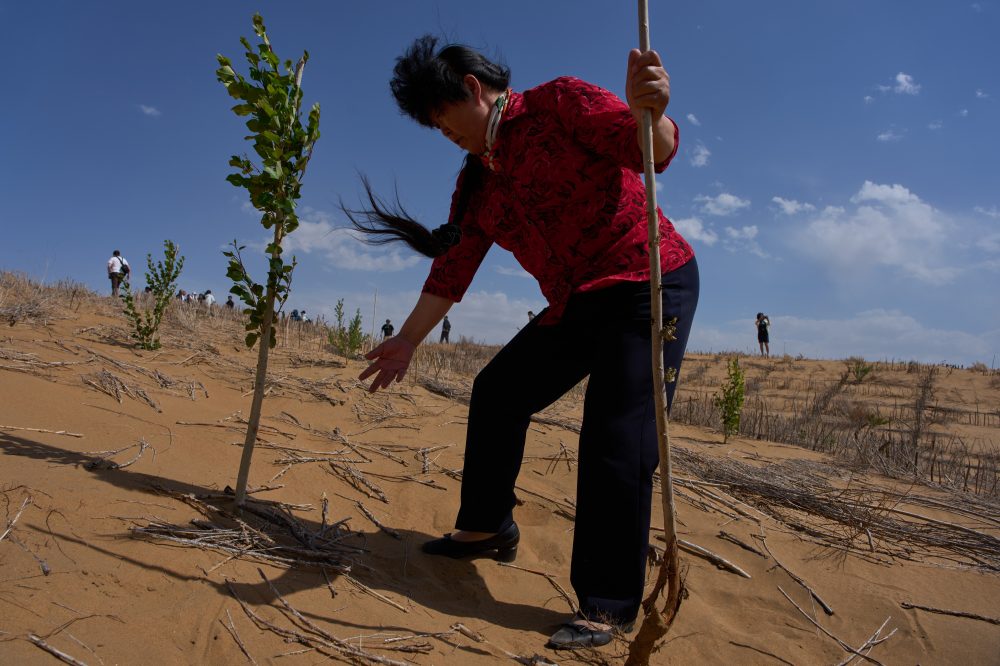

KUBUQI DESERT, China — For the past 50 years, millions of laborers across northern China have performed the same painstaking task: pushing forearm-length sticks into shifting sands, first in one direction, then crossing them to form a grid pattern. Once the grid is in place, young trees are planted at the center of each small square.
This method, called “straw checkerboards,” is a straightforward but highly effective approach to anchoring sand dunes against wind erosion. Combined with irrigation systems that deliver water to the plants, the technique has become central to China’s massive anti-desertification campaign known as the Three-North Protective Forest Program — or more popularly, the Green Great Wall.
Generations of effort have produced real, measurable results, though scientists are quick to point out that protecting those gains will require many more decades of sustained work.
Over a long period, drought, overgrazing, and farming stripped the land of vegetation, damaged the soil, and left vast areas exposed to fierce winds and sandstorms — a process known as desertification. That spread of desert conditions in northern China reached its worst point in 2000, but since then, the amount of desertified land has been reduced by more than 1,000 square kilometers, or about 400 square miles, every year, according to figures released by Chinese state media.
The Chinese government says the program, which got its start in 1978, has been central to transforming enormous stretches of land covering nearly half the country — shifting from a reality of “desertification advancing and people retreating” to one of “greenery advancing and the desertification retreating.” Forests planted under the program now span a total of 500,000 square kilometers, or roughly 200,000 square miles.
“The broad significance of the Three-North Program is not only the scale of restoration, but the long-term political commitment behind it,” said Barron Joseph Orr, chief scientist for the U.N. Convention to Combat Desertification. In written comments to The Associated Press, he noted that turning back desertification is achievable when it becomes embedded in long-term development strategies.
Similar efforts are underway elsewhere in the world. A project launched in Africa in 2007 aims to plant trees across multiple countries to help hold back the expanding Sahara Desert.
According to Zhu Jiaojun, a scientist at the Institute of Applied Ecology within the Chinese Academy of Sciences who has spent years working on the program, the results stem from the dedication of frontline workers combined with strong national planning and significant government funding. He also noted that some regions have seen increased rainfall in recent years, which has made it easier to restore plant life.
“The achievement of desertification combat is due to people’s hard work and a bit of luck with climate,” Zhu said.
Long-term monitoring data collected by Zhu’s research team shows that China’s total desertified land area has shrunk by roughly 10% since 2000, while land classified as severely or extremely desertified has fallen by more than 40%. Forest coverage within the program’s zone has climbed from approximately 5% in 1978 to 14% as of 2022.
During a recent media tour organized by the government to the Kubuqi Desert — located about 800 kilometers, or 500 miles, west of Beijing — a 60-year-old sand-control worker named Yin Yuzhen described her early years on the job as “very lonely.” Working with her husband near her hometown in the adjacent Mu Us desert, she said even the smallest signs of life were a source of joy.
“Even the passing of a bird across the sky made me happy,” she recalled.
She described conditions four decades ago when blowing sand was so dense it was difficult to see even a short distance ahead.
“But now we can see the sun. We can see the green in the distance. We can see the road,” Yin said.
Today, she and her husband work each morning from sunrise until noon, tending to trees and repairing or replacing checkerboard grids. Their children pitch in as well, along with local volunteers from time to time.
Zhu estimated that more than 300 million rural workers have taken part in the program over the years, most of them on a paid, part-time basis.
Orr noted that ecosystems restored in dry regions can gradually become more self-sufficient over time, but they still need careful management and ongoing monitoring. He said success hinges on factors like water availability and soil health.
The environmental group Green Camel Bell, based in Gansu province, works with farmers and herders to raise awareness about desertification and its dangers, plants trees alongside community members in dry areas, and helps sustain vegetation over the long term.
“Efforts to combat desertification and restore forests should be linked to local livelihoods, so communities do not see economic development and ecological protection as an either-or choice,” said the group’s founder, Zhao Zhong.
Orr echoed that view, saying restoration projects are far more likely to succeed when local communities can also benefit economically from the work.
Zhu identified a central question facing the program going forward: how can conservation be maintained if the level of human effort and government investment eventually decreases?
“This is what we are very concerned with and this is also the biggest challenge,” he said.
For Yin, her greatest hope is that younger people will carry on the mission she has devoted her life to.
“We need to teach young people to love this Earth. If we love it with all our hearts, nature will love us in return,” she said.