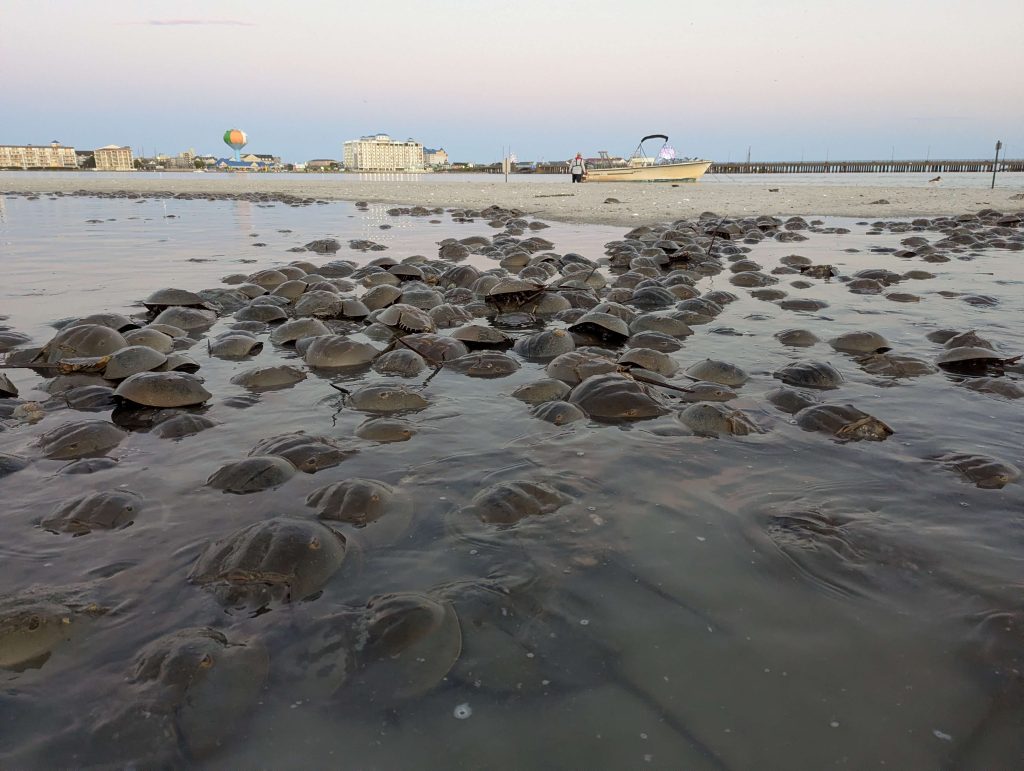

Beneath the glowing lights of the Ocean City boardwalk’s Ferris wheel and Slingshot ride, thousands of prehistoric creatures made their way onto a quiet stretch of beach — a ritual they and their ancestors have performed for hundreds of millions of years.
Horseshoe crabs are considered participants in the oldest wildlife migration on Earth. Every year between May and July, these ancient arthropods return to beaches along Maryland and the East Coast to find mates — a journey they’ve made through mass extinctions and the shifting of continents, long before humans ever walked the planet.
“The horseshoe crabs are on,” said Steve Doctor, a Maryland Department of Natural Resources fisheries biologist, during one June spawning night. “It’s ‘Jurassic Park’ out there.”
Doctor has led Maryland’s horseshoe crab management program since 2003. Each summer, he takes a team of DNR biologists out to Ocean City spawning sites on eight separate nights to conduct counts. The creatures add to their mysterious character by spawning specifically on nights around the full moon and new moon, when tidal conditions are at their peak.
This counting effort is part of a broader, ongoing monitoring program involving biologists across Maryland and other coastal states focused on the Atlantic horseshoe crab in the Delaware Bay region — where the species is most densely concentrated. The eggs horseshoe crabs deposit in the sand each year serve as a vital food source for numerous shorebird species passing through the Mid-Atlantic during migration.
The large numbers of horseshoe crabs now appearing on Maryland beaches represent a genuine conservation turnaround. After populations in the Delaware Bay region fell sharply during the 1990s, a study published in October in Marine and Coastal Fisheries determined that the species had recovered in the region by 2023, following protective management steps taken by Maryland, Delaware, New Jersey, and Virginia.
An ancient creature facing modern pressures
With its rounded shell and rigid spike-like tail, a horseshoe crab resembles something out of a natural history museum exhibit. Despite the name, these creatures are not true crabs or crustaceans — they’re more closely related to spiders and scorpions. They belong to an order of arthropods called Xiphosura, which have inhabited the world’s oceans for roughly 450 million years.
Over that vast span of time, horseshoe crabs have changed remarkably little. Fossils from the Jurassic Period, dating back 148 million years, are nearly identical to the horseshoe crabs found on the East Coast today. Scientists have given them the label “stabilomorph” — a term describing their extraordinary evolutionary consistency. Horseshoe crabs are so well-adapted to their environment that they simply haven’t needed to change much.
Four species of horseshoe crabs exist today — three in Asia and the Atlantic horseshoe crab, which ranges from Nova Scotia, Canada, down to the Yucatán Peninsula in Mexico. Despite surviving for hundreds of millions of years, the species has struggled in modern times due to habitat loss and overharvesting. Some populations, such as the tri-spined horseshoe crab in Japan, are now considered critically endangered.
Trouble signs emerged in the 1990s, when shorebird counts around the Delaware Bay began to drop. At the same time, the Marine and Coastal Fisheries study noted, horseshoe crab harvests in the region had climbed significantly.
In the United States, horseshoe crabs are harvested mainly as bait for American eel and whelk fishing. Biomedical companies also collect a regulated number of horseshoe crabs, draw blood from them, and return them to the water. The crabs’ distinctive blue blood contains a protein capable of detecting bacterial contamination in medical devices, vaccines, and pharmaceuticals.
A surge in demand for eel and whelk sent horseshoe crab harvest numbers skyrocketing — nearly 600% coastwide between 1990 and 1997. The ripple effects were felt among shorebirds that rely heavily on the crabs’ protein- and fat-rich eggs during migration. Red knot sightings plummeted from around 50,000 birds in the late 1990s to roughly half that number just a decade later.
In response, the Atlantic States Marine Fisheries Commission launched a horseshoe crab management plan in 1998. Doctor noted that the framework was distinctive because it was designed to protect multiple species simultaneously — both red knots and horseshoe crabs.
A comeback story, with some unresolved questions
In the years that followed, New Jersey placed a complete ban on the commercial harvest of horseshoe crabs, while Maryland, Delaware, and Virginia established reduced harvest quotas for male crabs and prohibited the harvest of females altogether.
Those protections have paid off. The most recent stock assessment from the Atlantic States Marine Fisheries Commission estimated 16 million adult female and 40 million adult male horseshoe crabs in the Delaware Bay region. The Marine and Coastal Fisheries study concluded that overall population levels are now comparable to where they stood in 1990, before the heavy harvests and subsequent decline.
Data gathered from trawl surveys conducted in New Jersey, Delaware, Maryland, and Virginia showed that horseshoe crab numbers fell from the 1990s through 2005 and stayed low until around 2010, before climbing steadily through 2023 — when the population matched or possibly surpassed 1990 levels.
“When the population did recover, it did at a faster rate than we expected,” said Doctor, who was a co-author on the study. “Once it started to recover it just took off.”
However, the red knot population hasn’t followed the same upward trajectory. Red knot numbers have remained stable but haven’t grown. Scientists believe this could reflect a delayed response to the horseshoe crab recovery, or it may point to other factors independently affecting red knot populations.
The Atlantic States Marine Fisheries Commission currently considers the horseshoe crab stock to be in good shape in the Delaware Bay and in the southeast. The New England population is considered stable, while numbers in the New York region remain poor.
As part of Maryland’s obligations under its agreement with the commission, state biologists track horseshoe crab spawning each year through an annual survey in the Ocean City inlet area. DNR also carries out seine and trawl surveys, programs that have been running continuously since 1972.
“We try to keep a pretty tight rein on what’s going on with them,” Doctor said.
During the June new moon — the peak spawning period in Maryland — DNR biologists visited Skimmer Island in the inlet, a beach on Assateague, and a beach at the southern end of Ocean City to tally crab numbers. Working alongside a Maryland Coastal Bays Program scientist and volunteers, the team walked the shoreline, setting out measured sections and counting horseshoe crabs within each area to estimate the total population present.
As biologists carefully stepped around them, the horseshoe crabs stayed focused on their ancient mission. Males trailed behind larger females as the females searched for the right spot to nest. Once settled, each female buried thousands of eggs in the sand to be fertilized by nearby males — completing a cycle far older than recorded history, and adding another generation to the horseshoe crabs that have long called the beaches of Ocean City home.