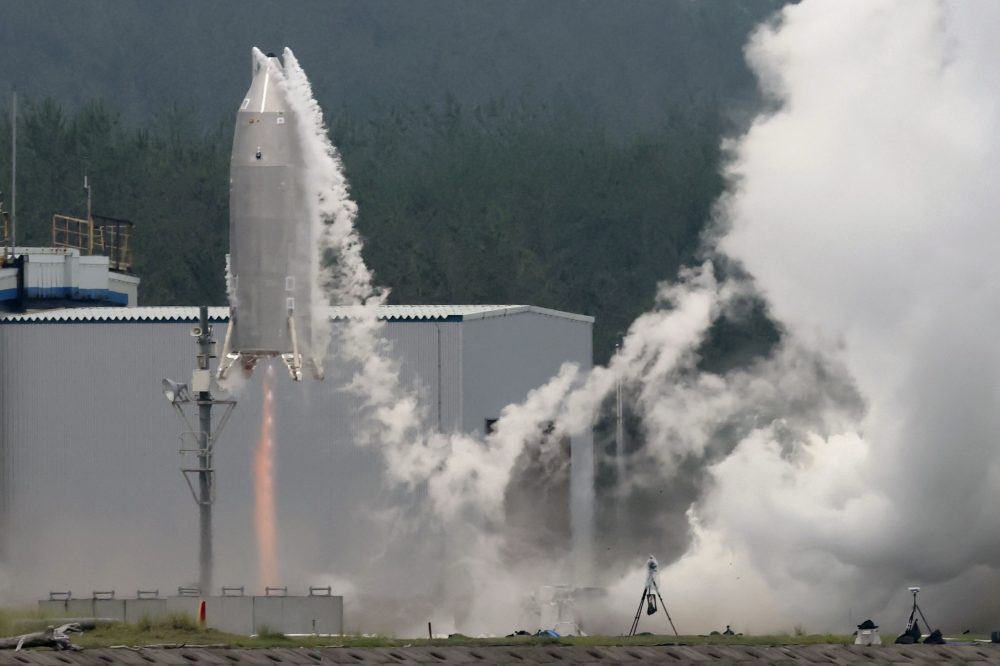

TOKYO (AP) — Japan took a major step in its space ambitions Saturday when an experimental reusable rocket successfully lifted off and touched back down during its very first test flight. The achievement is part of the country’s effort to master technology that could dramatically lower the cost of sending payloads into space and help it compete in a global market currently dominated by SpaceX.
The rocket, known as the RV-X, climbed into the air, hovered briefly, moved sideways, and then landed safely — all within a flight lasting less than one minute. The test took place at the Japan Aerospace Exploration Agency’s Noshiro Testing Center in northeastern Japan and was broadcast live by NVS, an organization made up of space enthusiasts.
JAXA was expected to hold an online briefing later Saturday to share details about the results of the test.
The goal is for Japan to catch up with the reusable rocket capabilities that Elon Musk’s SpaceX has been employing for years to bring down the expense of space launches. Saturday’s test brings Japan one step closer to developing a more affordable successor to its current primary rocket, the single-use H3 series.
The timing is notable — the test came just one day after state media in China reported that the country had successfully recovered the first stage of a rocket following a launch of its own.
Japan’s H3 rocket was already designed to be more economical than the previous H-2A series, which had an impressive success record. However, officials say further cost reductions are still needed to remain competitive on the world stage.
The Japanese government has stated that building a reliable, commercially viable launch capability is essential both to the nation’s space program and its national security interests.
The RV-X was jointly developed by JAXA and Mitsubishi Heavy Industries. The rocket measures 1.8 meters (5.9 feet) across and stands 7.3 meters (23.9 feet) tall. It features engines built for greater durability and is equipped with four landing legs designed to absorb the shock of touchdown.
Looking ahead, JAXA — which is also working on reusable rocket development alongside France and Germany — plans to fly the RV-X to a much higher altitude of around 100 meters (218 feet) in future tests.