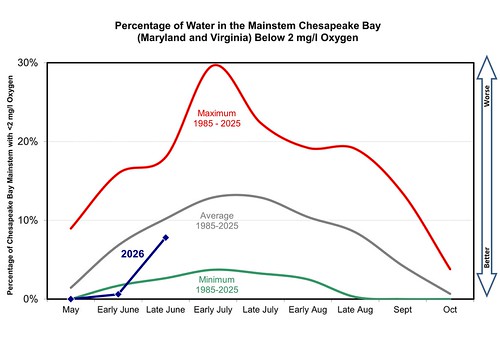

New data gathered by the Maryland Department of Natural Resources and Old Dominion University reveals that the Chesapeake Bay is off to its healthiest start in recorded history when it comes to dissolved oxygen levels. Measurements taken from May through late June 2026 across the Maryland and Virginia portions of the Bay’s mainstem show hypoxia — defined as water containing less than 2 milligrams per liter of oxygen — running well below historical norms.
In May, no hypoxia was detected at all, placing 2026 among only ten years out of the past 42 where May monitoring found zero hypoxic conditions. Early June set an all-time record low for that period, with hypoxic volume measuring less than one-tenth of a cubic mile — the lowest ever recorded for early June in 38 years of data. By late June, hypoxia climbed to just under one cubic mile, but that figure still fell below the long-term historical average of 1.27 cubic miles. Neither May nor early June showed any anoxia — water with less than 0.2 mg/l of oxygen — while late June recorded just 0.05 cubic miles of anoxic water.
The data, ranked from best to worst conditions across 42 years of monitoring, shows May 2026 tied for first place with a hypoxic volume of zero, compared to the historical average of 0.18 cubic miles. Early June ranked first out of 38 years at 0.076 cubic miles, far below the average of 0.85. Late June came in 14th out of 36 years at 0.97 cubic miles versus the 1.27 average.
Researchers point to ongoing drought conditions as a major factor behind the improved water quality. According to the U.S. Geological Survey, water flow into the Bay has been running below average since August 2025 due to persistent dry conditions across the watershed. Less water flowing in means fewer nutrients — specifically phosphorus and nitrogen — entering the Bay. Those nutrients are what feed algal blooms, which in turn consume oxygen in deeper Bay waters when they die and break down.
A seasonal forecast issued by Chesapeake Bay Program partners noted that from January through April 2026, river flow into the Bay ran 32% below the long-term average, while nitrogen levels came in 39% lower than typical, totaling roughly 59 million pounds of nitrogen according to monitoring station estimates. The forecast had predicted Bay hypoxia volumes would run about 31% below the long-term average this season — a prediction that current monitoring results appear to support.
However, scientists caution that conditions could shift. Since the late June measurements were taken, air temperatures across the watershed have reached record highs, and seasonal storms are expected to pick up. Warmer water naturally holds less oxygen, and increased freshwater flowing into the Bay could cause greater stratification — a layering effect that prevents oxygen from mixing down into deeper waters — while also carrying additional nutrients.
Dissolved oxygen is essential for the Bay’s wildlife. Crabs, fish, oysters, and countless other species depend on adequate oxygen levels to survive. Scientists and resource managers track hypoxia volumes and how long those conditions last in order to assess potential harm to Bay ecosystems.
Efforts to cut nitrogen and phosphorus pollution from industrial operations, wastewater treatment, farmland, and urban runoff continue as part of the long-term strategy to improve Bay health. The Maryland Department of Natural Resources calculates hypoxia volumes each year from May through October using water quality data managed in partnership with the Virginia Department of Environmental Quality, with funding support from both states and the Chesapeake Bay Program. Monitoring will continue through the summer, and additional water quality information is available through the Eyes on the Bay website.