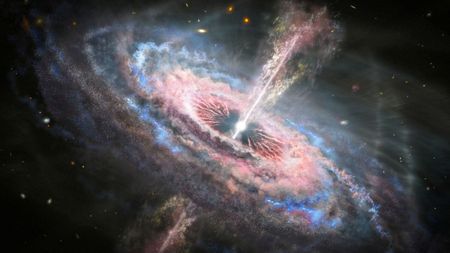

A quasar is one of the most powerful and brilliant objects in the entire universe — essentially a supermassive black hole at the center of a galaxy that is actively consuming surrounding matter. Now, scientists have discovered quasars so ancient that their very existence in the early universe has left researchers searching for answers.
Using the European Space Agency’s Euclid space telescope, a team of researchers identified 31 of these extremely old quasars. The findings deepen an already puzzling mystery: how was the early universe so much more developed than scientists had previously imagined?
Among the newly identified quasars are the two oldest ever recorded, both dating back more than 13.1 billion years. At that point, the universe was only about 5% of its current age — roughly 670 million years after the Big Bang. Each of those two quasars radiates light approximately one trillion times brighter than our sun.
Quasars of this type are fueled by black holes with masses ranging from hundreds of millions to billions of times that of the sun. The precise masses of these two particular quasars have not yet been determined.
Daming Yang, a doctoral student in astrophysics at Leiden Observatory at Leiden University in the Netherlands and the study’s lead author, described what a quasar actually is: “A quasar is the blazing core of a galaxy. At the center sits a giant black hole. Black holes themselves are dark, but the black hole’s gravity pulls in gas and dust, which spiral toward it like water going down a drain. As this happens, the gas gets incredibly hot and shines brighter than the entire galaxy around it.”
The two most ancient quasars in the study existed during what scientists refer to as the “epoch of reionization,” also known as cosmic dawn. Yang described that era this way: “The universe back then was much smaller and denser, and filled with a fog of neutral hydrogen. It was also a time of rapid change: the first stars, galaxies and black holes were lighting up and burning away that fog, transforming the universe into the transparent one we see today.”
During that period, hydrogen atoms had their electrons stripped away, leaving hydrogen in the ionized state that still dominates intergalactic space today.
In recent years, instruments like the James Webb Space Telescope and Euclid have helped scientists better understand the universe’s earliest chapters — revealing that it contained mature galaxies and enormous, matter-hungry black holes far earlier than expected.
Study co-author Joseph Hennawi, an astrophysicist at the University of California, Santa Barbara and Leiden University, explained the scale of the discovery: “Everything was packed into a much smaller volume since the universe has expanded roughly eightfold in linear scale since then.”
Hennawi went on to say, “The most important thing these distant quasars tell us is that these supermassive black holes were already present in the extremely early cosmic times. This does not provide very much time to grow these objects, because the universe is simply too young. This is a major unsolved problem in astrophysics.”
The existence of such massive black holes at that early stage stretches current scientific understanding of how black holes grow to its breaking point. Yang put it plainly: “Either the first black holes were born already massive through some exotic channel, or they grew much faster than we thought possible. Every step further back in time makes that puzzle harder. That is precisely the core mystery of these objects. And honestly, this study deepens it rather than solving it.”
The galaxies of that early era looked nothing like the large spiral and elliptical galaxies visible today. They were smaller in size but packed with the gas needed to rapidly produce new stars.
Just as they do today, each of those early galaxies had a supermassive black hole at its core. Our own Milky Way galaxy is home to one called Sagittarius A*, though it is currently in a quiet, inactive phase.
Euclid was launched in 2023 with a primary mission of studying dark energy and dark matter, but its observations of quasars have yielded an unexpected scientific bonus.
Yang reflected on what this new era of discovery means for the field: “Before Euclid, decades of searching by the whole astronomical community had yielded only a handful of quasars from the early era, limited mainly by the telescopes available. With this sample, we are entering a new era: studying these earliest supermassive black holes as a population, and finally addressing how they were born and grew so quickly when the universe was very young.”
The study was published in the journal Astronomy & Astrophysics.