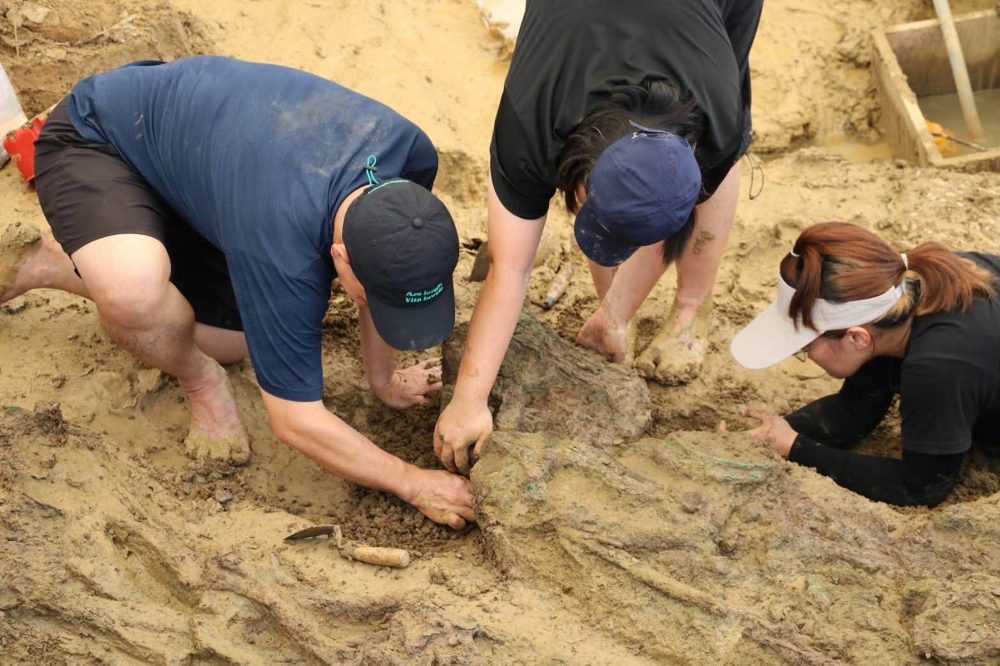

Excavation work at a newly discovered archaeological site in western Thailand has yielded a remarkable find — two gold rings believed to be approximately 2,000 years old, according to Thai government officials.
The rings were unearthed alongside human skeletal remains last week at the Don Yai Thong archaeological site, located in Phetchaburi province. Thailand’s Fine Arts Department announced the discovery in an official statement.
One of the rings, found on a Thursday, features engraved characters that experts believe to be Bhrami script — an ancient writing system originating in India. Specialists conducted an initial analysis and determined the inscription reads “pusarakhitasa,” which translates to “the one protected by Pushya.” According to the Fine Arts Department, Pushya is considered one of the most favorable zodiac signs in Indian astronomy.
The second ring, recovered from the same set of skeletal remains, is a plain gold band with no markings or decorative design. Based on their findings, experts believe the person who owned both rings may have been a merchant belonging to the Vaishyas, a caste within the ancient Indian social system.
The Don Yai Thong site sits roughly 130 kilometers — about 80 miles — southwest of the Thai capital, Bangkok. It came to light earlier this year after local residents stumbled upon fragments of ancient bronze drums in a rice field, prompting authorities to begin a formal excavation.
Researchers have dated the site to a late prehistoric period in Thailand, corresponding to what is known as the Iron Age — a span of human settlement roughly 1,500 to 2,500 years ago.
Since excavation work began in February, archaeologists have uncovered eight human skeletons along with bronze and gold jewelry, pottery, and other objects. The collection of finds suggests the site served as a ceremonial burial ground for affluent individuals or those of high social standing.
The Fine Arts Department said the dig is expected to wrap up within approximately one month, after which the recovered artifacts are planned to be put on public display.