DOSWELL—With meat prices hitting record levels and protein demand soaring, rural communities are set to benefit from a federal initiative designed to expand the nation’s smaller meat processing operations.
Virginia has the infrastructure to handle the 14,000 head of beef cattle produced annually within state borders, but farmers face significant challenges including long transportation requirements, workforce shortages, and extensive processing delays that impact both producers and consumers seeking locally-sourced products.
After hosting a June 3 discussion with 20 agricultural leaders at The Meadow Event Park in Caroline County, U.S. Secretary of Agriculture Brooke Rollins and Health and Human Services Secretary Robert F. Kennedy unveiled the new U.S. Department of Agriculture Small Processors Action Plan.
Rollins characterized the initiative as a crucial move toward increasing market competition, enhancing local accessibility, and maintaining livestock operations within regional boundaries.
“Why are we shipping these beautiful beef cattle from Virginia all the way to the middle of the country to get processed?” she asked.
Virginia Farm Bureau Federation state board member Barry Bates of Essex County explained that the shortage of local meat processing operations has generated significant scheduling challenges for agricultural producers, with processing appointments reserved months ahead of time.
Enhanced processing capabilities, he noted, “It would be a lot better logistically for the operators.”
The comprehensive package combines regulatory adjustments, service improvements, and financial support designed to help smaller meat and poultry facilities increase their operational capacity and better assist farmers. USDA officials said the plan will work alongside a fourth phase of the Meat and Poultry Processing Expansion Program, which provides an additional $60 million in funding for qualifying processors.
“We are building a food system that works not just for the biggest players, but also for the family farms and the small businesses across America,” Rollins said.
Trey Davis, president and CEO of the Virginia Agribusiness Council, expressed optimism about USDA’s commitment to supporting processors, noting the agency is demonstrating “there’s room for processors of every size.”
Rollins emphasized the program aims to bolster local food networks while maintaining existing safety protocols.
“This is about helping our small plants operate safely, compete fairly, and remain part of a strong local and regional food supply,” she said.
Kennedy connected the initiative to the administration’s wider food policy that prioritizes whole, nutrient-rich foods.
Agricultural leaders and supporters at the discussion, including VFBF President Scott Sink, said the announcement tackles a persistent industry challenge, though implementation will require patience.
The Virginia Foundation for Agriculture, Innovation and Rural Sustainability stands ready to assist farmers in understanding the action plan, which represents another valuable “tool in the toolbox,” according to Whitney Perkins, director of the nonprofit organization that provides technical support for value-added farming operations.
“We will be sure those tools are really working the way that they want them to, and that they’re adequately funded on top of that, because the demand is there,” she said. “We can help producers get connected and navigate the process.”
Visit vafairs.com to learn more.
Media: Contact Samuel Thomas Holcomb, USDA public affairs, at 771-233-3452; or Perkins at 804-290-1158.
Motorists traveling on Route 20 should expect delays this evening as construction crews continue work that requires periodic lane restrictions.
The affected stretch runs between Pepper Road and Fleetwood Pond Road, where workers are causing intermittent lane closures that will remain in effect until 7 PM today.
Drivers are advised to allow extra travel time and exercise caution when passing through the construction zone.
Stock prices for ADC Therapeutics dropped dramatically by nearly 53% during premarket hours Thursday following concerning results from a major clinical trial of their blood cancer treatment that showed increased patient mortality rates, even though the study achieved its primary effectiveness target of extending progression-free survival.
The large-scale confirmatory trial evaluated ADC’s drug Zynlonta combined with Roche’s antibody treatment Rituxan for patients suffering from relapsed or refractory diffuse large B-cell lymphoma, an aggressive form of blood cancer that rapidly spreads through the lymphatic system.
According to the company’s Wednesday evening announcement, the treatment group experienced 27 deaths representing 13.2% of patients, while the control group receiving Rituxan plus chemotherapy saw only 9 deaths or 4.6% of participants. The company noted that most fatalities in the treatment group occurred among patients who were 75 years old or older.
Guggenheim analyst Michael Schmidt observed that while other measures of effectiveness appeared promising, the elevated death rate in the Zynlonta treatment group overshadowed these positive results.
The U.S. Food and Drug Administration granted Zynlonta accelerated approval in 2021, making this confirmatory study essential for demonstrating clinical benefits necessary for complete U.S. approval.
Company officials stated they plan to conduct meetings with the FDA in August and intend to file a supplemental application during the fourth quarter of this year.
Schmidt commented on the treatment’s market position, saying “The overall value proposition of the combination — which is targeted as a community-friendly & easy-to-administer therapy for patients that are not bispecific antibody candidates — will likely be debated by some investors.”
Zynlonta functions as an antibody-drug conjugate engineered to specifically attack cancer cells while minimizing harm to healthy tissue.
The company explained the elevated mortality rate by pointing to factors including the advanced age of many patients and extended monitoring for adverse events in the treatment group, where participants remained on therapy for longer periods as control group patients frequently switched to alternative treatments early.
Regarding the death rates, Schmidt noted, “While Grade 5 TEAEs (deaths) are generally unfortunately not uncommon in the treatment of DLBCL, most other regimens have single-digit percentage Gr 5 TEAE rates, with higher rates reported due to COVID-19 during the pandemic.”
Military officials in Paris announced Thursday that NATO fighter jets were deployed 11 times during the past week to intercept Russian aircraft over the Baltic region, representing an unusually elevated level of aerial confrontations.
The interceptions occurred as part of NATO’s ongoing Baltic Air Policing Mission, which safeguards the airspace above Estonia, Latvia and Lithuania using rotating deployments of alliance fighter aircraft to supplement these nations’ defense capabilities. Jets are launched to respond to unidentified aircraft or those not following proper protocols.
A spokesperson for France’s armed forces, Guillaume Vernet, suggested during a weekly press conference that the spike in aerial encounters might indicate Moscow’s attempt to demonstrate military strength during the same period it held its yearly St Petersburg International Economic Forum.
“The French detachment deployed on the Baltic Air Policing mission carried out multiple interceptions of Russian military aircraft flying without flight plans or radio contact,” Vernet said, adding that the intercepted aircraft included armed fighter jets, intelligence and transport planes.
These latest incidents add to a growing pattern of military drone intrusions into the airspace of Finland, Estonia, Latvia and Lithuania, raising concerns about potential spillover effects from the ongoing conflict in Ukraine into NATO’s northern territories that border Russia.
A nonprofit organization dedicated to gun control advocacy has filed a federal lawsuit against two government agencies for withholding information about the country’s top sellers of firearms used in crimes.
Brady has taken legal action against both the Bureau of Alcohol, Tobacco, Firearms and Explosives and the Department of Justice after the agencies declined to provide requested documents and data identifying which gun dealers are responsible for selling the most weapons that end up being used in criminal activities across the United States.
The lawsuit centers on the organizations’ efforts to obtain transparency regarding firearms trafficking patterns and the sources of weapons that law enforcement agencies recover from crime scenes nationwide.
A collaborative effort between New Castle County Police detectives and federal agents has resulted in the arrest of a suspect allegedly involved in drug trafficking operations.
The investigation targeting 27-year-old Dale Womack began in April 2026 when members of the New Castle County Police Department’s Violent Crime Interdiction Team and the FBI Violent Crimes Safe Streets Task Force received tips suggesting he was distributing illegal drugs from a local residence.
Authorities have not released additional details about the specific charges or the quantities of narcotics and weapons recovered during the operation.
The latest U.S. Drought Monitor shows drought conditions continue across much of the Mid-Atlantic, including portions of Delaware, Maryland, Virginia, Pennsylvania, and New Jersey. While recent rounds of rain have provided some localized relief, long-term moisture deficits remain a concern heading into the heart of the summer season.
Across the region, areas of Abnormally Dry (D0), Moderate Drought (D1), and Severe Drought (D2) remain in place as precipitation deficits that developed during the winter and spring continue to impact soil moisture, streamflows, and groundwater levels. The ongoing dryness has been especially noticeable across portions of the Delmarva Peninsula and southeastern Pennsylvania, where drought conditions have expanded in recent weeks.
The drought outlook from NOAA indicates that drought conditions are expected to persist across much of the Mid-Atlantic through June, although periodic storm systems may help prevent further rapid deterioration in some locations. Forecast guidance suggests no widespread drought-ending rainfall event is currently on the horizon, meaning any improvements will likely occur gradually.
For the Delmarva region, recent rainfall has helped green up vegetation and improve topsoil moisture in some areas. However, deeper soil moisture deficits remain, and many streams and ponds continue to run below normal levels. Agricultural interests are closely monitoring conditions as crops enter critical growth stages during the early summer months.
The drought also continues to elevate wildfire concerns. Dry vegetation combined with occasional periods of low humidity and gusty winds can quickly increase fire danger, particularly in areas that have received below-normal rainfall over the past several months.
The U.S. Drought Monitor is updated every Thursday and integrates precipitation data, soil moisture observations, streamflow measurements, groundwater conditions, and reports from local experts to assess drought severity across the country.
Looking Ahead
While scattered showers and thunderstorms are expected periodically through June, forecasters say the region will likely need several widespread soaking rainfall events over an extended period to fully erase the drought that has developed across portions of the Mid-Atlantic. Until then, residents should remain mindful of local burn restrictions, water conservation efforts, and changing drought conditions throughout the summer.
WASHINGTON — Weekly unemployment benefit applications across the United States climbed to their highest point in four months, though job cuts continue to stay at historically low levels amid economic turbulence linked to the ongoing conflict in Iran.
Applications for unemployment assistance rose by 13,000 to reach 225,000 for the week that concluded May 30, according to Thursday’s Labor Department data. This marks the peak level since early February, prior to when the U.S. and Israel began military operations against Iran, yet remains at a historically modest figure. Financial experts polled by FactSet had anticipated 211,000 new claims.
These weekly unemployment benefit requests serve as a gauge for layoffs across the nation and provide nearly immediate insight into job market conditions.
Even with job cuts staying historically minimal, the employment landscape appears stuck in what economic experts describe as a “low-hire, low-fire” situation. This dynamic has maintained unemployment at 4.3%, though it has created challenges for jobless individuals seeking new positions.
While American companies added an unexpected 115,000 positions in April, the Iran conflict has created significant uncertainty regarding the overall U.S. economic outlook and employment conditions.
The Strait of Hormuz, a critical passage for one-fifth of global oil transport, continues to be blocked. Oil costs have surged approximately 50% since the conflict started in late February, pushing average U.S. gasoline prices to $4.24 per gallon from under $3 in late February. Beyond impacting household budgets, these elevated costs can discourage business hiring decisions.
Government statistics revealed that consumer-level inflation climbed 3.8% from April 2025, representing the largest increase in three years. Food costs have also risen, though analysts suggest they may not yet completely reflect increased energy expenses from the Iran conflict.
A separate analysis indicated wholesale prices jumped 6% year-over-year, hitting the highest level in over three years.
These developments occur while U.S. inflation already exceeds the Federal Reserve’s 2% goal. The Fed chose to maintain its benchmark rate unchanged during its most recent session, pointing to economic uncertainty from Middle Eastern instability and persistent inflation. Most financial analysts don’t anticipate Fed rate reductions in the near future.
Reduced interest rates could stimulate economic growth and job creation, but they typically fuel inflation, prompting several Fed officials to indicate they would consider raising rates this year.
Additionally, the current artificial intelligence surge and necessary investment for its advancement could transform or eliminate certain positions.
Companies that have recently implemented workforce reductions include Verizon, UPS, Amazon, Disney, Starbucks and Walmart.
Weekly unemployment benefit requests have remained stable within a 200,000 to 250,000 range since the U.S. economy recovered from the pandemic downturn. Nevertheless, hiring activity started declining approximately two years ago and decreased further in 2025 due to President Donald Trump’s unpredictable tariff implementations, federal workforce reductions and continuing effects of elevated interest rates designed to manage inflation.
Companies created fewer than 200,000 positions last year, compared to roughly 1.5 million in 2024, based on FactSet data.
The government will release its May employment report on Friday.
Thursday’s Labor Department findings showed the four-week rolling average of unemployment claims, which smooths weekly fluctuations, increased by 6,500 to 214,750.
The overall count of Americans seeking unemployment benefits for the prior week ending May 23 decreased by 8,000 to 1.78 million, matching analyst predictions.
A fragile truce between Israel and Lebanon has been extended through a new U.S.-mediated agreement announced Wednesday, though the arrangement faces significant opposition from the militant group at its center.
The accord between Israel and Lebanon comes following Israel’s most extensive military push into Lebanese territory in over 25 years, and establishes a framework for broader peace discussions scheduled for later this month.
However, the agreement contains several disputed elements, notably the establishment of experimental security areas within Lebanon where the Iranian-supported Hezbollah organization would be prohibited from operating, along with provisions calling for the group’s ultimate dissolution.
Lebanese President Joseph Aoun described the arrangement Thursday as the “last chance to enter a final and comprehensive ceasefire.” A previous U.S.-mediated accord from November 2024 aimed at stopping hostilities between Hezbollah and Israel, which began due to the conflict in Gaza, ultimately collapsed.
The announcement follows recent events where a major escalation was barely avoided through a separate Monday agreement that prevented Israel’s planned attacks on Beirut’s southern neighborhoods while Hezbollah agreed to stop striking northern Israel. However, questions persist about the current deal’s viability.
The present arrangement expands upon an initial truce established April 17 between Israel and Lebanon’s government.
Notably, while much of the agreement depends on Hezbollah’s actions, the militant organization did not participate directly in negotiations. Hezbollah’s leader, Sheikh Naim Kassem, has instead depended on Iran’s influence in discussions with Washington. Tehran has maintained that any resolution to the Iran conflict must encompass Lebanon.
Kassem harshly criticized the agreement Thursday, describing it as “Satan’s dream in heaven.” He demanded a total ceasefire and Israeli military withdrawal, arguing the deal would destabilize Lebanon and create internal divisions.
“The agreement allows Israel to take in politics what it couldn’t in war,” Kassem stated. “As long as the occupation is still present, then the resistance will continue.”
Israel maintains it is fighting Hezbollah, which it has long viewed as a significant threat, rather than Lebanon directly. Nevertheless, Israeli forces have targeted areas well beyond Hezbollah’s sphere of influence, including central areas of Lebanon’s capital city.
The Shiite Muslim armed organization formed in 1982 as a response to Israel’s occupation of southern Lebanon at that time, and has developed into one of Lebanon’s most powerful entities.
Emphasizing its perception of the group as an existential danger, Israel stated in Wednesday’s joint announcement that its security and territorial integrity “can only be achieved through the disarmament of Hezbollah and the dismantlement of its infrastructure throughout Lebanon.”
Lebanon’s endorsement of a statement characterizing Hezbollah as a threat highlights the widening rift within the country regarding the organization, and Beirut’s attempts to separate itself from Iran while strengthening relationships with Gulf nations and Washington. This approach also risks alienating Hezbollah and its supporters, primarily from the Shiite population.
The joint announcement states the ceasefire “is contingent on a complete cessation of Hezbollah fire and the evacuation of all Hezbollah operatives” from areas south of the Litani River. This river, situated approximately 30 kilometers (20 miles) north of Israel’s border, marks the boundary of a U.N.-established buffer zone from 2006 where Hezbollah is prohibited. Israeli forces have currently advanced well beyond the Litani River into southern Lebanon, displacing hundreds of thousands of Lebanese civilians.
The statement indicates Lebanon and Israel committed to “swiftly advance the creation of pilot zones in which the Lebanese Armed Forces will take exclusive control of the territory to the exclusion of all non-state actors.”
This places additional burden on Lebanon’s financially struggling military to establish authority in regions where Hezbollah maintains significant presence. Lebanon worries that an aggressive approach to disarming Hezbollah could trigger nationwide conflict, while Israel criticizes Beirut for insufficient action.
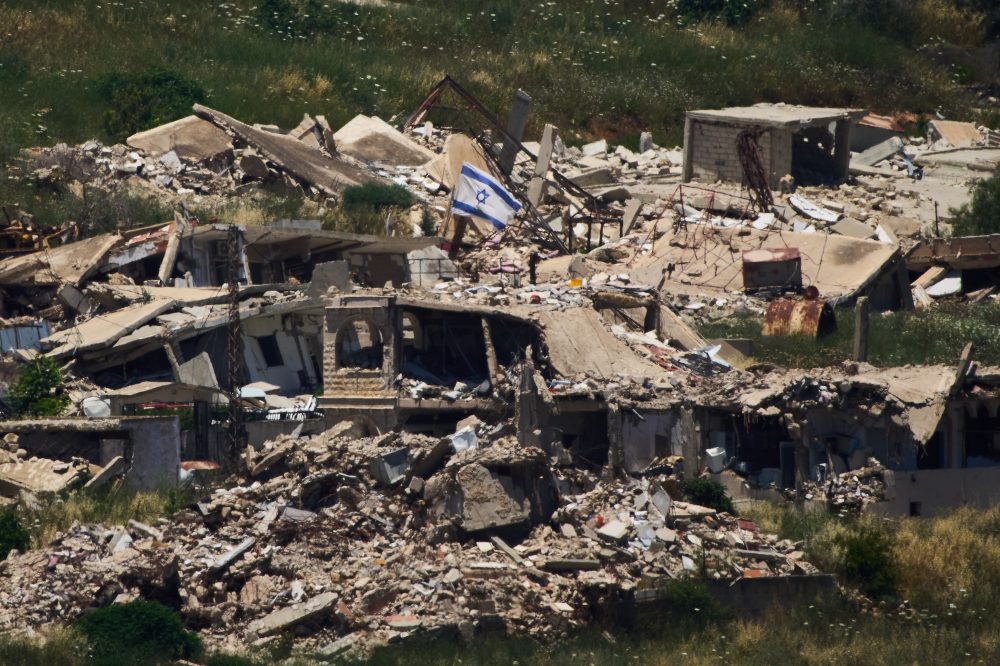
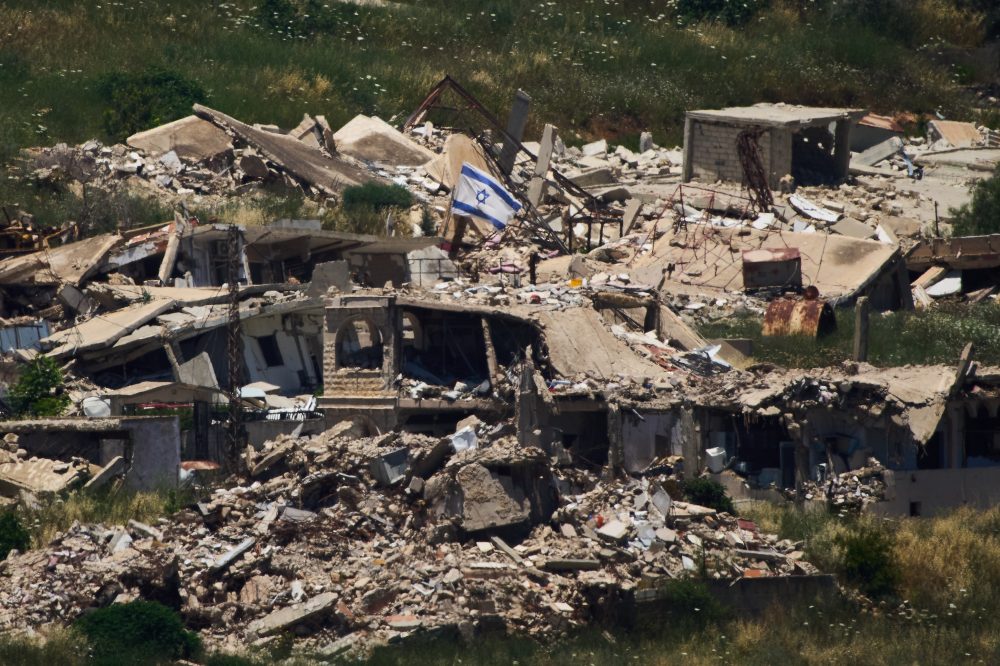
Israeli forces currently occupy substantial portions of southern Lebanon and have destroyed residential buildings and historical landmarks.
The statement also mentioned that negotiators explored a security structure that would encompass “the dismantlement of non-state armed groups, and the prevention of their reemergence.”
The specific methods for establishing these pilot zones and dismantling Hezbollah remain highly uncertain. Aoun suggested that a series of villages just north of the Litani could serve as the pilot zone.
Lebanon has emerged as a significant obstacle in efforts to expand the separate ceasefire in the Iran conflict. The joint statement declared that “all parties condemned Iran’s attacks on countries in the region, and ongoing activities that undermine stability throughout the Middle East, whether through support for proxies and all other acts of aggression.”
The document also contained explicit language aimed at separating the two conflicts.
“All countries reaffirmed that the future of the relationship between Israel and Lebanon must be decided by the two sovereign governments. They rejected any attempt, by any state or non-state actor, to hold Lebanon’s future hostage,” the statement read.
It continued that “any agreement to cease hostilities must be reached directly between the two governments, brokered by the United States, and not through any separate track.”
This language appears designed to stop Tehran from using Hezbollah and the Lebanese conflict as leverage in its own ceasefire talks.
Despite the initial truce agreement in mid-April, combat has persisted, with Hezbollah resuming attacks following Israeli strikes in Lebanon that Israel described as defensive measures.
The fighting shows little indication of decreasing. Israeli Defense Minister Israel Katz announced Thursday that Israeli forces would maintain their presence in what he termed a security zone in Lebanon, while continuing operations against Hezbollah facilities.
The military “will, at this stage, continue its fire and activity on the ground,” he stated. Katz said the arrangements reflect “the reality we have created in Lebanon so far” and could eventually result in a peace agreement with Lebanon and “real and lasting security” for northern Israel’s residents.
Thursday saw the Israeli military warn southern Lebanon residents that it was continuing to strike Hezbollah “infrastructure located in and near the area south of the Zahrani River.” The warning stated that “anyone who moves south of the river is putting their life at risk.” The Zahrani is positioned approximately 30 kilometers (18 miles) north of the Litani River.
ZAGREB, Croatia — At least four individuals lost their lives Thursday when a small aircraft went down in Croatia, according to police officials.
The aircraft crashed in the vicinity of Medulin, located on the Istria peninsula, authorities confirmed in an official statement. Reports from the HINA news agency indicated the aircraft was registered in Germany and had departed from Austria.
Images from the crash site revealed the destroyed aircraft lying in a field, with emergency responders and fire crews working at the location.
A local aviator, Nijaz Delic, described the incident to the Index news portal, stating the aircraft “spiralled (in the air) and crashed into the ground.”
Authorities have not confirmed the total number of individuals aboard the aircraft. Additional information about the incident remains unavailable at this time.
TAPPAHANNOCK—Virginia’s wheat farmers are dealing with substantial crop losses this season after a combination of extended spring dry conditions and unseasonable late frost damaged fields across the state, according to findings from an agricultural assessment conducted on May 28.
During the annual inspection that covered 10 farming operations, Virginia Farm Bureau Federation grain manager Robert Harper reported that wheat farms in the Northern Neck region showed an average yield of 69 bushels per acre, while Middle Peninsula operations averaged 47 bushels per acre.
The assessment marks the 11th consecutive year that Virginia has participated in the regional Mid-Atlantic wheat evaluation, which encompasses farming operations across Delaware, Maryland, New Jersey and Pennsylvania.
The Virginia Farm Bureau Federation and Virginia Cooperative Extension coordinated this year’s inspection alongside the Eastern Virginia Agricultural Research and Extension Center. During visits to 10 farming operations spanning the Northern Neck and Middle Peninsula areas, grain purchasers, processing facilities, researchers and agricultural industry professionals evaluated crop yield expectations, examined grain quality and monitored disease conditions.
The U.S. Department of Agriculture National Agricultural Statistics Service projects Virginia farmers will bring in 3.1 million bushels of winter wheat during this harvest season. Last year’s Virginia harvest yielded 4.6 million bushels thanks to expanded acreage and better crop performance.
Extended periods of temperatures below freezing inflicted major damage on wheat crops during a critical development phase, according to Robbie Longest, a Virginia Cooperative Extension agriculture and natural resources agent in Essex County.
“At about 28 to 29 degrees for several consecutive hours, you can have very severe yield losses due to floret sterility,” Longest explained. “We had that a lot in this area.”
Longest indicated that damage in some fields is so extensive that harvesting may not occur. Consequently, some producers are considering alternative options for their damaged crops. They are investigating markets for bundled wheat straw sold for autumn decorative purposes or construction industry applications, which could help compensate for decreased grain production.
“You’re going to see harvested acreage depressed even further,” Longest said, pointing to fields where entire sections may instead be replanted into other crops. Similar conditions were last seen in 2020, though Longest said such events historically occur only once every few decades.
The sequence of unusually warm February conditions followed by delayed freezing temperatures created particularly harmful circumstances, speeding up crop growth before subjecting plants to damaging cold weather.
“Timing is everything with wheat, and this year proved how little margin for error farmers have,” said Harper. “You can do everything right—plant on time, manage for a strong stand—but in the end, weather is one factor you can’t control. A late frost like this can undo a lot of hard work in just a few hours.”
Wheat producers are planning to harvest 60,000 acres for grain production throughout Virginia’s 95 counties during June and July.
CHESTER, Va.—A Virginia farming family has achieved a groundbreaking accomplishment in sustainable agriculture, earning recognition as pioneers in the regenerative farming movement.
Alan Thibault hosted agricultural leaders, policymakers, and food and wine industry representatives at his family’s Ashton Creek Vineyard in Chester on May 20 to celebrate estate wines, pasture-raised lamb, and a historic achievement in Virginia farming.
Ashton Creek Vineyard and its sister operation Riverside Vines in Dinwiddie County have become Virginia’s first vineyard facilities to earn Certified Regenified status—combining soil health, biodiversity, and animal care into a comprehensive farming approach.
“This distinction reflects a strong commitment to soil health, stewardship and a long-term agricultural sustainability that closely aligns with the mission and conservation priorities of the U.S. Department of Agriculture’s Natural Resources Conservation Service,” remarked Edwin Martinez, NRCS state conservationist for Virginia.
The NRCS Regenerative Pilot Program, which began in December 2025, is allocating $700 million to support voluntary regenerative agriculture conservation strategies. According to Martinez, the initiative “targets a whole-farm approach while promoting soil health, water management, natural vitality and productivity, and the prosperity of American agriculture and communities.”
Thibault, a first-generation farmer, shared his family’s transformation from “linear to circular farming” while facing growing agricultural obstacles. Starting with their initial grape plantings in 2006 and expanding with additional farmland purchases in Sutherland in 2018, the family battled rising input costs and deteriorating soil conditions.
“We really wanted to fix the root cause of the sickness instead of always addressing the symptoms,” he explained.
Faced with overwhelming mechanical weeding demands, the Thibaults brought Dormer sheep into their vineyards three years ago to manage vegetation and improve soil quality. With Ashton Creek’s regenerative certified lamb now featured prominently on their tasting room menu, the family has refined their expanding flock of approximately 100 sheep, introduced beneficial insects to combat vineyard pests, and expanded their cover crop varieties.
Beyond witnessing improved biodiversity in their fields, stronger young vines, and better nutrient content in their sheep, the Thibaults have successfully eliminated synthetic fertilizers and herbicides, reduced fungicide applications by 40%, minimized mowing and labor requirements, cut outside inputs by 65%, and boosted their soil’s organic matter by 400% and carbon sequestration by 350%.
“We’re really excited to build something that we feel can be sustainable for the next generation,” Thibault reflected. “And we’re not going to stop at this certification. We want to continue to improve that organic matter and capture more carbon, be that difference in the climate and community, and produce products that everyone can be proud of.”
AJ Greely, president of the Virginia Vineyards Association, referenced the devastating impacts of the April 21 freeze on vineyards throughout the state.
“Regenerative farming ultimately leads to stronger vineyards—ones that will move forward and flourish despite the challenges we face,” she added. “Now it’s time for the next generation to step up, and Alan is part of that next generation that’s going to lead us more sustainably.”
Serving as co-chair of the Virginia Farm Bureau Federation Chesterfield County Young Farmers Committee, Thibault helps guide emerging agricultural leaders from the community level. He recently hosted young farmers from throughout the state at Ashton Creek Vineyard for a VFBF Young Farmers Winter Expo networking dinner.
“A first-generation farmer who started one way but then figured out what was going to work for his operation, and being a pioneer in regenerative agriculture—something that’s still being looked at—is significant,” remarked VFBF President Scott Sink. “Our Farm Bureau leaders are always pioneering, and it’s just great to be able to support him in that journey.”
The small Balkan country of Montenegro has set an ambitious goal to join the European Union by 2028, displaying the slogan “28 by 28 – The Next EU Member” on its national airline’s aircraft.
This nation of 630,000 residents aims to become the 28th EU member state and the first new addition since Croatia joined in 2013. While Montenegro’s small size would make integration into the 450-million-person bloc relatively straightforward, achieving membership by 2028 remains a challenging target.
The country must complete demanding reforms, particularly in fighting corruption, and receive approval from all 27 current EU member states. Despite these obstacles, Montenegro gained momentum last month when the EU established a working group to prepare its membership agreement.
EU officials will meet with Western Balkan leaders this Friday in the coastal city of Tivat to discuss the integration process.
“Montenegro is the most advanced candidate country in the accession negotiations,” EU Enlargement Commissioner Marta Kos told Reuters. “Strong leadership in the country has seen significant steps forward in terms of reforms, but there is still a lot of work to do. Some of the most pressing reforms are… on rule of law and the judiciary.”
The country has undergone major changes since separating from Serbia in 2006. Montenegro’s relationship with Russia, once a close ally providing investment and tourism, has deteriorated significantly.
In 2016, officials accused Moscow of attempting a coup with Serbian extremists, which Russia denies. Tensions escalated when Montenegro joined NATO in 2017 and later imposed sanctions on Russia over the Ukraine conflict, prompting Moscow to label it an enemy state.
Milo Djukanovic, who governed Montenegro for thirty years until 2023 in various leadership roles, described the break from Russia as pivotal.
“Our primary motive is to take control of our own future, which will be European and Euro-Atlantic,” he told Reuters.
Citizens strongly support EU membership, with over 80% viewing it positively according to an April European Commission survey – a sharp contrast to growing skepticism elsewhere in Europe.
“We have a future in Europe, we should not remain a part of the Balkan quagmire,” said Novak, a 45-year-old physiotherapist from the capital who preferred not to share his full name.
Montenegro has made substantial progress, opening all 33 required negotiation areas and completing 14 of them. The country recently finished discussions on agriculture and capital movement in late 2025.
However, critical chapters on legal systems and fundamental rights remain unresolved. EU regulations prevent finalizing other areas until Montenegro meets all requirements in these key sectors.
While the country has launched anti-corruption efforts resulting in arrests and convictions of former senior judges, prosecutors and police officials, conviction rates remain low and problems continue, according to analysts.
Critics and international monitoring groups have accused Djukanovic and his Democratic Party of Socialists of corruption and organized crime connections, which they reject. These groups also cite concerns about press freedom restrictions.
“Montenegro is yet to close the chapters relating to the judiciary, which tend to be among the biggest hurdles for aspiring EU members,” said Mario Bikarski, senior Europe analyst at risk intelligence company Verisk Maplecroft. “Even closer attention is likely to be given to these by the European Commission given the backsliding of several member states on the rule of law in recent years.”
Predrag Zenovic, Montenegro’s chief EU negotiator, expressed confidence the country would satisfy these requirements on schedule.
“When the courts deliver a consolidated track record of results in… verdicts, that will be the final test,” he said.
MANCHESTER, Iowa — The state of Iowa serves as a striking illustration of water contamination challenges facing the Midwest region.
As a major farming state with numerous waterways, agricultural drainage containing nitrates and phosphorus flows from fertilized fields and livestock operations into local rivers and streams. This contamination makes Iowa a significant source of pollution feeding an oxygen-depleted zone in the Gulf of Mexico.
For generations, locals have dealt with polluted waterways. The contamination impacts both community health and recreational water activities during summer months.
Toxic algae growth creates hazardous beach conditions, while sediment runoff leaves water feeling unpleasant. Bacterial contamination, sometimes from human waste, prevents young people from using streams. State monitoring in 2024 found over half of surveyed river, stream and lake sections failed to meet safety standards for recreation, consumption or marine ecosystems.
Despite being inland, Iowa’s character is defined by major waterways like the Missouri and Mississippi Rivers that border the state. The region features scenic lakefront areas and quality trout fishing locations. These water bodies represent some of the state’s limited natural recreation areas.
During a recent outing, Hannah Ray J Childs navigated her kayak through Maquoketa River rapids, using her paddle to lift her boat’s bow skyward. She enjoys performing whitewater kayaking stunts that submerge her completely — these waters provided her with a sense of belonging.
However, waterborne illness has affected her, prompting her to use protective nose and ear gear to reduce exposure. Many people question her decision to enter the water at all.
“People’s first response when I tell them that I like to kayak and be upside down in the river,” Childs said, “is, ‘Ew, that’s disgusting. Why would you do that?’”
While she believes the risk is acceptable, water quality issues have become too concerning for others to feel safe.
Mary Swander, a 75-year-old theater director and former state poet laureate, recalls fondly learning water sports and swimming outdoors during her youth near waterways. Summer meant water play, while winter brought ice skating opportunities.
“I had a little group of friends and we played hooky once, and we all got our swimsuits and drove over to Lake MacBride and spent the whole day in the lake, in the water, swimming, and we had a whole picnic,” she said.
Swander now stays away from water following negative encounters. During one state park visit, the water felt unusual — sticky to the touch. On another occasion, a park official warned her canoeing party against any water contact.
“I was like, ‘Well, what the hell are we doing out here, then?’” she said.
Bacterial pollution represents the primary factor making waterways unusable. Sources include livestock, wildlife and other animals, though human sewage creates the most significant issues in certain areas. Specialists indicate heavy rainfall poses major risks by washing away animal waste — a threat that climate change will worsen — making sewage system improvements and septic repair essential.
Nutrients from livestock waste and farm fertilizers also drive the contamination crisis. Extensive farmland uses underground plastic drainage systems — known as tile drainage — to rapidly channel water toward streams. These nutrients fuel algae growth, resulting in lake warnings and endangering water supplies.
Environmental advocates view the state as unable to regulate agricultural interests effectively.
Minnesota has required protective vegetation along waterways to limit runoff, while Iowa has chosen an alternative strategy. The state depends on agriculture and natural resource agencies, working with Iowa State University, to create voluntary programs including reduced fertilizer application, better crop practices and wetland restoration to decrease runoff.
Farmers also face significant pressures. Input costs have increased dramatically recently, with fertilizer expenses rising following conflict in Iran, according to Aaron Lehman, president of the Iowa Farmers Union, which advocates for family operations and environmental practices.
“There’s a lot less control that farmers have,” Lehman said.
Additionally, producers may wait years to see financial benefits — if any — from adopting improved methods. Requests for federal and state assistance exceed available resources, according to Rachel Curry, an agriculture educator at the University of Illinois Extension.
Someone once described the situation to her this way: Modifying agricultural practices resembles steering a cruise ship — progress takes time, but with proper support, change is achievable.
MANCHESTER, Iowa — On a recent afternoon, Hannah Ray J Childs navigated her kayak through rapids on Iowa’s Maquoketa River, using her paddle to lift her boat’s bow skyward.
The whitewater kayaking stunts that submerge her completely give her a “feeling of flying,” she explained. These waters brought her community and romance — she first noticed her future husband while he was performing kayak rolls in turbulent currents, and he later became her instructor.
However, waterborne illness has affected her, prompting her to use nose and ear protection to reduce exposure. Many question her continued participation in the sport.
“People’s first response when I tell them that I like to kayak and be upside down in the river,” Childs said, “is, ‘Ew, that’s disgusting. Why would you do that?’”
The state serves as a striking illustration of the Midwest’s widespread contamination crisis. As a major producer of corn, soybeans and pork, Iowa features extensive waterway networks. Agricultural fertilizers and livestock waste containing nitrates and phosphorus flow into these systems, making the state a significant source of pollution feeding an oceanic dead zone in the Gulf of Mexico. During the previous summer, the state’s largest city implemented water usage limits while working to eliminate dangerous nitrates from municipal supplies.
Contamination has persisted as an intractable challenge for generations, impacting both community wellness and recreational opportunities during warmer months.
Toxic algae growth creates hazardous beach conditions, while sediment runoff makes water unpleasant for contact. Bacterial contamination, sometimes originating from human waste systems, prevents young people from using streams. Over half of the river, stream and lake segments monitored by the state in 2024 failed to achieve safety standards for swimming, consumption or supporting aquatic ecosystems.
Officials have depended on voluntary measures and financial incentives rather than regulatory requirements to decrease nitrate and phosphorus discharge, yet progress remains well below established targets. Environmental organizations recently filed legal action against the Trump administration, claiming it inappropriately overturned a Biden-era mandate requiring Iowa to tackle nitrate contamination in portions of multiple rivers.
Investment and modest progress have occurred. In May, Republican Gov. Kim Reynolds announced a $320 million funding package for water infrastructure and related initiatives, supplementing the approximately $100 million the state dedicates annually to addressing this issue. Phosphorus levels have decreased somewhat. Improved techniques including cover crops, reduced or eliminated tillage for soil protection, and farm-based installations to limit runoff have grown significantly in recent years.
Despite its inland location, Iowa’s character is influenced by waterways including the Missouri and Mississippi rivers that define portions of its boundaries. The state features scenic lakeside beaches and exceptional trout fishing opportunities. These waters represent some of its limited natural recreational areas.
Childs developed her appreciation for the Maquoketa River while growing up on a neighboring corn and hog operation. She recalls paddling with her brothers to locate fishing spots and exploring waterways with companions.
She currently volunteers to monitor the river for chemical contamination and advocated for a whitewater park in Manchester, her northeast Iowa community, to encourage others to experience the water.
“If we don’t get people invested in their local river, their local community, how are we ever going to ask them to take care of it?” she said.
Mary Swander, a 75-year-old theater director and former state poet laureate, recalls fondly learning to canoe and swim outdoors during her youth near water. Summer meant splashing activities, while winter brought ice skating.
“I had a little group of friends and we played hooky once, and we all got our swimsuits and drove over to Lake MacBride and spent the whole day in the lake, in the water, swimming, and we had a whole picnic,” she said.
Swander now stays away from water following negative experiences. Once the water at a state park felt unusual — sticky. Another time a ranger advised her canoeing party against putting their hands — or anything else — in the water.
“I was like, ‘Well, what the hell are we doing out here, then?’” she said.
While Swander found alternative activities to replace swimming and maintained some relationships, others diminished. The disappearance of gathering places beyond homes and workplaces where people can interact may complicate maintaining social connections, particularly for seniors, according to Philippa Clarke, a University of Michigan professor who studies social environments.
Bacterial contamination plays the primary role in making waterways unusable. It originates from cattle, deer and other wildlife, though human sewage represents the main problem in certain areas. Specialists indicate heavy rainfall poses major risks by washing away manure — something climate change will worsen — and upgrading sewage treatment and failing septic systems remains crucial.
Nitrates and phosphorus from livestock waste and agricultural fertilizers also drive the crisis. Millions of farmland acres utilize plastic underground pipes — called tile drainage systems — to rapidly channel water into streams. These nutrients fuel algae growth, prompting lake warnings and threatening drinking water supplies.
The difficulty of maintaining clean water bodies is demonstrated by Lake Darling, an approximately 300-acre artificial lake providing camping, trails and swimming beaches in Iowa’s southeast region. However, last year the lake experienced the poorest overall condition of any state beach with 10 weeks of E. Coli warnings and six algal advisories, according to the Iowa Environmental Council, which monitors such alerts.
Years earlier the lake was closed, emptied and renovated — transforming its previous brown water into appealing, clearer conditions. Adjacent property owners modified their land to capture runoff, and important acreage was acquired for conservation, according to Bob Shepherd who participates in a dedicated park volunteer organization.
Recently, though, it has faced difficulties, said Claire Hruby, an environmental science professor at Drake University who researched contamination at the lake. Hruby noted several new hog facilities have been established in the lake’s watershed, and nutrient discharge from manure creates algae problems.
During particularly severe conditions, “It’s like swimming in green paint,” she said.
Water quality worries deter people even during days that aren’t severely affected, according to Lawrence Eyre, a tennis camp director and instructor at a local school. As recently as a few years ago, children would complete tennis matches on courts heated by summer sun and, moments later, enjoy swimming rewards in another nearby lake.
However, parents observed that some children developed itchy skin, and algae emerged along the shoreline. Information circulated, and many preferred their children avoid the risk. Now they typically don’t attempt it, Eyre said.
“It does put a dent in the enjoyment of the summer,” he said.
Environmental advocates view a state unable to refuse agricultural interests.
In 2015, Des Moines’ water utility filed suit against three counties regarding expenses for filtering out nitrates. A judge ultimately dismissed the case, ruling that any effort to permit and reduce agricultural runoff fell under Iowa legislature authority.
While Minnesota has required vegetation near waterways to limit runoff, Iowa has chosen a different strategy. It depends on its agriculture and natural resources departments, alongside Iowa State University, to create voluntary approaches including reduced fertilizer application, enhanced crop management and wetland additions to decrease runoff.
The EPA assists states in implementing their nitrogen and phosphorus reduction strategies. The agency emphasized the importance of viewing agriculture as part of solutions and recognizing that progress requires time.
Many farmers also face pressures. Supply expenses have increased dramatically recently, as have fertilizer costs following the war in Iran, according to Aaron Lehman, president of the Iowa Farmers Union, which represents family operations and promotes sustainable methods.
“There’s a lot less control that farmers have,” Lehman said.
Additionally, farmers may wait years to see returns on their investments — if returns ever materialize — when they modify their practices. Demand for federal and state assistance exceeds availability, according to Rachel Curry, an agriculture educator at the University of Illinois Extension. Transforming farming methods resembles turning a cruise ship — it requires time, but with proper support, success is achievable.
Collaboration between the state and farmers remains essential, and mandates would undermine that trust, Iowa Secretary of Agriculture Mike Naig said in an interview with the Iowa Farm Bureau.
Others find encouragement in local achievements.
David Thoreson has sailed beyond the arctic circle and around continents — an adventurous life enabled because his mother taught him sailing on the Iowa Great Lakes in the state’s northwest region. He said local efforts to restore wetlands, acquire conservation land and upgrade sewage treatment have maintained lake health for visitors and residents.
“They understand the importance of it, and that’s what drives our economy and property values and multi-generational interest in this place that just keeps bringing people back,” Thoreson said.
BEIRUT (AP) — The militant organization Hezbollah turned down a new ceasefire proposal on Thursday that had been negotiated between Israel and Lebanon’s government, insisting instead on a total Israeli pullout from the region. The rejection occurred as Israeli military operations resulted in the deaths of at least four individuals, local officials reported, while a U.N. peacekeeper also died during the fighting.
In a written declaration broadcast on television, Hezbollah leader Naim Kassem stated that the proposal’s requirement for Hezbollah militants to evacuate southern Lebanon while under attack would constitute “surrender, defeat and achieving the enemy’s goals.”
“What we are concerned about is an end to the aggression, ceasefire and Israel’s withdrawal,” he said. “We did not make any commitment to any party to stop resisting as long as there is occupation,” he added.
The continued combat in Lebanon, where Israeli military units have captured significant portions of the southern region, poses challenges to efforts aimed at concluding the Iran conflict and reopening the Strait of Hormuz, a crucial passage for oil and gas transport whose blockade has disrupted the global economy.
Iran has insisted that any permanent ceasefire must include Lebanon. Israeli Prime Minister Benjamin Netanyahu, who is facing upcoming elections this year, aims to continue Israel’s military campaign until Hezbollah is no longer considered a threat. Israeli forces have captured approximately one-fifth of Lebanon since Hezbollah started launching rocket and drone strikes in support of Iran shortly after the broader conflict began.
U.S. President Donald Trump, who received unusual criticism from Congress on Wednesday, has attempted to minimize the diplomatic impasse and the inability of announced ceasefires to halt the violence, stating to reporters that in the Middle East, “a ceasefire is when you’re shooting in a more moderate manner.”
A Serbian peacekeeper lost his life, while two additional peacekeepers sustained injuries when mortar fire hit their position near Marjayoun, a town with a Christian majority that has experienced heavy fighting, according to the U.N. mission, called UNIFIL, and Serbia’s Defense Ministry.
Neither organization specified whether the mortar attack originated from Israeli or Hezbollah forces.
Lebanon’s government-operated National News Agency reported that a drone attack killed a motorcyclist and injured four individuals in the village of Maaroub. The agency stated that air attacks on the village of Sohmor in the Bekaa Valley in eastern Lebanon resulted in three deaths and additional injuries. Air strikes were also reported in other southern regions.
The Israeli military provided no immediate response, though it has cautioned people against entering areas of southern Lebanon where it claims to be targeting Hezbollah installations.
Hezbollah restarted its rocket attacks following Israel and the United States’ unexpected assault on Iran on Feb. 28. Prior to that date, Israel had consistently conducted strikes in Lebanon against what it described as militant locations, frequently resulting in civilian casualties, despite an earlier truce established in 2024.
In the southern city of Sidon, numerous residents responded to the ceasefire announcement with doubt, stating that previous agreements had been unsuccessful in ending the violence.
“Every few days a ceasefire is announced, but people keep getting killed,” said Mayada Hijazi.
“It’s all talk and no action,” said Salah Nassab. “We keep going back to our homes and then we get displaced again, back and forth. We’re very tired.”
During the current fighting, Israeli forces have advanced deeper into southern Lebanon than at any point since Israel’s 1982-2000 occupation concluded. The country now controls approximately one-fifth of Lebanese territory.
The conflict has claimed more than 3,500 lives in Lebanon and displaced over 1.2 million people. The violence has resulted in 27 Israeli military deaths and three civilian fatalities.
The most recent ceasefire declaration emerged from U.S.-mediated negotiations between Israel and Lebanon’s government, which blames Hezbollah for involving the nation in warfare and had attempted to disarm the group before the current hostilities.
The ceasefire proposal does not formally involve Hezbollah and requires Lebanon’s military forces to assume control of security areas in Lebanon where the militants would be prohibited. Hezbollah has previously stated it will only accept a ceasefire if Israel stops its attacks and starts withdrawing from Lebanese territory.
Lebanese President Joseph Aoun described the new proposal on Thursday as “the last chance to enter a final and comprehensive ceasefire.” He indicated Lebanon was prepared to implement Wednesday’s agreement upon receiving responses from relevant Lebanese factions, including Hezbollah. The United States — and Trump personally — would decide how and when the agreement takes effect, he informed reporters on Thursday.
The proposal declares that Hezbollah “is not just an enemy of Israel and an enemy of America, but that it is an enemy of Lebanon” and demands its dismantlement. The government has pledged to accomplish this previously but lacks the capacity to forcibly disarm Hezbollah.
The current agreement did not specify when Israel would withdraw from southern Lebanon but stated the U.S. would assist the Lebanese army as it works to establish control in regions where Hezbollah has maintained influence for years.
A senior Iranian general on Thursday restated Tehran’s requirement for a complete ceasefire in Lebanon and demanded Israel withdraw forces to their positions when the broader war started. At that time, Israel controlled five strategic border locations.
“Supporting the resistance in Lebanon is the duty of all of us, and eliminating Israel from the region is an achievable goal for Muslims,” Esmail Qaani, the head of the Revolutionary Guard’s elite Quds Force, was quoted as saying by the semiofficial Fars and Tasnim news agencies.
As diplomatic initiatives have consistently failed, Iran and the U.S. have engaged in combat in and around the Strait of Hormuz, which remains essentially blocked. Before the conflict, approximately one-fifth of global oil and gas, along with substantial shipments of fertilizer and other commodities, traveled through the narrow passage.
The U.S. has struck what it characterizes as Iranian threats to commercial vessels and its own military, while Iran has conducted missile and drone strikes against Gulf nations hosting U.S. forces.
An attack Wednesday on a commercial airport in Kuwait that American forces also utilize for logistics and refueling resulted in one Indian national’s death and injured more than 60 people, including passengers and workers. Iran has denied responsibility for the strike.
Drivers traveling through a busy section of Baynard Boulevard will need to navigate around construction work affecting traffic flow today.
One northbound lane remains closed on Baynard Boulevard in the area spanning from W 19th Street to W 21st Street while crews complete construction activities.
The lane restriction is scheduled to remain in place until 5 PM this afternoon, according to traffic officials.
Motorists are advised to allow extra travel time and use caution when driving through the work zone area.
Construction crews will begin installing median barriers along Route 301 in Odessa starting Monday, June 15th, according to the Delaware Department of Transportation.
The barrier installation project will span the stretch of Route 301 from Boyd’s Corner Road to Route 1. Work crews are scheduled to operate during weekday hours from 7:00 AM until 5:00 PM, Monday through Friday.
DelDOT officials say the construction is expected to wrap up prior to Labor Day weekend. Drivers traveling through the area should plan for possible minor delays and exercise extra caution around the work zone.
SRN News has launched a new daily audio program focusing on faith-related developments across the globe. The two-minute segment, called “Global Landscape,” offers audiences a brief overview of the most important religion news happening worldwide each day.
The program aims to keep listeners informed about major religious developments, changes in various faith communities, and important events where religion intersects with international affairs. The feature is designed to provide quick but meaningful updates on how faith continues to influence world events.
Motorists traveling on Christiana Road should expect delays as painting crews continue work on the bridge that crosses over Interstate 95 northbound.
The maintenance project is impacting one travel lane as well as the shoulder area of the bridge. Work is scheduled to wrap up by 12 PM today.
Drivers are advised to use caution when passing through the work zone and allow extra time for their commute while crews complete the painting operations.
An Iraqi citizen facing federal terrorism charges entered a not guilty plea this week in a New York federal courthouse. Mohammad Al-Saadi faces accusations of planning at least 18 attacks throughout Europe, with most targeting Jewish individuals and institutions.
Federal prosecutors allege Al-Saadi coordinated a firebombing incident at an Amsterdam bank and a stabbing attack against Jewish men in London. Authorities also claim he attempted to target a New York City synagogue last month and shared photographs and maps of Jewish community centers in Los Angeles and Scottsdale, Arizona, with an undercover federal agent as potential attack sites. Al-Saadi reportedly backs Iran in its conflict with the U.S. and considers himself a prisoner of war.
In Israel, massive demonstrations by tens of thousands of ultra-Orthodox Jews erupted this week, with protesters blocking transportation routes and igniting vehicles to oppose required military service. While military duty is mandatory for most Jewish men and women in Israel, ultra-Orthodox political groups have secured exemptions allowing their members to avoid service in favor of religious study. However, these exemptions face potential elimination. Israeli government statistics show that while approximately 13,000 ultra-Orthodox men reach military age annually, fewer than 10 percent choose to serve voluntarily.
A recent Gallup survey reveals that American support for same-sex marriage and relationships has plateaued following two decades of growth. Currently, about two-thirds of U.S. adults support legal same-sex marriage, declining from 71 percent in 2022 and 2023. The shift primarily stems from changing Republican viewpoints, while Democratic and independent opinions have remained relatively consistent. The same polling data indicates that roughly four in ten Americans view gender transition as morally acceptable, down from nearly half in 2021. These changing attitudes present challenges for the Democratic Party, which has embraced LGBT acceptance as a key platform issue.
Texas Children’s Hospital in Houston will establish a detransition clinic for individuals seeking to reverse gender transition procedures as part of a state settlement agreement. The settlement addresses the hospital’s previous practices of providing hormone treatments and puberty blockers to help children transition genders. The new facility will offer multiple services including endocrinology and psychiatric care. Under the agreement terms, the hospital must also create a website for the detransition clinic and establish an online donation portal for those wishing to financially support the program.
A major Christian translation ministry has announced reaching a significant achievement with the completion of its 800th biblical scripture translation. According to a representative from Wycliffe Bible Translators, this milestone represents substantial progress in global missionary work.
Organization spokesperson James Poole shared with Christian Today that the current era presents unprecedented opportunities for worldwide ministry efforts. “This is an extraordinary time for world mission. Over recent decades we have seen remarkable progress, with translation work accelerating in many parts of the world. Communities are receiving the Bible far sooner than would have seemed possible only a generation ago,” Poole stated.
The achievement marks a notable advancement in the organization’s mission to make biblical texts accessible to communities worldwide through translation efforts.
New research reveals a notable decline in corporate Pride Month visibility during 2024. According to findings from LifeSiteNews.com, a markedly smaller number of major companies are prominently featuring Pride Month celebrations this year compared to previous years.
The study shows that before President Trump’s 2024 election victory, large corporations typically incorporated rainbow imagery and other Pride-related symbols into their online presence and marketing campaigns, particularly across social media platforms. However, current research indicates only a handful of major firms are maintaining this practice.
The reduced visibility extends beyond the corporate sector. Military services have opted not to participate in Pride Month observances this year, while participation among professional sports organizations has also declined significantly.
A new study from the Pew Research Center reveals that most Americans who regularly attend religious services remain in the dark about their pastor’s political preferences. According to the research, 44% of frequent churchgoers report being unaware of which political party their pastor or other congregation leaders support. The findings show that 19% believe their religious leaders lean Republican, while just 8% identify them as Democrats. Meanwhile, 27% of respondents indicate their pastor, associate pastor, and other spiritual leaders represent a mixture of both major political parties.
The Delaware Division of the Arts and the Biggs Museum of American Art are set to unveil Award Winners XXVI this Thursday, June 4th, marking over two decades of recognizing the state’s talented Individual Artists.
This year’s exhibition stands out as it showcases the program’s largest group ever – 27 individual artist fellows being celebrated for their contributions to Delaware’s arts community.
After its initial showing in Dover, the exhibition will travel to additional venues including the Historic Odessa Foundation and the CAMP Rehoboth Community Center, bringing the honored artwork to communities across the state.
The annual celebration represents 26 years of the state’s commitment to supporting and highlighting Delaware’s creative talent through this prestigious recognition program.
Drivers should expect delays on Baynard Boulevard today as construction work has forced the closure of one northbound lane.
The lane shutdown affects the stretch of Baynard Boulevard running from W 19th Street to W 21st Street. Officials say the closure will remain in effect until 5 PM.
Motorists traveling through the area are advised to allow extra time for their commute and consider alternate routes if possible.
BARCELONA, Spain — The race for Real Madrid’s presidency has intensified as both contenders ramp up their campaigns before Sunday’s crucial vote by club members.
Current president Florentino Pérez, 79, has made Jose Mourinho a centerpiece of his reelection bid, suggesting the Portuguese manager’s return to the club depends on electoral success. Mourinho previously managed Madrid between 2010 and 2013.
On Wednesday evening, Pérez posted on X with the message “MOUcha historia por hacer” (“So MOUch history to make”), accompanied by footage of Mourinho saying “Si” (“Yes”).
Reports indicate Mourinho was already being considered for a comeback before Pérez announced the elections last month. The potential appointment would see him replace Alvaro Arbeloa following the team’s second consecutive season without capturing a major championship.
Challenger Enrique Riquelme, a 37-year-old renewable energy businessman, made waves during a late-night television appearance Wednesday by declaring his plans to acquire Haaland from Manchester City. The show’s host displayed a mock Madrid jersey bearing Haaland’s name as the audience cheered.
“Haaland has a clause (in his contract) and wants to come to Madrid,” Riquelme stated during the broadcast. He also expressed interest in negotiating for Spain midfielder Rodri.
Manchester City responded forcefully on Thursday, issuing a statement that called the Spanish reports “untrue.”
“There is no chance of this happening and there is no contractual clause to enable it,” City declared, adding they were “considering legal action for the use of our player image in this context.”
Haaland recently extended his City contract through 2034 in January 2025, securing one of soccer’s most valuable and longest agreements for a Premier League athlete. The club has kept any buyout clause details confidential.
City’s statement did not address Riquelme’s comments regarding Rodri, the 2024 Ballon d’Or winner whose current deal runs until 2027.
BELGRADE, Serbia (AP) — European Union leadership plans to explore new methods for accelerating membership procedures for six Western Balkan nations seeking to join the organization, European Council President Antonio Costa announced Thursday.
The countries of Albania, Bosnia-Herzegovina, Kosovo, North Macedonia, Serbia and Montenegro have pursued membership in the European bloc for many years without completing the merit-based approval requirements. Recent EU efforts have focused on promoting reforms within these applicant nations due to concerns about expanding Russian and Chinese influence.
Speaking at a press conference in Belgrade, Serbia’s capital city, Costa stated that “if you want to boost the trust between each other, we cannot create this feel of frustration” regarding the seemingly slow advancement toward membership. Costa clarified this doesn’t mean requirements will be reduced, “but it means how we can deliver together more rapidly.”
Friday’s summit in Tivat, a coastal community in Montenegro, will bring together senior European officials and representatives from the applicant countries. Each nation stands at varying levels of progress, with Montenegro and Albania currently ahead of the others.
Prospective member countries must align their legislation across 35 policy sectors or “chapters,” covering everything from judicial standards to agricultural and fisheries regulations. Opening and closing each chapter requires unanimous approval from all 27 existing EU member states.
The EU has additionally stipulated that Serbia and Kosovo must establish normalized diplomatic relations for their membership bids to advance.
Kosovo operated as a Serbian province until a 78-day NATO air campaign in 1999 concluded warfare between Serbian military forces and ethnic Albanian independence fighters. Serbia refuses to acknowledge Kosovo’s independence declaration from 2008.
Costa explained that “tomorrow the European leaders will discuss with the leaders of the Western Balkans how we can improve our methodology to move forward faster and better.”
“The enlargement is not a utopia but it is something that could be real in the coming years,” Costa emphasized. “For this we need to work harder and faster.”
Costa completed his pre-summit visits to Western Balkan candidate nations Thursday before departing for Montenegro. He informed Serbian populist President Aleksandar Vucic that his administration must strengthen democratic reforms and coordinate foreign policy positions with EU standards to progress.
Serbia faces potential loss of approximately 1.5 billion euros ($1.8 billion) in EU funding if it continues democratic deterioration, particularly within its court system. Officials have also demanded improvements in press freedoms and electoral conditions.
Ukraine and Moldova are also pursuing EU membership alongside the Western Balkan countries.
Serbia stands as the sole European country refusing to implement sanctions against Russia over the Ukraine conflict and continues maintaining positive relationships with Moscow, plus China, which Vucic recently visited.
“We want and we are ready to do more,” Costa stated. “But let me be clear, the pace of progress depends on Serbia’s own resolve.”
The increasingly authoritarian Vucic continues facing ongoing youth-driven street demonstrations that began in November 2024 following a train station incident in northern Serbia that resulted in 16 deaths. He committed Thursday to pursue reforms with “new enthusiasm” and maintain Serbia’s EU trajectory.
Vucic’s trip to Tivat follows Montenegro’s decision to prohibit 87 Serbian citizens from entering the country due to security concerns. Authorities reported the men possessed communication devices and signs displaying “Serbia wins,” a phrase Vucic regularly uses in public speeches.
The purpose of the men’s intended Montenegro visit remains unclear.
MELBOURNE, Australia — An Australian woman appeared in court Thursday seeking bail on slavery charges after a Yazidi witness testified she was purchased, sexually assaulted and beaten while held captive by the defendant’s family in Syria.
Zeinab Ahmad, 31, faces two slavery-related charges in Melbourne Magistrates’ Court, with proceedings set to continue Friday.
Ahmad and her 53-year-old mother Kawsar Ahmad, also called Kawsar Abbas, have remained in custody since arriving back in Australia last month from a Syrian refugee camp alongside other Australian women and children connected to the Islamic State organization.
According to Detective Senior Constable Mark Clendenning’s court testimony, the unnamed Iraqi-born Yazidi victim stated that Mohammed Ahmad — Zeinab’s father and Kawsar’s spouse — purchased her for $10,000 in 2017 within Raqqa, Syria, which was then controlled by IS forces.
Clendenning testified that Kawsar participated in acquiring the teenager as a slave, describing this as an uncommon position for women within the IS-controlled territory.
“Mohammed and Kawsar had status and privileges within Islamic State usually not afforded to others that allowed exceptions to their usual practices,” Clendenning stated.
The victim was taken to the family residence where the couple lived with their five daughters, including Zeinab, who became the witness’s roommate, according to Clendenning’s testimony.
Mohammed reportedly told the victim, “I bought you for the purpose of raping and at the same time serving the home,” Clendenning relayed. He further testified that Mohammed presented her to the household saying, “I bought her for sex and to do housework.”
Court records indicate Zeinab’s first spouse died in a drone strike in 2016, after which she wed an Egyptian IS combatant who had sustained combat injuries resulting in the loss of an arm.
Police testimony alleged Zeinab witnessed her father striking the victim and pulling her by the hair down two sets of stairs within their residence. Authorities said Mohammed, currently imprisoned in Iraq, physically abused the witness two to three times monthly in front of family members.
The victim reported Mohammed sexually attacked her “many times” despite her resistance, police testified. According to Clendenning’s account, the witness said Zeinab “did not physically hurt her, although she did threaten her very badly and ordered her to do things around the house.”
Police said Mohammed sold the victim for $10,000 in 2018, sixteen months following her purchase, telling her she was “bad” and failed to follow instructions.
The Islamic State organization has systematically persecuted Yazidis, a Kurdish-speaking ethnic and religious minority population primarily located in Syria, Iraq and Turkey.
The witness testified she was 15 when she became one of 6,800 Yazidi women and children enslaved and passed between IS members 17 times across five years until Kurdish forces liberated her in 2019.
Three generations of the Ahmad family relocated from Melbourne to Syria through Turkey during 2013 and 2014. Police allege Zeinab traveled there with her spouse in 2014.
Clendenning argued that releasing Zeinab from detention would create an unacceptable danger to public safety and welfare.
He noted she had been married to multiple IS-affiliated men and remains wed to an Egyptian IS member whose current location is unknown.
“The accused has never explicitly renounced or stated that she no longer supports Islamic State since her surrender to Kurdish forces,” Clendenning testified.
She faces two crimes against humanity charges: enslavement and utilizing a slave. Both offenses carry maximum sentences of 25 years imprisonment.
For the first time, the U.S. House of Representatives has passed a war powers resolution designed to stop American military operations against Iran, challenging President Donald Trump as several Republicans crossed party lines to join Democrats in ending the three-month conflict that has reshaped domestic and international politics.
At the same time, the Republican-controlled Senate is advancing legislation to provide funding for immigration enforcement agencies. This comes after they compelled the Trump administration to announce it would abandon its settlement fund for political allies and removed a separate White House security proposal from the bill.
Additionally, Trump announced Wednesday his intention to nominate Todd Blanche as attorney general, selecting his former personal attorney who has vigorously advanced the Republican president’s priorities while serving in an acting capacity at the Justice Department.
An unusual attraction has emerged at Bangladesh’s national zoo: an albino buffalo named Donald Trump, whose golden hair and 700-kilogram (1,500-pound) frame has been drawing visitors from across the country since his arrival last week.
The unusual pale buffalo gained fame after a farmer observed that his blonde hair tuft bore a striking resemblance to the American president’s signature hairstyle. Following a viral social media video of the light-colored horned animal, crowds began flocking to the farm outside Dhaka to witness him firsthand.
Originally destined for slaughter during the Muslim festival of sacrifice, the animal was relocated to the capital’s zoo due to security considerations, where large crowds now endure intense heat to see him.
“There is a resemblance to Donald Trump in its eyes, hairstyle, and skin color,” said Mohammed Nasim, a student in Dhaka. “And just as Donald Trump has a distinctive personality and lifestyle, this buffalo, after going viral, is now living a similar kind of life, enjoying a lot of attention and special treatment.”
The president dismissed the symbolic House vote on the war powers resolution as “meaningless.”
However, Trump expressed anger that four House Republicans sided with Democrats in supporting the measure.
“The Democrats are fueled by Trump Derangement Syndrome,” Trump said in a post on his social media site. “They would rather have our Country fail than give me another, of many, victories. The four Republicans, that’s a whole other story – They’re GRANDSTANDERS! They should be ashamed of themselves.”
Bessent declined to specify Wednesday whether Trump and his family would continue receiving immunity from IRS audits following the administration’s decision to scrap plans for a $1.776 billion compensation fund that would have benefited the president’s allies.
“There’s continuing litigation, and I’m unable to comment on ongoing litigation,” Bessent told lawmakers at the Senate Finance Committee hearing.
This response frustrated Democratic lawmakers seeking clarity from Bessent during a hearing supposedly centered on the Treasury Department’s budget. The hearing occurred one day after acting Attorney General Todd Blanche appeared to suggest that the settlement’s IRS audit immunity provision would remain active for the Republican president.
Following multiple unsuccessful attempts to obtain an answer from Bessent, Sen. Catherine Cortez Masto, D-Nev., said, “It’s been very clear you’re dodging this and you’re trying to use it as an excuse. It’s just outrageous on behalf of the American public.”
Trump announced Wednesday his plan to nominate Todd Blanche as attorney general, choosing his former personal attorney who has zealously promoted the Republican president’s agenda while heading the Justice Department in an acting capacity.
During a White House dinner, Trump revealed his intention to formally nominate Blanche on Thursday, based on a video of the gathering shared on social media by a White House aide.
“We are going to make him permanent attorney general,” Trump said at the Rose Garden event.
Blanche joined the Justice Department as deputy attorney general and was promoted following Bondi’s removal after her unsuccessful attempts to prosecute Trump’s perceived political adversaries. While Blanche maintained he wasn’t campaigning for the permanent position, his high-profile actions since assuming leadership clearly demonstrated his commitment to proving his allegiance to Trump.
The Republican-controlled Senate is proceeding with legislation to fund immigration enforcement agencies after compelling the Trump administration to announce it would eliminate its settlement fund for political allies and removing a separate White House security provision from the bill.
Wednesday’s Senate vote of 53-46 initiated debate on the approximately $70 billion bill to fund U.S. Immigration and Customs Enforcement and the Border Patrol. The legislation faced weeks of delays as Republican senators worked through various passage obstacles created by President Donald Trump and the White House, but they are now moving rapidly toward approval after reducing it to its original scope.
“Right now, the goal is to get the base bill across the finish line,” said Senate Majority Leader John Thune, R-S.D.
Nevertheless, Republicans must secure sufficient votes to defeat multiple amendments that Democrats — and some Republicans — pledge to propose for permanently prohibiting Trump’s $1.776 billion settlement fund.
Trump is receiving warnings from both opponents and supporters that he’s becoming trapped regarding the Iran conflict, a military engagement he promoted as a short-term operation but which has evolved into a stalemate.
Nearly a week has passed since U.S. and Iranian negotiators reached a preliminary agreement to extend the conflict’s ceasefire by 60 days and begin new discussions on Iran’s nuclear program, requiring Trump’s approval.
Yet Trump has demanded unspecified modifications to the agreement, and Iranian officials — possibly calculating that he is hesitant to resume bombing after depleting key weapons systems — show no indication of yielding to new demands.
Recent strikes by both the U.S. and Iran this week have heightened concerns that the ceasefire might fail. Trump minimized the importance on Wednesday.
Growing worry exists within the administration and among key advisers and allies that Trump now faces a difficult situation, according to a U.S. official and another person familiar with the administration’s internal discussions.
Wednesday marked the first time the House passed a war powers resolution aimed at stopping U.S. military action against Iran, challenging Trump as several Republicans joined Democrats to end the three-month conflict that has transformed politics domestically and internationally.
House Speaker Mike Johnson had attempted to avoid an outcome demonstrating increasing opposition to the conflict, abruptly halting floor proceedings two weeks earlier when the resolution neared approval. However, dissatisfaction has only intensified as the conflict continues and Trump struggles to negotiate a peace plan.
“Enough is enough,” said Rep. Gregory Meeks of New York, the top Democrat on the House Foreign Affairs Committee, who led the effort.
“It is time for the president to do the right thing,” he said. “The people are tired of suffering because of his war of choice — suffering at the gas pump, suffering at the supermarkets.”
A gas engine manufacturing company completed a massive $2.43 billion stock market launch and is preparing to start trading on the Nasdaq exchange following overwhelming investor demand.
Wall Street investors are increasingly backing companies that support artificial intelligence infrastructure, expanding their focus beyond computer chip manufacturers to include the supporting businesses that provide essential equipment for the technology sector’s growth.
The manufacturer sits at the center of the artificial intelligence expansion, tackling the technology’s enormous power needs by supplying energy generation systems to data centers.
“The market backdrop is very supportive for companies building the physical backbone of AI, with investors rewarding firms that can show revenue and a link to data-center demand – including power, cooling, grid equipment, renewables and so forth,” IPOX Research Associate Lukas Muehlbauer said.
“This strong interest also comes from the fact that it is not a speculative early-stage ‘AI story’ but has an established history with GE heritage.”
U.S. buyout firm Advent International carved out General Electric’s distributed power business in a $3.25 billion deal to form Innio in 2018.
The Munich, Germany-based company’s main shareholder, AI Alpine, co-owned by funds managed by Advent and the Abu Dhabi Investment Authority, sold 90 million shares at the highest price in the marketed range of $24 to $27 each.
The manufacturer produces gas engines under the Jenbacher and Waukesha brands for data centers, microgrids, grid stabilization, industrial energy, and gas compression.
One of the company’s key customers is the German city of Kiel, where it provides power and heat to thousands of people.
Orders for the company’s gas engines have skyrocketed as data center operators increasingly look for backup power systems to minimize dependence on grid limitations.
Artificial intelligence’s power demands are enormous, with generative AI consuming significantly more electricity than conventional computing operations.
The company’s data center equipment orders jumped to $1 billion as of March 31 from $309 million a year earlier. It has secured major contracts, including an agreement for a multi-gigawatt power plant.
“The key for the company will be to show that the growth in equipment orders can continue and turn into long-term service revenue. For data centers, reliability is important and gas engines need maintenance over many years,” Muehlbauer said.
A fresh ceasefire arrangement between Israel and Lebanon, facilitated by American negotiators, has generated optimism Thursday regarding potential diplomatic advancement in the broader conflict involving the United States and Iran, despite lingering questions about implementation timing and methods.
Iran has established a Lebanese ceasefire as a prerequisite for any peace agreement with the United States, and has indicated in recent statements that direct military intervention could occur to support its ally Hezbollah if Israeli attacks in the region persist or intensify.
Lebanese President Joseph Aoun announced the newest truce would take effect within a day of approval from all relevant parties, seemingly referencing Hezbollah, which remains outside the formal agreement and has not issued public statements regarding the arrangement.
However, questions about the durability of the ceasefire emerged when Israel’s Defence Minister Israel Katz stated Thursday that military operations in Lebanon would persist temporarily and that forces would not retreat from southern areas.
The commander of Iran’s Revolutionary Guards’ Quds Force, Esmail Qaani, declared that the basic requirement would involve Israeli withdrawal to pre-war positions, according to Iranian state media reports.
Fighting between Hezbollah and Israel resumed on March 2, when the organization launched attacks in solidarity with Tehran during U.S.-Israeli military operations. The conflict has persisted through multiple ceasefire declarations from Washington since April.
GULF REGION ESCALATION
The ceasefire announcement follows increased regional violence. Iranian military units engaged in Gulf combat Wednesday during one of the most severe fighting periods since a previous truce ended major U.S.-Israeli bombardment of Iran in early April.
Iranian military forces attacked Kuwait, causing airport damage and injuring numerous individuals, officials reported, while American forces conducted operations near the Strait of Hormuz. The waterway, which typically handles one-fifth of worldwide oil and liquefied natural gas transportation, has remained mostly blocked for over three months following U.S.-Israeli strikes on Iran.
Thursday oil markets retreated from previous gains amid hopes that the Lebanese ceasefire might provide Washington and Iran with diplomatic alternatives to continued warfare.
U.S. President Donald Trump, facing pressure to reduce fuel costs, hinted at possible negotiation progress with Iran potentially occurring this weekend.
“If it happens, it could happen over the weekend,” Trump told reporters in the White House’s Oval Office on Wednesday, without elaborating on what he expected to happen within that timeframe.
Trump mentioned that negotiating parties were attempting to separate strait reopening issues from the Lebanese conflict.
IRAN DISPUTES KUWAIT AIRPORT TARGETING
Wednesday’s Kuwait attacks damaged airport infrastructure and diplomatic facilities, resulting in one death and over 60 injuries, according to Kuwaiti officials and state media.
Iran’s elite Revolutionary Guards denied targeting Kuwait’s airport and attributed the damage to failed U.S. interceptor missiles that missed their intended targets, Iranian state media reported. American military officials stated Iranian drones deliberately targeted the airport.
Iranian media reported Revolutionary Guards also struck U.S. Fifth Fleet headquarters in Bahrain and an American airbase. U.S. Central Command rejected claims its installations were hit and said Iranian ballistic missiles failed to reach regional targets.
CENTCOM announced conducting new “defensive strikes” in southern Iran, targeting missile launch facilities and Iranian vessels attempting mine deployment, and executing strikes on Qeshm Island near the strait following attempted Iranian attacks.
IRAN ESTABLISHES PEACE CONDITIONS
Last week, Iran and the United States indicated movement toward a preliminary agreement to end hostilities and reopen the strait, though both nations have yet to finalize the arrangement, which would defer more complicated negotiations.
Iran’s Supreme Leader Ayatollah Mojtaba Khamenei stated Thursday that Iran’s adversaries had suffered battlefield defeats and were now attempting to create internal discord.
“In order to confront these plans, everyone must be patient, clear-minded, maintain unity, harmony, mutual trust, and not be in agreement with the enemy,” he said in a message read on his behalf during ceremonies marking the anniversary of the death of the Islamic Republic’s founder, Ruhollah Khomeini.
Khamenei has not appeared publicly since succeeding his father, who died in an airstrike at the war’s beginning.
Beyond Tehran’s requirement for Lebanese fighting to cease, Iran also seeks access to billions in oil revenue, sanctions waivers on crude exports, elimination of U.S. port blockades, and strait control.
Trump has identified preventing Iranian nuclear weapons acquisition as his primary objective. Iran maintains its atomic program serves peaceful purposes.
A deadly aircraft accident occurred Thursday in Croatia’s northwestern Istria region, claiming multiple lives when a small plane went down close to the Adriatic coastal town of Medulin, according to reports from the state news agency Hina citing local police sources.
Preliminary reports indicate that four individuals were discovered deceased at the crash site, while rescue teams continue their search efforts for two additional people who remain unaccounted for.
Authorities from the Istrian police department were not immediately accessible for official statements regarding the incident.
Emergency response teams, law enforcement officers, and fire department personnel have been deployed to the crash location, as reported by Hina.
The aircraft had departed from Germany prior to the fatal accident, according to information published by the Index.hr news portal.
Violence erupted in Brussels on Thursday when demonstrators protesting proposed changes to the education system clashed with law enforcement officers.
Local authorities used social media to warn residents to stay away from the area surrounding the capital’s main train station. News crews on the scene documented damage including vandalized bicycles and destroyed street signs scattered across the area.
The protests targeted reforms proposed by Belgium’s French Community government, which manages education conducted in French. Under the plan, yearly costs for university students would rise to approximately €1,100 ($1,280.18) from the current €835. Additionally, high school teachers would be required to work two extra hours in the classroom each week.
Lawmakers in the French Community parliament are scheduled to consider these budget-reduction proposals in a vote scheduled for later Thursday.
Coca-Cola’s chief financial officer addressed investor concerns about shifting consumer spending patterns during a Thursday industry conference, explaining how the company is modifying its approach to maintain product accessibility and attractiveness amid varying demand across different economic segments.
CFO John Murphy spoke at the Deutsche Bank consumer conference in Paris, where he discussed the beverage company’s response to ongoing geopolitical tensions. The company, which increased its yearly earnings forecast in April, described its handling of disruptions from the U.S.-Israeli war on Iran as proceeding “not perfectly well, but without fear, without trepidation.”
Murphy expressed uncertainty about future developments in the region, telling attendees that “The outlook… of the Middle East situation is still not clear.” He emphasized that the situation “is going to be a topic on all of our agenda as we go into 2027.”
The beverage manufacturer is implementing a diverse strategy involving various package sizes, product formats and pricing tiers to serve different consumer segments. This approach includes both smaller, budget-friendly single-serving products and larger premium options designed to maintain affordability for cost-conscious customers.
Financial reports from leading U.S. retail companies indicate that while consumers continue showing strength, their purchasing decisions have become more selective due to increased fuel expenses related to the Iran conflict and ongoing inflation pressures.
Murphy reinforced this assessment, warning that “the narrative on the consumer being resilient is a nuanced narrative… because they’re not all the same.”
The CFO specifically highlighted challenges facing certain portions of Coca-Cola’s customer base, particularly individuals with annual incomes ranging from $50,000 to $60,000. He noted that “we have segments… that are under pressure, and we have a choice to stay relevant with them or not.”
“The math is pretty obvious. It doesn’t work… they just don’t have the purchasing power,” Murphy explained.
Company stock showed positive movement in early trading, rising approximately 1.5% before market opening.
Motorists traveling on Foulk Road are experiencing traffic delays today as construction crews have shut down the right lane in the southbound direction.
The lane closure affects the stretch of roadway between Chatham Drive and Silverside Road, with work expected to continue until 3:30 PM this afternoon.
Drivers are advised to allow extra travel time and exercise caution when passing through the construction zone.
Drivers traveling north on Route 1 should expect delays due to an active construction zone that has eliminated one lane of traffic.
The right lane remains blocked between West James Street and Delaware Avenue as crews continue their work. Officials indicate the lane restriction will stay in place through 4 PM today.
Motorists are advised to allow extra travel time and exercise caution when passing through the construction area.
Drivers traveling north on Route 1 should expect delays due to a lane restriction currently in effect between West James Street and Delaware Avenue.
The right lane closure is the result of ongoing construction work in the area. Traffic officials indicate the lane will remain closed until 4 PM today.
Motorists are advised to plan for additional travel time and use caution when driving through the construction zone.
Motorists traveling on Elderon Drive should plan for potential delays as construction crews continue work in the area.
The Delaware Department of Transportation reports that intermittent lane restrictions are currently in effect on Elderon Drive at the loop location. The construction-related closures are expected to remain in place until 6PM today.
Drivers are advised to use caution when traveling through the work zone and allow extra time for their commute. Traffic may experience periodic delays as lanes are temporarily closed to accommodate the construction activities.
The celebrated Iranian-French artist Marjane Satrapi, known globally for her groundbreaking work advocating women’s rights, has passed away at the age of 56, according to an announcement from France’s presidential office on Thursday.
“Her passing marks the loss of a leading figure of French culture and an artist devoted to freedom, whose work carried a universal message and earned her immense international acclaim,” officials from the French presidency stated.
President Emmanuel Macron and his wife “pay tribute to a remarkable artist who transformed an Iranian childhood into a universal fable,” the official statement continued.
French news outlet BFM TV and additional media sources indicated that Satrapi “died of sadness” approximately one year following the passing of her spouse, Swedish film producer and actor Mattias Ripa, based on reports from individuals close to the artist.
The French Academy of Fine Arts, where she held membership, shared their profound grief through a social media post, honoring “a passionate advocate for cinema and film education” who recently established a foundation to assist international students pursuing film studies in Paris.
Satrapi gained worldwide recognition for her black-and-white autobiographical graphic novel and subsequent film “Persepolis,” which chronicles a young woman’s experiences during Iran’s Islamic Revolution.
“Persepolis” earned the Film Critics Grand Prix at Cannes in 2007 and received the César Award for Best Adapted Screenplay in 2008, while also securing a nomination for Best Animated Feature at the 2008 Academy Awards.
The story, which chronicles her experiences growing up in Tehran as the strong-willed child of intellectual Marxists, serves to show that Iranians share common humanity with people everywhere, Satrapi explained to The Associated Press during a 2007 Cannes interview.
“What we wanted to say is, if these people scare you, look closer: They have parents, they have lovers, they have hope, they have stories,” she explained.
Iranian officials objected to the film’s Cannes screening at the time, submitting a formal complaint to the French Embassy in Tehran.
Born November 22, 1969, in Rasht, Iran, Satrapi was sent by her family to Vienna, Austria, in 1983 to complete her education due to rising extremism following the 1979 Revolution that brought Ayatollah Khomeini into power.
However, Satrapi found Austria unwelcoming and longed for her family, prompting her return to Iran in 1989 to study at Tehran University, where she completed a degree in visual communications.
Upon graduation, Satrapi determined she was prepared to depart Iran and embrace the opportunities her parents had urgently wanted to provide her ten years earlier. She relocated to France in 1994, studying in Strasbourg before settling in Paris.
Her additional graphic works include “Broderies” (“Embroideries”) and “Poulet aux prunes” (“Chicken with plums”), with the latter also becoming a film. Her directorial portfolio encompasses multiple projects including “La Bande des Jotas” (“The Gang of Jotas”) and “Radioactive” (“Madame Curie”), a biographical work about Polish scientist Marie Curie.
In 2023, Satrapi collaborated with fellow artists and scholars on the publication “Femme, vie, liberté” (“Woman, Life, Freedom”) to document the uprisings in Iran following Mahsa Amini’s death in 2022 by the “morality police.” The publication condemns the oppression and human rights violations endured by Iranian society, particularly women, under the current Iranian government, according to the foundation.
Satrapi joined the French Academy of Fine Arts as a member in 2024. She was also presented with France’s highest honor, the Legion of Honor, that year but refused the recognition, stating France wasn’t adequately supporting Iranians fighting for democratic freedoms.
“Supporting the women’s revolution in Iran cannot be reduced to photos or speeches,” she stated in a January 2025 correspondence to French officials. “When people are fighting for democracy, we should support them.”
In 2024, Satrapi received the Princess of Asturias Foundation award in Spain for communication and humanities. The institution recognized her as “an essential voice in the defense of human rights and freedom,” with judges calling her “a symbol of civic engagement led by women.”
Satrapi’s husband passed away in April 2025 at age 53. Her Instagram account contained only one final post among her previous content: “Because I have lost the love of my life.”
WASHINGTON — Federal officials have shifted their approach toward higher education, moving away from targeting individual campuses to proposing sweeping regulatory changes that would impact universities across the nation.
Over the past year, the administration launched numerous investigations into college campuses and threatened to withdraw federal funding from institutions that didn’t align with the Republican president’s political objectives. Now, officials are pursuing broader regulatory reforms that would affect thousands of schools simultaneously.
“We’re coming over the higher education system and course correcting,” Nicholas Kent, undersecretary for the Education Department, told the Associated Press. He explained that unlike probes focusing on specific campuses, this new strategy has the capability “to affect 6,000 institutions.”
This tactical change follows court decisions that prevented the administration from implementing severe financial penalties against Harvard and the University of California, Los Angeles. The shift also comes after numerous civil rights attorneys who typically oversee university investigations left their positions. Despite these setbacks, the president continues his effort to eliminate what he describes as “wokeness” run amok in academia.
The regulatory approach targets similar issues previously addressed through investigations, including diversity, equity and inclusion programs, transgender athletes, antisemitism, and various practices viewed as anti-white discrimination.
A new Education Department proposal would restructure the accreditation system that determines which colleges qualify for federal funding. The plan would mandate that accreditors ensure colleges maintain “intellectual diversity,” which represents a coded request for increased conservative representation.
Higher education officials express concern about a proposal from the Office of Management and Budget requiring agencies to confirm federal grants “advance the President’s policy priorities.” Officials would verify grants aren’t supporting DEI initiatives, “anti-American values,” or anything rejecting “the sex binary in humans,” according to last week’s proposal. An OMB spokesperson stated the rule promotes transparency.
The General Services Administration has proposed another rule requiring federal grant recipients, including universities and their contractors, to verify they don’t maintain DEI policies the administration considers illegal.
The Education Department has introduced at least 11 new proposed regulations, including one designed to “streamline the process” for reducing funding to schools violating the administration’s civil rights law interpretations.
Creating federal regulations involves months of bureaucratic debate and procedures. However, unlike previous strategies that pushed presidential authority limits, the rulemaking process represents an established method for implementing federal policy without congressional approval.
Some higher education leaders view this change positively. Ted Mitchell, president of the American Council on Education representing college and university presidents, said the new approach allows for dialogue, unlike last year’s confrontational tactics.
“We’re playing a game that has rules and referees, and that’s good,” said Mitchell, a former Education Department official under President Barack Obama, a Democrat. “It gives us an opportunity to talk about where we might agree with the administration. That was impossible to do when these were just straight-on attacks.”
Meanwhile, the Education and Justice departments have announced fewer higher education investigations, releasing statements about roughly a dozen at U.S. universities this year. During the same period last year, they announced more than 70, according to AP analysis. The precise number of new investigations remains unclear since a public database hasn’t been updated since January 2025.
Kent stated the Education Department will continue opening investigations when necessary, describing it as using a “scalpel to cut out the bad.” He noted that colleges have begun complying with the administration’s priorities.
“Folks realize that it’s a new day and that we’re paying attention,” Kent said.
Most investigations launched last year remain active. The White House reached agreements with Columbia, Brown, and several other institutions, but most cases remain unresolved without public updates for months.
Catherine Lhamon, who directed the Education Department’s Office for Civil Rights under President Joe Biden, a Democrat, characterized the investigation surge as “performance art” that attracted attention but achieved little impact. She believes the administration is retreating after facing school resistance.
“It stopped putting itself in a position to lose,” said Lhamon, who currently leads the Edley Center on Law and Democracy at the University of California, Berkeley.
However, some conflicts have escalated. The White House has intensified battles with Harvard and UCLA after federal judges prevented the administration from eliminating research funding from these campuses.
The Justice Department has filed four lawsuits against Harvard and UCLA since February, claiming both institutions permitted antisemitism and that Harvard withheld admissions data requested by the administration. Leadership at both universities maintains they have actively combated antisemitism.
A White House official attributed the investigation reduction partly to increased focus on college admissions. The administration has been developing cases against colleges allegedly considering race in admissions decisions despite the Supreme Court’s affirmative action ruling. These investigations require more time due to extensive data collection needs, according to the official who spoke anonymously about internal strategy.
Some of these cases are now producing results.
The Justice Department recently determined that medical schools at Yale and UCLA discriminated against white and Asian American students by supposedly preferring Black and Latino applicants. The universities have defended their admissions procedures, maintaining they were thorough and merit-based.
Officials are taking an uncompromising stance against any racial consideration in admissions, conflicting with colleges that allow students to discuss their race in application essays. In its 2023 ruling, the Supreme Court indicated schools could consider how applicants’ race relates to broader qualities.
“We are making sure,” Kent said, “that we are elevating our best and our brightest and that we’re not putting the thumb on the scale because of somebody’s skin color.”
Facing last year’s aggressive campaign, many campuses quietly implemented changes to avoid scrutiny. Some eliminated DEI offices. The NCAA moved to restrict transgender athletes. Universities from UCLA to Columbia strengthened campus protest policies after pro-Palestinian demonstrations became subjects of federal investigations.
Research has been reduced as leading schools face ongoing funding cuts.
In classrooms, there’s been a chilling effect as professors worry that their words or teachings could draw federal attention, said Todd Wolfson, president of the American Association of University Professors.
Still, he remains optimistic that the power balance is shifting toward universities. Students and faculty at several campuses built pressure to reject a White House invitation last fall to endorse aspects of the president’s agenda in exchange for favorable research funding access, he said. The AAUP has filed several lawsuits against the administration, including one that halted funding cuts at UCLA.
“The sector is getting its feet under it, and it’s only getting stronger,” Wolfson said. “I can promise you that we will fight them tooth and nail.”
MOSCOW – Russian officials on Thursday criticized NATO’s involvement in military exercises taking place in Serbia, claiming the alliance is attempting to pressure the Balkan nation into submission.
The controversy centers around Serbia’s annual “Platinum Wolf” military exercise, which launched on June 1 with backing from the U.S. European command. Serbian officials describe the drill as an opportunity for participating nations to share military expertise and strengthen cooperation among the eight NATO member countries involved.
Maria Zakharova, a spokeswoman for Russia’s Foreign Ministry, alleged that NATO seeks to dominate the Balkans region and separate Serbia from its Russian ties.
“They are wrapping Serbia in the coils of their love like a boa constrictor,” Zakharova stated during a press briefing.
The tensions reflect the historically close relationship between Russia and Serbia, which dates back years and was complicated by NATO’s 1999 bombing campaign during the Kosovo conflict.
The leader of Brunei revealed significant changes to his government structure Thursday, establishing new key positions and naming two of his sons to ministerial roles, suggesting possible succession preparations in the wealthy oil nation.
This marks the first major government reorganization since 2022 and occurs while Brunei, located on Borneo island, confronts challenges from worldwide energy difficulties triggered by the U.S.-Israeli conflict with Iran.
The announcement also comes one year ahead of Sultan Hassanal Bolkiah’s diamond jubilee celebration. The monarch, who took power in 1967, holds the distinction of being the world’s longest-serving ruler.
The 79-year-old leader, who manages several government positions, has appeared publicly less frequently this year following knee replacement surgery in January.
During a television address, Sultan Hassanal stated he would maintain his positions as prime minister, defence minister and finance minister.
Prince Abdul Malik, his second eldest son, received appointment as Minister in the Prime Minister’s Office, marking his initial cabinet position.
Prince Abdul Mateen, his second youngest son who enjoys polo and has social media popularity, was named foreign minister, a position the sultan previously managed personally.
Crown Prince Al-Muhtadee Billah, his eldest son, kept his existing position as Senior Minister at the Prime Minister’s Office.
The sultan also revealed the establishment of three new ministerial positions designed to improve policy coordination throughout the government. He announced that the Primary Resources and Tourism Ministry would be restructured into the Ministry of Economy, Trade and Industry.
“This is intended to accelerate the development of priority sectors, strengthen economic diversification efforts, support sustainable economic growth and create meaningful employment opportunities,” he said.
The reorganization resulted in the greatest number of women appointed to cabinet positions to date, including the education minister and three deputy ministers.
Brunei has gained advantages from the Iranian conflict, increasing exports of crude oil, refined products and gas recently. However, the nation struggles with rising subsidy expenses to maintain some of the region’s lowest fuel prices.
Last month, Brunei implemented restrictions preventing foreign-registered vehicles with fuel tanks less than three-quarters full from entering the country, aiming to prevent cross-border smuggling and preserve domestic fuel supplies.
On Wednesday, the energy department announced that officials had formed a special committee to oversee and coordinate responses to address impacts from the Middle East conflict.
A consumer protection agency in Thailand announced Thursday it intends to file legal action against Meta’s Facebook platform, accusing the social media giant of inadequate protection against fraudulent activity.
The Consumer Council issued a statement declaring its intention to pursue litigation over Facebook’s alleged failure to prevent scammers from exploiting the platform through deceptive advertisements that target and defraud users.
The watchdog organization claims the social media company has not done enough to safeguard its user base from these fraudulent schemes operating through the platform’s advertising system.
Singapore Airlines is currently negotiating with major aircraft manufacturers Airbus and Boeing for a potential purchase of no fewer than 50 large passenger aircraft as the carrier prepares for its next expansion phase starting in the coming decade, according to industry sources.
The Southeast Asian carrier is requesting proposals for additional 400-seat Boeing 777X aircraft, which represents the largest model currently available in the industry, or alternatively for the somewhat smaller Airbus A350-1000, sources indicated. The negotiations remain in preliminary stages but may encompass additional options for many more aircraft.
Both Airbus and Boeing refused to provide comments on the matter. Singapore Airlines has not yet responded to requests for comment.
A quantum computing company backed by industrial conglomerate operations launched its stock market debut Thursday following a successful $1.68 billion initial public offering that exceeded expectations.
The Colorado-based firm sold 28 million shares priced at $60 each, surpassing its initial target range of $53 to $55 per share. Strong investor demand led the company to increase the number of shares offered earlier this week to 26.5 million.
Recent advances in quantum technology have sparked investor enthusiasm about the possibility that these specialized machines could eventually surpass traditional computers in handling certain complex calculations.
Market confidence received an additional boost last month when federal officials unveiled a $2 billion program to purchase equity positions in nine quantum computing firms, including a proposed $100 million investment in the newly public company.
“The investment case is centered on the long-term potential of quantum computing and its potential role in future computing infrastructure,” said IPOX Schuster analyst Kat Liu.
“The support is meaningful because quantum computing is increasingly viewed as a strategic technology with implications for national security, AI, communications and advanced computing,” Liu added.
Growing sophistication in artificial intelligence systems has heightened expectations that quantum computer demand could eventually accelerate, as these AI applications require increasingly powerful computational resources.
Competitor IonQ has seen its stock price jump approximately 52% this year, reaching a market capitalization of roughly $25.47 billion, based on data from LSEG.
This market entry occurs as the U.S. initial public offering market shows renewed activity, though investor interest remains focused primarily on technology companies and other rapidly expanding sectors.
The Broomfield, Colorado-based company emerged in 2021 from combining quantum computing divisions of an industrial technology company with software specialist Cambridge Quantum. The merged entity creates quantum hardware and software systems aimed at tackling complex computational challenges.
“Quantinuum also benefits from Honeywell’s backing and has expanded beyond hardware into software, cybersecurity, and quantum networking applications. Commercial adoption remains limited, but investors are primarily buying into the long-term opportunity,” Liu explained.
Following the offering’s completion, the industrial technology company will control approximately 48.1% of voting power in the quantum computing firm, according to regulatory documents.
However, the company’s commercial revenue shows significant concentration among a limited customer base.
Japan’s RIKEN research institute represented roughly 60% of the company’s 2025 revenue, demonstrating the sector’s ongoing dependence on government and research institution spending.
Edward Best, a partner at Willkie Farr & Gallagher, suggested investors should watch whether the company diversifies its customer base and expands both the quantity and value of commercial agreements going forward.
The quantum computing sector continues to face obstacles including substantial development expenses, technical complexity, and unclear timelines for broad commercial implementation.
J.P. Morgan and Morgan Stanley served as the primary active book-running managers for this public offering.
Motorists traveling along Bryants Corner Road should expect delays today as construction crews work in the area between Brittany Road and Hazlettville Road.
Traffic officials report that lanes are being periodically closed to accommodate the construction activities, with the work zone restrictions expected to remain in place through 6 PM this evening.
Drivers are advised to allow extra travel time when using this route and to exercise caution while passing through the work zone area.
WASHINGTON, June 4 – Three leading federal banking regulators will appear before Congress Thursday to defend their ongoing efforts to reduce banking regulations and oversight, claiming these changes will boost economic growth and encourage innovation while keeping appropriate protections in place.
The heads of the Federal Reserve, Federal Deposit Insurance Corporation and Office of the Comptroller of the Currency are scheduled to appear before the House Financial Services Committee, where they will provide updates on their wide-ranging review and relaxation of multiple banking regulations enacted after the 2008 financial crisis.
“By tailoring requirements to actual risk, focusing supervision on what truly matters, and integrating innovation into the regulatory framework, the Federal Reserve is creating conditions for banks to thrive while maintaining the robust safeguards,” said Fed Vice Chair for Supervision Michelle Bowman in prepared remarks posted Wednesday.
Bowman and her counterparts have been actively reviewing stricter standards implemented in recent years, contending that excessive regulatory oversight has limited banks’ capacity to support economic growth. As an example, Bowman explained that the Fed has discovered examiners have identified many bank shortcomings that were merely procedural or paperwork issues, rather than genuine financial threats.
“For over a year, we have been reforming supervision to focus on material financial risks rather than on process-oriented, check-the-box requirements,” said FDIC Chairman Travis Hill in his prepared remarks.
The regulators also plan to inform lawmakers about their desire to promote innovation within the financial industry, both through banks adopting blockchain technologies and artificial intelligence, and through nonbank entities.
“Our job is to facilitate, not stymie, responsible innovation,” said Comptroller Jonathan Gould in prepared testimony.
Nevertheless, they also cautioned that emerging technologies create new risks for banks. Bowman pointed out that new AI models have “dramatically accelerated” the identification of vulnerabilities in the banking system.
Armed clashes erupted between Somali government forces and opposition-backed militias in the capital city of Mogadishu, with fighting continuing from Wednesday evening into Thursday morning, according to local residents who spoke with Reuters.
The armed confrontations took place as demonstrators prepared for Thursday protests challenging President Hassan Sheikh Mohamud’s choice to continue serving after his presidential term ended last month. In March, parliamentary members approved constitutional modifications that could permit Mohamud to stay in power for an additional year while delaying scheduled elections.
A former president who served from 2009 to 2012, Sharif Sheikh Ahmed, claimed that government soldiers had attacked his residence and criticized Mohamud’s administration for “illegally altering the constitution.”
“The government forces encircled and attacked my house. I am never scared of their aggressive attack, I will fight back,” he stated in a video posted to his Facebook page during the overnight hours.
Through a message on X, former prime minister Hassan Ali Khaire alleged that government soldiers deployed heavy weaponry including anti-tank armaments and drones within a crowded residential zone. Reuters could not independently confirm these allegations.
Khaire further claimed the government had launched “a sustained and indiscriminate military assault” designed to eliminate both him and Ahmed.
Neither Somalia’s information nor defense ministers answered phone calls or responded to Reuters requests for statements.
Local residents reported that combat started around 5 p.m. Wednesday and extended into Thursday morning, with thousands of government soldiers positioned throughout Mogadishu’s Howlwadag and Abdiasis neighborhoods, where they engaged in firefights with militias backing opposition figures.
“A mortar shell landed on my neighbour’s house, injuring a mother. A big house near us is also ablaze, mortars and other weapons landed on it,” resident Ahmed Ismail told Reuters early Thursday morning.
“In front of our house I see a man injured and carried by hand. Civilians keep on fleeing the war, I see them walking with kids in hand and cursing the two warring groups,” he explained.
Another witness, Mohamud Farah, reported that opposition-supporting militias destroyed at least two armored vehicles.
Somalia has faced ongoing warfare and tribal conflicts without effective central leadership since autocratic leader Mohamed Siad Barre was overthrown in 1991. The nation has also been battling an insurgency lasting nearly twenty years, led by the al Qaeda-affiliated al Shabaab organization.
The U.S. embassy in Mogadishu characterized the violence as “reckless.”
“Somali leaders on all sides have a responsibility to preserve stability and resolve differences through peaceful means,” the embassy stated in an X post.
The UK similarly called for moderation and discussion, declaring the violence unacceptable.
A Mozambican worker seeking employment in South Africa found himself running for his life just four days ago when hostile residents in the coastal town of Kleinmond demanded all foreign nationals leave immediately.
Lado Amido, 49, was forced to hide in nearby mountains for two nights after an angry group arrived at his residence and confiscated his possessions. He now joins approximately 100 other displaced immigrants taking refuge in the local municipal building.
The incident reflects a broader pattern of anti-foreigner hostility sweeping through multiple communities in South Africa’s Western Cape region, where workers from neighboring Malawi and Mozambique have been targeted by organized groups going house to house.
Recent weeks have witnessed an escalation in anti-immigrant demonstrations throughout South Africa, with some turning deadly. Officials from Mozambique confirmed that five of their nationals lost their lives during xenophobic violence in Mossel Bay over the weekend.
“On the 31st, people came to my house, knocked on the door, and then took all my belongings,” Amido explained. The job-seeker had arrived in the country in February hoping to find employment opportunities.
Many of those now seeking safety are considering voluntary return programs established by their home governments rather than remain in an increasingly hostile environment.
Anti-foreign sentiment represents a persistent challenge in South Africa, where immigrant communities frequently face blame for the nation’s economic struggles, including widespread joblessness and criminal activity.
Political leaders across party lines have historically validated these unfounded accusations to appeal to voters, particularly with local elections scheduled for later this year, despite no supporting evidence for such claims.
During a parliamentary address on Tuesday, President Cyril Ramaphosa acknowledged the migration issue while simultaneously denouncing recent xenophobic attacks. “As we work to build a safer … and more prosperous society, we need to address the challenge of migration,” he stated.
Grant Cohen, who serves as ward councillor for Kleinmond, noted that immigration officials had recently conducted inspections of local restaurants and businesses searching for workers without proper documentation.
However, Cohen told Reuters that many immigrants currently sheltering at the municipal facility possess legal status to remain in the country.
“We’ve got kids here at the moment who should be in school, who have been in school in Kleinmond… (but) now want to flee the country out of fear and intimidation,” Cohen observed.
“I don’t believe that residents should take things into their own hands,” he added.
Michael Markson, a 31-year-old from Malawi, described spending one night outdoors in the mountains after evacuating the informal community where he had resided for approximately one year.
“My landlord came telling me that I should evacuate because if they find us, they’re going to kill us,” Markson recounted about Saturday’s events.
The following day, his employer brought food supplies while they remained hidden in the wilderness after a friend contacted the boss on their behalf.
From his hiding spot, Markson witnessed a substantial crowd of demonstrators in the town center, with some brandishing knives and wooden clubs.
He now awaits financial assistance to return home, lacking the resources for travel expenses.
“In our country there’s no-good economy… (but) it’s better than living in a community where your life is under threat,” Markson reflected.
A progressive Peruvian lawmaker is adopting a more moderate stance as the country approaches its presidential runoff election this weekend, backing away from earlier proposals that had concerned business interests.
Roberto Sanchez, who captured 12.03% of votes in April’s initial voting round, trails conservative candidate Keiko Fujimori’s 17.18% as they head into the June 7 decisive election. Polling data indicates the final contest will be competitive.
The 57-year-old former cabinet member, who served under the now-imprisoned ex-President Pedro Castillo, is representing the leftist Together for Peru party. While his campaign centers on major governmental reforms, recent weeks have seen him signal a more measured approach to economic matters.
“Insisting on something that is not viable, is not sensible,” he stated to reporters recently. He recognized that international challenges, including fuel price increases due to the Iran war, were influencing his policy agenda.
Sanchez became an unexpected competitor in the initial round’s crowded field by advocating for a new constitution to create a “plurinational” state while appealing to marginalized rural and Indigenous communities.
His platform’s cornerstone involves replacing the constitution from the 1990s that was established under the late President Alberto Fujimori, who is the father of his current opponent.
“The rural vote, the Andean vote, the Quechua, Aymara and Amazonian vote were never respected,” Sanchez explained during an April Reuters interview at a party headquarters in Lima, donning a broad-brimmed straw hat that previously belonged to Castillo and represents typical headwear in certain Peruvian rural regions.
As one of the globe’s top copper-producing nations, Peru relies on mining for approximately 10% of its economic output.
Sanchez has advocated for increased government supervision of natural resources, including contract reviews, windfall taxes, and wealth taxes — policies he describes as “rebalancing” to benefit extraction communities.
“Thirty years of mining and the mining towns are still the poorest in our country,” he observed.
Should he win, his agenda would encounter obstacles in the legislature, where conservative parties maintain control.
As the campaign reaches its conclusion, Sanchez has begun tempering his rhetoric — a change highlighted by his economic advisory team.
In May, he named former economy minister Pedro Francke, viewed as more business-friendly, as a senior advisor.
Francke, who also worked under Castillo, has quickly worked to calm investor concerns, stating a Sanchez administration would encourage private investment, honor current mining agreements, and maintain central bank autonomy.
“There will be no nationalizations,” Francke declared during a televised debate. “We will respect contracts and maintain a macroeconomic policy of stability.”
Political observers note this partnership demonstrates Sanchez’s effort to attract moderate voters who fear economic disruption. However, his previous connections to figures like Antauro Humala, a nationalist imprisoned for leading a 2001 government uprising, present difficulties. While Sanchez has attempted to create distance, he risks losing support from his core supporters, according to analyst Nicholas Watson of Teneo.
Sanchez’s relationship with imprisoned former president Castillo has also troubled Peruvian investors.
Castillo, removed from office in 2022 following an attempt to disband Congress, has endorsed Sanchez. He currently faces rebellion and conspiracy charges.
Sanchez has stated he would not restore power to Castillo if elected, though he has promised to pursue Castillo’s freedom.
As Castillo’s former foreign trade minister, Sanchez has maintained Peru should stay open to international partnerships but under “just” conditions.
Coming from an Indigenous family in southern Peru, Sanchez describes his humble background and former aspiration to join the priesthood, connecting his political involvement to church-based community service.
As a Catholic, he supports abortion access only in rape cases or when maternal life is threatened, and opposes discrimination based on sexual orientation, race, or religion.
His party has recommended stronger anti-corruption initiatives, judicial changes, and enhanced military assistance for police to address increasing crime.
Sanchez faces financial crime accusations, with a prosecutor alleging he falsified statements and campaign finance documents. His legal representative disputes these claims. Local media reports indicate a judge will decide June 4 whether the case proceeds to trial.
MILAN (AP) — Numerous artists taking part in the current Venice Biennale contemporary art exhibition are considering legal proceedings unless organizers remove their names from a visitor ballot system that replaced traditional jury awards for the prestigious Golden Lions.
The Venice Biennale launched what many consider its most tumultuous and controversial edition in years on May 9, after the jury resigned to protest the inclusion of Israel and Russia. The preview week before public opening featured noisy demonstrations outside both the Israeli and Russian exhibition spaces.
Rather than traditional jury recognition, organizers implemented a visitor voting system at the two primary locations, the Giardini and the Arsenale, to select winners for best national pavilion and top participant in the central exhibition called “In Minor Keys,” developed under the direction of the late Koyo Kouoh. Winners will be announced when the event concludes on Nov. 22.
A protest letter released Wednesday criticized the voting system for its “lacked transparency and accountability,” noting that organizers ignored the artists’ initial removal request submitted on May 20. The letter also received signatures from curators and commissioners.
The artists announced they were initiating legal proceedings.
When asked to respond, the Biennale provided a May 28 correspondence to the artists, curators and commissioners stating they would maintain all names on the voting list “to guarantee all visitors have the freedom of expression,” while confirming that protest signatories would be excluded from prize consideration.
The protest letter described this approach as “a waste of time” by requesting visitors “to cast votes that cannot be counted.”
In their resignation statement, the jury specifically mentioned Russia and Israel, referencing International Criminal Court investigations into crimes against humanity related to conflicts in Ukraine and Gaza.
Those requesting removal from the visitor prize system include approximately 70 artists in the main exhibition and nearly 40 national pavilions, including Iceland, Norway and Denmark, which have spearheaded efforts to ban Russia from future Biennales following its comprehensive invasion of Ukraine.
The list also includes Austrian artist Florentina Holzinger, whose display incorporating recycled waste water from portable toilets outside the Austrian Pavilion has become among the Biennale’s most visited attractions.
A member of the British Parliament announced Thursday that she has initiated legal proceedings against Elon Musk’s artificial intelligence company xAI, claiming violation of privacy after fabricated images of her were generated through their Grok chatbot.
Jess Asato, who serves as a legislator with the governing Labour Party, alleges that an individual utilized Grok to produce unauthorized images showing her in swimwear during January, following her public criticism of deepfake pornography proliferation on the internet.
The legal action was submitted Wednesday to London’s High Court, citing improper use of personal information under the Data Protection Act.
Asato is pursuing financial compensation and aims to establish legal precedent holding companies responsible for their artificial intelligence system designs.
“Nobody would be able to walk up to me in the street and strip me and put me in a bikini, and I don’t see why anybody should be able to do that to me online, because the feeling, while it is not quite the same, is very similar,” she stated. “It is like somebody has digitally stripped me without my consent.”
Asato expressed hope that additional individuals will participate in the legal action.
Following global criticism regarding deepfake pornography, Musk’s company announced in January that Grok users would no longer be permitted to modify images of actual people by digitally removing their clothing.
Legislation enacted last year in the U.K. criminalized the creation or solicitation of non-consensual deepfake images of adults. However, Asato maintains that xAI must answer for harm already inflicted.
“Once the damage is done, the damage is done,” she explained. “If you think about any other products, like a car, for example, that might have been manufactured with a fault, it doesn’t matter if, you know, the cars get recalled and the faults are fixed and no more harm is done.”
xAI had not provided a response to requests for comment as of Thursday.
THE HAGUE, Netherlands — Authorities in the Netherlands have arrested four men as part of a major criminal investigation involving allegations that they drugged and sexually assaulted women known to them, then recorded videos of the attacks, according to police officials.
The four suspects, whose names have not been made public due to Dutch privacy laws, were taken into custody following coordinated house searches conducted throughout the Netherlands over a two-day period last week. The arrests came after Dutch authorities received information from law enforcement agencies in Germany and the United Kingdom, police announced Thursday.
“Information indicates that possibly multiple women in the Netherlands were drugged by someone in their immediate circle. Subsequently, sexual acts were performed on the victims while they were being filmed,” police said. Investigators believe the suspects used online messaging platforms to distribute images of sexual abuse and exchange techniques for drugging victims.
Authorities are still working to determine the total number of victims involved in the case. Law enforcement officials are analyzing evidence collected from mobile devices and computers confiscated during last week’s raids to identify those who may have been victimized.
“But what is clear is that this is a case with an enormous impact,” Milou van der Kolk of the Rotterdam Sexual Crimes Team said in the police statement. “As a victim, you may not know what happened to you, because you may have been drugged and were unconscious. The news that your partner or an acquaintance may have drugged you and perhaps even raped you or attempted to do so can turn your life completely upside down.”
Investigators have not ruled out additional arrests as the probe continues.
The case mirrors the recent high-profile trial in France involving Gisèle Pelicot. In December 2024, her former husband, Dominique Pelicot, along with 50 other men, were found guilty of sexually assaulting her over nearly a decade from 2011 to 2020 while she was incapacitated by drugs. He received a 20-year prison sentence, while the other defendants were sentenced to terms between three and 15 years.
Dominique Pelicot, who had been married to Gisèle Pelicot for almost five decades, admitted to secretly adding sedatives to her meals and beverages for years, allowing him to assault her and facilitate attacks by other men.
NEW DELHI (AP) — Venezuela’s acting President Delcy Rodriguez met with Indian Prime Minister Narendra Modi on Thursday as India works to strengthen relationships with oil-producing nations amid global energy supply challenges.
According to Rudrendra Tandon, a senior official in India’s foreign ministry, the discussions in New Delhi centered on enhancing energy partnerships. He noted that Venezuela has risen to become India’s third-largest source of crude oil in recent weeks.
“India is aggressively seeking new sources of crude oil and energy to strengthen its energy security,” Tandon stated, describing Venezuela as an “opportunity and is very much part of our plans.”
The leaders also discussed potential investments by Indian companies in Venezuelan industries such as mining, critical minerals, pharmaceuticals and automobiles, according to Tandon.
The diplomatic meeting occurs as India has boosted Venezuelan crude purchases over recent months, elevating the South American nation’s importance as a supplier to the world’s third-largest oil importing country.
India relies on imports for approximately 90% of its oil needs. Roughly half of these supplies travel through the Strait of Hormuz, a crucial shipping corridor that has been effectively blocked due to the Iran war.
Rodriguez also conducted meetings with India’s foreign minister, Subrahmanyam Jaishankar, on Thursday and has planned discussions with Petroleum Minister Hardeep Singh Puri. Her visit will include tours of Indian facilities in the energy, pharmaceutical and automobile industries.
COLOMBO, Sri Lanka — Twelve residents lost their lives and eight sustained injuries when flames engulfed a care facility in western Sri Lanka, authorities reported Thursday.
The blaze erupted late Wednesday evening at the facility located in Anguruwatota town. According to police spokesman Fredrick Wootler, 51 residents were successfully evacuated from the building. Wootler noted that the facility also provided care for individuals with mental health conditions.
Authorities have taken the facility’s director into custody on charges related to causing deaths through negligence. Officials are conducting a full investigation into the incident.
Video from Associated Press revealed the building’s interior completely destroyed, with burned furniture and equipment scattered throughout. Victims’ bodies were visible in the surrounding area.
Television footage from local channel Hiru captured firefighters, law enforcement officers, and community members working together to battle the intense flames. Emergency responders and military personnel helped evacuate survivors onto buses, transporting them to secure locations.
Hungarian officials have confirmed the nation’s initial case of African swine fever among domesticated swine, according to an announcement from the National Food Chain Safety Office released on Thursday.
Officials have mandated the destruction of 3,000 animals at the impacted facility and are conducting investigations to determine how the disease originated and whether additional locations have been affected, according to the agency’s announcement.
Kosovo voters will head to the ballot box this Sunday for the nation’s third parliamentary election in just a year and a half, following the inability of political factions to find common ground on selecting a new president.
The small Balkan country, recognized as Europe’s newest nation, seeks membership in the European Union but has operated without an effective government for most of the previous year as divided parliaments couldn’t first choose a speaker, then struggled to pick a new head of state.
While recent polling data isn’t available, political experts anticipate another win for Prime Minister Albin Kurti’s Vetevendosje party. Analysts note, however, that he’ll still require cooperation from opposing parties to obtain the two-thirds parliamentary support needed for presidential selection.
Kurti’s political movement captured 51.1% of votes in December’s previous election but couldn’t find consensus with other parties regarding a presidential nominee for the mostly symbolic position, leading to parliament’s dissolution in April and this upcoming snap election.
“We can have 10 rounds of elections, but if there is no political will to sit down and find a deal, there is no solution. I don’t see that will among the parties,” said Eugen Cakolli, a researcher at Kosovo’s Democratic Institute (KDI).
POLITICAL STALEMATE EXPECTED TO PERSIST
Cakolli indicated that Kurti’s party would require over 60% of the vote to guarantee the selection of their chosen candidates for parliamentary speaker and president, describing this outcome as improbable.
“This Sunday’s election may not be the only one this year and holding four rounds within two years would be the worst scenario imaginable,” he added.
The EU has called on Kosovo politicians – the nation broke away from Serbia in 2008 – to establish robust institutions capable of implementing necessary reforms for EU membership.
“The EU can support Kosovo, but it cannot do Kosovo’s homework,” European Council President Antonio Costa said during a visit to Pristina on Wednesday.
Kurti’s party initially gained power in 2021 promoting a more nationalist, welfare-oriented platform. Similar to all Kosovo parties, it maintains a pro-Western stance while opposing additional concessions to Serbia, with whom tensions persist.
Kosovo’s election commission reports that over 900 candidates representing 17 parties and three coalition groups are vying for positions in the 120-seat parliament.
Approximately 2.1 million voters have registered – exceeding Kosovo’s 1.6 million resident population because of an extensive diaspora, primarily located in western Europe and typically supportive of Kurti’s party.
Many Kosovo citizens simply desire political stability.
“I am tired of voting,” pensioner Sadri Alija said in the capital Pristina. “May Allah unite our politicians – they are only thinking of themselves.”
A U.S.-brokered ceasefire between Israel and Lebanon could open the door to resolving the larger conflict between America and Iran, according to the Trump administration.
Tehran has established an end to Lebanon hostilities as a prerequisite for any peace agreement with Washington, and has indicated in recent statements that it might intervene directly to support its ally Hezbollah if Israel continues or intensifies attacks in the region.
Lebanese President Joseph Aoun announced Thursday that the ceasefire would take effect within 24 hours once all involved parties give their approval, seemingly referencing Hezbollah, which has yet to issue a statement about the agreement.
However, questions remain about how solid the truce will be, as Israel’s Defence Minister Israel Katz stated Thursday that military operations would persist in Lebanon for now and troops would not pull back from southern areas.
The agreement follows escalated violence throughout the region. Israeli attacks resulted in at least six deaths in southern Lebanon, while U.S. and Iranian forces exchanged strikes in the Gulf on Wednesday during one of the most severe confrontations since a previous ceasefire stopped major U.S.-Israeli bombardment of Iran in early April.
Iranian forces attacked Kuwait, causing airport damage and injuring dozens, while U.S. military forces conducted operations near the Strait of Hormuz. The strait, which typically handles one-fifth of worldwide oil and liquefied natural gas transport, has remained mostly shut for over three months following U.S. and Israeli strikes on Iran.
Oil markets Thursday gave back some of Wednesday’s increases amid optimism that the Lebanon ceasefire might help Washington and Iran discover a diplomatic solution to their conflict.
U.S. President Donald Trump, facing pressure to reduce fuel costs, hinted that progress in Iran negotiations could occur as early as this weekend.
“If it happens, it could happen over the weekend,” Trump informed reporters in the White House’s Oval Office on Wednesday, without providing details about what he anticipated within that timeframe.
Trump noted that parties were attempting to separate the strait reopening issue from the Lebanon conflict.
Wednesday’s attacks on Kuwait harmed airport infrastructure and diplomatic facilities, resulting in one death and more than 60 injuries, according to Kuwaiti officials and state media.
Iran’s elite Revolutionary Guards denied firing at Kuwait’s airport and attributed the damage to U.S. interceptor missiles that missed their intended targets, Iranian state media reported.
The U.S. military disputed that account, stating that Iranian drones deliberately targeted the airport.
Iranian media indicated the Revolutionary Guards also struck the U.S. Fifth Fleet headquarters in Bahrain and a U.S. airbase. U.S. Central Command rejected claims its bases were hit and said Iranian ballistic missiles failed to reach their regional targets.
CENTCOM announced it conducted additional “defensive strikes” in southern Iran, targeting missile launch locations and Iranian vessels attempting to place mines, and carried out strikes on Qeshm Island near the strait following attempted Iranian attacks.
Last week, Iran and the U.S. indicated movement toward a preliminary agreement to end the war and reopen the strait, but both sides have not yet finalized the deal, which would postpone more complicated negotiations.
Iran’s Supreme Leader Ayatollah Mojtaba Khamenei stated in a Thursday message that Iran’s adversaries had already suffered battlefield defeats and were now attempting to create internal divisions.
“In order to confront these plans everyone must be patient, clear-minded, maintain unity, harmony, mutual trust, and not be in agreement with the enemy,” he said in a message delivered on his behalf during ceremonies marking the anniversary of the death of the Islamic Republic’s founder, Ruhollah Khomeini.
Khamenei has not appeared publicly since succeeding his father, who died in an airstrike when the war began.
Beyond Tehran’s demand for ending Lebanon fighting, it also seeks access to billions in oil revenue, sanctions waivers on crude exports, removal of a U.S. port blockade, and continued control over the strait.
Trump has identified preventing Iran from obtaining nuclear weapons as his primary objective. Iran maintains its atomic program serves peaceful purposes. In a podcast interview released Wednesday, Trump said Iran had committed to not developing nuclear weapons and that Khamenei was participating in negotiations.
Market futures dropped Thursday morning as disappointing earnings from a major semiconductor company weighed heavily on technology stocks, interrupting Wall Street’s recent surge to all-time highs.
The chipmaker’s shares plummeted 12.4% in early trading after the company failed to meet revenue expectations, despite maintaining its ambitious $100 billion sales projection for artificial intelligence semiconductors. The stock, which had surged nearly 55% during the current quarter, faced potential market value losses exceeding $270 billion if the decline continued throughout the trading day.
“Broadcom is finding that meeting and even slightly beating forecasts is not enough when the market is holding it to such a high standard,” said AJ Bell, head of markets Dan Coatsworth.
The market’s impressive run came to a halt this week, threatening to end the S&P 500’s streak of nine consecutive weekly advances. Investors remained cautious amid escalating tensions between the United States and Iran.
Despite reaching a ceasefire agreement in early April, negotiations to conclude the conflict and reopen the Strait of Hormuz have shown minimal advancement, raising concerns about sustained elevated oil prices and increased inflation pressures.
As of 5:16 a.m. Eastern Time, Dow E-mini contracts gained 120 points or 0.24%, while S&P 500 E-minis declined 37 points or 0.49%. Nasdaq 100 E-minis fell 376 points or 1.23%.
Wednesday’s ISM survey revealed growth in the U.S. services sector during May. Thursday’s weekly unemployment claims report will provide the final economic indicator before Friday’s comprehensive monthly jobs data.
These employment figures will offer Federal Reserve Chairman Kevin Warsh new insights into the labor market as he prepares for his inaugural policy meeting this month, occurring while American consumers face pressure from conflict-related price increases.
Market participants anticipate a 75% probability of a 25 basis point interest rate increase before year-end, according to LSEG data.
Federal Reserve Bank of Richmond President Thomas Barkin and San Francisco Fed President Mary Daly are scheduled to speak Thursday, representing their final public appearances before the Fed enters its pre-meeting quiet period.
In other market movements, cybersecurity firm CrowdStrike dropped 10% following reports of increased first-quarter operational costs.
An investor presentation for Elon Musk’s SpaceX launches Thursday in preparation for its June 12 market debut. The company seeks to raise $75 billion through a record-setting initial public offering that would establish a $1.75 trillion valuation, positioning it among the nation’s top 10 publicly traded companies.
Shares of cybersecurity company CrowdStrike tumbled 11% during Thursday’s premarket session as investors expressed disappointment with the firm’s revenue performance, despite significant investments in artificial intelligence technology.
The sharp decline followed a remarkable 60% surge in the stock’s value throughout May.
The company reported that its annual recurring revenue climbed 22% compared to the previous year, reaching $4.44 billion. During the first quarter alone, the firm added $193.8 million in net new annual recurring revenue.
Analysts from Morgan Stanley attributed the stock selloff to a “relatively skinnier net new ARR beat this quarter and elevated expectations following the stock’s 60% move over the last month.”
Companies in the cybersecurity sector, including CrowdStrike and Palo Alto, have seen benefits from businesses increasing their spending on AI-powered security solutions, while concerns about artificial intelligence’s impact on the broader software sector persist.
Palo Alto’s stock also declined, falling nearly 3% during the session.
CrowdStrike has made substantial commitments to AI technology, introducing new products including Falcon Data Security and Charlotte AI AgentWorks Ecosystem, a platform requiring no coding that was created in partnership with AWS, Nvidia, and OpenAI.
The company’s significant AI expenditures contributed to rising operational costs, with quarterly total operating expenses increasing 15% to $1.07 billion, up from $934.3 million in the same period last year.
Meanwhile, Palo Alto improved its annual profit projections earlier this week, citing robust demand for cybersecurity services.
Wall Street analysts maintained positive outlooks for CrowdStrike’s future performance despite the recent setback.
“While near-term expectations may have been a bit elevated following the recent rally, we continue to see room for further multiple expansion… as investors gain confidence in the durability of accelerating ARR growth through FY27,” Morgan Stanley analysts noted.
According to LSEG data, CrowdStrike’s current trading multiple stands at 137.81 times projected earnings over the next twelve months, significantly higher than Palo Alto’s 68.91 times and Okta’s 31.03 times.
After an extensive 11-month deployment described as the longest since the Vietnam War era, the USS Gerald R. Ford has arrived back at Naval Station Norfolk in Virginia, bringing 4,600 sailors home.
The $13 billion aircraft carrier now faces a period of significant maintenance work, including critical repairs and improvements to its problematic sewage system that has plagued the vessel.
The Ford’s return on May 16 marks the end of its extended overseas mission, and naval officials are preparing to address the ship’s infrastructure issues during its time in port.
Good morning, Delmarva! We’re looking at another beautiful summer day across the peninsula with plenty of sunshine to go around.
Today will be sunny and warm with temperatures climbing to a comfortable 88 degrees. Light north winds of 0 to 5 mph will keep things pleasant, making it a perfect day to get outside and enjoy the early June weather. No rain or storms in sight!
Tonight, we’ll see mostly clear skies as temperatures drop to a refreshing 64 degrees – ideal for opening those windows and letting in the natural air conditioning.
Looking ahead to Friday, expect more of the same great weather! We’ll see mostly sunny skies with the mercury rising just a touch to 89 degrees. Friday night brings partly cloudy conditions with lows around 68 degrees.
This is classic early summer weather for our area – warm days, comfortable nights, and plenty of sunshine. Whether you’re hitting the beaches, working in the garden, or planning outdoor activities, Mother Nature is certainly cooperating!
Stay cool out there, Delmarva, and have a wonderful Thursday!
Recent research indicates that deploying National Guard troops in Washington, D.C. has failed to decrease violent crime rates in the nation’s capital.
The military personnel have been operating in the city since August as part of a federal crime-fighting initiative. Officials plan to expand the Guard’s presence by doubling their current numbers in the upcoming weeks.
The analysis examined the effectiveness of the National Guard’s role in addressing criminal activity since their deployment began last year as part of the federal task force focused on combating crime in the district.
While meteorologists are forecasting a less severe hurricane season than typical this year, wireless service providers aren’t taking any chances with their emergency preparations.
Mobile phone companies are implementing comprehensive strategies to ensure customers stay connected during potential storm events, utilizing cutting-edge technology and specialized equipment to maintain network operations when severe weather strikes.
As educational institutions across the country debate removing digital devices from classrooms, concerns are growing about how these policies might affect students who depend on technology to overcome learning challenges.
Students with various disabilities often rely on assistive technology tools to succeed academically, and advocates worry these essential resources could be eliminated alongside broader efforts to reduce screen time in educational settings.
Ninth grader Soraya Martin, who has dyslexia, demonstrates how technology can transform the learning experience for students with disabilities. Her mother, Heather Martin, emphasizes that students with learning differences aren’t always considered when schools implement comprehensive screen restrictions.
The situation highlights a complex challenge facing educators as they balance concerns about excessive screen exposure with the legitimate needs of students who require technological assistance to access their education effectively.
The appointment of David Venturella as acting director of Immigration and Customs Enforcement represents the continuation of a well-established trend of personnel exchanges between the private prison corporation GEO Group and the federal immigration agency.
Venturella’s new role at ICE follows a recurring pattern where numerous former GEO Group staff members have transitioned to positions within the federal agency, while agency personnel have also moved in the opposite direction to work for the private prison company.
This revolving door between the private detention corporation and the immigration enforcement agency demonstrates the deep institutional relationships that have developed between the two organizations over time.
Medical facilities in Gaza reported that nine Palestinians died during overnight attacks in Gaza City, as international attention remained largely focused on the conflict between Israel and Hezbollah forces in Lebanon.
Hospital officials at Shifa Hospital confirmed they received the bodies from at least four different attacks that occurred throughout Gaza City during the night.
Israeli military officials have not yet provided any statement regarding these overnight operations. Earlier this week, Israeli forces eliminated a senior Hamas military commander, coming just two weeks after similar strikes that killed that leader’s predecessor.
These deaths represent the most recent casualties in the Palestinian territory following an October ceasefire agreement that aimed to end more than two years of warfare between Israeli forces and the Hamas militant organization controlling Gaza. Despite the reduction in major combat operations, the fragile truce continues to experience nearly constant Israeli military action.
Israeli military forces have conducted numerous aerial bombardments and regularly engage Palestinians approaching military-controlled areas, resulting in over 936 deaths since the ceasefire began, Gaza’s Health Ministry reports.
The ministry operates under Hamas leadership but maintains credibility with United Nations organizations and independent analysts. Officials do not distinguish between civilian and militant casualties in their reporting.
Hamas fighters have launched armed assaults against Israeli troops, with Israel stating its military operations respond to ceasefire violations or threats against its personnel. Israeli military casualties in Gaza total four soldiers since the truce took effect.
Israel began its Gaza military campaign following Hamas’ October 2023 assault that resulted in approximately 1,200 deaths and 251 people taken as hostages.
Scientists have unlocked the genetic secrets of one of history’s most formidable predators – the cave lion that dominated vast territories spanning from Western Europe through Siberia to North America during the Ice Age, hunting massive prey and possibly even humans before disappearing approximately 14,000 years ago.
Breakthrough genetic research has unveiled what distinguished this enormous feline and how it varied from today’s lions, despite occasional crossbreeding between the species. The cave lion, scientifically known as Panthera spelaea, vanished around 14,000 years ago.
Scientists analyzed genetic material from 12 cave lions that existed between 17,000 and 148,000 years ago across locations including Russia, Austria and Canada’s Yukon territory, comparing them with genetic data from 20 contemporary lions. The ancient DNA came primarily from bones and teeth, plus soft tissue from remarkably preserved frozen cubs discovered in Siberia, where freezing conditions maintained the ancient genetic material. Among these specimens, a female named Sparta ranks as one of the finest Ice Age discoveries ever made.
“We show that cave lions were not simply Ice Age versions of modern lions, but instead represented a highly distinct evolutionary lineage,” said evolutionary geneticist Love Dalén of the Centre for Palaeogenetics, a collaboration between Stockholm University and the Swedish Museum of Natural History, senior author of the study published in the journal Cell.
The research demonstrated that these two species split evolutionarily approximately 1.7 million years ago during the Pleistocene Epoch. Both species developed distinct genetic traits that helped them adapt to different environments and lifestyles. These genetic variations affected growth patterns, eyesight, brain development and blood circulation.
Despite its misleading name, the cave lion didn’t actually inhabit caves but was considerably more massive and powerfully built than today’s lions. It thrived in colder environments, preferring the open grasslands and tundra regions of northern Eurasia and northwestern North America. This lost ecosystem, known as the mammoth steppe after its most famous resident, was similar to modern African savannas but with freezing temperatures.
“The cave lion was absolutely an apex predator, and as such filled an incredibly important and impactful ecological role,” said evolutionary geneticist and study lead author David Stanton of Cardiff University in Wales. “They were one of the most widespread carnivores to ever live.”
Their hunting targets likely included woolly mammoths – particularly young or old animals – along with woolly rhinoceroses, antelope, reindeer, horses and bison. Humans also inhabited these areas during the Ice Age’s final phases.
“While there is no clear evidence that cave lions preyed on humans, it seems highly likely that they occasionally did so. Cave paintings show that Ice Age people were highly familiar with these animals. They are often depicted with remarkable accuracy, and are usually shown without the large mane characteristic of modern male lions,” Dalén said.
Additional predators in this environment included wolves, cave hyenas, brown bears, cave bears and the scimitar-toothed cat Homotherium. The formidable saber-toothed cat Smilodon inhabited more southern regions but potentially encountered cave lions in Yukon and Alaska areas during brief Pleistocene warming periods.
Modern lions didn’t range as far north as cave lions typically lived. However, the study revealed the species met during especially frigid Ice Age periods when expanding ice sheets and growing steppe tundra pushed cave lions southward, creating overlapping territories.
“Climate appears to dictate the level of interbreeding that we see between these species,” Stanton said.
Researchers believe this crossbreeding possibly happened in areas like present-day Iran. That region once supported a substantial modern lion population, though they’re now mainly limited to Africa.
Rising temperatures at the Ice Age’s conclusion helped drive many large Pleistocene creatures, or megafauna, to extinction, with human hunting adding another destabilizing element.
“Cave lions, like the rest of the megafauna at the end of the Pleistocene, were under a huge amount of pressure due to rapid changes in climate combined with increasing human population densities. The extinction of cave lions falls into the general pattern that we see of mass extinction of megafauna at this time, but for reasons that we don’t completely understand,” Stanton said.
A mountain guide from Nepal has been pulled to safety from Mount Everest after enduring nearly a week on the world’s tallest peak with no food or supplemental oxygen, according to climbing officials who described the survival as extraordinary.
The 52-year-old guide, Dawa Sherpa, had been descending the mountain with a Polish climber following an unsuccessful summit attempt when he disappeared somewhere between Camp III and Camp IV.
Climbing records show Dawa was last spotted on May 29. While his client made it back to base camp safely, officials have not explained how the two became separated during their descent.
The pair were among the final mountaineers attempting Everest during this year’s climbing season, which concluded last month.
Lama Kazi Sherpa, who works with the Sagarmatha Pollution Control Committee, reported that his cleanup crew found Dawa positioned above base camp close to the Khumbu Icefall and successfully brought him to safety. The team had been conducting post-season cleanup operations when they made the discovery.
Medical personnel transported Dawa, who was still wearing his climbing gear, from the helicopter landing area to a medical facility using a stretcher.
Family members report that Dawa is recovering and receiving medical care for frostbite along with other health issues related to his ordeal.
“He recognised me … is good and speaks,” said Mhendo Lhamo Sherpa, the guide’s daughter. “We are happy.”
The Himalayan Times reported that throughout seven days, the guide survived with “no food, no bottled oxygen, no rescue team.”
This climbing season saw unprecedented numbers, with more than 1,000 mountaineers and their guides successfully reaching Everest’s summit. The government distributed 494 climbing permits during the period.
Earlier in the season, numerous climbers found themselves stuck at base camp when a massive glacial ice formation blocked access to the summit route during April.
A dangerous flesh-eating parasite that devastates livestock has made its way into the United States, with officials confirming Wednesday that New World screwworm was found in a Texas calf. The destructive pest had been moving northward from Central America through Mexico, breaking through biological defenses that had successfully contained it for many years, according to experts.
Federal authorities have banned cattle imports from Mexico for the past year due to the parasite’s expanding presence in that country.
The import restriction has pushed already record-breaking beef prices even higher by reducing the number of calves entering the U.S. market, at a time when the nation’s cattle population has already dropped to its lowest level in decades. This first confirmed U.S. case during the current outbreak poses a significant threat to ranchers and may drive beef costs up further.
Understanding the New World Screwworm
These parasitic flies reproduce by having females deposit eggs in open wounds on any animal with warm blood. Farm animals and wildlife typically fall victim to these pests. After the eggs develop, hundreds of screwworm larvae utilize their razor-sharp mouths to tunnel through living tissue, consuming flesh, expanding wounds, and ultimately destroying their host without proper treatment.
When these parasites attack cattle, even minor scratches, fresh brands, or healing ear tag sites can rapidly transform into massive wounds filled with writhing maggots that threaten the entire herd with contamination. Scientists eliminated screwworms from the United States during the 1960s by deploying millions of sterilized male flies that would mate with wild females to create eggs that couldn’t hatch.
Impact on American Consumers
Mexico normally supplies more than one million cattle to the U.S. annually. The suspension of these imports has intensified beef price increases by restricting the available supply of cattle, which had already decreased after drought conditions forced ranchers to reduce their herds.
Cattle from Mexico typically spend five to six months being fed and prepared on American farms before processing, so reduced slaughter numbers can drive up meat prices.
A widespread outbreak across the U.S. would further restrict cattle availability and endanger other farm animals and family pets.
Dr. Timothy Goldsmith, a veterinary medicine professor at the University of Minnesota, explained that screwworms will attack humans when possible. Goldsmith noted that homeless individuals face particular danger from infestation since they sleep outdoors and have limited access to sanitation supplies and healthcare.
Current Control Efforts
A specialized facility in Panama that breeds and sterilizes screwworms currently releases 100 million sterile flies weekly, though experts believe additional factories would need rapid deployment to halt the parasite’s northern migration.
Texas won’t have its own sterile fly production facility operational until late 2027. Federal agriculture officials completed a distribution center for sterile flies in Texas this past February.
Sonja Swiger, an entomologist at Texas A&M University, explained that while screwworms can only fly about 12 miles independently, they can travel vast distances while embedded in their hosts. The flies have already moved through the most narrow land areas in Panama and Mexico, requiring exponentially larger releases of sterile flies to manage the outbreak.
The U.S. Department of Agriculture announced last year it would spend $21 million to modify a fruit fly facility in Mexico for sterile screwworm production.
Consequences for Cattle Ranchers
Federal agriculture officials estimate a screwworm outbreak would cost Texas $1.8 billion through livestock losses, labor expenses, and medication costs. Following decades without the pest, most cattle ranchers lack the knowledge or equipment to identify and address screwworm infestations. While treatable, the process requires extracting hundreds of larvae and completely sanitizing wounds, making it expensive, time-consuming, and labor-demanding.
“This is a pest we don’t want back. This is a bad thing,” said David Anderson, livestock economist at Texas A&M University. “I can’t imagine having to deal with that. It’s gross.”
Broadcom experienced a significant stock decline of approximately 12% during premarket trading Thursday, following the company’s failure to achieve anticipated quarterly revenue figures and its inability to satisfy investor expectations for enhanced artificial intelligence market performance.
The technology firm faces potential market capitalization losses exceeding $285 billion at its current trading price of $418.83, should these declines persist.
The company competes directly with Nvidia, whose graphics processing units continue to set industry standards for artificial intelligence applications, highlighting the fierce rivalry within the top tier of the AI semiconductor sector.
According to Matt Britzman, senior equity analyst at Hargreaves Lansdown, the stock decline represents “a classic case of very high expectations meeting a market that wanted perfection,” noting that investors are penalizing performance that doesn’t meet their demands.
Chief Executive Officer Hock Tan of Broadcom slightly increased delivery projections to exceed 10 gigawatts of AI semiconductors by 2027, while maintaining the organization’s extended goal of achieving $100 billion in artificial intelligence revenue.
Analysts from TD Cowen noted that repeating previously bold AI revenue objectives without increasing them in a marketplace expecting “material beats and raises” will likely frustrate investors, stating the quarter creates “lingering questions” regarding implementation and scaling schedules.
Rising memory semiconductor costs caused by supply shortages have pressured the entire industry. Nevertheless, company leadership stated Broadcom feels “very comfortable,” having obtained supply agreements through 2026 and 2027.
Market confidence also suffered from Broadcom’s pessimistic third-quarter AI semiconductor revenue projections, strengthening worries that despite continued robust demand, expansion might not accelerate as rapidly as markets expected.
Industry rivalry is intensifying as competitors like Marvell Technology broaden their specialized semiconductor operations and strengthen relationships with hyperscaler customers.
Marvell stock prices declined approximately 4%.
Broadcom’s primary operations showed strength, with AI semiconductor sales increasing 143% annually to $10.8 billion during the reporting period.
The company’s shares trade at 29.90 times forward earnings projections, compared to Marvell’s 61.70 multiple and the overall S&P 500 index’s 27.94, based on LSEG information.
Vietnam’s foreign ministry has pushed back against U.S. Trade Representative findings that suggest the Southeast Asian nation has not done enough to prevent trade involving goods produced through forced labor.
Speaking at a Thursday press briefing in Hanoi, foreign ministry spokesperson Pham Thu Hang stated that the U.S. assessment “does not fully or accurately reflect Vietnam’s mitigation efforts.”
“Vietnam’s policy strictly prohibits any form of forced labour, and it complies with the regulations of the International Labour Organization,” Hang explained during the regular press conference.
The disagreement follows the Trump administration’s announcement earlier this week of proposed tariffs reaching 12.5% on goods from 60 nations, including Vietnam. The administration determined these countries had not adequately addressed trade involving forced labor products, a claim that affected trading partners have disputed.
This investigation has occurred alongside a dramatic increase in Vietnamese exports to America. During the first quarter of this year, the U.S. trade deficit with Vietnam hit $54.8 billion, ranking second only to Taiwan and exceeding deficits with major exporters China and Mexico, according to U.S. trade data.
The Trump administration has consistently expressed its goal of reducing trade deficits with other nations.
“Vietnam has been and will continue to exchange and work with the United States in a constructive and cooperative manner to resolve existing disagreements, while always trying to protect legitimate interests of workers and businesses,” Hang stated.
The Trump administration has focused on Vietnam for what it considers trade distortions through excess capacity, intellectual property violations and the use of goods from forced labour.
Motorists traveling on Naamans Road should expect delays due to construction work affecting traffic flow overnight.
The eastbound left lane will be blocked to traffic in the section running from Peach Tree Lane to Hickman Road, with the closure set to last until 6:00 AM.
Drivers are advised to plan alternate routes or allow extra travel time when using this stretch of roadway during the closure period.
The Obama Presidential Center is scheduled to welcome visitors later this month. NPR received an advance tour of the facility ahead of its public opening.
A memorial arch proposed by President Trump is drawing criticism from those who say the structure would interfere with an important historic sight line. The planned arch would be constructed between the Lincoln Memorial and the former residence of Confederate Gen. Robert E. Lee, according to opponents of the project.
Critics argue that placing the arch in this location would disrupt the symbolic sight line that currently exists between these two significant locations. They contend that this unobstructed view carries important meaning about national reconciliation and unity.
The controversy centers on concerns that the proposed memorial would fundamentally alter the visual connection between the Lincoln Memorial and Lee’s former home, potentially diminishing the symbolic significance that many believe this sight line represents.
Listen to the Morning Delmarva Farm Report Update — June 4, 2026
DELMARVA — Federal agriculture officials have confirmed New World screwworm in the United States for the first time. Agriculture Secretary Brooke Rollins announced yesterday evening that the dangerous livestock parasite was discovered in a 3-week-old calf in La Pryor, Texas. The infestation was found in the animal’s umbilical region. Officials have established a 20-kilometer containment area with quarantines, movement controls, and surveillance to prevent spread. The parasite poses a serious threat to all livestock producers.
Markets
Cattle futures took a beating yesterday at the Chicago Mercantile Exchange. August live cattle dropped $1.80 to close at $347.85. October contracts fell $1.87 to $229. Feeder cattle saw even steeper losses with August contracts down $5.80 to $342.62. September feeders also lost $5.80 closing at $339.32.
Locally, corn at Laurel Grain Company in Laurel, Delaware is bringing $4.71 a bushel for July delivery. Soybeans for July are at $10.89.
Forecast
Expect sunny skies today with a high near 80° and light southwest winds. Tonight stays mostly clear with lows around 64°. Friday brings more sunshine, high of 81° with light southwest breezes. Perfect weather for field work across Delmarva.
This article is based on the Delmarva Farm Report Update Morning Edition, June 4, 2026. Hosted by Tom Bradley.
CANTON, Mich. — Each week, Mirvet Makki allocates a portion of her catering business profits to assist Lebanese families forced from their homes due to ongoing hostilities between Israel and Hezbollah forces.
The 47-year-old entrepreneur, who prepares traditional Lebanese cuisine including couscous dishes and kibbeh in Dearborn Heights, came to Michigan in 1990. However, her emotional ties remain strong to Bint Jbeil, her hometown village, which has become one of the most severely affected regions in southern Lebanon.
The current round of violence has touched virtually every Lebanese American family, forcing over 1 million residents to flee their homes — approximately one-sixth of Lebanon’s entire population — while claiming more than 3,500 lives. This represents Israel’s most extensive military operation in Lebanon in over 25 years.
“I was thinking, ‘What can I do for other people?’” Makki said. “So I used my business.”
Despite increasing living expenses across America, she explained, “the money I can spare personally, I’ve been sending it to family.”
Throughout metro Detroit, where Arabic script decorates restaurant storefronts, coffee shops, and bakeries along busy commercial strips, a profound sadness has settled over the community as residents monitor the distant crisis.
Similar to Makki’s experience, many community members struggle with feelings of guilt and powerlessness. Providing assistance to relatives who cannot or will not abandon their homeland becomes increasingly challenging amid Lebanon’s deteriorating economic situation.
“Honestly it’s hard. Like, what do you say?” Makki said. “They’re going to ask me what I’m doing. Let’s say I’m at work. They lost their jobs. Let’s say I tell them I’m home. They lost their homes.”
Lebanese migration to America began in the 1890s. Current census figures show approximately 625,000 Lebanese Americans residing in the United States, though alternative calculations suggest the population may reach 1.4 million.
Political perspectives regarding Lebanon’s government, Hezbollah, and Israel differ throughout the diaspora community, mirroring the divisions within Lebanon itself, where viewpoints correlate strongly with religious identity. The nation’s demographics include roughly equal proportions of Sunni Muslims, Shiite Muslims, and various Christian groups, plus a smaller Druze population.
Regardless of these disagreements, the worldwide Lebanese diaspora maintains strong homeland connections, partially through billions of dollars in annual remittances.
“There is really no Lebanese homeland without the Lebanese diaspora,” Edward Curtis, director of Arabic Studies at Indiana University, said.
Lebanese Americans frequently unite around shared concerns, such as during the 2024 presidential campaign supporting the “uncommitted movement” opposing American backing for Israel’s Gaza operations, or denouncing the Michigan synagogue incident perpetrated by a Lebanese individual in March.
“When they see suffering in Lebanon, people’s immediate reaction … is for the community to come together, raise funds, raise money, and try to help everybody as much as they can,” Akram Khater, director of Lebanese Diaspora Studies at North Carolina State University, said.
Most community members depend on mutual support networks rather than seeking federal government assistance.
Curtis noted that numerous Lebanese Americans have become frustrated with American political processes, instead choosing to “celebrate Lebanese life when other peoples are threatening its death.”
Maya Attoui, whose parents remain in Beirut, coordinates a metro Detroit charity event supporting Lebanon while increasing public awareness about the situation. Although lacking sufficient personal funds to help her extended family members, she believes an event featuring activities and speakers will generate substantially more resources.
“We don’t feel like talking, we don’t feel like cooking in our houses,” Attoui said. “We’re just 24/7 on the phone or on the news. Our heart is really melting and breaking because of whatever we see.”
While international remittances flow to nations worldwide, Lebanon demonstrates exceptional reliance on its extensive diaspora population. The nation’s financial system has collapsed dramatically in recent years, with the American dollar increasingly replacing local currency in daily transactions.
During Makki’s February Lebanon visit, she witnessed dramatic price increases firsthand. Previously, $200 covered both vehicle rental and hotel accommodations; this trip, the same amount barely purchased a single restaurant meal.
Some individuals utilize online crowdfunding platforms. Although established humanitarian organizations exist, most prefer transferring funds directly to family members.
Makki plans to limit her total contributions to $10,000 to avoid raising regulatory concerns. Beyond that threshold, she joked, “Maybe take it there myself?”
Nadia Bryant, 37, from Troy, Michigan, regularly transfers money to her half-sisters in Lebanon, who currently occupy temporary shelter after Israeli forces entered their village of Ayta ash-Shab.
Instead of using the funds personally, Bryant explained, her sisters directed the money toward helping orphaned children.
“They’re such righteous people,” Bryant said. “They are not even trying to take the money and get themselves a better house or anything. They’re like, ‘Oh, we have shelter, but this person needs a mattress.’”
Through WhatsApp, her sister shared an image of a boiling teapot positioned over flames among the scattered remains of their former residence. The message stated: “Best cup of tea since 9 october 2023.”
“I don’t even ask, ‘How are you?’ That feels so stupid to me,” Bryant said. “I ask, you know, ‘What does today look like,’ or ‘Where are you today?’”
Attoui, who organizes fundraising efforts, has repeatedly attempted to persuade her family to relocate to America since her own 2006 arrival. They refuse to depart. Additionally, the United States suspended immigrant visa processing for Lebanese citizens in late January.
“I have all my aunts and my cousins over there,” she said. “So like, how many people can you bring here?”
Drivers using Interstate 95 southbound should plan for continued traffic delays due to an extended lane closure affecting the stretch between Exit 1A and the cash lanes.
The right lane restriction will remain active until June 5, 2026 at 5:00 PM, according to state transportation officials.
Motorists are advised to allow extra travel time and exercise caution when navigating through the construction zone.
Iran’s Supreme Leader Mojtaba Khamenei delivered a message Thursday claiming that the country’s adversaries have shifted tactics after suffering military setbacks, now attempting to weaken public morale and create internal discord.
In his statement, Khamenei emphasized the need for national solidarity when confronting these challenges and cautioned that behaviors fostering pessimism or discouragement among citizens serve to assist hostile forces.
The statement was delivered on his behalf during commemorative events honoring the death anniversary of Ruhollah Khomeini, who founded the Islamic Republic, alongside observances of an important Shi’ite religious occasion.
The world’s second-largest rare earth mining company announced Thursday that its Chief Operating Officer Pol Le Roux will step into the interim CEO position starting June 30th.
Le Roux will replace Amanda Lacaze, who is stepping down after leading the Australian mining company for 12 years.
The new interim chief executive has been with the company since late 2010, arriving several years before Lacaze took the helm. During his tenure, Le Roux has managed company operations spanning both Australia and Malaysia.
His background includes various positions with French chemical manufacturer Rhône-Poulenc, which later became part of Belgium-based Solvay.
Company Chair John Humphrey praised the appointment, stating: “Pol has over 20 years of experience in the rare earths industry and is recognised among our customers, investors and industry for his extensive knowledge of Lynas’ operations and the rare earths market.”
The 90-year-old Dalai Lama is scheduled to receive medical care for his left knee in New Delhi this month, his office announced Thursday, as the spiritual leader continues to address ongoing health concerns.
The leader of Tibetan Buddhists plans to depart Friday from his residence in exile in the mountain town of Dharamshala for India’s capital. His devoted supporters, who have grown increasingly worried about his wellbeing in recent years, traditionally conduct extensive prayer ceremonies before any scheduled medical treatments.
“He will undergo medical treatment on his left knee,” his office stated on X, noting that he is anticipated to journey to India’s Ladakh region by late June for a prolonged visit.
The Nobel Peace Prize recipient underwent an operation on the same knee in New York in 2024, although he later informed Reuters it was “nothing serious,” despite moving carefully with assistance from his staff. He currently relies on a golf cart when traveling longer distances around his residence.
The 14th Dalai Lama expressed last year his desire to live past 130 years, expanding upon his previous forecast, and has comforted supporters by promising he will be reborn following his death.
The most enduring leader of Tibetan Buddhism has resided in Dharamshala since escaping Tibet in 1959 after an unsuccessful rebellion against Chinese authority.
China, which aims to strengthen its dominance over Tibet, views the Dalai Lama as a separatist and insists it must authorize his replacement, referencing an ancient ceremony. The Dalai Lama has encouraged his supporters to refuse anyone selected by Beijing.
Philadelphia’s Cristopher Sanchez watched his remarkable scoreless innings streak reach 50⅔ before finally surrendering a run during the Phillies’ narrow 3-2 victory against the San Diego Padres on Wednesday evening.
The Dominican southpaw (7-2) maintained a perfect month of May without allowing any runs and received recognition earlier Wednesday as the National League’s Pitcher of the Month. His June debut continued that dominance until Jackson Merrill connected for an RBI hit with two runners out in the seventh frame.
Sanchez completed seven innings, giving up just one run on four hits while walking one batter and recording eight strikeouts. His scoreless run ranks as the fifth-best in baseball history and establishes the record for any left-handed hurler.
The Phillies secured the win when J.T. Realmuto and Kyle Schwarber both connected against San Diego reliever Jason Adam (2-1) during the seventh inning. Philadelphia’s Jhoan Duran closed out the victory in the ninth for his 14th save of the campaign.
Dodgers 7, Diamondbacks 0
Shohei Ohtani delivered six solid innings for his fourth consecutive win while reaching base five times as Los Angeles shut out Arizona in Phoenix.
Ohtani (6-2) surrendered two hits, issued one walk and fanned six batters while lowering his ERA to 0.74. His 61 innings pitched falls just one short of qualifying for the major league rankings, where he would lead all pitchers in earned run average.
Kyle Tucker collected three hits and launched a two-run blast in the second inning against Zac Gallen (3-5), while Freddie Freeman drove home two runs during a three-run third that built a quick 5-0 advantage. Ohtani registered three singles and drew two walks, extending his consecutive games reaching base to 19, during which he’s batting .438 with four home runs, 17 RBIs and 11 multi-hit contests.
Tigers 7, Rays 2
Detroit’s Dillon Dingler knocked in four runs as the Tigers finished their sweep of Tampa Bay by plating six runs through the first four innings, pulling away from the American League East leaders in St. Petersburg, Fla.
Dingler finished 2-for-4 while getting hit by a pitch. His fourth-inning blast marked his third homer of the series and one of 10 Detroit long balls during the sweep. Gleyber Torres went 3-for-5 with a double and three runs scored. Jake Rogers collected two hits, including a solo homer. Kevin McGonigle managed a double, single and one run. Making his third start, Troy Melton (2-0) performed well and allowed two runs on four hits across eight innings.
Cedric Mullins connected for a solo blast and Yandy Diaz singled home a run, but Tampa Bay managed only four hits — none following the second inning — and dropped to 2-8 over their last 10 games. Nick Martinez (5-2), who had permitted two runs or fewer in his first 11 starts, was hammered for six runs on nine hits in four innings.
Guardians 5, Yankees 4
Jose Ramirez launched a sixth-inning homer off Gerrit Cole as part of a three-hit night as visiting Cleveland defeated New York.
Following three consecutive doubles in Tuesday’s 9-4 win, Ramirez grounded out in his first plate appearance before singling in the fourth and homering against Cole (1-1). Kyle Manzardo went deep for the second straight game, while Rhys Hoskins delivered a two-run homer in the fourth. Cleveland’s Gavin Williams (9-3) surrendered three runs on four hits over 5⅓ innings.
Jazz Chisholm Jr. connected for a tying blast in the second and Jose Caballero homered in the fourth to keep it a one-run game. After two scoreless appearances following his return from reconstructive elbow surgery that sidelined him in 2025, Cole allowed four runs on six hits in 5⅓ innings.
Giants 1, Brewers 0
Logan Webb carried a no-hitter into the seventh inning while Victor Bericoto connected for his first career home run as San Francisco edged Milwaukee.
Brice Turang broke up the no-hit attempt with one out in the seventh, lining an opposite-field single to left. Milwaukee left the potential tying run at third base in the ninth after Christian Yelich’s leadoff double. Keaton Winn retired the final three batters for his first save this season.
Webb (3-4) surrendered only that single hit across seven innings. He struck out four and walked one while throwing 95 pitches. The 29-year-old right-hander extended his mastery over Milwaukee, improving to 5-0 with a 1.79 ERA in eight career starts against them.
Astros 11, Pirates 9
Cam Smith lined a go-ahead two-run triple down the first base line, capping a six-run eighth inning as host Houston rallied past Pittsburgh.
Isaac Paredes’ two-run homer in the seventh cut Houston’s five-run deficit to 8-5. After Pittsburgh added a run in the eighth, the Astros exploded for six runs with two outs in the bottom half, finishing against closer Gregory Soto (4-1). Houston closer Josh Hader made his season debut in the ninth and earned his first save after missing time with biceps tendinitis.
Henry Davis belted his first career grand slam for Pittsburgh, while Nick Gonzales also homered and drove in three. The expected pitching matchup between Pittsburgh’s Paul Skenes and Houston’s Spencer Arrighetti never materialized as they combined to surrender seven runs. Smith drove in three runs and Isaac Paredes homered with three RBIs for Houston.
Mets 7, Mariners 1
Bo Bichette collected four hits with three RBIs while Freddy Peralta tossed six quality innings as New York ended host Seattle’s eight-game winning streak and salvaged the final game of a three-game interleague series.
Peralta (4-4) permitted one run on six hits. The veteran right-hander walked two and struck out six. A.J. Ewing registered three hits and scored once, Luis Torrens went 2-for-4 with two runs and Jared Young added two hits with an RBI.
J.P. Crawford finished 3-for-4 with a double and homer for the American League West-leading Mariners. Starter George Kirby (5-5) surrendered five runs (four earned) on nine hits over four innings, walking one and striking out five.
White Sox 8, Twins 0
Rookie Sam Antonacci delivered an RBI double to highlight his career-best four-hit performance, helping Chicago cruise past Minnesota in Minneapolis.
Antonacci added another double leading off the eighth before scoring on Miguel Vargas’ RBI single. Andrew Benintendi launched a two-run homer later in the inning to complete the scoring. Rookie Jacob Gonzalez recorded his first two career RBIs with a two-run single that highlighted Chicago’s four-run first inning. Erick Fedde (1-5) scattered two hits over five scoreless frames.
Taj Bradley (5-2) allowed four runs on seven hits with five walks in 4⅔ innings for Minnesota, suffering his first loss since April 24.
Marlins 4, Nationals 1
Max Meyer surrendered just one run on two hits over seven innings for visiting Miami, which defeated Washington to complete a three-game sweep.
Joe Mack’s two-out, two-run single off reliever Clayton Beeter (1-1) in the eighth gave Miami the lead. Meyer (6-0), who fanned seven, won for the fourth time in his last five starts. Esteury Ruiz connected for his third homer this season in the second, a solo shot.
Washington starter Andrew Alvarez worked 4⅔ innings. The left-hander allowed four hits, including Ruiz’s homer, and one walk while striking out five.
Red Sox 8, Orioles 1
Wilyer Abreu provided Boston’s first three RBIs before the Red Sox unleashed a five-run fifth inning en route to defeating visiting Baltimore.
Payton Tolle (3-2) tossed six scoreless innings for Boston, which collected 15 hits and has won three of their last four contests. Ryan Watson handled the final three innings for his first major league save. Ceddanne Rafaela and Willson Contreras both recorded three-hit performances.
Chris Bassitt (4-4) lasted only three innings and surrendered six hits with three runs for Baltimore, whose three-game winning streak ended.
Royals 5, Reds 2
Michael Massey lined a go-ahead RBI single in the top of the ninth before Nick Loftin added a two-run homer, helping visiting Kansas City defeat Cincinnati.
Vinnie Pasquantino also homered, while Stephen Kolek worked seven innings, allowing two runs on six hits with eight strikeouts and two walks for Kansas City, which secured its first road series victory since sweeping Seattle from May 1-3.
After being scratched Monday due to illness, Chase Burns threw six innings of two-run, four-hit ball with nine strikeouts and one walk for Cincinnati, which lost its fifth game in seven attempts. Blake Dunn provided the Reds’ runs with a two-run homer.
Braves 7, Blue Jays 3
Atlanta received a pair of three-run homers from Mauricio Dubon and Ozzie Albies and cruised to victory, giving Toronto its fourth consecutive loss.
Dubon connected in the third against starter Patrick Corbin, while Albies homered in the seventh off Adam Macko. Grant Holmes (4-2) overcame a rough start and permitted two runs on five hits and two walks. Holmes struck out four, including Brandon Valenzuela with runners on the corners to end a fourth-inning threat.
Corbin (2-2) worked five innings and allowed four runs on six hits and two walks with one strikeout. It marked the most runs he’s surrendered since his season opener April 10, as he absorbed his 12th straight loss to Atlanta, a streak dating to Sept. 6, 2019. Valenzuela and Nathan Lukes hit solo shots for Toronto.
Athletics 5, Cubs 4 (10 innings)
Nick Kurtz singled home the winning run in the top of the 10th, Justin Sterner threw a perfect bottom of the inning for his first career save and Oakland overcame Chicago for a road victory.
After scoring twice in the eighth to tie the game, the A’s moved automatic baserunner Alika Williams to third on a Jonah Heim infield out before Kurtz went opposite field against Cubs reliever Ethan Roberts (0-1) to deliver his run-scoring hit to left. Hogan Harris (3-0) pitched a scoreless bottom of the ninth.
Cubs starter Colin Rea departed with a 4-2 lead in the sixth after allowing single runs in each of the first two innings. He limited Oakland to four hits in his 5⅓ innings. Seiya Suzuki hit a solo blast and Pete Crow-Armstrong added a two-run homer.
Cardinals 5, Rangers 3
Alec Burleson drove in three runs with a two-run double and RBI single as St. Louis defeated visiting Texas to avoid a series sweep.
Cardinals starter Andre Pallante (6-4) surrendered one run on three hits over 5⅔ innings. Riley O’Brien worked around a leadoff walk in the ninth for his 15th save. St. Louis’ Jordan Walker went 3-for-4 with three runs scored.
Joc Pederson delivered a two-run triple for Texas, whose five-game winning streak ended. MacKenzie Gore (4-5) permitted four runs on nine hits over 4⅔ innings.
Angels 11, Rockies 4
Nick Madrigal and Wade Meckler each collected four hits as Los Angeles salvaged the finale of a three-game series against Colorado in Anaheim, Calif.
Los Angeles’ Vaughn Grissom homered and drove in three runs. Madrigal had an RBI and scored once, while Meckler doubled and crossed the plate twice. Oswald Peraza went 2-for-5 with a double, two RBIs and one run, and Jose Siri hit an RBI double and scored twice for the Angels, who matched a season high with 16 hits. Angels starter Walbert Urena (3-4) permitted three runs on three hits over six innings.
Tyler Freeman homered, Troy Johnston collected two hits with two RBIs and Hunter Goodman doubled, walked, stole a base and drove in a run for Colorado, which had won four of its previous five games. Rockies starter Michael Lorenzen (2-8) allowed eight runs on 10 hits in 3⅓ innings.
MOGADISHU, Somalia (AP) — Violence broke out Wednesday night between opposition supporters and government security forces in Somalia’s capital city of Mogadishu, occurring just hours before a scheduled protest against the current administration.
Casualty numbers from the fighting were not immediately released, though the violence prompted both the United Nations and United States to call for calm as government officials and opposition leaders pointed fingers at each other for starting the conflict.
Local residents described hearing intense gunfire and explosions as battles spread across multiple neighborhoods on Wednesday.
“We heard heavy weapons fire, and people were fleeing their homes,” said Abdullahi Mohamed, who lives in the city’s Howlwadaag district. “Many families left the area looking for safer places.”
Opposition leaders stated that Thursday’s planned demonstration was meant to challenge what they describe as constitutional violations and attempts by President Hassan Sheikh Mohamud to extend his time in office. Government officials have denied these claims.
Police in Mogadishu characterized the violence as stemming from “organized attacks” conducted by armed militias connected to groups with political motivations.
“The incidents were not the organization of peaceful public demonstrations, but rather coordinated armed acts that directly threatened the security, order and stability of the capital,” the police said in a statement.
According to police, state security forces fought off attacks on their locations and began investigations to determine who was responsible for planning, funding and executing the violence.
Opposition figures claimed that security forces targeted homes associated with former Prime Minister Hassan Ali Khaire and former President Sheikh Sharif Sheikh Ahmed.
“We are under attack,” Khaire said in a statement. “For the second time in less than 24 hours, Hassan Sheikh Mohamud has directed armed forces against our peaceful gatherings.”
Khaire reported that traditional elders, politicians, and community leaders were gathered at his home when the attack took place.
Government officials disputed this version of events.
The U.N. expressed serious concern about the fighting. Secretary-General António Guterres noted that the violence caused deaths, civilian injuries, and damage to essential infrastructure.
“The Secretary-General strongly condemns all acts of violence and incitement to violence undertaken for political advantage,” he said in a statement. Guterres also called on all parties to exercise restraint, protect civilians and resolve political differences through dialogue.
The U.S. also expressed worry about the conflict. The U.S. Embassy in Mogadishu called the violence “reckless” and pushed for Somali leaders to find a peaceful solution.
“Somali leaders on all sides have a responsibility to preserve stability and resolve differences through peaceful means,” the embassy said. “Actions taken in the coming hours and days may have lasting consequences for Somalia’s security, unity, and future.”
Khaire accused the president of using government security forces against political rivals and claimed that troops trained and equipped by international allies to combat the al-Shabab extremist group had been turned against opposition members.
The fighting highlights increasing political tensions as disagreements over the nation’s electoral and constitutional future have created growing friction between government and opposition leadership. Somalia remains engaged in fighting al-Shabab while working to build stronger government institutions with help from international allies.
RIO DE JANEIRO (AP) — João Victor Gonçalves never imagined that kicking a soccer ball in one of Rio de Janeiro’s most impoverished and dangerous favelas would eventually take him across international borders to compete on a world stage.
The 18-year-old Brazilian joined nine other young players on a trip to Mexico last month, where they represented their nation in the Street Child World Cup. This tournament brought together teams from 30 nations, all featuring youth from disadvantaged communities, and was held in advance of this year’s FIFA World Cup.
“I never could have imagined that one day this would happen, that I would represent my country, doing what I most love — playing soccer — in another country,” Gonçalves stated. The Brazilian squad remained unbeaten throughout the competition and claimed the championship title, making the experience even more memorable.
Gonçalves and his fellow players share the same passion as countless Brazilians, spending their childhood years playing with soccer balls and following the achievements of the Seleção, Brazil’s national soccer team. Their ultimate aspiration is to become professional players like their sporting idols.
According to the players, this program has already transformed their daily existence.
The Street Child United Brazil project operates in the Penha complex of favelas, offering participants a temporary refuge from their challenging daily reality filled with poverty and violence. The program creates an environment where young people can experience safety, community connection, and optimism for the future.
The program launched in 2014 when Brazil served as host for the FIFA World Cup. Currently, approximately 100 young people participate in training sessions that occur four times weekly throughout the year. The program accepts both male and female participants starting at age 6.
For 17-year-old Ryan Mercedes, who also made the journey to Mexico, soccer embodies “love, passion, the realization of dreams.” He explained, “When we enter the field, it’s time for us to have fun and be happy.”
However, soccer enthusiast Rafael Gomes acknowledges that the harsh realities of favela life sometimes intrude on their activities. The players have been forced to halt at least one match due to police operations occurring in their neighborhood.
“We were training when all of a sudden there were shots, we had to run and stay in the corners,” Gomes recalled.
More than 120 people lost their lives last year during a devastating police operation conducted in Penha and the adjacent Alemao complex of favelas. The operation targeted members of the criminal organization Red Command.
This drug-trafficking organization — recently designated as a foreign terrorist organization by the Trump administration — maintains control over sections of the favela. The group poses a dangerous attraction for young people who might consider criminal activity as a rapid path to earning money.
Project coordinator Drica Santos explains that the organization works to provide an alternative to that lifestyle.
“If the project didn’t exist, we would have lost a lot of lives,” Santos noted. “We’re not going to save everyone, but the greatest number of children that we manage to save — that don’t get involved in drug-trafficking — that will already be our victory.”
Community leader Carlos Cassiano da Silva reports that parents appreciate the project because it ensures their children remain engaged in positive activities and avoid dangerous situations.
Da Silva also emphasized that the program helps showcase Penha’s positive aspects. “Many people aren’t used to seeing Penha in a positive manner, they don’t know of the good things we have here too,” he said.
With the World Cup drawing near, Gonçalves expressed his hope that the Seleção would achieve the same success as his team and return home with the championship.
“We did our part. Now it’s up to the Brazilian national team,” Gonçalves concluded.
HAVANA — Rising temperatures and mounting concern gripped residents on a Havana street as they confronted a makeshift garbage dump sprawling across the sidewalk.
The pile contained decomposing food waste, ripped plastic bags, cardboard pieces and construction debris. Flies swarmed the area while stray cats prowled through the refuse, which emitted a foul odor carried by ocean breezes.
“What you’re looking at is depressing,” lamented María Odalys Ramírez, a 63-year-old who lives across the street from the capital’s iconic Hermanos Ameijeiras hospital. “The trash in this area, the flies, the rats, the filth — it’s completely unsanitary.”
For several months, Havana’s 2 million inhabitants — representing one-fifth of Cuba’s nearly 10 million population — have endured growing mounds of refuse on virtually every corner. Conditions worsened following a U.S. energy blockade that caused electrical blackouts, water supply disruptions and a fuel shortage that left government waste collection vehicles unable to operate.
With no regular pickup service, citizens have resorted to incinerating garbage in public areas, prompting health authorities to express concern about dangerous fumes.
Local residents worry that approaching months will bring deteriorating circumstances as summer temperatures rise and hurricane season approaches.
An extensive survey conducted by The Associated Press throughout the city documented similar conditions in neighborhoods across Havana, where locals reported sporadic garbage truck visits at best.
From downtown districts to suburban areas, vehicles, cyclists and pedestrians navigate around waste heaps. Some people sift through the debris searching for salvageable items.
Municipal data from last July showed Havana generated solid waste equivalent to roughly 12 Olympic-sized swimming pools daily. Even at that time, city services managed to collect only 57% of the total.
The “improper management of urban solid waste” has been designated as a major environmental concern in Cuba’s national strategy, according to Odalys Goicochea, an official at the ministry of science, technology and the environment.
Goicochea cautioned that the present waste collection crisis, when combined with increasing heat and approaching rainfall, threatens to make matters worse. The combination of elevated temperatures and humidity could lead to explosive growth of disease-transmitting flies and mosquitoes.
The emergency has prompted grassroots efforts to address neighborhood cleanup needs.
El Batazo represents one such program covering eight city blocks in Havana. A waste collector sounds a bell twice each day to gather pre-separated household garbage, while additional team members maintain street cleanliness.
Participants generate income by selling recyclable materials including aluminum and glass, convert organic waste into animal feed, and deposit remaining refuse in containers for eventual landfill disposal.
“The fundamental impact of this project is proving to the community that it can be done,” said Evelyn Martínez, a collaborator at El Batazo. “It is entirely possible to live in a cleaner environment, give value to what we call ‘trash’ and put it to good use.”
Memory chip manufacturer SK Hynix received overwhelming investor enthusiasm for its planned U.S. stock exchange listing, according to a source with knowledge of the discussions.
During meetings with investors this week, the South Korean semiconductor company reported “tremendously positive” responses to its proposal for trading shares in the United States, the source revealed Thursday.
The chip manufacturer submitted a confidential application earlier this year to list on a U.S. exchange, with sources indicating in March the offering could generate as much as $14 billion in funding.
This fundraising effort comes after the company’s stock price skyrocketed 250% this year amid an artificial intelligence-driven market surge. The firm’s market capitalization exceeded $1 trillion last week, making it the third Asian company to reach this benchmark, joining Taiwan’s TSMC and Samsung Electronics.
According to the source, SK Hynix informed investors during recent presentations that stockholder response has been “tremendously positive” regarding the U.S. listing strategy, citing artificial intelligence demand and the company’s strong position in the memory chip sector.
As a key supplier to Nvidia, the company anticipates that a U.S. listing will expand its shareholder base, particularly since certain American institutional investors are restricted to purchasing only U.S.-traded securities due to internal policies, the source explained.
The company also informed investors that it cannot share detailed updates about the listing timeline since the U.S. Securities and Exchange Commission review process is still ongoing.
“SK Hynix plans to issue ADRs within 2026, but the details, including the size and timing, have not yet been decided,” the company stated in response to questions.
The growing demand for memory semiconductors to support AI data centers has created significant supply shortages, affecting sectors including smartphones and computers. Meanwhile, leading memory chip producers like Samsung and SK Hynix have benefited from rising semiconductor prices.
The source said SK Hynix told investors it anticipates favorable pricing conditions for its high-bandwidth memory chips to persist through next year, as negotiations with customers continue regarding future pricing for these advanced semiconductors used in AI systems.
The company also noted that robust demand for LPDDR memory – low-power chips typically used in phones and tablets – from Nvidia for the company’s upcoming Vera Rubin AI platform could create tighter supply conditions across the broader memory market starting in 2027, according to the source.
To address this challenge, SK Hynix indicated it plans to modify investments and product combinations to maximize production capacity, the source said.
However, SK Hynix also cautioned investors that it would be challenging to guarantee complete satisfaction of all demand, with anticipated demand significantly outpacing supply availability, the source reported.
When Anna Yegoyan relocated from Armenia’s capital city to the mountainous northern community of Ijevan, she had to navigate rough, damaged roadways to reach her destination.
Today, she highlights freshly constructed streets and roadways as evidence of progress during Prime Minister Nikol Pashinyan’s leadership, who was raised in that area, and declares her intention to support him in Sunday’s electoral contest.
The nation has transformed into “a proper country,” stated the 40-year-old, who participated in a Pashinyan campaign event in the community of approximately 20,000 residents. “Our place in the world is more recognisable.”
Citizens will cast ballots in a parliamentary election on June 7 that will evaluate Pashinyan’s attempts to establish peace with long-standing adversary Azerbaijan and strengthen relationships with Western nations, shifting away from traditional ally Russia. He expresses his goal to transform the landlocked country of 3 million into a “crossroads of peace,” reopening borders with Azerbaijan and its partner Turkey that have been sealed for years.
Polling data indicates Pashinyan’s Civil Contract party holds the lead with approximately 30% backing, while his primary opponent, Russian-Armenian billionaire Samvel Karapetyan, who advocates for strengthened Moscow relations, follows with 6 to 11% support.
The shift from Russia represents a sensitive maneuver. Armenia exports roughly one-third of its goods to Russia and has historically relied on Moscow for energy needs. Recently, Russia – which operates a significant military installation in Armenia – has increased pressure by limiting various Armenian exports and threatening to eliminate affordable gas and oil supplies.
Yerevan’s administration has mostly minimized these concerns, though polling reveals one-third of Armenians now consider Russia threatening, ranking only behind Azerbaijan and Turkey.
Pashinyan has received strong backing from U.S. President Donald Trump, who facilitated discussions between him and Azerbaijani President Ilham Aliyev while promoting a transportation route through southern Armenia as part of peace negotiations.
European leaders are also monitoring developments closely. Seeking influence in a region positioned between Russia and Iran, Europe has clear interests in Armenia “being more sovereign, more autonomous, and more able to trade westwards,” according to Thomas de Waal, a senior fellow at Carnegie Europe.
Sunday’s election marks the first since Armenia’s 2023 military loss, when Azerbaijan reclaimed the separatist territory of Nagorno-Karabakh, causing approximately 100,000 ethnic Armenians to flee.
Pashinyan emphasizes his achievements toward peace and reopening the Turkish border, closed since 1993. However, no agreement with Baku has been finalized, and opponents argue he has surrendered too much.
“The ruling party says peace has arrived, (but this) diverts the responsibility for all the security failures we’ve had throughout the years,” said Tigran Grigoryan, director of the Regional Centre for Democracy and Security think-tank in Yerevan.
If Pashinyan cannot achieve a two-thirds parliamentary majority, his commitment to Azerbaijan regarding a constitutional referendum would become challenging to honor, potentially hampering peace initiatives.
He also confronts accusations of authoritarian behavior from opposition groups and international human rights organizations. Numerous political opponents have been arrested, including supporters of main challenger Karapetyan, who remains under house arrest for allegedly inciting power seizure.
Karapetyan and another candidate, former President Robert Kocharyan, seek to preserve positive Russian relations and caution that Pashinyan is developing excessive closeness with Azerbaijan.
During the 2021 election, Pashinyan gained backing from voters outside power centers while struggling in the affluent capital.
“Pashinyan is able to talk the language of the common people, the language people understand,” said Mikayel Zolyan, a political analyst and former member of parliament.
Since assuming leadership during the 2018 Velvet Revolution, he has presided over doubled GDP per capita, established hundreds of kindergartens, and constructed thousands of kilometers of roadway.
Such achievements hold no significance for Anahit Grigoryan, who escaped Nagorno-Karabakh with her young child after her spouse died in a military fuel depot explosion during the brief conflict.
Now 26, she resides with four family generations in a village near Yerevan, surviving on modest refugee assistance and income from selling baked goods made with eggs from her backyard poultry.
As a former Karabakh resident, Grigoryan would require Armenian citizenship documentation to participate in voting, but expressed no interest.
“I feel like my voice will not be heard,” said the mother of four-year-old Karen. “Justice, for me is not realistic…It’s very hard for me to look my mother, my grandmother, and other women who lost their kids in the eyes.”
BELGRADE, June 4 — Serbia’s intelligence service has cautioned President Aleksandar Vucic against attending a summit in Montenegro on Friday where European Union and Balkan leaders will gather, pointing to safety concerns amid escalating diplomatic tensions between the neighboring nations.
The coastal town of Tivat will host French President Emmanuel Macron, German Chancellor Friedrich Merz, and European Commission head Ursula von der Leyen on Friday as they meet with leaders from six Western Balkan nations to evaluate progress on EU membership prospects.
In a Wednesday evening statement, Serbia’s Security and Information Agency (BIA) declared that Montenegro poses significant safety risks for Vucic because of “hostile activities of foreign secret services and a presence of a criminal clan there.”
Despite the security warning, Parliament Speaker Ana Brnabic indicated that Vucic intends to proceed with his Montenegro travel plans and expects to conduct significant meetings during his visit.
The security alert follows reports from media outlets in Podgorica that Montenegro authorities on Wednesday rejected entry to an aircraft carrying 87 Serbian men who had landed in Tivat, declaring them a security concern before the EU-Western Balkan Summit.
According to the Vijesti news portal, law enforcement confiscated two buses intended to transport the group.
Diplomatic relations between Serbia and Montenegro have deteriorated due to Podgorica’s connections with Kosovo, which Serbia refuses to acknowledge, and Belgrade’s perceived interference in domestic political matters through religious institutions and political organizations linked to Vucic’s Serbian Progressive Party.
Montenegro, a NATO member nation, declared independence in 2006 after ending its union with Serbia, and contrary to Belgrade’s position, has imposed sanctions on Russia while coordinating its foreign policy with the European Union.
Serbian N1 TV reported that Serbia implemented enhanced border controls with Montenegro on Wednesday evening, resulting in extensive delays at border crossings.
Japan’s central bank is anticipated to increase interest rates this month unless severe escalation of Middle East conflicts disrupts financial markets, according to three sources who spoke on condition of anonymity because they lack authorization to comment publicly.
The sources indicate that rising energy costs from regional tensions are contributing to growing inflation pressures throughout Japan’s economy. Central bank officials plan to monitor Middle East developments and their economic impact right up until their final decision.
Financial markets are currently anticipating approximately an 80% probability that the central bank will increase its short-term policy rate from 0.75% to 1% during the two-day policy meeting concluding June 16. Such an increase would push the policy rate to heights not witnessed since 1995.
Bank of Japan Governor Kazuo Ueda nearly guaranteed a June rate increase during Wednesday remarks, signaling a clear shift toward combating inflation and suggesting more regular increases in borrowing costs ahead.
“Unless there’s a severe escalation in the conflict, the BOJ will probably hike rates in June,” stated one source knowledgeable about the bank’s deliberations, with two additional sources expressing similar views.
These comments follow a series of recent signals from the central bank that have increased expectations for a June rate adjustment, as worries about inflation risks from the Iran war drove bond yields to nearly 30-year peaks last month.
Following that development, central bank board members Kazuyuki Masu and Junko Koeda have issued warnings about increasing price pressures, suggesting they might align with three other officials favoring a rate increase as early as June.
A surge in wholesale inflation has concerned policymakers regarding how quickly businesses are transferring costs to consumers, which analysts believe will drive consumer inflation beyond the central bank’s 2% objective.
The Bank of Japan ended its decade-long massive stimulus program in 2024 and has implemented several policy rate increases, including one in December, based on expectations that Japan was approaching sustainable achievement of its inflation goal.
Escalating energy expenses from Middle East conflicts have created challenges for central bank rate decisions, driving up prices while simultaneously harming an economy that depends heavily on fuel imports.
South Korean President Lee Jae Myung’s Democratic Party dominated Wednesday’s local elections across the nation, securing 12 out of 16 major mayoral and provincial races, while the conservative People Power Party claimed four victories.
The results provide Lee’s party with extensive control over local governments one year after he took office. However, the ruling party faced a significant symbolic blow when conservative incumbent Oh Se-hoon secured another term as Seoul’s mayor.
The defeat in Seoul, the nation’s largest city and most politically significant mayoralty, dampened the ruling party’s overall success and provides conservatives with an important stronghold as they work to recover from the controversy surrounding former President Yoon Suk Yeol’s unsuccessful 2024 martial law attempt and resulting impeachment.
On the first anniversary of taking office, President Lee stated the government would “humbly accept the will of the people” and collaborate actively with local governments from all political parties.
Democratic Party leader Jung Chung-rae expressed gratitude to voters for what he described as a “great victory” across the nation, while recognizing the disappointment of the capital city loss.
“I deeply thank the people for giving the Democratic Party a great victory across the country. But it hurts that we failed to retake Seoul,” Jung stated.
During his victory address, Oh declared that Seoul voters had maintained “the great democratic principle of checks and balances” to prevent the nation from leaning completely toward one political direction.
“The key question was who would win symbolic battlegrounds such as Seoul and Busan,” explained Shin Yul, a political science professor at Myongji University.
According to Shin, Seoul voters seemed partly influenced by displeasure with the government’s housing policies, as officials attempt to moderate the capital’s overheated real estate market.
Nevertheless, the Democratic Party’s comprehensive performance, including a victory in Busan — the country’s second-largest city and traditional conservative territory — indicates Lee maintains solid nationwide backing, supported by strong exports from an AI chip surge and related stock market gains.
Prior to the election, the opposition People Power Party held 12 of the 16 major local government positions.
Fourteen parliamentary by-elections occurred simultaneously with the local races. In Busan’s Buk-A district, independent candidate and former People Power Party leader Han Dong-hoon prevailed, representing a political return for a prominent conservative who had separated himself from the party’s pro-Yoon wing.
The election faced disruption due to ballot paper shortages at several Seoul polling locations, prompting demands for accountability from Lee and both major political parties.
The shortages, documented at more than a dozen voting sites, forced some citizens to wait for hours or depart without voting, leading to extended voting hours at impacted locations.
These problems sparked demonstrations by voters and conservative organizations, including actions that blocked ballots from leaving a Seoul polling station and prevented the National Election Commission from officially validating the Seoul mayoral results as of Thursday midday.
The commission issued an apology and promised a comprehensive investigation, stating the incidents did not justify postponing the election or conducting a new vote.
Lee voiced “deep regret” regarding the ballot shortages, directing relevant organizations to identify the cause, hold responsible parties accountable, and quickly establish reliable protective measures.
KATHMANDU, Nepal — A mountain guide has been rescued alive from Mount Everest after disappearing for seven days, with a helicopter transporting him to medical care on Thursday, according to rescue teams.
Dawa Sherpa was last spotted approximately on May 29 making his way down the mountain, but failed to reach base camp despite his client successfully completing the descent. The two were among the final climbers on the peak as the season concluded and equipment was being removed.
A cleanup team discovered Dawa on Thursday morning as he crawled through the snow-covered terrain near the Khumbu Icefall above base camp, according to Pemba Sherpa from 8K Expeditions, who helped coordinate rescue efforts.
Rescue workers immediately brought him to safety and provided food and water before a helicopter arrived to transport him to medical facilities.
Despite the guide’s disappearance since the previous week, organizing a search operation was delayed. Air searches conducted earlier this week failed to locate him.
The crew that found him belonged to the Sagarmatha Pollution Control Committee, an organization responsible for installing ladders and ropes at the beginning of each climbing season and later removing equipment and cleaning the area after climbers depart.
The 52-year-old Dawa is employed by Himalayan Traverse, a small company based in Kathmandu, and was leading a Polish climber. He originates from Okhaldhunga, a town located south of Everest.
Over 1,000 climbers and their guides successfully reached Everest’s summit this May, marking the most crowded climbing season in the mountain’s history.
This year’s climbing period started later than usual due to a large ice formation blocking the path above base camp, requiring approximately two weeks to remove.
The peak, standing 8,849 meters (29,032 feet) tall, was initially conquered on May 29, 1953, by New Zealander Edmund Hillary and Sherpa guide Tenzing Norgay.
China has imposed a one-year travel prohibition on four New Zealand parliamentarians and is requesting they issue an apology following their visit to Taiwan during a parliamentary delegation, according to correspondence from China’s embassy that was shared with The Associated Press on Thursday through parliamentary channels.
While China has previously imposed sanctions on legislators from other nations for Taiwan-related activities, this marks the first instance involving New Zealand parliamentarians, Wellington’s government confirmed. China has escalated its pressure in recent years on the democratically-ruled island, which it considers part of its territory.
When contacted by the AP on Thursday, two of the affected lawmakers refused the apology demand, while the remaining two were not immediately available for comment. New Zealand’s government indicated it plans to raise concerns about these travel restrictions with China.
The parliamentarians traveled to Taipei in May, continuing a practice New Zealand legislators have maintained “for decades,” according to a statement from a spokesperson for Foreign Minister Winston Peters.
China maintains that Taipei lacks authority to engage in foreign diplomatic activities and considers visits by international lawmakers to the island as challenges to China’s territorial claims.
The spokesperson for Peters stated the officials’ trip was “not inconsistent with New Zealand’s One China policy,” which recognizes China’s position that Taiwan constitutes a Chinese province. New Zealand does not maintain formal diplomatic ties with Taiwan’s government, unlike 12 other countries globally.
Communications sent to the legislators through New Zealand’s Parliamentary Service, which the AP reviewed, indicated that China’s Wellington embassy had requested notification be given to the four officials regarding their prohibition from entering China, Macau and Hong Kong for twelve months.
The restriction could potentially be lifted if the affected lawmakers issued apologies for their Taiwan visit, the correspondence noted.
“China has consistently opposed visits to China’s Taiwan region by members of the legislatures of countries that have established diplomatic relations with China, including New Zealand, and this case is no exception,” stated a spokesperson for China’s Wellington embassy in a Thursday website posting. “The New Zealand side should not be surprised.”
New Zealand representatives in both Beijing and Wellington plan to address this issue with China “in order to express concern at this departure from past practice and to better understand it,” Peters’ spokesperson noted. New Zealand lawmakers make individual decisions about joining international delegations, and these trips typically include members from various political parties.
Laura McClure, a legislator from the libertarian ACT party, characterized the apology “demand” as “frankly insulting” and stated she would not comply.
Duncan Webb from the center-left Labour Party emphasized that New Zealand supports democratic institutions and the freedom to engage with international partners.
“If the cost of doing that is to be excluded from China for a year, I will pay that price,” Webb stated in an email response.
Wellington-Beijing relations have generally remained favorable in recent years. China serves as New Zealand’s primary trading partner, and New Zealand became the first Western nation to establish a free trade agreement with China.
In neighboring Australia, Foreign Minister Penny Wong announced Thursday that her government would also voice concerns to Beijing and China’s Canberra mission regarding the lawmakers’ restrictions.
“We agree with the principle expressed by New Zealand that members of parliament, including the Australian Parliament, are free to make their own decisions about their travel independent of government,” she informed a Senate committee in Canberra on Thursday.
“Placing pressure on parliamentarians is not appropriate,” she continued.
Chinese officials are intensifying their efforts to eliminate any public remembrance of the 1989 Tiananmen Square massacre, blocking families of victims from visiting graves on Thursday’s 37th anniversary of the deadly crackdown on pro-democracy demonstrations.
Authorities informed family members they would be prohibited from accessing a Beijing cemetery on the anniversary date, according to an individual familiar with the situation who requested anonymity due to concerns about retaliation.
For over three decades, family members belonging to the Tiananmen Mothers organization had conducted annual cemetery visits on the anniversary to deliver memorial statements while under police surveillance, according to Amnesty International.
The 1989 military assault resulted in hundreds or potentially thousands of deaths as armed forces pushed through crowds attempting to block troops from reaching demonstrators in the expansive central Beijing plaza. The Communist Party leadership’s choice to deploy military force marked a crucial turning point in China’s contemporary history, establishing that economic reforms transforming the nation into the globe’s second-largest economy would proceed without accompanying political freedoms.
In Hong Kong, law enforcement increased security measures Thursday to block any commemorative activities at or around a park that previously hosted an annual massive candlelight ceremony until restrictions began following significant anti-government demonstrations in 2019. On Wednesday, officers detained two performance artists attempting symbolic acts in separate events, including one who briefly displayed a question-mark-shaped balloon outside a retail store.
U.S. Secretary of State Marco Rubio, who recently traveled with President Donald Trump on a state visit to Beijing, released a commemorative statement. “No amount of censorship can erase the past,” it said. “Those who sacrificed to uphold their unalienable rights of free expression and peaceful assembly will be vindicated someday.”
The Tiananmen Mothers organization published their yearly justice appeal before this year’s anniversary. Their declaration, endorsed by 107 individuals, called for complete transparency about the events, victim and family compensation, and legal prosecution of responsible parties.
“The sacrifice of our family members is an indelible pain etched in our hearts. Our tears have run dry, grief is buried deep within, what remains is eternal remembrance of our family members and hatred for the crime of massacring the people,” Zhang Xianling, a group member, stated in a Facebook video message — a platform banned within China.
Amnesty expressed serious concern about China’s apparently intensifying suppression of commemoration efforts. “Banning the relatives of people killed in the Tiananmen crackdown from visiting their loved ones’ graves is a heartless act by the Chinese authorities,” Sarah Brooks, the organization’s deputy director for Asia, said in a statement.
The Beijing Public Security Bureau failed to respond to a faxed comment request.
Hong Kong officials have prohibited the vigil since 2020, initially citing COVID-19 pandemic concerns. Three vigil organizers face charges under a 2020 national security law, with one entering a guilty plea that could lead to reduced sentencing while the other two await trial verdicts.
Lawyer Chow Hang-tung, one of the defendants, announced in a recent online post that she would conduct a 37-hour prison hunger strike. “Behind the glitter of power and dictatorship lies the blood and broken dreams of ordinary people. For in amnesia lies the demise of democracy,” she wrote.
Derek Chu, a former district councilor, posted on Instagram that he visited Chow on Thursday and pledged to join her 37-hour fast in solidarity. He noted that his shop is distributing LED candles for victim remembrance.
MELBOURNE, Australia — An Australian court issued a restraining order Wednesday against a 63-year-old man, prohibiting him from contacting Norway’s Princess Ingrid Alexander or her relatives for the next two years while she pursues her education at a Sydney university.
David James Cook faced court proceedings where he received an Apprehended Violence Order lasting two years, which bars him from stepping foot on Sydney University grounds, conducting online searches about the 22-year-old royal, or reaching out to her or her family members.
These protective orders are designed to shield individuals from violent acts, threatening behavior, or persistent harassment.
Speaking to media outside the Newtown Court House in Sydney, Cook explained that the legal action resulted from correspondence he mailed to Ingrid, who holds the position of second heir to Norway’s throne.
“I sent her a card just asking for friendship, that’s all,” Cook stated to Nine News television. He continued: “I did not intentionally upset her in any way and I wouldn’t do so. She’s a nice person. I bumped into her at an event and I followed up with the card.”
Following his court hearing, Cook faced additional charges for attacking a news photographer. Police confirmed the photographer sustained minor injuries during the incident.
Authorities released Cook from custody, and he is scheduled to return to court July 17 to face the assault charges.
The princess has resided on the Sydney university campus since arriving in Australia the previous year to pursue a three-year academic program in international relations.
According to media accounts, the daughter of Norway’s Crown Prince Haakon and Crown Princess Mette-Marit recently traveled back to Norway to be with her mother, who is facing a serious illness.
Taiwan plans to dramatically expand its collection of anti-ship missiles to exceed 1,800 weapons by early 2029, according to a calculation by Reuters. The massive buildup represents the island’s effort to strengthen defenses against potential Chinese invasion or blockade threats.
This weapons expansion reflects Taiwan’s adoption of an asymmetric defense strategy, where the island seeks to counter China’s overwhelming military superiority through large quantities of cost-effective yet lethal armaments. The approach also incorporates shorter-range missiles and swarms of surface and aerial drones, according to current and former Taiwan military officers.
Military officials say Taiwan’s goal is creating a defensive force capable of surviving an initial Chinese bombardment and remaining able to attack invasion fleets or vessels attempting to blockade the island. These officers cite Ukraine and Iran’s effectiveness in using missiles and drones against more powerful opponents as proof this strategy works.
Reuters’ calculation draws from arms trade information, U.S. export approval records, defense analyst projections, and conversations with Taiwanese government representatives.
Taiwan’s parliament recently authorized an additional $25 billion for U.S. munitions purchases, funding more precision missiles with enough range to target Chinese ships in the Taiwan Strait or forces at Chinese coastal departure points.
The core of Taiwan’s anti-ship capabilities consists of U.S.-provided Harpoon missiles and locally manufactured Hsiung Feng missiles. Such a substantial weapons force would enable Taiwan to establish a “kill zone” in the Taiwan Strait, creating concentrated firepower to inflict severe casualties and potentially stop a Chinese invasion, explained Ou Si-fu, deputy chief executive officer for research at the Institute for National Defense and Security Research, Taiwan’s leading military think tank.
“Our goal is to stop them from landing and completing their mission, not to destroy every PLA ship,” Ou told Reuters, referring to the People’s Liberation Army, China’s military.
Grant Newsham, a retired U.S. Marine Corps colonel and researcher at the Japan Forum for Strategic Studies, called anti-ship missile investment a smart decision.
From China’s perspective, “one thing you’d not want to deal with are long-range precision weapons that can crack your ships in half before they even set out across the Taiwan Strait, or at any point between the Chinese mainland” and Taiwan’s shores, Newsham said. “Employed properly and with adequate numbers, these missiles are a huge problem for a Chinese invasion force.”
Military experts say China would require a massive fleet of warships and civilian transport vessels to launch an invasion across the Taiwan Strait. China operates the world’s largest navy and an enormous merchant fleet.
Taiwan’s defense ministry stated that anti-ship missiles “can establish a powerful maritime strike capability and degrade the enemy’s combat effectiveness. Details regarding their deployment involve military security and are not disclosed.”
China’s defense ministry and Taiwan Affairs Office did not respond to comment requests. A Pentagon official said they had no comment on Taiwan’s specific capabilities, delivery schedules, or potential future security assistance packages. The White House did not respond to questions.
Taiwan is seeking approval from U.S. President Donald Trump for an arms sale package worth up to $14 billion currently under consideration. Trump indicated last month he would decide soon on the sale after meeting with Chinese President Xi Jinping in Beijing. During their discussions, Xi cautioned Trump that mishandling Taiwan could trigger conflict between the two superpowers.
Beijing considers Taiwan its own territory and has never ruled out using force to bring the island under its control. Taiwan rejects Beijing’s sovereignty claims, maintaining that only the island’s residents can determine their future.
Ou and other military specialists point to Ukraine’s success attacking Russian warships and transports with missiles and surface drones in the Black Sea as proof this strategy could work for Taiwan against Chinese invasion or blockade. Iran’s continued ability to strike shipping in the Strait of Hormuz and hit other regional targets despite over a month of massive U.S. and Israeli air-and-missile attacks showed how a weaker power could maintain fighting capability, they noted.
Supporters of this warfare type argue that anti-ship missiles, especially those on ground-based mobile launchers, could be spread out and hidden around Taiwan. This would make it harder for the PLA to locate and destroy them in initial attack waves.
However, many of the island’s anti-ship missiles remain deployed on warships and at fixed ground installations vulnerable to preemptive strikes, said Yuster Yu, a retired Taiwanese naval officer who served on Taiwan’s National Security Council. “And, the Chinese know where they are,” he said.
Taiwan’s defense ministry said existing anti-ship missiles were “deployed in a mobile and dispersed manner to preserve combat effectiveness.” Missiles in fixed positions, it said, were “equipped with protective and backup mechanisms and can be converted to mobile configurations as needed to enhance battlefield survivability.”
While Taiwan’s military keeps weapon inventory sizes secret, the figure of more than 1,800 anti-ship missiles includes 450 Boeing-manufactured Harpoon missiles already delivered to the island, according to two senior Taiwanese government officials speaking anonymously.
Deliveries of another 400 of these sea-skimming cruise missiles will start this year under an arms sale worth $2.4 billion approved during the final months of the first Trump administration in late 2020. All 400 missiles are expected to arrive by the end of March 2029, according to U.S. government arms sales approval documents. The Taiwanese navy told Reuters that according to the letter of offer signed by the U.S. in 2021, the missiles would arrive on schedule.
If deliveries proceed as planned, Taiwan would possess 850 Harpoon missiles by early 2029.
By that time, the island’s military will also have approximately 1,000 or more domestically manufactured Hsiung Feng II and Hsiung Feng III anti-ship cruise missiles, according to Ou and two senior Taiwanese government officials. This would bring Taiwan’s anti-ship missile collection to roughly 1,850.
This projection of Taiwan’s anti-ship missile inventory by 2029 assumes U.S. deliveries occur mostly on time and in full. It doesn’t account for potential production delays or competing wartime demands on U.S. supplies that could slow deliveries.
One of the two senior Taiwanese officials told Reuters the delivery schedule could extend to 2030.
In separate arms agreements, Washington has also approved selling another 195 air-launched Harpoon missiles or weapons derived from this system, valued at a combined $1.36 billion, according to U.S. government approval documents and arms trade data from the Stockholm International Peace Research Institute. The two sides are still negotiating terms for these deals and no delivery date has been set, according to one of the senior Taiwanese officials.
Michael F. Miller, director of the Defense Security Cooperation Agency, confirmed during congressional testimony in March that Taiwan is America’s top priority for Harpoon deliveries.
To coordinate this additional firepower, the Taiwan military will establish a new Littoral Combat Command on July 1 to combine its coastal radars, anti-ship missiles and drones into one force.
For Taiwan’s defenders, the anti-ship missiles will support their goal of resisting an attempted invasion long enough to allow allied forces time to assist the island.
“We must always be prepared to fight a prolonged, war-of-attrition style battle,” Ou said.