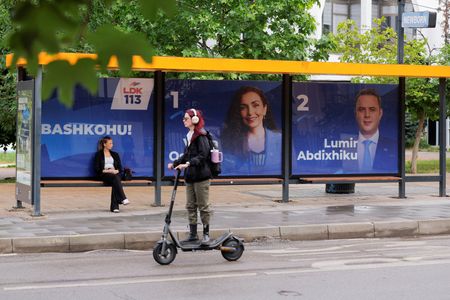

Kosovo voters will head to the ballot box this Sunday for the nation’s third parliamentary election in just a year and a half, following the inability of political factions to find common ground on selecting a new president.
The small Balkan country, recognized as Europe’s newest nation, seeks membership in the European Union but has operated without an effective government for most of the previous year as divided parliaments couldn’t first choose a speaker, then struggled to pick a new head of state.
While recent polling data isn’t available, political experts anticipate another win for Prime Minister Albin Kurti’s Vetevendosje party. Analysts note, however, that he’ll still require cooperation from opposing parties to obtain the two-thirds parliamentary support needed for presidential selection.
Kurti’s political movement captured 51.1% of votes in December’s previous election but couldn’t find consensus with other parties regarding a presidential nominee for the mostly symbolic position, leading to parliament’s dissolution in April and this upcoming snap election.
“We can have 10 rounds of elections, but if there is no political will to sit down and find a deal, there is no solution. I don’t see that will among the parties,” said Eugen Cakolli, a researcher at Kosovo’s Democratic Institute (KDI).
POLITICAL STALEMATE EXPECTED TO PERSIST
Cakolli indicated that Kurti’s party would require over 60% of the vote to guarantee the selection of their chosen candidates for parliamentary speaker and president, describing this outcome as improbable.
“This Sunday’s election may not be the only one this year and holding four rounds within two years would be the worst scenario imaginable,” he added.
The EU has called on Kosovo politicians – the nation broke away from Serbia in 2008 – to establish robust institutions capable of implementing necessary reforms for EU membership.
“The EU can support Kosovo, but it cannot do Kosovo’s homework,” European Council President Antonio Costa said during a visit to Pristina on Wednesday.
Kurti’s party initially gained power in 2021 promoting a more nationalist, welfare-oriented platform. Similar to all Kosovo parties, it maintains a pro-Western stance while opposing additional concessions to Serbia, with whom tensions persist.
Kosovo’s election commission reports that over 900 candidates representing 17 parties and three coalition groups are vying for positions in the 120-seat parliament.
Approximately 2.1 million voters have registered – exceeding Kosovo’s 1.6 million resident population because of an extensive diaspora, primarily located in western Europe and typically supportive of Kurti’s party.
Many Kosovo citizens simply desire political stability.
“I am tired of voting,” pensioner Sadri Alija said in the capital Pristina. “May Allah unite our politicians – they are only thinking of themselves.”