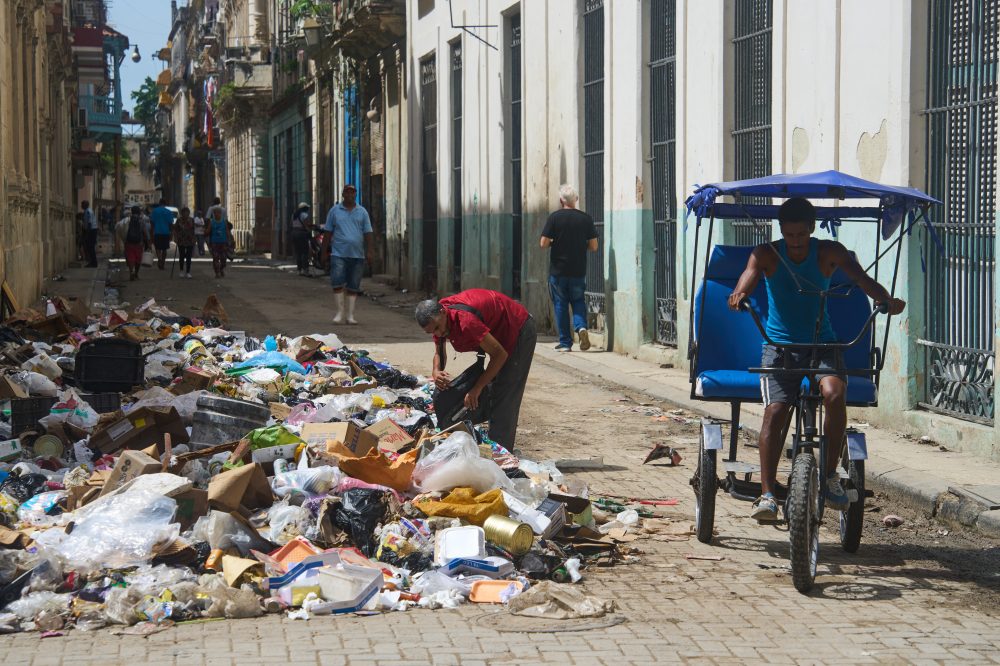

HAVANA — Rising temperatures and mounting concern gripped residents on a Havana street as they confronted a makeshift garbage dump sprawling across the sidewalk.
The pile contained decomposing food waste, ripped plastic bags, cardboard pieces and construction debris. Flies swarmed the area while stray cats prowled through the refuse, which emitted a foul odor carried by ocean breezes.
“What you’re looking at is depressing,” lamented María Odalys Ramírez, a 63-year-old who lives across the street from the capital’s iconic Hermanos Ameijeiras hospital. “The trash in this area, the flies, the rats, the filth — it’s completely unsanitary.”
For several months, Havana’s 2 million inhabitants — representing one-fifth of Cuba’s nearly 10 million population — have endured growing mounds of refuse on virtually every corner. Conditions worsened following a U.S. energy blockade that caused electrical blackouts, water supply disruptions and a fuel shortage that left government waste collection vehicles unable to operate.
With no regular pickup service, citizens have resorted to incinerating garbage in public areas, prompting health authorities to express concern about dangerous fumes.
Local residents worry that approaching months will bring deteriorating circumstances as summer temperatures rise and hurricane season approaches.
An extensive survey conducted by The Associated Press throughout the city documented similar conditions in neighborhoods across Havana, where locals reported sporadic garbage truck visits at best.
From downtown districts to suburban areas, vehicles, cyclists and pedestrians navigate around waste heaps. Some people sift through the debris searching for salvageable items.
Municipal data from last July showed Havana generated solid waste equivalent to roughly 12 Olympic-sized swimming pools daily. Even at that time, city services managed to collect only 57% of the total.
The “improper management of urban solid waste” has been designated as a major environmental concern in Cuba’s national strategy, according to Odalys Goicochea, an official at the ministry of science, technology and the environment.
Goicochea cautioned that the present waste collection crisis, when combined with increasing heat and approaching rainfall, threatens to make matters worse. The combination of elevated temperatures and humidity could lead to explosive growth of disease-transmitting flies and mosquitoes.
The emergency has prompted grassroots efforts to address neighborhood cleanup needs.
El Batazo represents one such program covering eight city blocks in Havana. A waste collector sounds a bell twice each day to gather pre-separated household garbage, while additional team members maintain street cleanliness.
Participants generate income by selling recyclable materials including aluminum and glass, convert organic waste into animal feed, and deposit remaining refuse in containers for eventual landfill disposal.
“The fundamental impact of this project is proving to the community that it can be done,” said Evelyn Martínez, a collaborator at El Batazo. “It is entirely possible to live in a cleaner environment, give value to what we call ‘trash’ and put it to good use.”