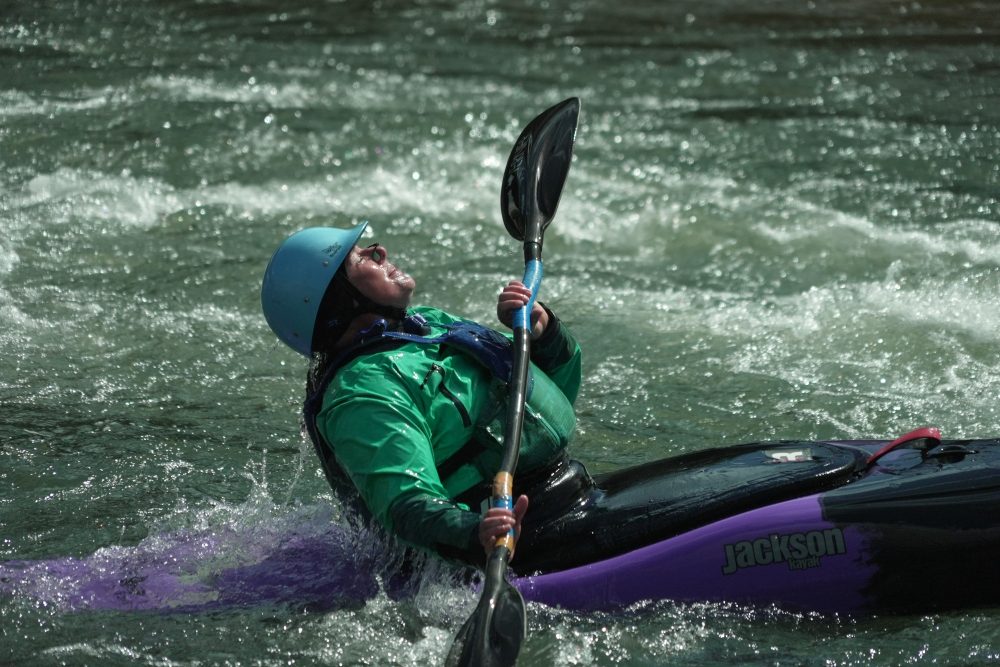

MANCHESTER, Iowa — On a recent afternoon, Hannah Ray J Childs navigated her kayak through rapids on Iowa’s Maquoketa River, using her paddle to lift her boat’s bow skyward.
The whitewater kayaking stunts that submerge her completely give her a “feeling of flying,” she explained. These waters brought her community and romance — she first noticed her future husband while he was performing kayak rolls in turbulent currents, and he later became her instructor.
However, waterborne illness has affected her, prompting her to use nose and ear protection to reduce exposure. Many question her continued participation in the sport.
“People’s first response when I tell them that I like to kayak and be upside down in the river,” Childs said, “is, ‘Ew, that’s disgusting. Why would you do that?’”
The state serves as a striking illustration of the Midwest’s widespread contamination crisis. As a major producer of corn, soybeans and pork, Iowa features extensive waterway networks. Agricultural fertilizers and livestock waste containing nitrates and phosphorus flow into these systems, making the state a significant source of pollution feeding an oceanic dead zone in the Gulf of Mexico. During the previous summer, the state’s largest city implemented water usage limits while working to eliminate dangerous nitrates from municipal supplies.
Contamination has persisted as an intractable challenge for generations, impacting both community wellness and recreational opportunities during warmer months.
Toxic algae growth creates hazardous beach conditions, while sediment runoff makes water unpleasant for contact. Bacterial contamination, sometimes originating from human waste systems, prevents young people from using streams. Over half of the river, stream and lake segments monitored by the state in 2024 failed to achieve safety standards for swimming, consumption or supporting aquatic ecosystems.
Officials have depended on voluntary measures and financial incentives rather than regulatory requirements to decrease nitrate and phosphorus discharge, yet progress remains well below established targets. Environmental organizations recently filed legal action against the Trump administration, claiming it inappropriately overturned a Biden-era mandate requiring Iowa to tackle nitrate contamination in portions of multiple rivers.
Investment and modest progress have occurred. In May, Republican Gov. Kim Reynolds announced a $320 million funding package for water infrastructure and related initiatives, supplementing the approximately $100 million the state dedicates annually to addressing this issue. Phosphorus levels have decreased somewhat. Improved techniques including cover crops, reduced or eliminated tillage for soil protection, and farm-based installations to limit runoff have grown significantly in recent years.
Despite its inland location, Iowa’s character is influenced by waterways including the Missouri and Mississippi rivers that define portions of its boundaries. The state features scenic lakeside beaches and exceptional trout fishing opportunities. These waters represent some of its limited natural recreational areas.
Childs developed her appreciation for the Maquoketa River while growing up on a neighboring corn and hog operation. She recalls paddling with her brothers to locate fishing spots and exploring waterways with companions.
She currently volunteers to monitor the river for chemical contamination and advocated for a whitewater park in Manchester, her northeast Iowa community, to encourage others to experience the water.
“If we don’t get people invested in their local river, their local community, how are we ever going to ask them to take care of it?” she said.
Mary Swander, a 75-year-old theater director and former state poet laureate, recalls fondly learning to canoe and swim outdoors during her youth near water. Summer meant splashing activities, while winter brought ice skating.
“I had a little group of friends and we played hooky once, and we all got our swimsuits and drove over to Lake MacBride and spent the whole day in the lake, in the water, swimming, and we had a whole picnic,” she said.
Swander now stays away from water following negative experiences. Once the water at a state park felt unusual — sticky. Another time a ranger advised her canoeing party against putting their hands — or anything else — in the water.
“I was like, ‘Well, what the hell are we doing out here, then?’” she said.
While Swander found alternative activities to replace swimming and maintained some relationships, others diminished. The disappearance of gathering places beyond homes and workplaces where people can interact may complicate maintaining social connections, particularly for seniors, according to Philippa Clarke, a University of Michigan professor who studies social environments.
Bacterial contamination plays the primary role in making waterways unusable. It originates from cattle, deer and other wildlife, though human sewage represents the main problem in certain areas. Specialists indicate heavy rainfall poses major risks by washing away manure — something climate change will worsen — and upgrading sewage treatment and failing septic systems remains crucial.
Nitrates and phosphorus from livestock waste and agricultural fertilizers also drive the crisis. Millions of farmland acres utilize plastic underground pipes — called tile drainage systems — to rapidly channel water into streams. These nutrients fuel algae growth, prompting lake warnings and threatening drinking water supplies.
The difficulty of maintaining clean water bodies is demonstrated by Lake Darling, an approximately 300-acre artificial lake providing camping, trails and swimming beaches in Iowa’s southeast region. However, last year the lake experienced the poorest overall condition of any state beach with 10 weeks of E. Coli warnings and six algal advisories, according to the Iowa Environmental Council, which monitors such alerts.
Years earlier the lake was closed, emptied and renovated — transforming its previous brown water into appealing, clearer conditions. Adjacent property owners modified their land to capture runoff, and important acreage was acquired for conservation, according to Bob Shepherd who participates in a dedicated park volunteer organization.
Recently, though, it has faced difficulties, said Claire Hruby, an environmental science professor at Drake University who researched contamination at the lake. Hruby noted several new hog facilities have been established in the lake’s watershed, and nutrient discharge from manure creates algae problems.
During particularly severe conditions, “It’s like swimming in green paint,” she said.
Water quality worries deter people even during days that aren’t severely affected, according to Lawrence Eyre, a tennis camp director and instructor at a local school. As recently as a few years ago, children would complete tennis matches on courts heated by summer sun and, moments later, enjoy swimming rewards in another nearby lake.
However, parents observed that some children developed itchy skin, and algae emerged along the shoreline. Information circulated, and many preferred their children avoid the risk. Now they typically don’t attempt it, Eyre said.
“It does put a dent in the enjoyment of the summer,” he said.
Environmental advocates view a state unable to refuse agricultural interests.
In 2015, Des Moines’ water utility filed suit against three counties regarding expenses for filtering out nitrates. A judge ultimately dismissed the case, ruling that any effort to permit and reduce agricultural runoff fell under Iowa legislature authority.
While Minnesota has required vegetation near waterways to limit runoff, Iowa has chosen a different strategy. It depends on its agriculture and natural resources departments, alongside Iowa State University, to create voluntary approaches including reduced fertilizer application, enhanced crop management and wetland additions to decrease runoff.
The EPA assists states in implementing their nitrogen and phosphorus reduction strategies. The agency emphasized the importance of viewing agriculture as part of solutions and recognizing that progress requires time.
Many farmers also face pressures. Supply expenses have increased dramatically recently, as have fertilizer costs following the war in Iran, according to Aaron Lehman, president of the Iowa Farmers Union, which represents family operations and promotes sustainable methods.
“There’s a lot less control that farmers have,” Lehman said.
Additionally, farmers may wait years to see returns on their investments — if returns ever materialize — when they modify their practices. Demand for federal and state assistance exceeds availability, according to Rachel Curry, an agriculture educator at the University of Illinois Extension. Transforming farming methods resembles turning a cruise ship — it requires time, but with proper support, success is achievable.
Collaboration between the state and farmers remains essential, and mandates would undermine that trust, Iowa Secretary of Agriculture Mike Naig said in an interview with the Iowa Farm Bureau.
Others find encouragement in local achievements.
David Thoreson has sailed beyond the arctic circle and around continents — an adventurous life enabled because his mother taught him sailing on the Iowa Great Lakes in the state’s northwest region. He said local efforts to restore wetlands, acquire conservation land and upgrade sewage treatment have maintained lake health for visitors and residents.
“They understand the importance of it, and that’s what drives our economy and property values and multi-generational interest in this place that just keeps bringing people back,” Thoreson said.