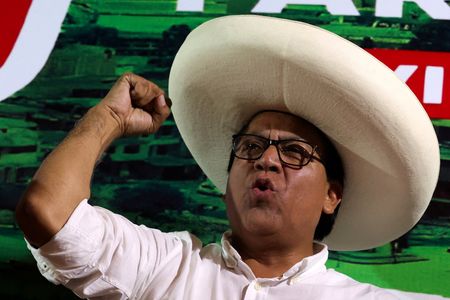

A progressive Peruvian lawmaker is adopting a more moderate stance as the country approaches its presidential runoff election this weekend, backing away from earlier proposals that had concerned business interests.
Roberto Sanchez, who captured 12.03% of votes in April’s initial voting round, trails conservative candidate Keiko Fujimori’s 17.18% as they head into the June 7 decisive election. Polling data indicates the final contest will be competitive.
The 57-year-old former cabinet member, who served under the now-imprisoned ex-President Pedro Castillo, is representing the leftist Together for Peru party. While his campaign centers on major governmental reforms, recent weeks have seen him signal a more measured approach to economic matters.
“Insisting on something that is not viable, is not sensible,” he stated to reporters recently. He recognized that international challenges, including fuel price increases due to the Iran war, were influencing his policy agenda.
Sanchez became an unexpected competitor in the initial round’s crowded field by advocating for a new constitution to create a “plurinational” state while appealing to marginalized rural and Indigenous communities.
His platform’s cornerstone involves replacing the constitution from the 1990s that was established under the late President Alberto Fujimori, who is the father of his current opponent.
“The rural vote, the Andean vote, the Quechua, Aymara and Amazonian vote were never respected,” Sanchez explained during an April Reuters interview at a party headquarters in Lima, donning a broad-brimmed straw hat that previously belonged to Castillo and represents typical headwear in certain Peruvian rural regions.
As one of the globe’s top copper-producing nations, Peru relies on mining for approximately 10% of its economic output.
Sanchez has advocated for increased government supervision of natural resources, including contract reviews, windfall taxes, and wealth taxes — policies he describes as “rebalancing” to benefit extraction communities.
“Thirty years of mining and the mining towns are still the poorest in our country,” he observed.
Should he win, his agenda would encounter obstacles in the legislature, where conservative parties maintain control.
As the campaign reaches its conclusion, Sanchez has begun tempering his rhetoric — a change highlighted by his economic advisory team.
In May, he named former economy minister Pedro Francke, viewed as more business-friendly, as a senior advisor.
Francke, who also worked under Castillo, has quickly worked to calm investor concerns, stating a Sanchez administration would encourage private investment, honor current mining agreements, and maintain central bank autonomy.
“There will be no nationalizations,” Francke declared during a televised debate. “We will respect contracts and maintain a macroeconomic policy of stability.”
Political observers note this partnership demonstrates Sanchez’s effort to attract moderate voters who fear economic disruption. However, his previous connections to figures like Antauro Humala, a nationalist imprisoned for leading a 2001 government uprising, present difficulties. While Sanchez has attempted to create distance, he risks losing support from his core supporters, according to analyst Nicholas Watson of Teneo.
Sanchez’s relationship with imprisoned former president Castillo has also troubled Peruvian investors.
Castillo, removed from office in 2022 following an attempt to disband Congress, has endorsed Sanchez. He currently faces rebellion and conspiracy charges.
Sanchez has stated he would not restore power to Castillo if elected, though he has promised to pursue Castillo’s freedom.
As Castillo’s former foreign trade minister, Sanchez has maintained Peru should stay open to international partnerships but under “just” conditions.
Coming from an Indigenous family in southern Peru, Sanchez describes his humble background and former aspiration to join the priesthood, connecting his political involvement to church-based community service.
As a Catholic, he supports abortion access only in rape cases or when maternal life is threatened, and opposes discrimination based on sexual orientation, race, or religion.
His party has recommended stronger anti-corruption initiatives, judicial changes, and enhanced military assistance for police to address increasing crime.
Sanchez faces financial crime accusations, with a prosecutor alleging he falsified statements and campaign finance documents. His legal representative disputes these claims. Local media reports indicate a judge will decide June 4 whether the case proceeds to trial.