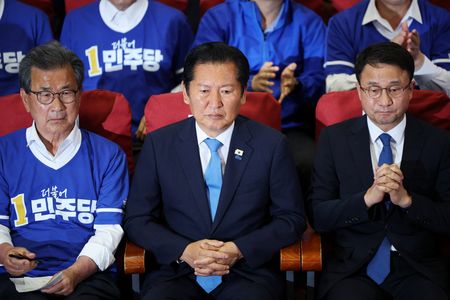

South Korean President Lee Jae Myung’s Democratic Party dominated Wednesday’s local elections across the nation, securing 12 out of 16 major mayoral and provincial races, while the conservative People Power Party claimed four victories.
The results provide Lee’s party with extensive control over local governments one year after he took office. However, the ruling party faced a significant symbolic blow when conservative incumbent Oh Se-hoon secured another term as Seoul’s mayor.
The defeat in Seoul, the nation’s largest city and most politically significant mayoralty, dampened the ruling party’s overall success and provides conservatives with an important stronghold as they work to recover from the controversy surrounding former President Yoon Suk Yeol’s unsuccessful 2024 martial law attempt and resulting impeachment.
On the first anniversary of taking office, President Lee stated the government would “humbly accept the will of the people” and collaborate actively with local governments from all political parties.
Democratic Party leader Jung Chung-rae expressed gratitude to voters for what he described as a “great victory” across the nation, while recognizing the disappointment of the capital city loss.
“I deeply thank the people for giving the Democratic Party a great victory across the country. But it hurts that we failed to retake Seoul,” Jung stated.
During his victory address, Oh declared that Seoul voters had maintained “the great democratic principle of checks and balances” to prevent the nation from leaning completely toward one political direction.
“The key question was who would win symbolic battlegrounds such as Seoul and Busan,” explained Shin Yul, a political science professor at Myongji University.
According to Shin, Seoul voters seemed partly influenced by displeasure with the government’s housing policies, as officials attempt to moderate the capital’s overheated real estate market.
Nevertheless, the Democratic Party’s comprehensive performance, including a victory in Busan — the country’s second-largest city and traditional conservative territory — indicates Lee maintains solid nationwide backing, supported by strong exports from an AI chip surge and related stock market gains.
Prior to the election, the opposition People Power Party held 12 of the 16 major local government positions.
Fourteen parliamentary by-elections occurred simultaneously with the local races. In Busan’s Buk-A district, independent candidate and former People Power Party leader Han Dong-hoon prevailed, representing a political return for a prominent conservative who had separated himself from the party’s pro-Yoon wing.
The election faced disruption due to ballot paper shortages at several Seoul polling locations, prompting demands for accountability from Lee and both major political parties.
The shortages, documented at more than a dozen voting sites, forced some citizens to wait for hours or depart without voting, leading to extended voting hours at impacted locations.
These problems sparked demonstrations by voters and conservative organizations, including actions that blocked ballots from leaving a Seoul polling station and prevented the National Election Commission from officially validating the Seoul mayoral results as of Thursday midday.
The commission issued an apology and promised a comprehensive investigation, stating the incidents did not justify postponing the election or conducting a new vote.
Lee voiced “deep regret” regarding the ballot shortages, directing relevant organizations to identify the cause, hold responsible parties accountable, and quickly establish reliable protective measures.