
A fragile truce between Israel and Lebanon has been extended through a new U.S.-mediated agreement announced Wednesday, though the arrangement faces significant opposition from the militant group at its center.
The accord between Israel and Lebanon comes following Israel’s most extensive military push into Lebanese territory in over 25 years, and establishes a framework for broader peace discussions scheduled for later this month.
However, the agreement contains several disputed elements, notably the establishment of experimental security areas within Lebanon where the Iranian-supported Hezbollah organization would be prohibited from operating, along with provisions calling for the group’s ultimate dissolution.
Lebanese President Joseph Aoun described the arrangement Thursday as the “last chance to enter a final and comprehensive ceasefire.” A previous U.S.-mediated accord from November 2024 aimed at stopping hostilities between Hezbollah and Israel, which began due to the conflict in Gaza, ultimately collapsed.
The announcement follows recent events where a major escalation was barely avoided through a separate Monday agreement that prevented Israel’s planned attacks on Beirut’s southern neighborhoods while Hezbollah agreed to stop striking northern Israel. However, questions persist about the current deal’s viability.
The present arrangement expands upon an initial truce established April 17 between Israel and Lebanon’s government.
Notably, while much of the agreement depends on Hezbollah’s actions, the militant organization did not participate directly in negotiations. Hezbollah’s leader, Sheikh Naim Kassem, has instead depended on Iran’s influence in discussions with Washington. Tehran has maintained that any resolution to the Iran conflict must encompass Lebanon.
Kassem harshly criticized the agreement Thursday, describing it as “Satan’s dream in heaven.” He demanded a total ceasefire and Israeli military withdrawal, arguing the deal would destabilize Lebanon and create internal divisions.
“The agreement allows Israel to take in politics what it couldn’t in war,” Kassem stated. “As long as the occupation is still present, then the resistance will continue.”
Israel maintains it is fighting Hezbollah, which it has long viewed as a significant threat, rather than Lebanon directly. Nevertheless, Israeli forces have targeted areas well beyond Hezbollah’s sphere of influence, including central areas of Lebanon’s capital city.
The Shiite Muslim armed organization formed in 1982 as a response to Israel’s occupation of southern Lebanon at that time, and has developed into one of Lebanon’s most powerful entities.
Emphasizing its perception of the group as an existential danger, Israel stated in Wednesday’s joint announcement that its security and territorial integrity “can only be achieved through the disarmament of Hezbollah and the dismantlement of its infrastructure throughout Lebanon.”
Lebanon’s endorsement of a statement characterizing Hezbollah as a threat highlights the widening rift within the country regarding the organization, and Beirut’s attempts to separate itself from Iran while strengthening relationships with Gulf nations and Washington. This approach also risks alienating Hezbollah and its supporters, primarily from the Shiite population.
The joint announcement states the ceasefire “is contingent on a complete cessation of Hezbollah fire and the evacuation of all Hezbollah operatives” from areas south of the Litani River. This river, situated approximately 30 kilometers (20 miles) north of Israel’s border, marks the boundary of a U.N.-established buffer zone from 2006 where Hezbollah is prohibited. Israeli forces have currently advanced well beyond the Litani River into southern Lebanon, displacing hundreds of thousands of Lebanese civilians.
The statement indicates Lebanon and Israel committed to “swiftly advance the creation of pilot zones in which the Lebanese Armed Forces will take exclusive control of the territory to the exclusion of all non-state actors.”
This places additional burden on Lebanon’s financially struggling military to establish authority in regions where Hezbollah maintains significant presence. Lebanon worries that an aggressive approach to disarming Hezbollah could trigger nationwide conflict, while Israel criticizes Beirut for insufficient action.
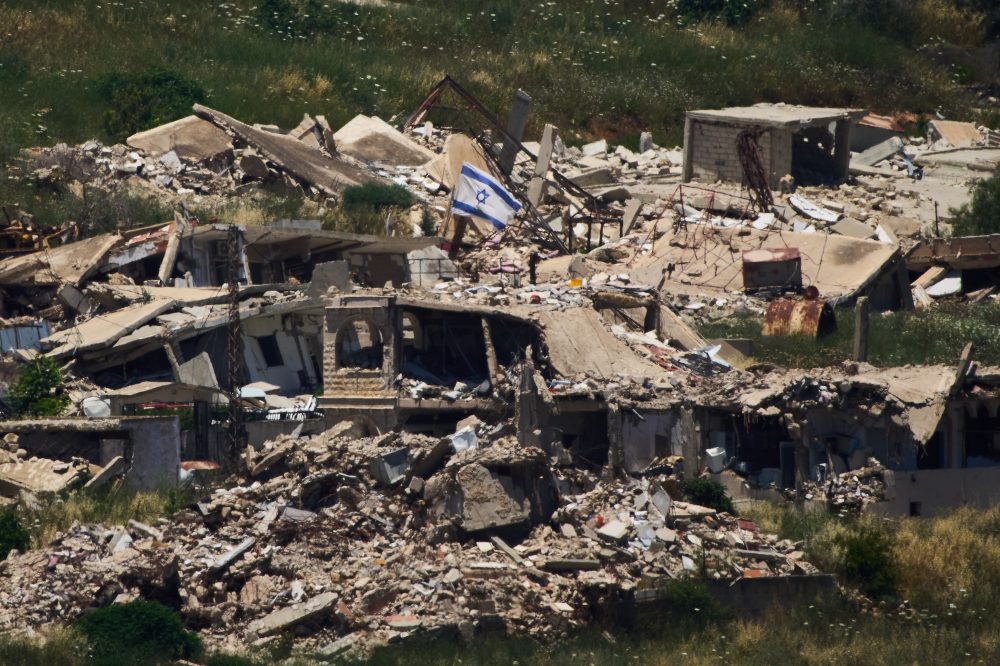
Israeli forces currently occupy substantial portions of southern Lebanon and have destroyed residential buildings and historical landmarks.
The statement also mentioned that negotiators explored a security structure that would encompass “the dismantlement of non-state armed groups, and the prevention of their reemergence.”
The specific methods for establishing these pilot zones and dismantling Hezbollah remain highly uncertain. Aoun suggested that a series of villages just north of the Litani could serve as the pilot zone.
Lebanon has emerged as a significant obstacle in efforts to expand the separate ceasefire in the Iran conflict. The joint statement declared that “all parties condemned Iran’s attacks on countries in the region, and ongoing activities that undermine stability throughout the Middle East, whether through support for proxies and all other acts of aggression.”
The document also contained explicit language aimed at separating the two conflicts.
“All countries reaffirmed that the future of the relationship between Israel and Lebanon must be decided by the two sovereign governments. They rejected any attempt, by any state or non-state actor, to hold Lebanon’s future hostage,” the statement read.
It continued that “any agreement to cease hostilities must be reached directly between the two governments, brokered by the United States, and not through any separate track.”
This language appears designed to stop Tehran from using Hezbollah and the Lebanese conflict as leverage in its own ceasefire talks.
Despite the initial truce agreement in mid-April, combat has persisted, with Hezbollah resuming attacks following Israeli strikes in Lebanon that Israel described as defensive measures.
The fighting shows little indication of decreasing. Israeli Defense Minister Israel Katz announced Thursday that Israeli forces would maintain their presence in what he termed a security zone in Lebanon, while continuing operations against Hezbollah facilities.
The military “will, at this stage, continue its fire and activity on the ground,” he stated. Katz said the arrangements reflect “the reality we have created in Lebanon so far” and could eventually result in a peace agreement with Lebanon and “real and lasting security” for northern Israel’s residents.
Thursday saw the Israeli military warn southern Lebanon residents that it was continuing to strike Hezbollah “infrastructure located in and near the area south of the Zahrani River.” The warning stated that “anyone who moves south of the river is putting their life at risk.” The Zahrani is positioned approximately 30 kilometers (18 miles) north of the Litani River.