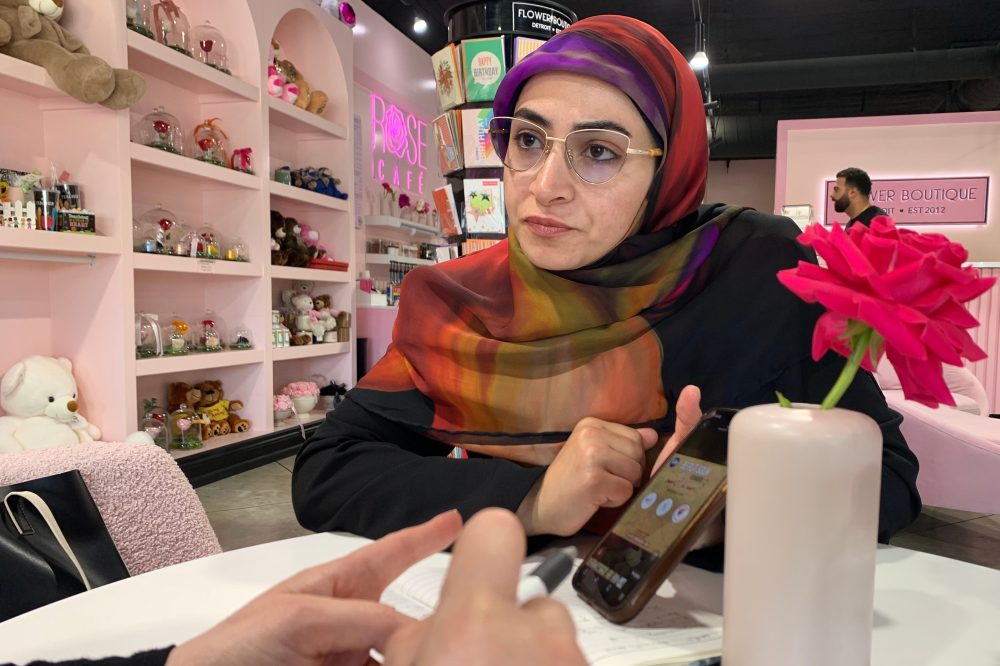

CANTON, Mich. — Each week, Mirvet Makki allocates a portion of her catering business profits to assist Lebanese families forced from their homes due to ongoing hostilities between Israel and Hezbollah forces.
The 47-year-old entrepreneur, who prepares traditional Lebanese cuisine including couscous dishes and kibbeh in Dearborn Heights, came to Michigan in 1990. However, her emotional ties remain strong to Bint Jbeil, her hometown village, which has become one of the most severely affected regions in southern Lebanon.
The current round of violence has touched virtually every Lebanese American family, forcing over 1 million residents to flee their homes — approximately one-sixth of Lebanon’s entire population — while claiming more than 3,500 lives. This represents Israel’s most extensive military operation in Lebanon in over 25 years.
“I was thinking, ‘What can I do for other people?’” Makki said. “So I used my business.”
Despite increasing living expenses across America, she explained, “the money I can spare personally, I’ve been sending it to family.”
Throughout metro Detroit, where Arabic script decorates restaurant storefronts, coffee shops, and bakeries along busy commercial strips, a profound sadness has settled over the community as residents monitor the distant crisis.
Similar to Makki’s experience, many community members struggle with feelings of guilt and powerlessness. Providing assistance to relatives who cannot or will not abandon their homeland becomes increasingly challenging amid Lebanon’s deteriorating economic situation.
“Honestly it’s hard. Like, what do you say?” Makki said. “They’re going to ask me what I’m doing. Let’s say I’m at work. They lost their jobs. Let’s say I tell them I’m home. They lost their homes.”
Lebanese migration to America began in the 1890s. Current census figures show approximately 625,000 Lebanese Americans residing in the United States, though alternative calculations suggest the population may reach 1.4 million.
Political perspectives regarding Lebanon’s government, Hezbollah, and Israel differ throughout the diaspora community, mirroring the divisions within Lebanon itself, where viewpoints correlate strongly with religious identity. The nation’s demographics include roughly equal proportions of Sunni Muslims, Shiite Muslims, and various Christian groups, plus a smaller Druze population.
Regardless of these disagreements, the worldwide Lebanese diaspora maintains strong homeland connections, partially through billions of dollars in annual remittances.
“There is really no Lebanese homeland without the Lebanese diaspora,” Edward Curtis, director of Arabic Studies at Indiana University, said.
Lebanese Americans frequently unite around shared concerns, such as during the 2024 presidential campaign supporting the “uncommitted movement” opposing American backing for Israel’s Gaza operations, or denouncing the Michigan synagogue incident perpetrated by a Lebanese individual in March.
“When they see suffering in Lebanon, people’s immediate reaction … is for the community to come together, raise funds, raise money, and try to help everybody as much as they can,” Akram Khater, director of Lebanese Diaspora Studies at North Carolina State University, said.
Most community members depend on mutual support networks rather than seeking federal government assistance.
Curtis noted that numerous Lebanese Americans have become frustrated with American political processes, instead choosing to “celebrate Lebanese life when other peoples are threatening its death.”
Maya Attoui, whose parents remain in Beirut, coordinates a metro Detroit charity event supporting Lebanon while increasing public awareness about the situation. Although lacking sufficient personal funds to help her extended family members, she believes an event featuring activities and speakers will generate substantially more resources.
“We don’t feel like talking, we don’t feel like cooking in our houses,” Attoui said. “We’re just 24/7 on the phone or on the news. Our heart is really melting and breaking because of whatever we see.”
While international remittances flow to nations worldwide, Lebanon demonstrates exceptional reliance on its extensive diaspora population. The nation’s financial system has collapsed dramatically in recent years, with the American dollar increasingly replacing local currency in daily transactions.
During Makki’s February Lebanon visit, she witnessed dramatic price increases firsthand. Previously, $200 covered both vehicle rental and hotel accommodations; this trip, the same amount barely purchased a single restaurant meal.
Some individuals utilize online crowdfunding platforms. Although established humanitarian organizations exist, most prefer transferring funds directly to family members.
Makki plans to limit her total contributions to $10,000 to avoid raising regulatory concerns. Beyond that threshold, she joked, “Maybe take it there myself?”
Nadia Bryant, 37, from Troy, Michigan, regularly transfers money to her half-sisters in Lebanon, who currently occupy temporary shelter after Israeli forces entered their village of Ayta ash-Shab.
Instead of using the funds personally, Bryant explained, her sisters directed the money toward helping orphaned children.
“They’re such righteous people,” Bryant said. “They are not even trying to take the money and get themselves a better house or anything. They’re like, ‘Oh, we have shelter, but this person needs a mattress.’”
Through WhatsApp, her sister shared an image of a boiling teapot positioned over flames among the scattered remains of their former residence. The message stated: “Best cup of tea since 9 october 2023.”
“I don’t even ask, ‘How are you?’ That feels so stupid to me,” Bryant said. “I ask, you know, ‘What does today look like,’ or ‘Where are you today?’”
Attoui, who organizes fundraising efforts, has repeatedly attempted to persuade her family to relocate to America since her own 2006 arrival. They refuse to depart. Additionally, the United States suspended immigrant visa processing for Lebanese citizens in late January.
“I have all my aunts and my cousins over there,” she said. “So like, how many people can you bring here?”