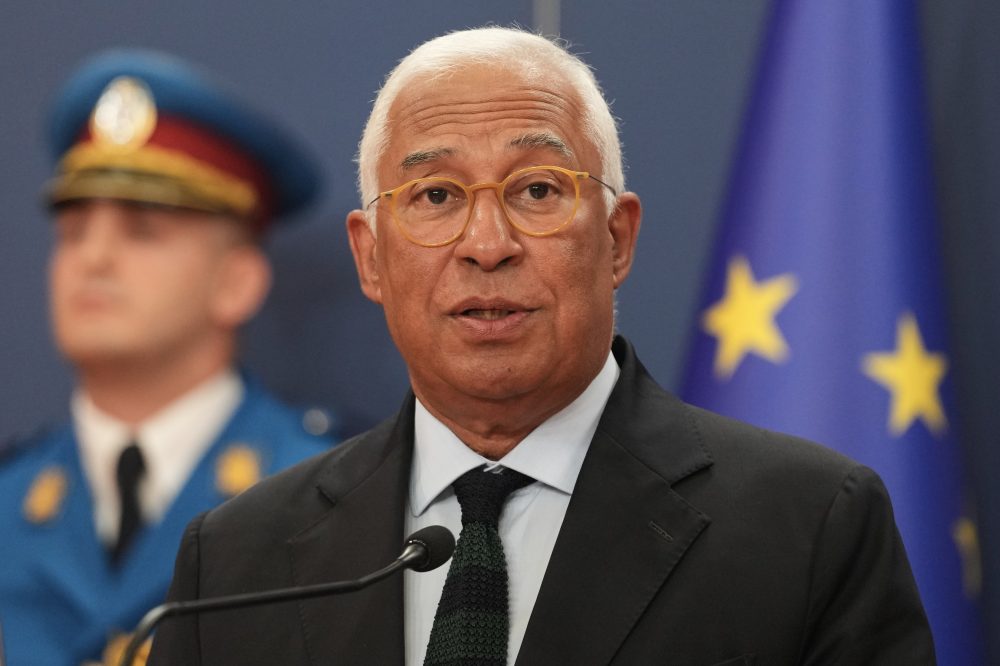

BELGRADE, Serbia (AP) — European Union leadership plans to explore new methods for accelerating membership procedures for six Western Balkan nations seeking to join the organization, European Council President Antonio Costa announced Thursday.
The countries of Albania, Bosnia-Herzegovina, Kosovo, North Macedonia, Serbia and Montenegro have pursued membership in the European bloc for many years without completing the merit-based approval requirements. Recent EU efforts have focused on promoting reforms within these applicant nations due to concerns about expanding Russian and Chinese influence.
Speaking at a press conference in Belgrade, Serbia’s capital city, Costa stated that “if you want to boost the trust between each other, we cannot create this feel of frustration” regarding the seemingly slow advancement toward membership. Costa clarified this doesn’t mean requirements will be reduced, “but it means how we can deliver together more rapidly.”
Friday’s summit in Tivat, a coastal community in Montenegro, will bring together senior European officials and representatives from the applicant countries. Each nation stands at varying levels of progress, with Montenegro and Albania currently ahead of the others.
Prospective member countries must align their legislation across 35 policy sectors or “chapters,” covering everything from judicial standards to agricultural and fisheries regulations. Opening and closing each chapter requires unanimous approval from all 27 existing EU member states.
The EU has additionally stipulated that Serbia and Kosovo must establish normalized diplomatic relations for their membership bids to advance.
Kosovo operated as a Serbian province until a 78-day NATO air campaign in 1999 concluded warfare between Serbian military forces and ethnic Albanian independence fighters. Serbia refuses to acknowledge Kosovo’s independence declaration from 2008.
Costa explained that “tomorrow the European leaders will discuss with the leaders of the Western Balkans how we can improve our methodology to move forward faster and better.”
“The enlargement is not a utopia but it is something that could be real in the coming years,” Costa emphasized. “For this we need to work harder and faster.”
Costa completed his pre-summit visits to Western Balkan candidate nations Thursday before departing for Montenegro. He informed Serbian populist President Aleksandar Vucic that his administration must strengthen democratic reforms and coordinate foreign policy positions with EU standards to progress.
Serbia faces potential loss of approximately 1.5 billion euros ($1.8 billion) in EU funding if it continues democratic deterioration, particularly within its court system. Officials have also demanded improvements in press freedoms and electoral conditions.
Ukraine and Moldova are also pursuing EU membership alongside the Western Balkan countries.
Serbia stands as the sole European country refusing to implement sanctions against Russia over the Ukraine conflict and continues maintaining positive relationships with Moscow, plus China, which Vucic recently visited.
“We want and we are ready to do more,” Costa stated. “But let me be clear, the pace of progress depends on Serbia’s own resolve.”
The increasingly authoritarian Vucic continues facing ongoing youth-driven street demonstrations that began in November 2024 following a train station incident in northern Serbia that resulted in 16 deaths. He committed Thursday to pursue reforms with “new enthusiasm” and maintain Serbia’s EU trajectory.
Vucic’s trip to Tivat follows Montenegro’s decision to prohibit 87 Serbian citizens from entering the country due to security concerns. Authorities reported the men possessed communication devices and signs displaying “Serbia wins,” a phrase Vucic regularly uses in public speeches.
The purpose of the men’s intended Montenegro visit remains unclear.