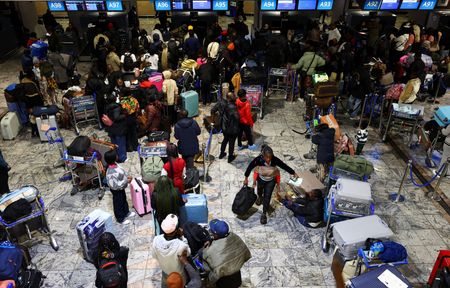

A Mozambican worker seeking employment in South Africa found himself running for his life just four days ago when hostile residents in the coastal town of Kleinmond demanded all foreign nationals leave immediately.
Lado Amido, 49, was forced to hide in nearby mountains for two nights after an angry group arrived at his residence and confiscated his possessions. He now joins approximately 100 other displaced immigrants taking refuge in the local municipal building.
The incident reflects a broader pattern of anti-foreigner hostility sweeping through multiple communities in South Africa’s Western Cape region, where workers from neighboring Malawi and Mozambique have been targeted by organized groups going house to house.
Recent weeks have witnessed an escalation in anti-immigrant demonstrations throughout South Africa, with some turning deadly. Officials from Mozambique confirmed that five of their nationals lost their lives during xenophobic violence in Mossel Bay over the weekend.
“On the 31st, people came to my house, knocked on the door, and then took all my belongings,” Amido explained. The job-seeker had arrived in the country in February hoping to find employment opportunities.
Many of those now seeking safety are considering voluntary return programs established by their home governments rather than remain in an increasingly hostile environment.
Anti-foreign sentiment represents a persistent challenge in South Africa, where immigrant communities frequently face blame for the nation’s economic struggles, including widespread joblessness and criminal activity.
Political leaders across party lines have historically validated these unfounded accusations to appeal to voters, particularly with local elections scheduled for later this year, despite no supporting evidence for such claims.
During a parliamentary address on Tuesday, President Cyril Ramaphosa acknowledged the migration issue while simultaneously denouncing recent xenophobic attacks. “As we work to build a safer … and more prosperous society, we need to address the challenge of migration,” he stated.
Grant Cohen, who serves as ward councillor for Kleinmond, noted that immigration officials had recently conducted inspections of local restaurants and businesses searching for workers without proper documentation.
However, Cohen told Reuters that many immigrants currently sheltering at the municipal facility possess legal status to remain in the country.
“We’ve got kids here at the moment who should be in school, who have been in school in Kleinmond… (but) now want to flee the country out of fear and intimidation,” Cohen observed.
“I don’t believe that residents should take things into their own hands,” he added.
Michael Markson, a 31-year-old from Malawi, described spending one night outdoors in the mountains after evacuating the informal community where he had resided for approximately one year.
“My landlord came telling me that I should evacuate because if they find us, they’re going to kill us,” Markson recounted about Saturday’s events.
The following day, his employer brought food supplies while they remained hidden in the wilderness after a friend contacted the boss on their behalf.
From his hiding spot, Markson witnessed a substantial crowd of demonstrators in the town center, with some brandishing knives and wooden clubs.
He now awaits financial assistance to return home, lacking the resources for travel expenses.
“In our country there’s no-good economy… (but) it’s better than living in a community where your life is under threat,” Markson reflected.